
BuddhistCatholicContemplativeEvangelicalGeneral ChristianHinduJewishLatter-day SaintMuslimNew VisionsProgressive Christian
Beliefs
- Buddhist
- Catholic
- Contemplative
- Evangelical
- General Christian
- Hindu
- Jewish
- Latter-day Saint
- More Voices
- Muslim
- New Visions
- Pagan
- Progressive Christian
Topics
- Religion News
- Food and Religion
- Sports and Religion
- Religious Art
- Religious Music and Entertainment
- Religious Events
- History and Religion
- Style and Religion
- Politics and Religion
- Women in Religion
- Recreation Outdoors and Religion
- Business Finance and Religion
- Careers Workplace and Religion
- Education and Religion
- Family Parenting and Religion
- Health Fitness and Religion
- Home and Religion
- Relationships and Religion
- Technology and Religion
- Travel and Religion
Columnists
- Buddhist Columnists
- Business Finance and Religion Columnists
- Careers Workplace and Religion Columnists
- Catholic Columnists
- Contemplative Columnists
- Education and Religion Columnists
- Evangelists Columnists
- Family Parenting and Religion Columnists
- General Christian Columnists
- Health Fitness and Religion Columnists
- Hindu Columnists
- History and Religion Columnists
- Home and Religion Columnists
- Jewish Columnists
- More Voices Columnists
- Latter Day Columnists
- Muslim Columnists
- New Visions Columnists
- Nonreligious Columnists
- Pagan Columnists
- Politics and Religion Columnists
- Progressive Columnists
- Recreation Outdoors and Religion Columnists
- Relationships and Religion Columnists
- Religion News Columnists
- Religious Art Columnists
- Religious Events Columnists
- Religious Music and Entertainment Columnists
- Sports and Religion Columnists
- Style and Religion Columnists
- Technology and Religion Columnists
- Travel and Religion Columnists
- Women in Religion Columnists
Resource Library
- 2026 Calendar
- Library of World Religions
- The 100 Most Holy Places on Earth
- Patheos Answers
- Podcasts
- Videos
- Faith Leaders Database
- Anglican Episcopalian
- Bahai
- Baptist
- Buddhism
- Christianity
- Confucianism
- Eastern Orthodoxy
- Hinduism
- Holiness and Pentecostal
- ISKCON
- Islam
- Judaism
- Lutheran
- Methodist
- The Church of Jesus Christ of Latter-day Saints
- New Age
- Paganism
- Presbytarian and Reformed
- Protestantism
- Religion Behind the Scenes
- Roman Catholic
- Scientology
- Shia Islam
- Sikhism
- Sufism
- Sunni Islam
- Taoism
- Zen
- See all religions
Research Tools
 Ad-Free & Subscriber Log-In Subscription Support
Ad-Free & Subscriber Log-In Subscription Support
Follow Patheos 

- Trending:
- Forgiveness
- |
- Marriage
- |
- Consciousness
- |
- Death Penalty
- |
- Election
- |
- Halloween
 Good Letters
-
Contributors
- Home
- Catholic
- Inner Peace Part 1: Zen Gardens
Inner Peace Part 1: Zen Gardens
Last updated on: June 17, 2014 at 3:38 pm by Peggy Rosenthal
Inner Peace Part 1: Zen Gardens 2014-06-17T15:38:34-07:00 Peggy Rosenthal
Patheos Explore the world's faith through different perspectives on religion and spirituality! Patheos has the views of the prevalent religions and spiritualities of the world.
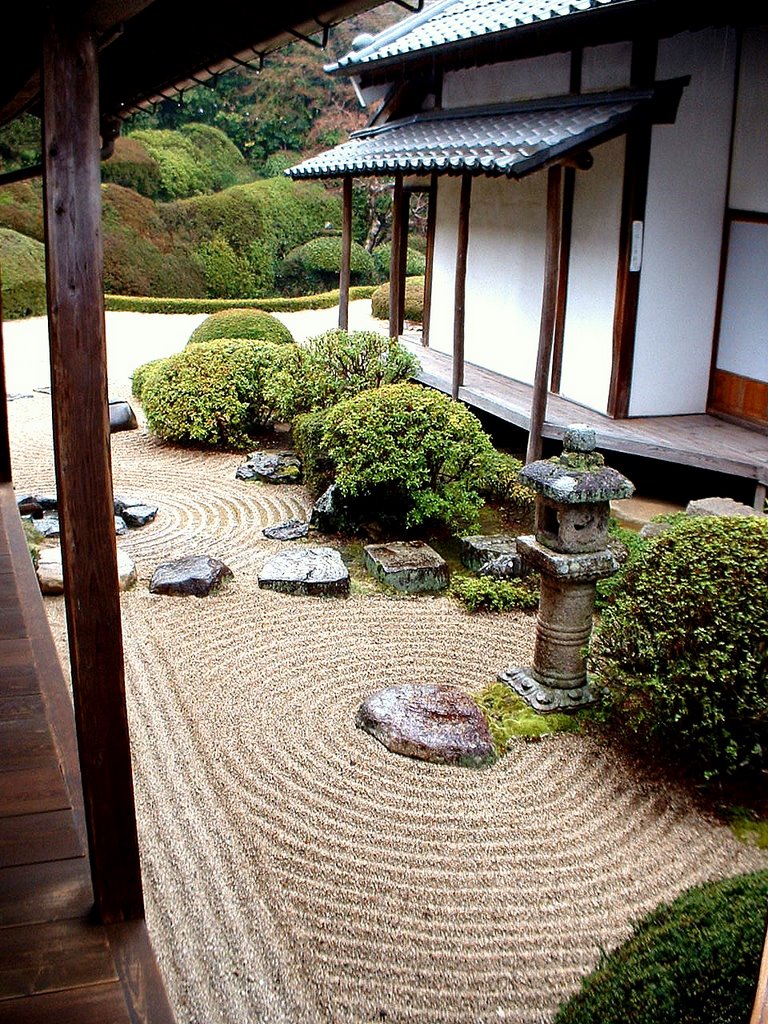 Zen gardens were all the rage when I installed a modified version in my backyard some years ago. They still are, I’ve noticed.
Peek behind the gentrified urban home or into a back corner of the suburban lot and you’re likely to see the telltale rock triad, the twisting gravel path, the lone dwarf evergreen, and the stone water bowl of the Zen garden.
Just a peek won’t give you the intended experience, though. Japanese gardens are meant to be strolled through.
The sound of the gravel under your feet is soothing. Shinto priests in pre-Buddhist Japan sensed this over fifteen hundred years ago, and so their sacred spaces were spread with small stones.
The odd windings of the Zen garden path are meant to slow you down, while taking you meditatively through real life in abbreviated form. Medieval Zen priests planned out these gardens as spiritually-directed space. The way to enlightenment is necessarily contorted, they said. The Zen path is designed to take you through life’s inevitable twists and turns without getting tangled or tied in knots.
You might come upon an asymmetrical rock grouping or a single rock with its swirling strata roughly exposed. These are the irregularities of human relations, the ups and downs, the rough and the smooth. Suddenly confronting them, you mustn’t stumble.
The Zen garden is meant to be a pathway to inner peace, a pathway that doesn’t waft you from this world but weaves you through the world’s essence. The spare, bare minimum in miniature puts you in mind of the whole. The slightly mounded soil recalls mountains; gravel raked in a swirl is a silent waterfall; the single flower met around a bend is every delighted Ah! Strolling through this space designed on a millennium of Zen spiritual principles, you begin to feel uncluttered.
In the words of the sixteenth century teahouse designer, Sen-no-Rikkyu:
When you hear the splash
of the water drops that fall
into the stone bowl,
you will feel that all the dust
of your mind is washed away.
“The dust of your mind” is putting it mildly, in my case. I’ve got an attic-full of fusty clutter up there. Piles of Pandora’s boxes all personalized with my private nightmares. Legitimate cares (like my husband’s health) crammed in with trivial ones (like a neighbor’s loud radio). Files and files of opinions that I cling to passionately; lists and lists of personal agendas. Wedged against the wall is some old baggage of bitter resentments.
And I can’t let the boxes and baggage simply be. I keep shifting them around: restlessly reaching for one thing, shoving away another, always stirring up the dust. I can’t think a straight thought without getting detoured by a distraction. I can barely budge in this metaphorical attic without bumping my head on some imagined need.
Join the crowd, says Zen Buddhism, via modern scholar D. T. Suzuki: “The mind is ordinarily chock full with all kinds of intellectual nonsense and passional rubbish.” The Buddha knew, 2,500 years ago, that hanging onto this transient stuff is what keeps us from happiness, from peace. We’re yanked every which way by clinging to what must pass.
Feeling possessive about what we falsely think is “mine,” feeling possessive about what we falsely think is “me,” feeling possessive period: this is the core human problem. The bliss we’re meant for is the extinction of all these false desires. “The extinction of greed, the extinction of anger, the extinction of delusion,” says an early Buddhist scripture: “this indeed is called Nirvana and this truly is Peace.”
Remembering that Nirvana literally means “blowing out” (as of a flame), I’m eager to clear out my mind’s attic clutter in one blast. I’m ready to hire the Three Little Pigs’ wolf to huff and puff and blow the house down, just to be done with it. But of course that wouldn’t work. The house is my whole being. Huffing and puffing would only make my head spin; blown down, I’d just be a wreck.
The emptiness that’s a Buddhist synonym for Nirvana doesn’t come from blowing the stuff of ego out with a hurricane blast—or even from hauling it away. “The realization of Emptiness” writes Suzuki, “is no more, no less than seeing into the nonexistence of a thingish ego-substance. It consists not in getting rid of the self but in realizing the fact that there is no such existence from the first.”
The stuff of myself collected over a lifetime isn’t really me. So don’t even grant it the reality of fussing to get rid of it. Let it be. But look at it as essentially insubstantial: mere dotted lines taking the shape of attic boxes.
Metaphors like this are easy to make. But actually seeing into the nonexistence of a thingish ego-substance is no simple task. The classic text for how it’s done is the Bhagavad-Gita (that gem formed from early Buddhism and the Hindu Upanishads). From the Gita we get the discipline of yoga—even more popular these days than Zen gardens. The Gita’s yoga is a spiritual exercise, and it’s hard work. “Yoking” is yoga’s root Sanskrit meaning, which the Gita stretches to mean disciplined skill at “integrating the self.”
Yoga-meditation’s ultimate goal is Nirvana: the self’s liberation from all the illusory stuff obscuring its real ground of being—in Krishna, who is Brahman’s incarnation as the personal God. Our true self is one with God, but our false self-creations keep us from seeing our true identity. (Thomas Merton said the same thing to Christians in the twentieth century.) Meditation doesn’t shove the inner self-made clutter aside so much as help us see through it. Those piles of attic possessions fade into transparent forms.
Tomorrow: my adventures in meditation and a surprising result.
Peggy Rosenthal is director of Poetry Retreats and writes widely on poetry as a spiritual resource. Her books include Praying through Poetry: Hope for Violent Times (Franciscan Media), and The Poets’ Jesus (Oxford). See Amazon for full list. She also teaches an online course, “Poetry as a Spiritual Practice,” through Image’s Glen Online program*.*
Previous Post

June 13, 2014
Can We Bridge the Racial Divide?
Next Post
June 17, 2014 Inner Peace Part 2: Mirror and Furnace
Browse Our Archives
Select a Category A. G. Harmon Alissa Wilkinson Allison Backous Art Authors Brad Fruhauff Bradford Winters Bryan Bliss Caroline Langston Chad Thomas Johnston Chris Hoke Christiana N. Peterson Culture D.G. Myers D.L. Mayfield Daniel Bowman Jr. David Griffith Elizabeth Duffy Faith Film Greg Wolfe Guest Contributor Interview Jan Vallone Jeffrey Overstreet Jessica Eddings-Roeser Jessica Mesman Griffith Kelly Foster Lindsey Crittenden Morgan Meis music Natalie Vestin Nick Olson Peggy Rosenthal Personal Reflection Poetry Friday Reflection Relationships Review Richard Chess Richard Cole Sara Zarr Shannon Huffman Polson Sonya Bilocerkowycz Tania Runyan Tony Woodlief Topical Categories Uncategorized Vic Sizemore Writing
Select a Month October 2018 September 2018 August 2018 July 2018 June 2018 May 2018 April 2018 March 2018 February 2018 January 2018 December 2017 November 2017 October 2017 September 2017 August 2017 July 2017 June 2017 May 2017 April 2017 March 2017 February 2017 January 2017 December 2016 November 2016 October 2016 September 2016 August 2016 July 2016 June 2016 May 2016 April 2016 March 2016 February 2016 January 2016 December 2015 November 2015 October 2015 September 2015 August 2015 July 2015 June 2015 May 2015 April 2015 March 2015 February 2015 January 2015 December 2014 November 2014 October 2014 September 2014 August 2014 July 2014 June 2014 May 2014 April 2014 March 2014 February 2014 January 2014 December 2013 November 2013 October 2013 September 2013 August 2013 July 2013 June 2013 May 2013 April 2013 March 2013 February 2013 January 2013 December 2012 November 2012 October 2012 September 2012 August 2012 July 2012 June 2012 May 2012 February 2008
Follow Us!
TAKE THE
Religious Wisdom Quiz
How long did the judges rule before kings?
Select your answer to see how you score.
300 years Approximately 350 years 200 years 400 years
Related posts from Good Letters




Can a Racist Drive a Prius? Stereotypes and...
TRENDING AT PATHEOS Catholic

Rejecting Doom: Christian Hope And Human Action
Christianity is a religion of hope. We are to have hope and...

It’s What Comes From Within Which Matters
One of the most difficult things for us to understand is why...

Why I Choose the Eucharist Over the Sermon
Choose the Eucharist, Not the Sermon What are we supposed to get...

5 Design Elements Found in Spiritually Rooted Homes
Putting Spirituality Into Home Decor Our homes are more than our living...

Credo: A Story of God Told with the...
About 10 years ago, I began to imagine a personal "Credo" that...

The Anatomy of Divine Revelation in Catholic Thought
The claim that God has made Himself known to human beings is...
view all Catholic blogs
Ad-Free & Subscriber Log-In Subscription Support
- About Us
- 2026 Calendar
- Videos
- Podcasts
- Library of World Religions
- Faith In Media Tracker
- Advertise With Us
- Write for Us
- Privacy Policy
- Terms of Service
- Do Not Sell My Data
- Contact Us
- Radiant Digital
- Manage Newsletter Subscriptions
- Unsubscribe From Notifications
- Sitemap
Copyright 2008-2026, Patheos. All rights reserved.
Subscription Support Ad-Free & Subscriber Log-In
Follow Patheos