
BuddhistCatholicContemplativeEvangelicalGeneral ChristianHinduJewishLatter-day SaintMuslimNew VisionsProgressive Christian
Beliefs
- Buddhist
- Catholic
- Contemplative
- Evangelical
- General Christian
- Hindu
- Jewish
- Latter-day Saint
- More Voices
- Muslim
- New Visions
- Pagan
- Progressive Christian
Topics
- Religion News
- Food and Religion
- Sports and Religion
- Religious Art
- Religious Music and Entertainment
- Religious Events
- History and Religion
- Style and Religion
- Politics and Religion
- Women in Religion
- Recreation Outdoors and Religion
- Business Finance and Religion
- Careers Workplace and Religion
- Education and Religion
- Family Parenting and Religion
- Health Fitness and Religion
- Home and Religion
- Relationships and Religion
- Technology and Religion
- Travel and Religion
Columnists
- Buddhist Columnists
- Business Finance and Religion Columnists
- Careers Workplace and Religion Columnists
- Catholic Columnists
- Contemplative Columnists
- Education and Religion Columnists
- Evangelists Columnists
- Family Parenting and Religion Columnists
- General Christian Columnists
- Health Fitness and Religion Columnists
- Hindu Columnists
- History and Religion Columnists
- Home and Religion Columnists
- Jewish Columnists
- More Voices Columnists
- Latter Day Columnists
- Muslim Columnists
- New Visions Columnists
- Nonreligious Columnists
- Pagan Columnists
- Politics and Religion Columnists
- Progressive Columnists
- Recreation Outdoors and Religion Columnists
- Relationships and Religion Columnists
- Religion News Columnists
- Religious Art Columnists
- Religious Events Columnists
- Religious Music and Entertainment Columnists
- Sports and Religion Columnists
- Style and Religion Columnists
- Technology and Religion Columnists
- Travel and Religion Columnists
- Women in Religion Columnists
Resource Library
- 2026 Calendar
- Library of World Religions
- The 100 Most Holy Places on Earth
- Patheos Answers
- Podcasts
- Videos
- Faith Leaders Database
- Anglican Episcopalian
- Bahai
- Baptist
- Buddhism
- Christianity
- Confucianism
- Eastern Orthodoxy
- Hinduism
- Holiness and Pentecostal
- ISKCON
- Islam
- Judaism
- Lutheran
- Methodist
- The Church of Jesus Christ of Latter-day Saints
- New Age
- Paganism
- Presbytarian and Reformed
- Protestantism
- Religion Behind the Scenes
- Roman Catholic
- Scientology
- Shia Islam
- Sikhism
- Sufism
- Sunni Islam
- Taoism
- Zen
- See all religions
Research Tools
 Ad-Free & Subscriber Log-In Subscription Support
Ad-Free & Subscriber Log-In Subscription Support
Follow Patheos 

- Trending:
- Forgiveness
- |
- Marriage
- |
- Consciousness
- |
- Death Penalty
- |
- Election
- |
- Halloween
 Good Letters
-
Contributors
- Home
- Catholic
- Can We Bridge the Racial Divide?
Can We Bridge the Racial Divide?
Last updated on: January 16, 2015 at 3:30 pm by Vic Sizemore
Can We Bridge the Racial Divide? 2015-01-16T15:30:49-07:00 Vic Sizemore
Patheos Explore the world's faith through different perspectives on religion and spirituality! Patheos has the views of the prevalent religions and spiritualities of the world.
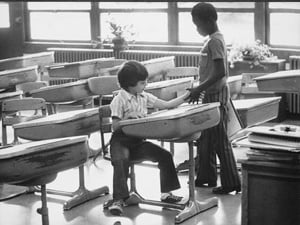 Recently, after I’d just watched the documentary about food deserts called A Place at the Table, I was being taxi dad, driving kids around town. I discovered that a kid I know and see relatively often is not only poor, but experiences every day what is now euphemistically called “food insecurity.” Also, not incidentally, the kid is African American.
All three of my kids are musicians, the circles in which they move at school are integrated, and they have formed close friendships with their black peers. It is heartening to see what appears to be Martin Luther King Jr.’s dream of “little black boys and black girls…able to join hands with little white boys and white girls as sisters and brothers.”
Outside of school however, things can get awkward fast. The disparity is undeniable—even if it is uncomfortable to talk about. These kids are on a path that will likely split along racial lines as they grow into adulthood. Not only is it not likely they will remain friends, it is not likely that their life trajectories will be anything alike.
First, in this group of close friends the line between the haves and the have-nots is drawn on racial lines. Second, while they are reaching an age at which they are noticing and showing discomfort with these inequalities, they are also encoding poisonous systemic notions about race, wealth, merit, and opportunity.
Take opportunity: My children do not have limitless opportunities—we live on teachers’ salaries—but their family and social situations have placed them on a springboard that, if they choose to use it, will launch them into success. They will have to work hard, sure, but the chances that their work will pay off with a comfortable life are a foregone conclusion. For their friends on the other side of the racial divide, not so. Where my kids find a springboard, they often find a fence. And behind that a wall.
This is where I begin to get push back from many white people I know. Because they do not want to be labeled with the R word, they discuss this issue carefully. Why do I hesitate even now to use the word, when racism—individual, institutional, and systemic—is a massive and undeniable problem?
What I inevitably get is some variation of two defensive responses: They say to me, “You are the one who is racist, because you think black people need handouts, can’t be successful on their own merit.” They also say, “It is not fair to take away what I have earned fair and square and give it to someone else who will not work for it.”
The root assumption of both these claims is that most everyone starts with a similar array of opportunities, and some have squandered theirs, or at least not worked quite hard enough. This is simply not the case. In his excellent essay “The Case for Reparations” Ta-Nehisi Coates gets to the point. He writes, that, “America was built on the preferential treatment of white people—395 years of it.”
It is not ancient history either. We live in an America, “in which black college graduates still suffer higher unemployment rates than white college graduates, and black job applicants without criminal records enjoy roughly the same chance of getting hired as white applicants with criminal records.”
An interesting study was done with the board game Monopoly. Volunteers played the game, but with changed rules. One player was given $2000 at the beginning, $200 at each pass of Go, and allowed to roll two dice; the other player was given $1000 to start with, $100 at each pass of Go, and was allowed only one die for each roll.
“Initially, [the advantaged player] reacted to the inequality between him and his opponent with a series of smirks, an acknowledgment, perhaps, of the inherent awkwardness of the situation.” As the game progressed, he became more assertive, then cocky, picking up the poor player’s elf shoe and moving it for him, even engaging in some lighthearted taunting. “As the game nears its finish, [the advantaged player] moves his Rolls faster. The taunting is over now: He’s all efficiency. He refuses to meet [the disadvantaged player’s] gaze. His expression is stone cold as he takes the loser’s cash.” He comes to believe it is his own acumen that has given him the win. He deserves it more than the disadvantaged player.
What I am talking about here is racial inequality, not simply a problem of rich and poor and the opportunities allotted to each. It is a mistake to conflate the two issues. This is what Mr. Coates calls our “particular history of white-imposed black disadvantage,” and many white Christians are implicated along with everyone else. It doesn’t help to try to gloss over this.
I do not want my children growing away from their black friends, but I fear it will happen. I do not want them to grow into the advantaged Monopoly players who will someday run into these childhood friends and assume they are better off because they have worked harder and smarter. I do not want their friends, bright, beautiful, and amazingly talented kids, to learn that they must circumscribe their dreams as experience is teaching them every day of their lives right now to do.
As I look at these kids, I am at a loss: what can be done to right this wrong? I know Mr. Coates is right when he writes, “Vaguely endorsing a cuddly, feel-good diversity does very little to redress this.” His sights are set for something more: “What I’m talking about is a national reckoning that would lead to spiritual renewal.”
Vic Sizemore earned his MFA in fiction from Seattle Pacific University in 2009. His short stories are published or forthcoming in StoryQuarterly, Southern Humanities Review, Connecticut Review, Portland Review, Blue Mesa Review, Sou’wester, Silk Road Review, Atticus Review, PANK Magazine Fiction Fix, Vol.1 Brooklyn, Conclave, and elsewhere. Excerpts from his novel The Calling are published in Connecticut Review, Portland Review, Prick of the Spindle, Burrow Press Review, Rock & Sling, and Relief. His fiction has won the New Millennium Writings Award for Fiction, and been nominated for Best American Nonrequired Reading and a Pushcart Prize. You can find Vic at http://vicsizemore.wordpress.com/.
Previous Post

June 12, 2014
Appreciating Andrew Wyeth
Next Post
June 16, 2014 Inner Peace Part 1: Zen Gardens
Browse Our Archives
Select a Category A. G. Harmon Alissa Wilkinson Allison Backous Art Authors Brad Fruhauff Bradford Winters Bryan Bliss Caroline Langston Chad Thomas Johnston Chris Hoke Christiana N. Peterson Culture D.G. Myers D.L. Mayfield Daniel Bowman Jr. David Griffith Elizabeth Duffy Faith Film Greg Wolfe Guest Contributor Interview Jan Vallone Jeffrey Overstreet Jessica Eddings-Roeser Jessica Mesman Griffith Kelly Foster Lindsey Crittenden Morgan Meis music Natalie Vestin Nick Olson Peggy Rosenthal Personal Reflection Poetry Friday Reflection Relationships Review Richard Chess Richard Cole Sara Zarr Shannon Huffman Polson Sonya Bilocerkowycz Tania Runyan Tony Woodlief Topical Categories Uncategorized Vic Sizemore Writing
Select a Month October 2018 September 2018 August 2018 July 2018 June 2018 May 2018 April 2018 March 2018 February 2018 January 2018 December 2017 November 2017 October 2017 September 2017 August 2017 July 2017 June 2017 May 2017 April 2017 March 2017 February 2017 January 2017 December 2016 November 2016 October 2016 September 2016 August 2016 July 2016 June 2016 May 2016 April 2016 March 2016 February 2016 January 2016 December 2015 November 2015 October 2015 September 2015 August 2015 July 2015 June 2015 May 2015 April 2015 March 2015 February 2015 January 2015 December 2014 November 2014 October 2014 September 2014 August 2014 July 2014 June 2014 May 2014 April 2014 March 2014 February 2014 January 2014 December 2013 November 2013 October 2013 September 2013 August 2013 July 2013 June 2013 May 2013 April 2013 March 2013 February 2013 January 2013 December 2012 November 2012 October 2012 September 2012 August 2012 July 2012 June 2012 May 2012 February 2008
Follow Us!
TAKE THE
Religious Wisdom Quiz
Who built an ark to survive a great flood?
Select your answer to see how you score.
Moses David Noah Abraham
Related posts from Good Letters



Lynching, Racial Terror, and Black Liberation Theology
TRENDING AT PATHEOS Catholic

Rejecting Doom: Christian Hope And Human Action
Christianity is a religion of hope. We are to have hope and...

It’s What Comes From Within Which Matters
One of the most difficult things for us to understand is why...

Why I Choose the Eucharist Over the Sermon
Choose the Eucharist, Not the Sermon What are we supposed to get...

5 Design Elements Found in Spiritually Rooted Homes
Putting Spirituality Into Home Decor Our homes are more than our living...

Credo: A Story of God Told with the...
About 10 years ago, I began to imagine a personal "Credo" that...

The Anatomy of Divine Revelation in Catholic Thought
The claim that God has made Himself known to human beings is...
view all Catholic blogs
Ad-Free & Subscriber Log-In Subscription Support
- About Us
- 2026 Calendar
- Videos
- Podcasts
- Library of World Religions
- Faith In Media Tracker
- Advertise With Us
- Write for Us
- Privacy Policy
- Terms of Service
- Do Not Sell My Data
- Contact Us
- Radiant Digital
- Manage Newsletter Subscriptions
- Unsubscribe From Notifications
- Sitemap
Copyright 2008-2026, Patheos. All rights reserved.
Subscription Support Ad-Free & Subscriber Log-In
Follow Patheos