
BuddhistCatholicContemplativeEvangelicalGeneral ChristianHinduJewishLatter-day SaintMuslimNew VisionsProgressive Christian
Beliefs
- Buddhist
- Catholic
- Contemplative
- Evangelical
- General Christian
- Hindu
- Jewish
- Latter-day Saint
- More Voices
- Muslim
- New Visions
- Pagan
- Progressive Christian
Topics
- Religion News
- Food and Religion
- Sports and Religion
- Religious Art
- Religious Music and Entertainment
- Religious Events
- History and Religion
- Style and Religion
- Politics and Religion
- Women in Religion
- Recreation Outdoors and Religion
- Business Finance and Religion
- Careers Workplace and Religion
- Education and Religion
- Family Parenting and Religion
- Health Fitness and Religion
- Home and Religion
- Relationships and Religion
- Technology and Religion
- Travel and Religion
Columnists
- Buddhist Columnists
- Business Finance and Religion Columnists
- Careers Workplace and Religion Columnists
- Catholic Columnists
- Contemplative Columnists
- Education and Religion Columnists
- Evangelists Columnists
- Family Parenting and Religion Columnists
- General Christian Columnists
- Health Fitness and Religion Columnists
- Hindu Columnists
- History and Religion Columnists
- Home and Religion Columnists
- Jewish Columnists
- More Voices Columnists
- Latter Day Columnists
- Muslim Columnists
- New Visions Columnists
- Nonreligious Columnists
- Pagan Columnists
- Politics and Religion Columnists
- Progressive Columnists
- Recreation Outdoors and Religion Columnists
- Relationships and Religion Columnists
- Religion News Columnists
- Religious Art Columnists
- Religious Events Columnists
- Religious Music and Entertainment Columnists
- Sports and Religion Columnists
- Style and Religion Columnists
- Technology and Religion Columnists
- Travel and Religion Columnists
- Women in Religion Columnists
Resource Library
- 2026 Calendar
- Library of World Religions
- The 100 Most Holy Places on Earth
- Patheos Answers
- Podcasts
- Videos
- Faith Leaders Database
- Anglican Episcopalian
- Bahai
- Baptist
- Buddhism
- Christianity
- Confucianism
- Eastern Orthodoxy
- Hinduism
- Holiness and Pentecostal
- ISKCON
- Islam
- Judaism
- Lutheran
- Methodist
- The Church of Jesus Christ of Latter-day Saints
- New Age
- Paganism
- Presbytarian and Reformed
- Protestantism
- Religion Behind the Scenes
- Roman Catholic
- Scientology
- Shia Islam
- Sikhism
- Sufism
- Sunni Islam
- Taoism
- Zen
- See all religions
Research Tools
 Ad-Free & Subscriber Log-In Subscription Support
Ad-Free & Subscriber Log-In Subscription Support
Follow Patheos 

- Trending:
- Forgiveness
- |
- Marriage
- |
- Consciousness
- |
- Death Penalty
- |
- Election
- |
- Halloween
 Good Letters
-
Contributors
- Home
- Catholic
- Appreciating Andrew Wyeth
Appreciating Andrew Wyeth
Last updated on: June 12, 2014 at 1:00 am by A. G. Harmon
Appreciating Andrew Wyeth 2014-06-11T23:47:59-07:00 A. G. Harmon
Patheos Explore the world's faith through different perspectives on religion and spirituality! Patheos has the views of the prevalent religions and spiritualities of the world.
 I’ve had a few nasty discoveries of late. All too often, I’ve found out that things I’ve always valued are considered to have very little value in the estimation of the going market. They’re just not worth as much as I’d believed.
“And why the hell not?” I’ll ask, irked, when given the dismissive news by financiers, appraisers, auctioneers, and agents—anybody whose expertise I’ve called upon for a valuation.
It doesn’t sit well, disillusionment—especially when you think the rest of the world has got it all wrong, and when you’d been counting on their tastes to be in line with your own.
So I wasn’t in the mood for more of the same the other day, after I went to The National Gallery of Art’s new exhibit on Andrew Wyeth. I like Wyeth very much, and after seeing the works—wonderful, evocative renderings of various portals in the farmhouses that he memorialized around his Maine landscape—I did a little research to learn more about some of the images.
Lo and behold, turns out Andrew is a favorite whipping boy of the modern art scene.
Not only is he disfavored, he’s considered a “kitschmeister.” To my shock and dismay, I learned his work is often called “tired” and “overwrought”; “a cold gimmick.” His eschewing of abstraction—the preferred mode of the cognoscenti for nearly a century—and his vast popularity have made him the kind of artist you’re not supposed to like. Nowadays, he’s akin to Hemingway (whom I also appreciate), and Steinbeck (yep), and Frost (ditto). Admitting an admiration for them is like taking off your shoes at the dinner table—you reveal yourself quite clearly.
Well, all right then. Here I am, barefoot—and pass the ketchup.
I’m not trying to be a populist antagonist, but I don’t see that rarity of opinion is the litmus test for artistic achievement.
I understand the criticism of art that doesn’t have any tension in it, the kind that’s meant for calling cards, jigsaw puzzles, and wall posters (but then I don’t think people who paint such matters actually contend that what they’re doing is profound, so the criticism is unfair), but that’s hardly what’s going on in these paintings. I also bridle at the idea that if something’s accessible, it’s somehow discount-worthy.
Probably what these critics find so distasteful is the fact that Wyeth is capable of interpretation. Wary of committing the effective fallacy, I do actually feel something when viewing his work. Anyhow, that fallacy is intended to caution against claiming a work is only what it makes you feel; it’s not intended to banish feeling altogether or to discredit its role in a work’s achievement.
I also think that the art world has a kind of clubby establishment that favors whatever confuses and dispossesses. To them, seriousness equates to the claustrophobic and morose. The more people that “get” the work, the less fun it is to scoff at them.
The thing is, although Wyeth is stark and somber, even sad much of the time, he’s not really depressing. There’s an ironic lambency in his paintings, like the stoic beauty of Shaker furniture, lit by the fragile light of a quiet winter afternoon. There’s even a note of abstraction in his efforts, as a friend pointed out—the houses and windows are Mondrian boxes, washed of color (but infinitely more interesting for their depth).
And why is Wyeth charged with aloofness when Edward Hopper, who shares cold landscapes and subject matter, is not? Maybe it’s because there is so little hope in Hopper’s work. He seems to confirm the spirit of the age (and I like Hopper, by the way).
Not so with Wyeth: he says he loved the windows so much because they held within them the spirits of those who stood there, passed by there—the portals between the domestic and the wild, between the manufactured and the natural, the places where we linger, caught between the worlds, at a junction that is both harbor and exposure.
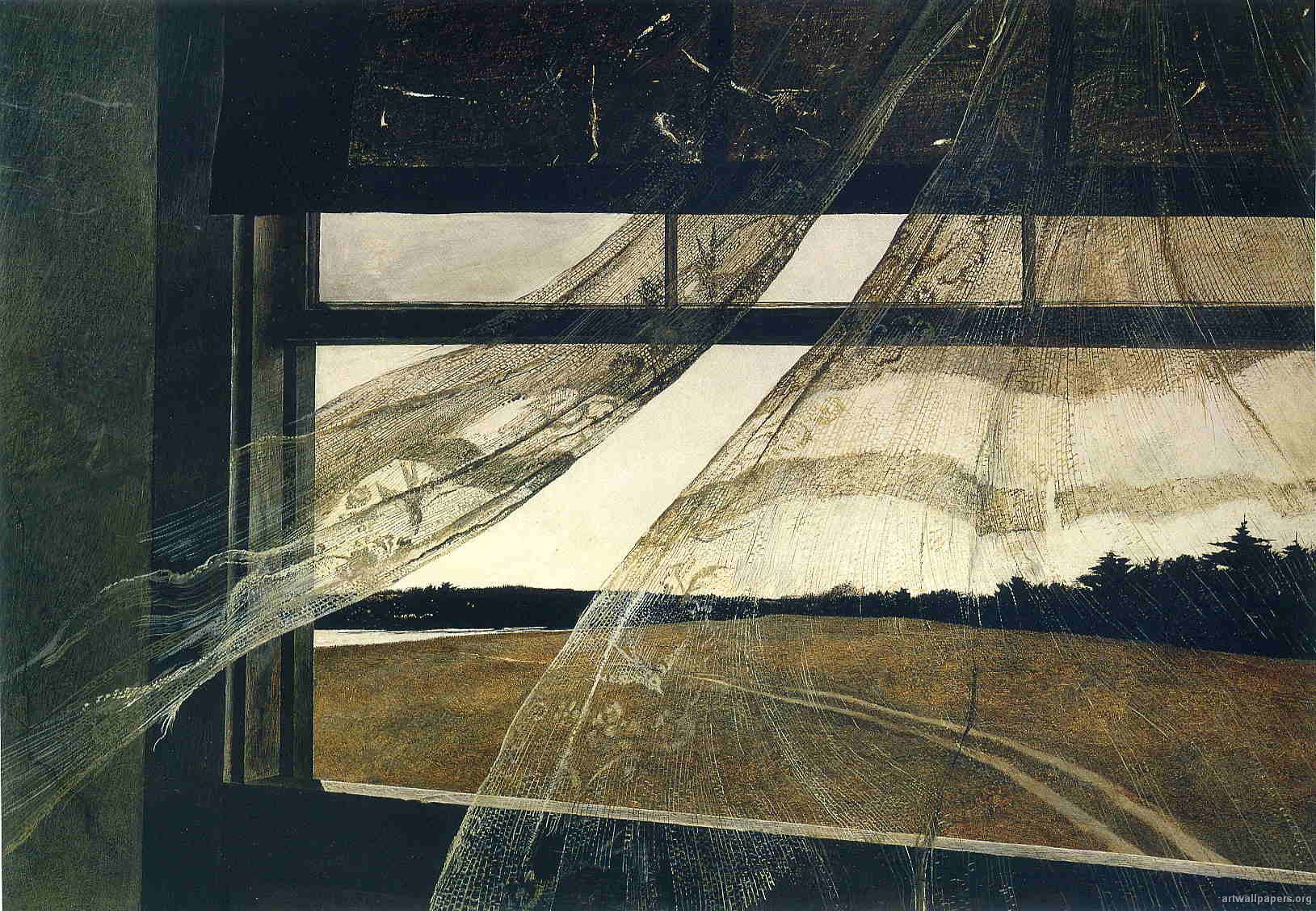
The Gallery exhibit is anchored by what Wyeth considered one of his best works, Wind from the Sea, which was inspired by a visit made to the farmhouse of his friends, Christina and Alvaro Olson. Christina was the polio-stricken woman whose nobility Wyeth immortalized in Christina’s World, and her house was the staging ground for much of his art. Wyeth said of this image:
I walked up into the dry, attic room one day. It was a hot summer day in August, so hot that I went over to that window, pushed it up about six inches and as I stood there, looking out, all of a sudden this curtain that had been lying there stale for years, God knows how long, began slowly to rise, and the birds crocheted on it began to move. My hair about stood on end. So I drew in very quickly and incisively and I didn’t get a west wind for a month and a half after that either. I did many drawings for it because I was so moved by that sudden thing.
The curtains evanesce before the window, fading to nothing in the far left; ghost birds dance upon the wind that undulates the fabric upon which they lie. The place beyond that, like any vista that we behold from afar, beckons to our hopes and directs our intentions. What sight, be it street, ocean, or valley, does not cast us off, launch us out from the place behind our eyes and ferry us forth across the view. It’s why we climb high, why we want to see out.
So when it comes to Wyeth, count me in. I’m on his side. My granddaddy’s shotgun may not be the deposit of worth I thought it was, and my silver dollars aren’t going to let me retire early, but when it comes to what a masterpiece is, I’ll trust my own scales to do the weighing.
A.G. Harmon teaches Shakespeare, Law and Literature, Jurisprudence, and Writing at The Catholic University of America in Washington, D.C. His novel, A House All Stilled, won the 2001 Peter Taylor Prize for the Novel.
Image Used: Wind From The Sea, 1947 by Andrew Wyeth
Previous Post

June 11, 2014
Where Is the Human Touch?
Next Post
June 13, 2014 Can We Bridge the Racial Divide?
Browse Our Archives
Select a Category A. G. Harmon Alissa Wilkinson Allison Backous Art Authors Brad Fruhauff Bradford Winters Bryan Bliss Caroline Langston Chad Thomas Johnston Chris Hoke Christiana N. Peterson Culture D.G. Myers D.L. Mayfield Daniel Bowman Jr. David Griffith Elizabeth Duffy Faith Film Greg Wolfe Guest Contributor Interview Jan Vallone Jeffrey Overstreet Jessica Eddings-Roeser Jessica Mesman Griffith Kelly Foster Lindsey Crittenden Morgan Meis music Natalie Vestin Nick Olson Peggy Rosenthal Personal Reflection Poetry Friday Reflection Relationships Review Richard Chess Richard Cole Sara Zarr Shannon Huffman Polson Sonya Bilocerkowycz Tania Runyan Tony Woodlief Topical Categories Uncategorized Vic Sizemore Writing
Select a Month October 2018 September 2018 August 2018 July 2018 June 2018 May 2018 April 2018 March 2018 February 2018 January 2018 December 2017 November 2017 October 2017 September 2017 August 2017 July 2017 June 2017 May 2017 April 2017 March 2017 February 2017 January 2017 December 2016 November 2016 October 2016 September 2016 August 2016 July 2016 June 2016 May 2016 April 2016 March 2016 February 2016 January 2016 December 2015 November 2015 October 2015 September 2015 August 2015 July 2015 June 2015 May 2015 April 2015 March 2015 February 2015 January 2015 December 2014 November 2014 October 2014 September 2014 August 2014 July 2014 June 2014 May 2014 April 2014 March 2014 February 2014 January 2014 December 2013 November 2013 October 2013 September 2013 August 2013 July 2013 June 2013 May 2013 April 2013 March 2013 February 2013 January 2013 December 2012 November 2012 October 2012 September 2012 August 2012 July 2012 June 2012 May 2012 February 2008
Follow Us!
TAKE THE
Religious Wisdom Quiz
What happened three days after Jesus was crucified?
Select your answer to see how you score.
A giant earthquake The temple was destroyed He rose from the dead The sea split
Related posts from Good Letters

The Crown and Victoria: Tales of Two Queens
TRENDING AT PATHEOS Catholic

Rejecting Doom: Christian Hope And Human Action
Christianity is a religion of hope. We are to have hope and...

It’s What Comes From Within Which Matters
One of the most difficult things for us to understand is why...

Why I Choose the Eucharist Over the Sermon
Choose the Eucharist, Not the Sermon What are we supposed to get...

5 Design Elements Found in Spiritually Rooted Homes
Putting Spirituality Into Home Decor Our homes are more than our living...

Credo: A Story of God Told with the...
About 10 years ago, I began to imagine a personal "Credo" that...

The Anatomy of Divine Revelation in Catholic Thought
The claim that God has made Himself known to human beings is...
view all Catholic blogs
Ad-Free & Subscriber Log-In Subscription Support
- About Us
- 2026 Calendar
- Videos
- Podcasts
- Library of World Religions
- Faith In Media Tracker
- Advertise With Us
- Write for Us
- Privacy Policy
- Terms of Service
- Do Not Sell My Data
- Contact Us
- Radiant Digital
- Manage Newsletter Subscriptions
- Unsubscribe From Notifications
- Sitemap
Copyright 2008-2026, Patheos. All rights reserved.
Subscription Support Ad-Free & Subscriber Log-In
Follow Patheos