
BuddhistCatholicContemplativeEvangelicalGeneral ChristianHinduJewishLatter-day SaintMuslimNew VisionsProgressive Christian
Beliefs
- Buddhist
- Catholic
- Contemplative
- Evangelical
- General Christian
- Hindu
- Jewish
- Latter-day Saint
- More Voices
- Muslim
- New Visions
- Pagan
- Progressive Christian
Topics
- Religion News
- Food and Religion
- Sports and Religion
- Religious Art
- Religious Music and Entertainment
- Religious Events
- History and Religion
- Style and Religion
- Politics and Religion
- Women in Religion
- Recreation Outdoors and Religion
- Business Finance and Religion
- Careers Workplace and Religion
- Education and Religion
- Family Parenting and Religion
- Health Fitness and Religion
- Home and Religion
- Relationships and Religion
- Technology and Religion
- Travel and Religion
Columnists
- Buddhist Columnists
- Business Finance and Religion Columnists
- Careers Workplace and Religion Columnists
- Catholic Columnists
- Contemplative Columnists
- Education and Religion Columnists
- Evangelists Columnists
- Family Parenting and Religion Columnists
- General Christian Columnists
- Health Fitness and Religion Columnists
- Hindu Columnists
- History and Religion Columnists
- Home and Religion Columnists
- Jewish Columnists
- More Voices Columnists
- Latter Day Columnists
- Muslim Columnists
- New Visions Columnists
- Nonreligious Columnists
- Pagan Columnists
- Politics and Religion Columnists
- Progressive Columnists
- Recreation Outdoors and Religion Columnists
- Relationships and Religion Columnists
- Religion News Columnists
- Religious Art Columnists
- Religious Events Columnists
- Religious Music and Entertainment Columnists
- Sports and Religion Columnists
- Style and Religion Columnists
- Technology and Religion Columnists
- Travel and Religion Columnists
- Women in Religion Columnists
Resource Library
- 2026 Calendar
- Library of World Religions
- The 100 Most Holy Places on Earth
- Patheos Answers
- Podcasts
- Videos
- Faith Leaders Database
- Anglican Episcopalian
- Bahai
- Baptist
- Buddhism
- Christianity
- Confucianism
- Eastern Orthodoxy
- Hinduism
- Holiness and Pentecostal
- ISKCON
- Islam
- Judaism
- Lutheran
- Methodist
- The Church of Jesus Christ of Latter-day Saints
- New Age
- Paganism
- Presbytarian and Reformed
- Protestantism
- Religion Behind the Scenes
- Roman Catholic
- Scientology
- Shia Islam
- Sikhism
- Sufism
- Sunni Islam
- Taoism
- Zen
- See all religions
Research Tools
 Ad-Free & Subscriber Log-In Subscription Support
Ad-Free & Subscriber Log-In Subscription Support
Follow Patheos 

- Trending:
- Forgiveness
- |
- Marriage
- |
- Consciousness
- |
- Death Penalty
- |
- Election
- |
- Halloween
 Good Letters
-
Contributors
- Home
- Catholic
- A Jew Prays in Venice, Part 2
A Jew Prays in Venice, Part 2
Last updated on: June 6, 2014 at 1:00 am by Richard Chess
A Jew Prays in Venice, Part 2 2014-06-03T16:07:37-07:00 Richard Chess
Patheos Explore the world's faith through different perspectives on religion and spirituality! Patheos has the views of the prevalent religions and spiritualities of the world.
 Continued from yesterday.
On the pleasant train ride from Florence to Venice, my wife Laurie and I began to piece together a relaxed itinerary for our final days in Italy: the Jewish Ghetto—definitely; the Peggy Guggenheim Collection—pretty sure; the Doge’s Palace—we should (but haven’t we had enough history?); the Basilica di San Marco, the Santa Maria Gloriosa dei Frari—haven’t we seen enough churches?
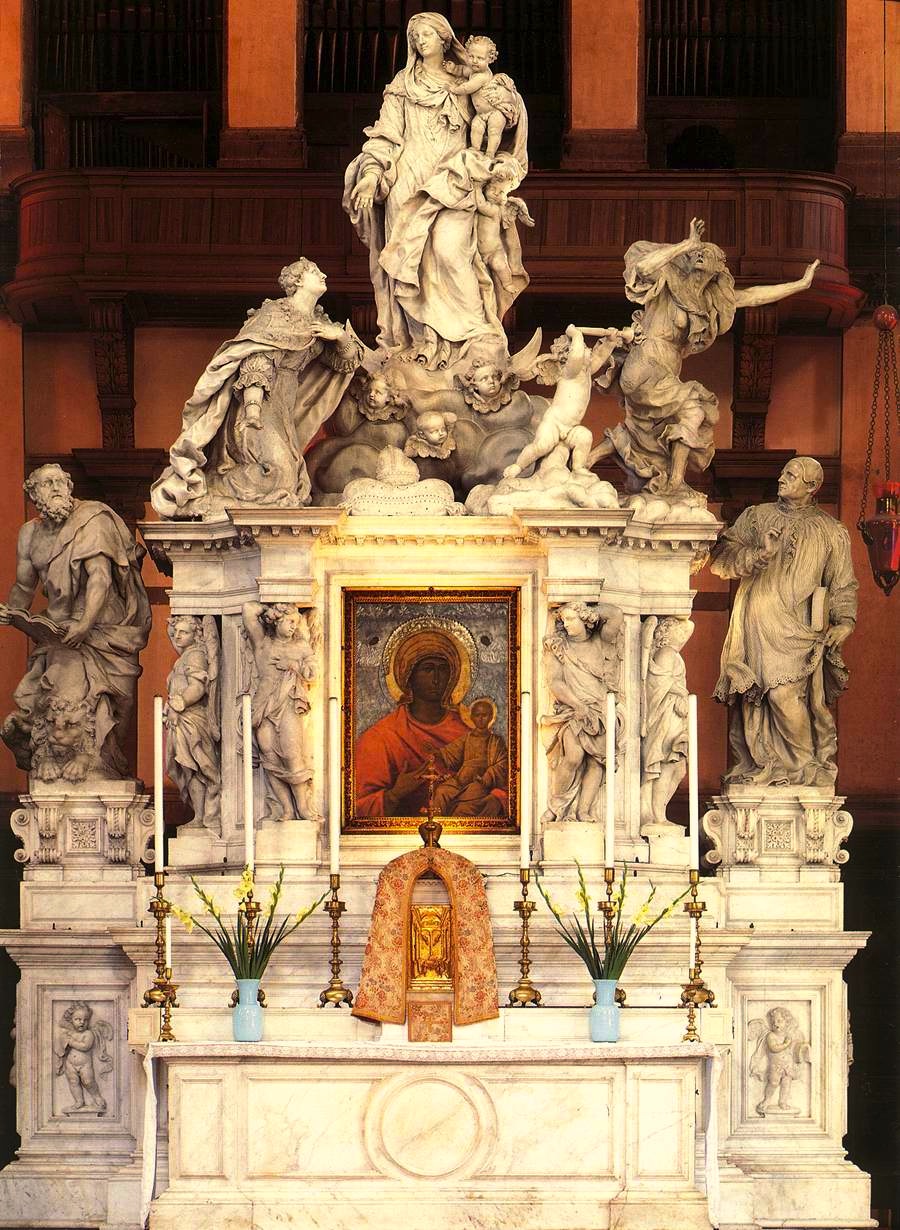
As it turns out, we did make it into a church (more than one) in Venice, but it was only at Santa Maria della Salute—a church on which we stumbled while rushing to the Peggy Guggenheim Collection so we could see it and have plenty of time for the famous Jewish Ghetto in Venice—where I felt the tenacious need to maintain my separate, external, egotistic will relax.
There was a prayer to be said and I said it in this church built to honor the Virgin Mary for saving Venice from a plague that in 1629 to 1630 killed 47,000 residents; a third of Venice’s population.
In the presence of the Madonna of Healing, my eyes fixed on the sculptures above the main altar, fixed on one sculpted figure in particular: a woman below and to the right of the Madonna, her body turned away from the Madonna, her arms outstretched beyond the “frame” of the sculpture, into the void, in anguish, afflicted, her neck twisted so she could look back and up at the towering Virgin holding an infant in one arm.
That’s human suffering. That’s the desperate cry for healing when healing, at least physical healing, may be, finally, unattainable.
“Mi shebeirach—may the One who blessed—the One who blesses—our patriarchs and matriarchs,” I sang quietly to myself, “bless those in need of healing.” My list: Sam, Cindy, Katherine, Ed, Sharon, in various stages of being ravaged with illness. “Bless those—bless *these—*with perfect healing—with whatever form of healing is possible—the renewal of body and spirit, and may the One who blesses help us find the courage to make our lives a blessing.”
To myself I sang the Hebrew, to myself the English, to myself I sang this contemporary interpretation of a traditional Jewish prayer for healing. In church I sang it. Maybe it’s more accurate, more honest to say, in this Catholic church, a church in all its particularity and also a sacred space—or space made sacred by artists and architects and culture and worshippers and the fullness of the human heart and spirit— in this space I was sung by a Jewish prayer, by a prayer whose vehicle I became, for though it wasn’t planned, it wasn’t on any itinerary.
Unbeknownst to me I had carried the prayer all the way to Italy to be offered here. And when it rose from my heart to my lips, I was a Jew and not a Jew, far from home and home.
When I was finished with the prayer, I rose from the bench and became a tourist again, a tourist delighted to see magnificent works of Titian displayed elsewhere in the church, delighted to wander sections of Venice where fewer tourists wandered, delighted to watch the Vaparettos come and go from Celestia station, just below the window of our modest apartment.
I don’t know who, if anyone, benefited from my prayer. I was certain none of those for whom I prayed knew they had moved me to pray. I wasn’t even certain that they had moved me to pray. Might it have been something else, some other force—the power of art in a place of worship? The feeling of helplessness as I thought about colleagues, friends, and family suffering from illnesses from which they may not, finally, recover?
Later that day, our trip nearly over, we sat on a quiet street beside a canal along which gondoliers plied romance for forty minutes and eighty Euros. We sipped our first Spritz Venezianos as the gondolas slid by just below us.
Even as we sat there, Laurie and I, grateful for beauty, history, privilege, each other, we were already composing the stories of our trip, stories that include a moment of easing out of our story to let God’s story be enacted and told in our hearts, before our eyes.
Richard Chess is the author of three books of poetry, Tekiah, Chair in the Desert, and Third Temple. Poems of his have appeared in Telling and Remembering: A Century of American Jewish Poetry, Bearing the Mystery: Twenty Years of IMAGE, and Best Spiritual Writing 2005. He is the Roy Carroll Professor of Honors Arts and Sciences at the University of North Carolina at Asheville. He is also the director of UNC Asheville’s Center for Jewish Studies.
Previous Post

June 5, 2014
A Jew Prays in Venice, Part 1
Next Post
June 9, 2014 Ripping Out My Past
Browse Our Archives
Select a Category A. G. Harmon Alissa Wilkinson Allison Backous Art Authors Brad Fruhauff Bradford Winters Bryan Bliss Caroline Langston Chad Thomas Johnston Chris Hoke Christiana N. Peterson Culture D.G. Myers D.L. Mayfield Daniel Bowman Jr. David Griffith Elizabeth Duffy Faith Film Greg Wolfe Guest Contributor Interview Jan Vallone Jeffrey Overstreet Jessica Eddings-Roeser Jessica Mesman Griffith Kelly Foster Lindsey Crittenden Morgan Meis music Natalie Vestin Nick Olson Peggy Rosenthal Personal Reflection Poetry Friday Reflection Relationships Review Richard Chess Richard Cole Sara Zarr Shannon Huffman Polson Sonya Bilocerkowycz Tania Runyan Tony Woodlief Topical Categories Uncategorized Vic Sizemore Writing
Select a Month October 2018 September 2018 August 2018 July 2018 June 2018 May 2018 April 2018 March 2018 February 2018 January 2018 December 2017 November 2017 October 2017 September 2017 August 2017 July 2017 June 2017 May 2017 April 2017 March 2017 February 2017 January 2017 December 2016 November 2016 October 2016 September 2016 August 2016 July 2016 June 2016 May 2016 April 2016 March 2016 February 2016 January 2016 December 2015 November 2015 October 2015 September 2015 August 2015 July 2015 June 2015 May 2015 April 2015 March 2015 February 2015 January 2015 December 2014 November 2014 October 2014 September 2014 August 2014 July 2014 June 2014 May 2014 April 2014 March 2014 February 2014 January 2014 December 2013 November 2013 October 2013 September 2013 August 2013 July 2013 June 2013 May 2013 April 2013 March 2013 February 2013 January 2013 December 2012 November 2012 October 2012 September 2012 August 2012 July 2012 June 2012 May 2012 February 2008
Follow Us!
TAKE THE
Religious Wisdom Quiz
What was the primary trade good in Biblical times?
Select your answer to see how you score.
Olive oil Purple cloth Spices Wheat
Related posts from Good Letters

Poetry Friday: "The Burned Butterfly"

A Conversation with Alicia Ostriker: Part 1

Ready or Not for the Days of Awe

TRENDING AT PATHEOS Catholic

Rejecting Doom: Christian Hope And Human Action
Christianity is a religion of hope. We are to have hope and...

It’s What Comes From Within Which Matters
One of the most difficult things for us to understand is why...

Why I Choose the Eucharist Over the Sermon
Choose the Eucharist, Not the Sermon What are we supposed to get...

5 Design Elements Found in Spiritually Rooted Homes
Putting Spirituality Into Home Decor Our homes are more than our living...

Credo: A Story of God Told with the...
About 10 years ago, I began to imagine a personal "Credo" that...

The Anatomy of Divine Revelation in Catholic Thought
The claim that God has made Himself known to human beings is...
view all Catholic blogs
Ad-Free & Subscriber Log-In Subscription Support
- About Us
- 2026 Calendar
- Videos
- Podcasts
- Library of World Religions
- Faith In Media Tracker
- Advertise With Us
- Write for Us
- Privacy Policy
- Terms of Service
- Do Not Sell My Data
- Contact Us
- Radiant Digital
- Manage Newsletter Subscriptions
- Unsubscribe From Notifications
- Sitemap
Copyright 2008-2026, Patheos. All rights reserved.
Subscription Support Ad-Free & Subscriber Log-In
Follow Patheos