
BuddhistCatholicContemplativeEvangelicalGeneral ChristianHinduJewishLatter-day SaintMuslimNew VisionsProgressive Christian
Beliefs
- Buddhist
- Catholic
- Contemplative
- Evangelical
- General Christian
- Hindu
- Jewish
- Latter-day Saint
- More Voices
- Muslim
- New Visions
- Pagan
- Progressive Christian
Topics
- Religion News
- Food and Religion
- Sports and Religion
- Religious Art
- Religious Music and Entertainment
- Religious Events
- History and Religion
- Style and Religion
- Politics and Religion
- Women in Religion
- Recreation Outdoors and Religion
- Business Finance and Religion
- Careers Workplace and Religion
- Education and Religion
- Family Parenting and Religion
- Health Fitness and Religion
- Home and Religion
- Relationships and Religion
- Technology and Religion
- Travel and Religion
Columnists
- Buddhist Columnists
- Business Finance and Religion Columnists
- Careers Workplace and Religion Columnists
- Catholic Columnists
- Contemplative Columnists
- Education and Religion Columnists
- Evangelists Columnists
- Family Parenting and Religion Columnists
- General Christian Columnists
- Health Fitness and Religion Columnists
- Hindu Columnists
- History and Religion Columnists
- Home and Religion Columnists
- Jewish Columnists
- More Voices Columnists
- Latter Day Columnists
- Muslim Columnists
- New Visions Columnists
- Nonreligious Columnists
- Pagan Columnists
- Politics and Religion Columnists
- Progressive Columnists
- Recreation Outdoors and Religion Columnists
- Relationships and Religion Columnists
- Religion News Columnists
- Religious Art Columnists
- Religious Events Columnists
- Religious Music and Entertainment Columnists
- Sports and Religion Columnists
- Style and Religion Columnists
- Technology and Religion Columnists
- Travel and Religion Columnists
- Women in Religion Columnists
Resource Library
- 2026 Calendar
- Library of World Religions
- The 100 Most Holy Places on Earth
- Patheos Answers
- Podcasts
- Videos
- Faith Leaders Database
- Anglican Episcopalian
- Bahai
- Baptist
- Buddhism
- Christianity
- Confucianism
- Eastern Orthodoxy
- Hinduism
- Holiness and Pentecostal
- ISKCON
- Islam
- Judaism
- Lutheran
- Methodist
- The Church of Jesus Christ of Latter-day Saints
- New Age
- Paganism
- Presbytarian and Reformed
- Protestantism
- Religion Behind the Scenes
- Roman Catholic
- Scientology
- Shia Islam
- Sikhism
- Sufism
- Sunni Islam
- Taoism
- Zen
- See all religions
Research Tools
 Ad-Free & Subscriber Log-In Subscription Support
Ad-Free & Subscriber Log-In Subscription Support
Follow Patheos 

- Trending:
- Forgiveness
- |
- Marriage
- |
- Consciousness
- |
- Death Penalty
- |
- Election
- |
- Halloween
 Good Letters
-
Contributors
- Home
- Catholic
- Sunday in Sweet Afton
Sunday in Sweet Afton
Last updated on: May 14, 2014 at 1:00 am by Vic Sizemore
Sunday in Sweet Afton 2014-05-12T15:56:03-07:00 Vic Sizemore
Patheos Explore the world's faith through different perspectives on religion and spirituality! Patheos has the views of the prevalent religions and spiritualities of the world.
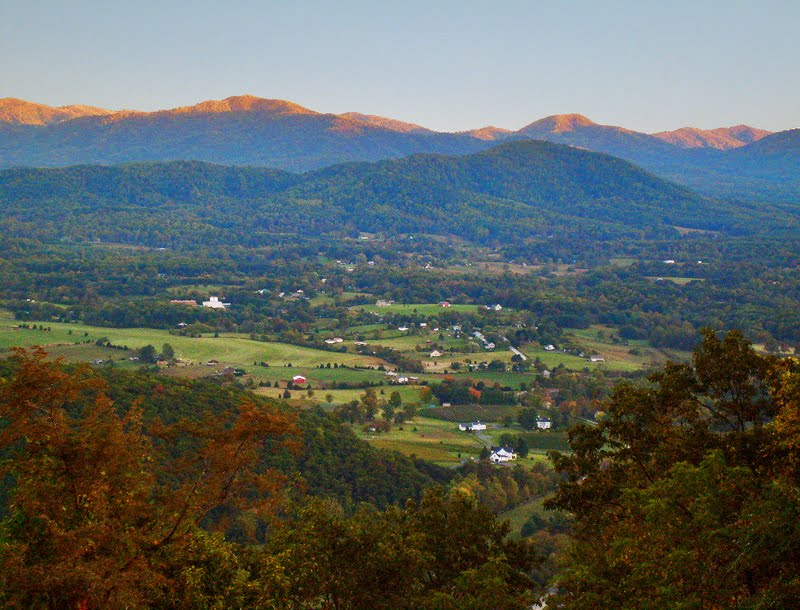 Last Sunday my wife decided to celebrate the end of our semester by taking a drive on a scenic stretch of Route 151, a two-lane road that winds along the foothills of the Blue Ridge Mountains between Lynchburg and Charlottesville. Often on this road, you find yourself sliding through a flashing green canopy of leaves. More than once, a climbing series of hairpin turns will open onto sweeping green valleys.
The mountains roll soft as the curves of a human body, and surround some valleys on all sides, creating a wide natural bowl protecting small Edens of farmhouses and fertile land. Yesterday, the mountaintops reached almost, but not quite, to the cumulus clouds—fat globs, heavy and motionless, as if they had been hung there by invisible wires and would drop of their own weight otherwise. It was one of those Virginia days in spring when the beauty of it all strikes you dumb but for exclaimed clichés.
Not that you would need more reason to make this drive, but strung along Route 151 are seven wineries, three breweries, one cidery, and one distillery—all do tastings, and some have restaurants. It is dubbed the Brew Ridge Trail, and it travels across Afton Mountain.
I once had a friend who smoked “Sweet Afton” cigarettes. Though they were made in Ireland, the package advertised them as “Virginia Cigarettes,” as this is where they got the tobacco. The name does not come from our Afton however, but from the Robert Burns poem about a river in Scotland. Under Burns’ picture on the pack, are these lines:
Flow gently, sweet Afton, among thy green braes,
Flow gently, I’ll sing thee a song in thy praise
If you think it is all too poetic, too romantic for a pack of smokes, no worry; the government warning on Irish cigarettes gets right to the point: “Smoking Kills.”
In the New York Times Magazine that very morning, a man asked The Ethicist if it was okay to give cigarettes leftover from a party—the only place he and his friends smoke—to some homeless people. The Ethicist said the real ethical question was why he would assume his friends have the right to make their own choice about smoking cigarettes he offers them, but not homeless people. “Why does having a home grant someone special agency?”
Most of the homes along this road are quite modest, but some are old southern mansions, restored from the grand days of tobacco farming. A great deal of wealth in this area came from tobacco, a fact that our children are taught at the Point of Honor Museum, by a woman garbed in colonial dress and bonnet and apron. What she doesn’t mention—or at least didn’t mention when Liz went along with our daughter Grace on a field trip—is the role slavery played in the accumulation of that wealth.
When I went with my son Evan several years ago on a field trip to Avoca, Charles Lynch’s home, the guide did mention slavery in passing, only to note that slave quarters were once out behind the house. In the place where they once stood, now stands a model of a settler’s house, to show the children what frontier living would have been like, which I suppose makes for happier field trips. (A model slave home is being constructed on the grounds of Thomas Jefferson’s Poplar Forest.)
On Sunday, I saw no slave quarters out back of any of the massive old homes along 151. I’m sure it is partly because slave houses were not built to last. Several years ago, Liz and I went to St. John, another place of breathtaking beauty. Along a walking trail at Cinnamon Bay, we saw the graves of plantation owners and their wives. The guidebook informed us that the slaves were buried in shallow graves down at the beach—the beach where at that moment people lay in the sun, paddled standup boards, snorkeled, and swam. Were human skeletons under them as they took their ease on the sand? Had they long since washed out and become a part of the ocean’s cycle?
We sit here in the courtyard of Blue Mountain Brewery on a late Sunday afternoon. We are sampling craft brews—most here are too hoppy for Liz, so I get to finish them. The sun is hot, but the cooling breeze is brisk. In the field beyond, lines are strung for the new crop of hops. Beyond that, pastureland stretches toward mountains that sport cloud shadows like spots on the backs of Holstein cows. Everything seems a little bit unreal, as if this natural bowl we are inside is a diorama box created by a giant Wes Anderson, everything placed precisely in its spot.
This place. It is so beautiful that for a brief instant I almost, but not quite, forget its brutal human history.
Vic Sizemore earned his MFA in fiction from Seattle Pacific University in 2009. His short stories are published or forthcoming in StoryQuarterly, Southern Humanities Review, Connecticut Review, Portland Review, Blue Mesa Review, Sou’wester, Silk Road Review, Atticus Review, PANK Magazine Fiction Fix, Vol.1 Brooklyn, Conclave, and elsewhere. Excerpts from his novel The Calling are published in Connecticut Review, Portland Review, Prick of the Spindle, Burrow Press Review, Rock & Sling, and Relief. His fiction has won the New Millennium Writings Award for Fiction, and been nominated for Best American Nonrequired Reading and a Pushcart Prize. You can find Vic at http://vicsizemore.wordpress.com/.
Previous Post

May 13, 2014
Ruin and Possibility in David Gordon Green’s Joe
Next Post
May 15, 2014 That Woman is Gone: Discovering Postpartum Depression
Browse Our Archives
Select a Category A. G. Harmon Alissa Wilkinson Allison Backous Art Authors Brad Fruhauff Bradford Winters Bryan Bliss Caroline Langston Chad Thomas Johnston Chris Hoke Christiana N. Peterson Culture D.G. Myers D.L. Mayfield Daniel Bowman Jr. David Griffith Elizabeth Duffy Faith Film Greg Wolfe Guest Contributor Interview Jan Vallone Jeffrey Overstreet Jessica Eddings-Roeser Jessica Mesman Griffith Kelly Foster Lindsey Crittenden Morgan Meis music Natalie Vestin Nick Olson Peggy Rosenthal Personal Reflection Poetry Friday Reflection Relationships Review Richard Chess Richard Cole Sara Zarr Shannon Huffman Polson Sonya Bilocerkowycz Tania Runyan Tony Woodlief Topical Categories Uncategorized Vic Sizemore Writing
Select a Month October 2018 September 2018 August 2018 July 2018 June 2018 May 2018 April 2018 March 2018 February 2018 January 2018 December 2017 November 2017 October 2017 September 2017 August 2017 July 2017 June 2017 May 2017 April 2017 March 2017 February 2017 January 2017 December 2016 November 2016 October 2016 September 2016 August 2016 July 2016 June 2016 May 2016 April 2016 March 2016 February 2016 January 2016 December 2015 November 2015 October 2015 September 2015 August 2015 July 2015 June 2015 May 2015 April 2015 March 2015 February 2015 January 2015 December 2014 November 2014 October 2014 September 2014 August 2014 July 2014 June 2014 May 2014 April 2014 March 2014 February 2014 January 2014 December 2013 November 2013 October 2013 September 2013 August 2013 July 2013 June 2013 May 2013 April 2013 March 2013 February 2013 January 2013 December 2012 November 2012 October 2012 September 2012 August 2012 July 2012 June 2012 May 2012 February 2008
Follow Us!
TAKE THE
Religious Wisdom Quiz
What does Paul say in Colossians has been nailed to the cross?
Select your answer to see how you score.
The written code with its regulations Satan's authority The old covenant Our sins
Related posts from Good Letters

A Conversation with Gene Luen Yang: Part 1
Race Relations: A Personal History
TRENDING AT PATHEOS Catholic

The Parable Of The Sower And The Word...
One of Christ’s most famous parables is that of the sower who...

Rejecting Doom: Christian Hope And Human Action
Christianity is a religion of hope. We are to have hope and...

Why I Choose the Eucharist Over the Sermon
Choose the Eucharist, Not the Sermon What are we supposed to get...

5 Design Elements Found in Spiritually Rooted Homes
Putting Spirituality Into Home Decor Our homes are more than our living...

Credo: A Story of God Told with the...
About 10 years ago, I began to imagine a personal "Credo" that...

The Anatomy of Divine Revelation in Catholic Thought
The claim that God has made Himself known to human beings is...
view all Catholic blogs
Ad-Free & Subscriber Log-In Subscription Support
- About Us
- 2026 Calendar
- Videos
- Podcasts
- Library of World Religions
- Faith In Media Tracker
- Advertise With Us
- Write for Us
- Privacy Policy
- Terms of Service
- Do Not Sell My Data
- Contact Us
- Radiant Digital
- Manage Newsletter Subscriptions
- Unsubscribe From Notifications
- Sitemap
Copyright 2008-2026, Patheos. All rights reserved.
Subscription Support Ad-Free & Subscriber Log-In
Follow Patheos