
BuddhistCatholicContemplativeEvangelicalGeneral ChristianHinduJewishLatter-day SaintMuslimNew VisionsProgressive Christian
Beliefs
- Buddhist
- Catholic
- Contemplative
- Evangelical
- General Christian
- Hindu
- Jewish
- Latter-day Saint
- More Voices
- Muslim
- New Visions
- Pagan
- Progressive Christian
Topics
- Religion News
- Food and Religion
- Sports and Religion
- Religious Art
- Religious Music and Entertainment
- Religious Events
- History and Religion
- Style and Religion
- Politics and Religion
- Women in Religion
- Recreation Outdoors and Religion
- Business Finance and Religion
- Careers Workplace and Religion
- Education and Religion
- Family Parenting and Religion
- Health Fitness and Religion
- Home and Religion
- Relationships and Religion
- Technology and Religion
- Travel and Religion
Columnists
- Buddhist Columnists
- Business Finance and Religion Columnists
- Careers Workplace and Religion Columnists
- Catholic Columnists
- Contemplative Columnists
- Education and Religion Columnists
- Evangelists Columnists
- Family Parenting and Religion Columnists
- General Christian Columnists
- Health Fitness and Religion Columnists
- Hindu Columnists
- History and Religion Columnists
- Home and Religion Columnists
- Jewish Columnists
- More Voices Columnists
- Latter Day Columnists
- Muslim Columnists
- New Visions Columnists
- Nonreligious Columnists
- Pagan Columnists
- Politics and Religion Columnists
- Progressive Columnists
- Recreation Outdoors and Religion Columnists
- Relationships and Religion Columnists
- Religion News Columnists
- Religious Art Columnists
- Religious Events Columnists
- Religious Music and Entertainment Columnists
- Sports and Religion Columnists
- Style and Religion Columnists
- Technology and Religion Columnists
- Travel and Religion Columnists
- Women in Religion Columnists
Resource Library
- 2026 Calendar
- Library of World Religions
- The 100 Most Holy Places on Earth
- Patheos Answers
- Podcasts
- Videos
- Faith Leaders Database
- Anglican Episcopalian
- Bahai
- Baptist
- Buddhism
- Christianity
- Confucianism
- Eastern Orthodoxy
- Hinduism
- Holiness and Pentecostal
- ISKCON
- Islam
- Judaism
- Lutheran
- Methodist
- The Church of Jesus Christ of Latter-day Saints
- New Age
- Paganism
- Presbytarian and Reformed
- Protestantism
- Religion Behind the Scenes
- Roman Catholic
- Scientology
- Shia Islam
- Sikhism
- Sufism
- Sunni Islam
- Taoism
- Zen
- See all religions
Research Tools
 Ad-Free & Subscriber Log-In Subscription Support
Ad-Free & Subscriber Log-In Subscription Support
Follow Patheos 

- Trending:
- Forgiveness
- |
- Marriage
- |
- Consciousness
- |
- Death Penalty
- |
- Election
- |
- Halloween
 Good Letters
-
Contributors
- Home
- Catholic
- Voices in the Methow Valley
Voices in the Methow Valley
Last updated on: April 25, 2014 at 4:36 pm by Shannon Huffman Polson
Voices in the Methow Valley 2014-04-25T16:36:42-07:00 Shannon Huffman Polson
Patheos Explore the world's faith through different perspectives on religion and spirituality! Patheos has the views of the prevalent religions and spiritualities of the world.
 Spring in the Methow Valley of Northeastern Washington comes quietly, a gradual warming, winter grass rustling with the breezes carrying promise of new life. I am here for my first spring, though I’ve been here often winters, occasional summers and falls. I’ve never seen the opening here, the uncovering of so much asleep, the pale yellow winter grass so thick it seems nothing green will come again, that all is lost.
I head out for a hike along Virginia Ridge toward Mt. Gardner. Amidst the dead grass and dry pine needles, the cones of the Ponderosa along the trail, flash improbable patches of color: tiny pink blossoms, other small yellow and blue flowers, and yellow daisy-shaped blooms. They come out of nowhere, these glimpses into spring and the life that is growing under the surface. I’m new to this valley in the spring; I do not know their names.
How important it is to know names—is it enough to simply notice, to take the time to pay attention? There are birds here I don’t yet know, though I looked up the mountain bluebird the other day. He is common in areas of forest opening to meadow, where we are staying. Hanging up a hummingbird feeder, we’ve had several visitors with backs shining orange and green. I know they are hummingbirds, but not which kind.
So much is happening around me. I am not equipped to understand. It is not enough to notice. I need to meet and learn this world, to know it, to be saturated in beauty.
My husband and two young sons have left me alone to write for a bit. I am supposed to meet them outside for a walk to Wolf Creek. I call to them in the chill spring breeze, search the open woods but see nothing, hear nothing. Finally, part annoyed and part concerned, I head down the hill toward Wolf Creek.
I hear it well before it comes into view, a stream rushing with the snow melt from the high peaks of the North Cascades. I scramble down the steep slope leaning back into the mountain for balance, looking around to keep my bearings: in the gully behind me are two long dead ponderosa pines, their grey trunks pointing toward each other and upward like an arrow. A marker I can follow when I need to go back. At the bottom of the gorge, water crashes over rocks, swirling around fallen trees, pools deep and clear and marked only by the boil of current.
Climbing back the hill is steeper than I’d estimated on descent; I take a low angle up the gorge. Soon I stumble across a social trail, whether made by animals or people it is impossible to tell, but given the remoteness of the area, the former seems likely. Large fauna of the Methow Valley include deer, bear, and cougar. All would find the water sources here.
I follow the path for several yards until it disappears beneath a fallen tree, and pick up another just uphill. It disappears too and I find another and another and then pick my way slowly through the pine-needled steepness toward the light at the top of the gorge.
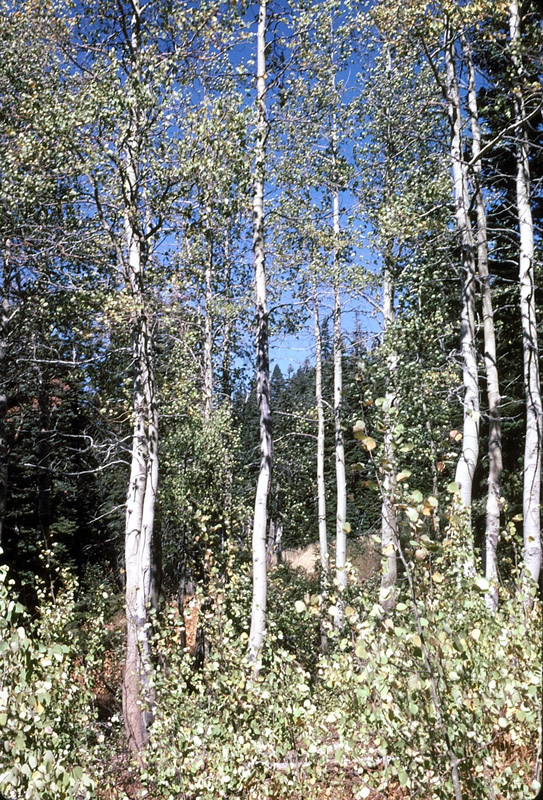
I come out much further downhill than my entry to the gorge; my way home takes me past a stand of aspen in a small depression. They grow close to water, and it seems likely there is an underground stream nearby. Where most of the forest is free of tangled underbrush, the stand of aspen is crowded with still barren plant life. There is only the slightest breeze, and the winter grass and dead leaves, the bare branches of aspen, are whispering. It is an eerie sound, a sound alive and possible and unknown.
A large sleek shape appears at the corner of the small settler’s cabin at the edge of the copse. I watch it stop, knowing its surroundings so intimately, it senses my presence even at a distance. It is a marmot, fat and smooth, and in a quivering instant it disappears.
The squirrel on the tree trunk ahead of me stops and watches me. The sound in the trees, in the air, continues. I think I hear my son’s voice amid the whisper of aspens and my skin prickles.
Last week while attending the Calvin Festival to give a presentation on writing as lament, I heard Christine Byl talk about her writing and work in the Alaska wilderness, my other love. She took issue with the idea of nature writing.
“Nature—what is that?” she asked. Metabolism is nature. Our bodies fatigued and hungry after a long day’s work—that’s nature. We are not separate from it. We are a part of it.
I thought hearing the high sweet sound of my son’s voice in the middle of those trees that if something had happened— had something happened—the squirrel would go on with its quick starts and stops, the aspens would keep whispering. We are a part of this nature, living or dead.
I have written—and I talk—about the requirement that we live Good Friday before we can live Easter. I am writing something new now, about war, and about the things we see and learn that we cannot move through. There are some things we cannot let go. What of these things?
There is movement through the valley, even in our hardest times, and this is a hard thing to learn, and to do. But perhaps harder is to live in the tension, the tension that must at once hold Good Friday and Easter, the greatest sorrows and terrors, the greatest joys.
Theologian Paul Tillich talks of living in the tension between the self and the other. The tension I think is harder to hold is that of horror and transcendence: a tension that somehow must still bring light.
I walk uphill and I hear my sons’ voices, both of them. I call out, and look ahead to see my husband and the boys. I leave the whispering behind, and we walk to the cabin together.
Shannon Huffman Polson is the author of North of Hope: A Daughter’s Arctic Journey. Her essays and articles have appeared in a number of literary and commercial magazines including High Country News, Huffington Post, Cirque Journal and Alaska and Seattle Magazines. She can be found writing or with her her family in Washington State or Alaska, and always at her website, Facebook, and Twitter.
Previous Post

April 23, 2014
Crying Ocean
Next Post
April 25, 2014 Sex and Power and Christian Education
Browse Our Archives
Select a Category A. G. Harmon Alissa Wilkinson Allison Backous Art Authors Brad Fruhauff Bradford Winters Bryan Bliss Caroline Langston Chad Thomas Johnston Chris Hoke Christiana N. Peterson Culture D.G. Myers D.L. Mayfield Daniel Bowman Jr. David Griffith Elizabeth Duffy Faith Film Greg Wolfe Guest Contributor Interview Jan Vallone Jeffrey Overstreet Jessica Eddings-Roeser Jessica Mesman Griffith Kelly Foster Lindsey Crittenden Morgan Meis music Natalie Vestin Nick Olson Peggy Rosenthal Personal Reflection Poetry Friday Reflection Relationships Review Richard Chess Richard Cole Sara Zarr Shannon Huffman Polson Sonya Bilocerkowycz Tania Runyan Tony Woodlief Topical Categories Uncategorized Vic Sizemore Writing
Select a Month October 2018 September 2018 August 2018 July 2018 June 2018 May 2018 April 2018 March 2018 February 2018 January 2018 December 2017 November 2017 October 2017 September 2017 August 2017 July 2017 June 2017 May 2017 April 2017 March 2017 February 2017 January 2017 December 2016 November 2016 October 2016 September 2016 August 2016 July 2016 June 2016 May 2016 April 2016 March 2016 February 2016 January 2016 December 2015 November 2015 October 2015 September 2015 August 2015 July 2015 June 2015 May 2015 April 2015 March 2015 February 2015 January 2015 December 2014 November 2014 October 2014 September 2014 August 2014 July 2014 June 2014 May 2014 April 2014 March 2014 February 2014 January 2014 December 2013 November 2013 October 2013 September 2013 August 2013 July 2013 June 2013 May 2013 April 2013 March 2013 February 2013 January 2013 December 2012 November 2012 October 2012 September 2012 August 2012 July 2012 June 2012 May 2012 February 2008
Follow Us!
TAKE THE
Religious Wisdom Quiz
Which prophet's book names the birthplace of the Messiah?
Select your answer to see how you score.
Amos Obadiah Jonah Micah
Related posts from Good Letters

On Writing Odes: Taking Time to Celebrate


The Stars of the Earth Cry Out

A Conversation with Barbara Brown Taylor
TRENDING AT PATHEOS Catholic

Rejecting Doom: Christian Hope And Human Action
Christianity is a religion of hope. We are to have hope and...

It’s What Comes From Within Which Matters
One of the most difficult things for us to understand is why...

Why I Choose the Eucharist Over the Sermon
Choose the Eucharist, Not the Sermon What are we supposed to get...

5 Design Elements Found in Spiritually Rooted Homes
Putting Spirituality Into Home Decor Our homes are more than our living...

Credo: A Story of God Told with the...
About 10 years ago, I began to imagine a personal "Credo" that...

The Anatomy of Divine Revelation in Catholic Thought
The claim that God has made Himself known to human beings is...
view all Catholic blogs
Ad-Free & Subscriber Log-In Subscription Support
- About Us
- 2026 Calendar
- Videos
- Podcasts
- Library of World Religions
- Faith In Media Tracker
- Advertise With Us
- Write for Us
- Privacy Policy
- Terms of Service
- Do Not Sell My Data
- Contact Us
- Radiant Digital
- Manage Newsletter Subscriptions
- Unsubscribe From Notifications
- Sitemap
Copyright 2008-2026, Patheos. All rights reserved.
Subscription Support Ad-Free & Subscriber Log-In
Follow Patheos