
BuddhistCatholicContemplativeEvangelicalGeneral ChristianHinduJewishLatter-day SaintMuslimNew VisionsProgressive Christian
Beliefs
- Buddhist
- Catholic
- Contemplative
- Evangelical
- General Christian
- Hindu
- Jewish
- Latter-day Saint
- More Voices
- Muslim
- New Visions
- Pagan
- Progressive Christian
Topics
- Religion News
- Food and Religion
- Sports and Religion
- Religious Art
- Religious Music and Entertainment
- Religious Events
- History and Religion
- Style and Religion
- Politics and Religion
- Women in Religion
- Recreation Outdoors and Religion
- Business Finance and Religion
- Careers Workplace and Religion
- Education and Religion
- Family Parenting and Religion
- Health Fitness and Religion
- Home and Religion
- Relationships and Religion
- Technology and Religion
- Travel and Religion
Columnists
- Buddhist Columnists
- Business Finance and Religion Columnists
- Careers Workplace and Religion Columnists
- Catholic Columnists
- Contemplative Columnists
- Education and Religion Columnists
- Evangelists Columnists
- Family Parenting and Religion Columnists
- General Christian Columnists
- Health Fitness and Religion Columnists
- Hindu Columnists
- History and Religion Columnists
- Home and Religion Columnists
- Jewish Columnists
- More Voices Columnists
- Latter Day Columnists
- Muslim Columnists
- New Visions Columnists
- Nonreligious Columnists
- Pagan Columnists
- Politics and Religion Columnists
- Progressive Columnists
- Recreation Outdoors and Religion Columnists
- Relationships and Religion Columnists
- Religion News Columnists
- Religious Art Columnists
- Religious Events Columnists
- Religious Music and Entertainment Columnists
- Sports and Religion Columnists
- Style and Religion Columnists
- Technology and Religion Columnists
- Travel and Religion Columnists
- Women in Religion Columnists
Resource Library
- 2026 Calendar
- Library of World Religions
- The 100 Most Holy Places on Earth
- Patheos Answers
- Podcasts
- Videos
- Faith Leaders Database
- Anglican Episcopalian
- Bahai
- Baptist
- Buddhism
- Christianity
- Confucianism
- Eastern Orthodoxy
- Hinduism
- Holiness and Pentecostal
- ISKCON
- Islam
- Judaism
- Lutheran
- Methodist
- The Church of Jesus Christ of Latter-day Saints
- New Age
- Paganism
- Presbytarian and Reformed
- Protestantism
- Religion Behind the Scenes
- Roman Catholic
- Scientology
- Shia Islam
- Sikhism
- Sufism
- Sunni Islam
- Taoism
- Zen
- See all religions
Research Tools
 Ad-Free & Subscriber Log-In Subscription Support
Ad-Free & Subscriber Log-In Subscription Support
Follow Patheos 

- Trending:
- Forgiveness
- |
- Marriage
- |
- Consciousness
- |
- Death Penalty
- |
- Election
- |
- Halloween
 Good Letters
-
Contributors
- Home
- Catholic
- The Prodigal Bears His Scars
The Prodigal Bears His Scars
Last updated on: April 9, 2014 at 1:00 am by Tony Woodlief
The Prodigal Bears His Scars 2014-04-07T16:33:13-07:00 Tony Woodlief
Patheos Explore the world's faith through different perspectives on religion and spirituality! Patheos has the views of the prevalent religions and spiritualities of the world.
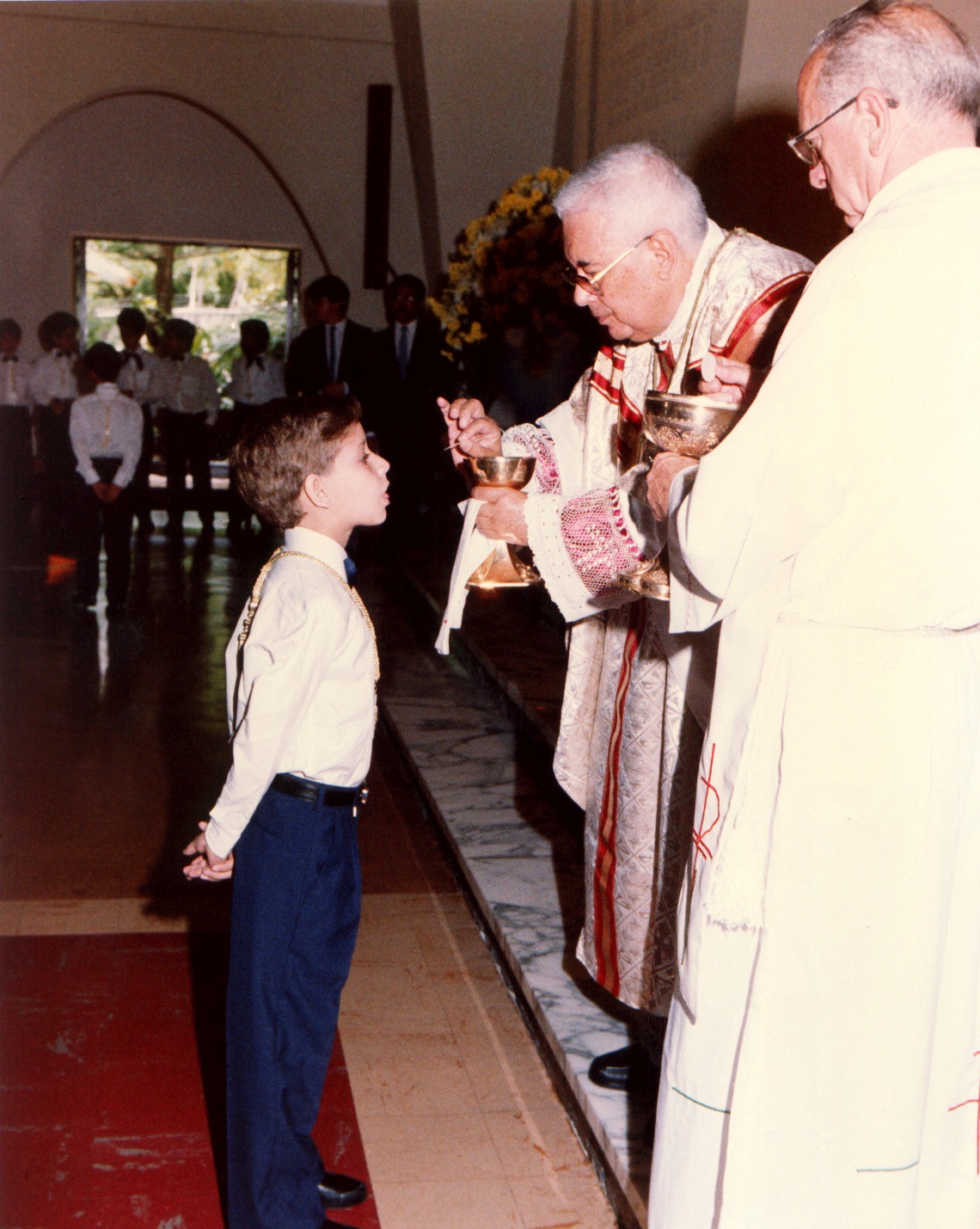 My last communion was during a brief suspension of my former church’s policy of forbidding it to children. I was already halfway out Protestantism’s door, and three-quarters out of my marriage, but on this their mother and I agreed: we should seize the opportunity to have communion alongside our children. The table was soon blocked again, after much pastoral consultation of texts. Communion remained accessible for hard-drinking adulterers like me, but not for my four year-old.
I lingered at the edges of another church in the following months, and then not at all. The shape of a newly divorced and even harder drinking man is not well-suited—at least it can seem to him, in his vanity and stupor—to pews. I drifted, and far.
My memory of that long descent’s end is the memory of a voice, nightly, over the phone. That voice spoke truths I’d forgotten apply to me: truths about forgiveness, about purpose. It was not the voice of an angel, but close enough, and to this day the sound of it conjures for me salvation.
I still hear it every morning, because it is the voice of a woman who chose to become my wife, long after I stopped believing I deserve such a thing. She took my hand despite my past, took it though her cancer left us unsure if she would live long past a honeymoon. We had no money, no home. Each of us bore a sickness. Today we are mending, and we have a house in a little town, and my children love her more than I imagined possible.
I believe in miracles. How else can a man like me wake each morning to the sound of salvation?
A friend recently asked if God abandons us. I told her I used to think so, but now I see differently. We imagine God goes missing when we craft about ourselves a hell. It is we who abandon him.
Yet all about is grace, and how foolish must the prodigal feel, to realize how long his father waited. He should take that foolishness into his heart, and run his fingers along the scars of his wandering, lest he ever be tempted to forget.
There is grace, and one such grace is that in days, my wife and I will receive Holy Chrismation in the Orthodox Church. Our priest will anoint us, and we will receive communion. After so many years, I hunger and thirst, and here is another miracle: that the table would be set for the likes of me.
Some Protestant friends are suspicious of Orthodoxy, most especially the icons. I like to remind them of the tribes that Joshua sent to live in the land of Moses, across the Jordan. They erected an altar there, to symbolize their covenant with the God of Israel. Their neighbors saw the altar, reckoned it an idol, and came bearing swords to slay the infidels. It is not for worshipping falsely, was the reply. “It is to be a witness between us and you and the generations that follow.” Not every reverenced thing is an idol, I tell my friends.
The best rebuttal Flannery O’Connor offered to bloodless rationalism is not a short story, but her famous retort to Mary McCarthy’s condescending praise of the Eucharist as a “pretty good” symbol: “Well, if it’s a symbol, to hell with it.”
To hell with McCarthy’s attitude, but perhaps not with the symbol itself. As elsewhere, our words for God’s mysteries have been denuded. The West came to think of “symbol” in the Platonic sense, as a representative of the true thing. Some Reformers saw in it only danger; best eradicate it, lest man worship the created thing, rather than his Creator. Thus did John Calvin ban throughout his dominion the tradition of coming to the communion table with one’s arms in the form of the cross.
But long before this alteration, symbolos was understood as bringing two things together. As making present the unseen. It was counterposed to diabolos: to divide. Perhaps unsurprisingly, a West that embraced the rational idea of symbol also embraced a reductionism best characterized by diabolos. How fitting that the word also means: “to make someone fall.” How fitting that it evokes the name we give to the prince of darkness.
I know about diabolos. I have been diabolos. A stumbling block in my former church, a stumbling block to my former wife, and in my divorce, a stumbling block to my children. I have been diabolos, yet in my father’s house, a banquet is prepared.
And yet. Not all things are made new, this side of the veil. Though my children come to church with me, their mother wanted them to be members of her church. The bitter irony in my return to communion is that I still cannot partake with my children; the Orthodox Church forbids it to anyone who will not forsake communion in non-Orthodox churches. My children will fare, at least for a time, without the fullness of symbolos, because their father was diabolos.
The prodigal bears his scars, as do his children. But the table awaits. It awaits me, and so surely it awaits them, when they are ready, when they can navigate yet another acre of the minefield cast before children of divorced parents.
I am tempted to wait for them, but I need the mystery, and they need me to enter into it. “There is power in the blood,” goes the old hymn. Many Christians never stopped believing that. There is power in the blood, redemption in the body, and healing in the house of God, even for someone like me.
Especially, I see now, for someone like me.
Tony Woodlief lives outside Wichita, Kansas, and is the author of a spiritual memoir, Somewhere More Holy. His essays on faith and parenting have appeared in The Wall Street Journal, The London Times, and WORLD Magazine. His short stories, two of which have been nominated for Pushcart prizes, have been published in Image and Ruminate. His website is www.tonywoodlief.com.
Previous Post

April 8, 2014
The Grace of the Unexpected, Part 2
Next Post
April 10, 2014 Keeping Up with the Writing Joneses
Browse Our Archives
Select a Category A. G. Harmon Alissa Wilkinson Allison Backous Art Authors Brad Fruhauff Bradford Winters Bryan Bliss Caroline Langston Chad Thomas Johnston Chris Hoke Christiana N. Peterson Culture D.G. Myers D.L. Mayfield Daniel Bowman Jr. David Griffith Elizabeth Duffy Faith Film Greg Wolfe Guest Contributor Interview Jan Vallone Jeffrey Overstreet Jessica Eddings-Roeser Jessica Mesman Griffith Kelly Foster Lindsey Crittenden Morgan Meis music Natalie Vestin Nick Olson Peggy Rosenthal Personal Reflection Poetry Friday Reflection Relationships Review Richard Chess Richard Cole Sara Zarr Shannon Huffman Polson Sonya Bilocerkowycz Tania Runyan Tony Woodlief Topical Categories Uncategorized Vic Sizemore Writing
Select a Month October 2018 September 2018 August 2018 July 2018 June 2018 May 2018 April 2018 March 2018 February 2018 January 2018 December 2017 November 2017 October 2017 September 2017 August 2017 July 2017 June 2017 May 2017 April 2017 March 2017 February 2017 January 2017 December 2016 November 2016 October 2016 September 2016 August 2016 July 2016 June 2016 May 2016 April 2016 March 2016 February 2016 January 2016 December 2015 November 2015 October 2015 September 2015 August 2015 July 2015 June 2015 May 2015 April 2015 March 2015 February 2015 January 2015 December 2014 November 2014 October 2014 September 2014 August 2014 July 2014 June 2014 May 2014 April 2014 March 2014 February 2014 January 2014 December 2013 November 2013 October 2013 September 2013 August 2013 July 2013 June 2013 May 2013 April 2013 March 2013 February 2013 January 2013 December 2012 November 2012 October 2012 September 2012 August 2012 July 2012 June 2012 May 2012 February 2008
Follow Us!
TAKE THE
Religious Wisdom Quiz
The night of the Passover what did Israel have to do so their firstborn wouldn't die?
Select your answer to see how you score.
Go to Sleep Change Clothes Take a Bath Put blood around the door of their homes
Related posts from Good Letters
Black Mirror and My Superego Nightmare


TRENDING AT PATHEOS Catholic

Rejecting Doom: Christian Hope And Human Action
Christianity is a religion of hope. We are to have hope and...

It’s What Comes From Within Which Matters
One of the most difficult things for us to understand is why...

Why I Choose the Eucharist Over the Sermon
Choose the Eucharist, Not the Sermon What are we supposed to get...

5 Design Elements Found in Spiritually Rooted Homes
Putting Spirituality Into Home Decor Our homes are more than our living...

Credo: A Story of God Told with the...
About 10 years ago, I began to imagine a personal "Credo" that...

The Anatomy of Divine Revelation in Catholic Thought
The claim that God has made Himself known to human beings is...
view all Catholic blogs
Ad-Free & Subscriber Log-In Subscription Support
- About Us
- 2026 Calendar
- Videos
- Podcasts
- Library of World Religions
- Faith In Media Tracker
- Advertise With Us
- Write for Us
- Privacy Policy
- Terms of Service
- Do Not Sell My Data
- Contact Us
- Radiant Digital
- Manage Newsletter Subscriptions
- Unsubscribe From Notifications
- Sitemap
Copyright 2008-2026, Patheos. All rights reserved.
Subscription Support Ad-Free & Subscriber Log-In
Follow Patheos