
BuddhistCatholicContemplativeEvangelicalGeneral ChristianHinduJewishLatter-day SaintMuslimNew VisionsProgressive Christian
Beliefs
- Buddhist
- Catholic
- Contemplative
- Evangelical
- General Christian
- Hindu
- Jewish
- Latter-day Saint
- More Voices
- Muslim
- New Visions
- Pagan
- Progressive Christian
Topics
- Religion News
- Food and Religion
- Sports and Religion
- Religious Art
- Religious Music and Entertainment
- Religious Events
- History and Religion
- Style and Religion
- Politics and Religion
- Women in Religion
- Recreation Outdoors and Religion
- Business Finance and Religion
- Careers Workplace and Religion
- Education and Religion
- Family Parenting and Religion
- Health Fitness and Religion
- Home and Religion
- Relationships and Religion
- Technology and Religion
- Travel and Religion
Columnists
- Buddhist Columnists
- Business Finance and Religion Columnists
- Careers Workplace and Religion Columnists
- Catholic Columnists
- Contemplative Columnists
- Education and Religion Columnists
- Evangelists Columnists
- Family Parenting and Religion Columnists
- General Christian Columnists
- Health Fitness and Religion Columnists
- Hindu Columnists
- History and Religion Columnists
- Home and Religion Columnists
- Jewish Columnists
- More Voices Columnists
- Latter Day Columnists
- Muslim Columnists
- New Visions Columnists
- Nonreligious Columnists
- Pagan Columnists
- Politics and Religion Columnists
- Progressive Columnists
- Recreation Outdoors and Religion Columnists
- Relationships and Religion Columnists
- Religion News Columnists
- Religious Art Columnists
- Religious Events Columnists
- Religious Music and Entertainment Columnists
- Sports and Religion Columnists
- Style and Religion Columnists
- Technology and Religion Columnists
- Travel and Religion Columnists
- Women in Religion Columnists
Resource Library
- 2026 Calendar
- Library of World Religions
- The 100 Most Holy Places on Earth
- Patheos Answers
- Podcasts
- Videos
- Faith Leaders Database
- Anglican Episcopalian
- Bahai
- Baptist
- Buddhism
- Christianity
- Confucianism
- Eastern Orthodoxy
- Hinduism
- Holiness and Pentecostal
- ISKCON
- Islam
- Judaism
- Lutheran
- Methodist
- The Church of Jesus Christ of Latter-day Saints
- New Age
- Paganism
- Presbytarian and Reformed
- Protestantism
- Religion Behind the Scenes
- Roman Catholic
- Scientology
- Shia Islam
- Sikhism
- Sufism
- Sunni Islam
- Taoism
- Zen
- See all religions
Research Tools
 Ad-Free & Subscriber Log-In Subscription Support
Ad-Free & Subscriber Log-In Subscription Support
Follow Patheos 

- Trending:
- Forgiveness
- |
- Marriage
- |
- Consciousness
- |
- Death Penalty
- |
- Election
- |
- Halloween
 Good Letters
-
Contributors
- Home
- Catholic
- The Grace of the Unexpected, Part 1
The Grace of the Unexpected, Part 1
Last updated on: April 7, 2014 at 1:00 am by Caroline Langston
The Grace of the Unexpected, Part 1 2014-04-04T15:45:49-07:00 Caroline Langston
Patheos Explore the world's faith through different perspectives on religion and spirituality! Patheos has the views of the prevalent religions and spiritualities of the world.
 Listen up, brothers and sisters—what follows here is the only sermon I know how to give:
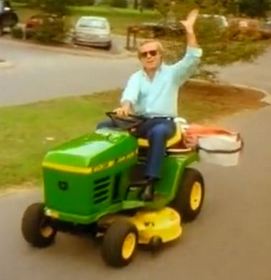
Sometime in the late summer of 1975, when I was seven, my father took the blade off a John Deere riding mower, and in a moment of whimsical decision, drove out of the yard, and onto the asphalt street where we lived. He rounded the corner, went a block, then proceeded out onto Grand Avenue, the wide main boulevard that cut through town, and kept on going.
He was wearing a sky blue zip-up workman’s jumpsuit. The cancer that would kill him in a year was already branching through his lungs. I can imagine him grinning and waving at the cars passing by, though at the time I was inside the house and didn’t see a thing.
I was right there, though, when the telephone rang and my mother answered it, to get an earful from a neighbor who was at once both amused and annoyed: “Miz Langston, do you know what your husband is doing?”
I remember my mother laughing, but I also remember being cognizant of the neighbor’s implication, however slight, that my father had crossed some kind of social boundary and had to be brought back into line.
There are several points I’d like to extrapolate from that story, from the simply temperamental to the aesthetic to the final, deadly serious question of how we live our faith before others—IF we do so, ever, at all. (And I’m speaking as a Christian here, but what I mean would, in the broader sense, apply to just about anyone.)
What I love about that story is what it says about my father’s sense of humor, of course, but also his sense of risk, his refusal to be measured by others. And how driving a Kermit-green riding mower through the middle of town was not some act of rebellion, some social point, but rather an expression of joy.
We are short on joy these days, I think, though we are not lacking in our passion for making social points.
To wit, here are two recent examples:
One: I was on an email thread (these are my churchy people) in which a parent said that she avoided letting her children be around some neighbors, “because they had voted for Obama.”
Two: I was sharing a meal with another set of intimates when I remarked casually that I had a friend (actually more than one) who worked for a libertarian nonprofit that receives funding from the famous Koch Brothers. And even though our entire table was composed of folks who would have considered themselves nonjudgmental and “open-minded,” there rose over the table an instant and audible hiss.
These kinds of reactions may just be the result of living in the DMV (District, Maryland, Virginia) bubble, but I doubt it. If anything, I suspect that out in the “real America” we locals are constantly reminded we do NOT live in, the divisions are even sharper—that it is possible to go around never encountering anyone with a different set of a priori assumptions or foundational narratives.
And increasingly, this is as much a reflection of race, class, or socioeconomics as it is values or religion.
It always blows my mind to see how progressives of a certain upper-middle-class stripe in Washington (other than in my very eclectic neighborhood, which I write about here) almost invariably know very little about the culture of African-Americans—not even the very affluent, professional suburban cohort that’s such a presence in Prince George’s County, Maryland where I live.
There’s a dismissiveness that gets shoveled around this city in conversational references to what happens over in PG. And that even relates to the older working-class Catholic white population of Prince George’s, from back in the day. There are students in Northwest D.C. private schools more comfortable devising irrigation systems for Lesotho than, say, driving on Branch Avenue out of town.
But this is not solely a problem of the DMV, but of all kinds of fragments of the culture: It strikes me that mainstream Episcopalians, Reform Jews, and Sunday-morning-yoga-studio-attending Nones have a lot more in common with one another than the Episcopalians do with Southern Baptists. Time was, it was possible, at least in the South, to meet a working-class Episcopalian, or a country club Southern Baptist. I love these kinds of walking cultural contradictions—and I haven’t seen one in years.
“Why are you so worried about people from different backgrounds having to be around one another? How come you are so stuck on that?” one of my brothers once asked me. Wasn’t it natural for people to want to be around the people who are like them?
Yes, of course. And yet to shrink into group-identity politics poses a danger—for everyone, I think, but especially so for those of us who call ourselves Christians: How easy it is, then, to miss the images of God, spread out so flagrantly and unexpectedly through the faces of the world—the ones we do not bother to know, and see.
And that is where the image of my father on the riding mower comes back to me: Not caring what anyone thought, having overcome the thought that other people might think him crazy.
Having opened himself to possibility, possibility opened itself to him. And on down, through the decades, to me.
To be continued tomorrow.
A native of Yazoo City, Mississippi, Caroline Langston is a convert to the Eastern Orthodox Church. She is a widely published writer and essayist, a winner of the Pushcart Prize, and a commentator for NPR’s “All Things Considered.”
Previous Post

April 4, 2014
The Notecards of Paradise: 25 Years of Image
Next Post
April 8, 2014 The Grace of the Unexpected, Part 2
Browse Our Archives
Select a Category A. G. Harmon Alissa Wilkinson Allison Backous Art Authors Brad Fruhauff Bradford Winters Bryan Bliss Caroline Langston Chad Thomas Johnston Chris Hoke Christiana N. Peterson Culture D.G. Myers D.L. Mayfield Daniel Bowman Jr. David Griffith Elizabeth Duffy Faith Film Greg Wolfe Guest Contributor Interview Jan Vallone Jeffrey Overstreet Jessica Eddings-Roeser Jessica Mesman Griffith Kelly Foster Lindsey Crittenden Morgan Meis music Natalie Vestin Nick Olson Peggy Rosenthal Personal Reflection Poetry Friday Reflection Relationships Review Richard Chess Richard Cole Sara Zarr Shannon Huffman Polson Sonya Bilocerkowycz Tania Runyan Tony Woodlief Topical Categories Uncategorized Vic Sizemore Writing
Select a Month October 2018 September 2018 August 2018 July 2018 June 2018 May 2018 April 2018 March 2018 February 2018 January 2018 December 2017 November 2017 October 2017 September 2017 August 2017 July 2017 June 2017 May 2017 April 2017 March 2017 February 2017 January 2017 December 2016 November 2016 October 2016 September 2016 August 2016 July 2016 June 2016 May 2016 April 2016 March 2016 February 2016 January 2016 December 2015 November 2015 October 2015 September 2015 August 2015 July 2015 June 2015 May 2015 April 2015 March 2015 February 2015 January 2015 December 2014 November 2014 October 2014 September 2014 August 2014 July 2014 June 2014 May 2014 April 2014 March 2014 February 2014 January 2014 December 2013 November 2013 October 2013 September 2013 August 2013 July 2013 June 2013 May 2013 April 2013 March 2013 February 2013 January 2013 December 2012 November 2012 October 2012 September 2012 August 2012 July 2012 June 2012 May 2012 February 2008
Follow Us!
TAKE THE
Religious Wisdom Quiz
How was the crossing of the Jordan similar to the crossing of the Red Sea?
Select your answer to see how you score.
A great wind caused the event The people walked on stones It happened at night The waters were parted
Related posts from Good Letters


Leonard Cohen’s Holy and Broken Hallelujah

Ready or Not for the Days of Awe

TRENDING AT PATHEOS Catholic

Rejecting Doom: Christian Hope And Human Action
Christianity is a religion of hope. We are to have hope and...

It’s What Comes From Within Which Matters
One of the most difficult things for us to understand is why...

Why I Choose the Eucharist Over the Sermon
Choose the Eucharist, Not the Sermon What are we supposed to get...

5 Design Elements Found in Spiritually Rooted Homes
Putting Spirituality Into Home Decor Our homes are more than our living...

Credo: A Story of God Told with the...
About 10 years ago, I began to imagine a personal "Credo" that...

The Anatomy of Divine Revelation in Catholic Thought
The claim that God has made Himself known to human beings is...
view all Catholic blogs
Ad-Free & Subscriber Log-In Subscription Support
- About Us
- 2026 Calendar
- Videos
- Podcasts
- Library of World Religions
- Faith In Media Tracker
- Advertise With Us
- Write for Us
- Privacy Policy
- Terms of Service
- Do Not Sell My Data
- Contact Us
- Radiant Digital
- Manage Newsletter Subscriptions
- Unsubscribe From Notifications
- Sitemap
Copyright 2008-2026, Patheos. All rights reserved.
Subscription Support Ad-Free & Subscriber Log-In
Follow Patheos