
BuddhistCatholicContemplativeEvangelicalGeneral ChristianHinduJewishLatter-day SaintMuslimNew VisionsProgressive Christian
Beliefs
- Buddhist
- Catholic
- Contemplative
- Evangelical
- General Christian
- Hindu
- Jewish
- Latter-day Saint
- More Voices
- Muslim
- New Visions
- Pagan
- Progressive Christian
Topics
- Religion News
- Food and Religion
- Sports and Religion
- Religious Art
- Religious Music and Entertainment
- Religious Events
- History and Religion
- Style and Religion
- Politics and Religion
- Women in Religion
- Recreation Outdoors and Religion
- Business Finance and Religion
- Careers Workplace and Religion
- Education and Religion
- Family Parenting and Religion
- Health Fitness and Religion
- Home and Religion
- Relationships and Religion
- Technology and Religion
- Travel and Religion
Columnists
- Buddhist Columnists
- Business Finance and Religion Columnists
- Careers Workplace and Religion Columnists
- Catholic Columnists
- Contemplative Columnists
- Education and Religion Columnists
- Evangelists Columnists
- Family Parenting and Religion Columnists
- General Christian Columnists
- Health Fitness and Religion Columnists
- Hindu Columnists
- History and Religion Columnists
- Home and Religion Columnists
- Jewish Columnists
- More Voices Columnists
- Latter Day Columnists
- Muslim Columnists
- New Visions Columnists
- Nonreligious Columnists
- Pagan Columnists
- Politics and Religion Columnists
- Progressive Columnists
- Recreation Outdoors and Religion Columnists
- Relationships and Religion Columnists
- Religion News Columnists
- Religious Art Columnists
- Religious Events Columnists
- Religious Music and Entertainment Columnists
- Sports and Religion Columnists
- Style and Religion Columnists
- Technology and Religion Columnists
- Travel and Religion Columnists
- Women in Religion Columnists
Resource Library
- 2026 Calendar
- Library of World Religions
- The 100 Most Holy Places on Earth
- Patheos Answers
- Podcasts
- Videos
- Faith Leaders Database
- Anglican Episcopalian
- Bahai
- Baptist
- Buddhism
- Christianity
- Confucianism
- Eastern Orthodoxy
- Hinduism
- Holiness and Pentecostal
- ISKCON
- Islam
- Judaism
- Lutheran
- Methodist
- The Church of Jesus Christ of Latter-day Saints
- New Age
- Paganism
- Presbytarian and Reformed
- Protestantism
- Religion Behind the Scenes
- Roman Catholic
- Scientology
- Shia Islam
- Sikhism
- Sufism
- Sunni Islam
- Taoism
- Zen
- See all religions
Research Tools
 Ad-Free & Subscriber Log-In Subscription Support
Ad-Free & Subscriber Log-In Subscription Support
Follow Patheos 

- Trending:
- Forgiveness
- |
- Marriage
- |
- Consciousness
- |
- Death Penalty
- |
- Election
- |
- Halloween
 Good Letters
-
Contributors
- Home
- Catholic
- Oasis: An Observation from The Way of Saint James
Oasis: An Observation from The Way of Saint James
Last updated on: July 29, 2014 at 9:27 am by Jan Vallone
Oasis: An Observation from The Way of Saint James 2014-07-29T09:27:50-07:00 Jan Vallone
Patheos Explore the world's faith through different perspectives on religion and spirituality! Patheos has the views of the prevalent religions and spiritualities of the world.
I almost passed it by.
When the offer came in January, I was too busy teaching college writing. Too busy mentoring a student group. Too busy reading for three book clubs. Too busy writing for a blog. Too busy marketing my memoir. Too busy caring for my family, cat, and home.
Maybe I could do it in the summer. More realistically, maybe in the fall.
But the director of the Mental Health Ministry persisted. She described the new program she envisioned at Seattle’s Saint James Cathedral and hoped I’d facilitate: a weekly creative writing workshop for people suffering from painful life events—the death of a loved one, the loss of a job, the effects of abuse, disability, or disease. A workshop where participants could share their stories, order their thoughts, release repressed emotions, begin to heal their grief. A workshop starting February sixth.
To be honest, the prospect was intriguing. For years I’d longed to teach creative writing, something I’d earned a masters degree in, something I’d done when I taught high school. How I’d loved teaching teens to write their stories. Doing so had been more priceless than rubies, more rousing than sunshine, more comfortable than fleece.
The high school students and I became close through our writing endeavors—reading, critiquing, affirming, revising until the stories sang. We became a community of colleagues, one that delighted and fulfilled me, one I hadn’t found a substitute for in the six years since I’d lost that job.
Maybe the cathedral writing group could fill the chasm in my heart that loss had cleaved. But at the time the opportunity was offered, I was overextended, my days packed with obligations from which I couldn’t extricate myself.
Maybe in the summer. Maybe in the fall. The timing simply wasn’t right to make my way to Saint James.
In fact, I’d just made my way to Saint James, although in a very different manner, one not involving teaching in Seattle, but instead perambulating Spain.
El Camino de Santiago—The Way of Saint James—is a pilgrimage to Santiago de Compostela, where according to tradition, the apostle James the Greater is interred. Each year 200,000 pilgrims walk there on a variety of routes. The most travelled is 500 miles long and starts five miles from the Spanish border in the Pyrenean foothills of France, but some pilgrims walk from farther points—Paris, Rome, Munich—others from spots nearer Santiago—Burgos, León, Samos. Last September my husband and I joined them, trekking 200 miles from León.
Walking the Camino is a metaphor for living life. Head sheathed from blazing sun, blisters burning in boots, back bent under heavy pack, to succeed you have to strip possessions to essentials—a single change of clothes, a sleeping sheet and toothbrush, sunscreen and a pair of sturdy shoes—and you have to limit each day’s tasks to a necessary few—walking scores of miles, eating, washing underwear, bathing, sleeping, repacking your bag.
With little to distract you on the way but the crunching of your soles on gravel and the susurration of your breath, you synchronize with an inner rhythm you likely never realized you possessed. That rhythm hypnotizes you. You become so high on endorphins, fresh air, exhaustion, that your mind seems to detach from your body, rise above your head, and hover in the ether, enabling you to observe yourself.
You learn that the mistakes you make on the Camino mirror are those you make generally in life. And you begin to understand how to avoid them.
Or so it was for me. Take, for example, our first day, when we walked from León to Hospital de Órbigo, a distance of twenty-three miles, a trek of ten hours.
We began early in the morning on Puente Río Bernesga, a Roman bridge that spans a river running through the outskirts of León. After winding through the city suburbs, we came to the open countryside known as the Páramo Leonés. The topography of this region is one of the flattest in Spain, having been generated by alluvial deposits millions of years ago. Hot, dusty, desolate, these dry grasslands bereft of trees and breeze extend as far as you can see.
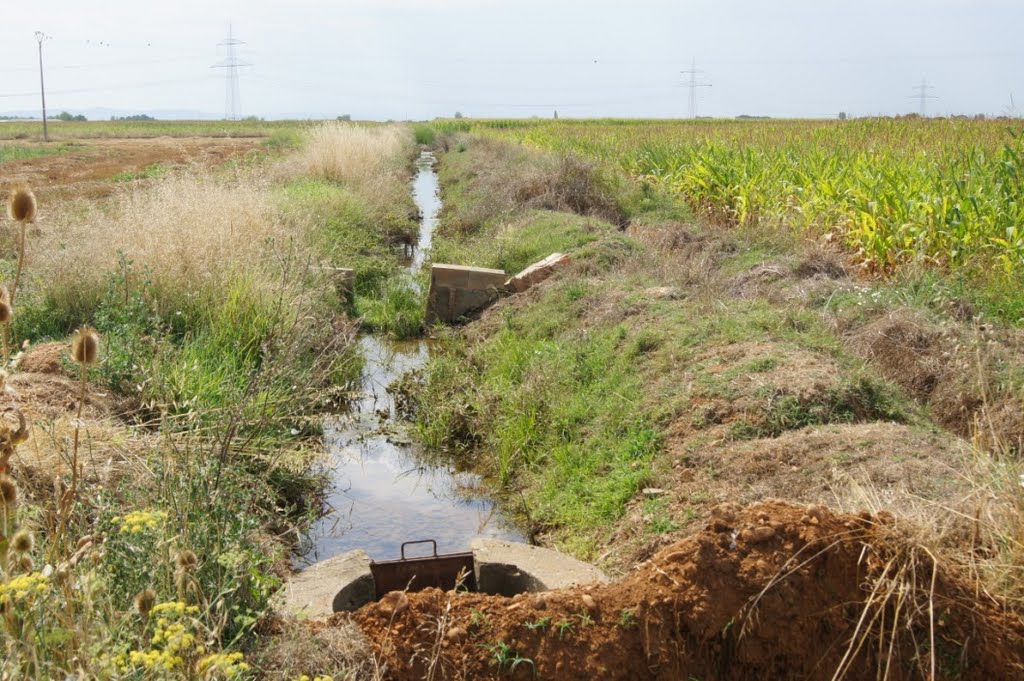
By the time we’d walked six hours on the trail, my skin was sunburned, my tongue was parched, my legs and back were collapsing. I wanted to quit the Camino. But suddenly we came upon a cornfield traversed by an irrigation channel that brimmed with brightly babbling water. It looked to be everything I needed, a perfect oasis edged by wildflowers, buttressed by a low stone wall, and shaded by a broad Holm oak.
“Mark,” I said to my husband. “I need to sit and rest.”
He looked at his watch. “It’s not time yet. Half-an-hour more. You can do it. It’s only two thirty.”
He was right. We’d scheduled our break for three o’clock. So I heaved my pack higher on my shoulders, grunted, and trudged on.
A mistake I often make in life.
Thirty minutes later, we took our break, the oasis far behind us. Squatting on a dusty roadside in the scathing sun, lizards darting over my boot-tips, flies buzzing round my head, I sipped some water from a plastic bottle and pictured the verdant spot we’d bypassed. I began to cry.
This is why I decided to teach writing at Saint James beginning in the dead of winter. No, the timing wasn’t perfect. But if I had waited I’d have missed the chance to do work that’s proved delightful. If I’d delayed I’d have missed becoming part of a group that’s growing close. If I had passed it by I’d have missed an oasis that’s refreshed me for my other tasks.
Once a man met Jesus on the way to Jerusalem. Jesus said to him, “Come with me,” but the man said, “Let me first go bury my father.”
I hope the man avoided that mistake.
When you encounter an oasis on the way, stop and set down your pack.
Jan Vallone is the author of Pieces of Someday: One Woman’s Search for Meaning in Lawyering Family, Italy, Church, and a Tiny Jewish High School,which was released in December, 2013, and has won the Reader Views Reviewers’ Choice Award. Her stories have appeared in The Seattle Times, Good Letters, Faith & Values in the Public Square, Catholic Digest, Guideposts Magazine, English Journal, Chicken Soup for the Soul, and Writing it Real. She teaches writing and literature at Seattle Pacific University.
Previous Post

April 14, 2014
New Plagues This Passover
Next Post
April 16, 2014 25 Years of Image, 18 of Glen Workshops
Browse Our Archives
Select a Category A. G. Harmon Alissa Wilkinson Allison Backous Art Authors Brad Fruhauff Bradford Winters Bryan Bliss Caroline Langston Chad Thomas Johnston Chris Hoke Christiana N. Peterson Culture D.G. Myers D.L. Mayfield Daniel Bowman Jr. David Griffith Elizabeth Duffy Faith Film Greg Wolfe Guest Contributor Interview Jan Vallone Jeffrey Overstreet Jessica Eddings-Roeser Jessica Mesman Griffith Kelly Foster Lindsey Crittenden Morgan Meis music Natalie Vestin Nick Olson Peggy Rosenthal Personal Reflection Poetry Friday Reflection Relationships Review Richard Chess Richard Cole Sara Zarr Shannon Huffman Polson Sonya Bilocerkowycz Tania Runyan Tony Woodlief Topical Categories Uncategorized Vic Sizemore Writing
Select a Month October 2018 September 2018 August 2018 July 2018 June 2018 May 2018 April 2018 March 2018 February 2018 January 2018 December 2017 November 2017 October 2017 September 2017 August 2017 July 2017 June 2017 May 2017 April 2017 March 2017 February 2017 January 2017 December 2016 November 2016 October 2016 September 2016 August 2016 July 2016 June 2016 May 2016 April 2016 March 2016 February 2016 January 2016 December 2015 November 2015 October 2015 September 2015 August 2015 July 2015 June 2015 May 2015 April 2015 March 2015 February 2015 January 2015 December 2014 November 2014 October 2014 September 2014 August 2014 July 2014 June 2014 May 2014 April 2014 March 2014 February 2014 January 2014 December 2013 November 2013 October 2013 September 2013 August 2013 July 2013 June 2013 May 2013 April 2013 March 2013 February 2013 January 2013 December 2012 November 2012 October 2012 September 2012 August 2012 July 2012 June 2012 May 2012 February 2008
Follow Us!
TAKE THE
Religious Wisdom Quiz
Who said, "What is impossible with man is possible with God"?
Select your answer to see how you score.
Moses Jesus Peter Paul
Related posts from Good Letters

On Writing Odes: Taking Time to Celebrate


A Conversation with Barbara Brown Taylor
Sonnets in the Prime of My Life
TRENDING AT PATHEOS Catholic

The Parable Of The Sower And The Word...
One of Christ’s most famous parables is that of the sower who...

Rejecting Doom: Christian Hope And Human Action
Christianity is a religion of hope. We are to have hope and...

Why I Choose the Eucharist Over the Sermon
Choose the Eucharist, Not the Sermon What are we supposed to get...

5 Design Elements Found in Spiritually Rooted Homes
Putting Spirituality Into Home Decor Our homes are more than our living...

Credo: A Story of God Told with the...
About 10 years ago, I began to imagine a personal "Credo" that...

The Anatomy of Divine Revelation in Catholic Thought
The claim that God has made Himself known to human beings is...
view all Catholic blogs
Ad-Free & Subscriber Log-In Subscription Support
- About Us
- 2026 Calendar
- Videos
- Podcasts
- Library of World Religions
- Faith In Media Tracker
- Advertise With Us
- Write for Us
- Privacy Policy
- Terms of Service
- Do Not Sell My Data
- Contact Us
- Radiant Digital
- Manage Newsletter Subscriptions
- Unsubscribe From Notifications
- Sitemap
Copyright 2008-2026, Patheos. All rights reserved.
Subscription Support Ad-Free & Subscriber Log-In
Follow Patheos