
BuddhistCatholicContemplativeEvangelicalGeneral ChristianHinduJewishLatter-day SaintMuslimNew VisionsProgressive Christian
Beliefs
- Buddhist
- Catholic
- Contemplative
- Evangelical
- General Christian
- Hindu
- Jewish
- Latter-day Saint
- More Voices
- Muslim
- New Visions
- Pagan
- Progressive Christian
Topics
- Religion News
- Food and Religion
- Sports and Religion
- Religious Art
- Religious Music and Entertainment
- Religious Events
- History and Religion
- Style and Religion
- Politics and Religion
- Women in Religion
- Recreation Outdoors and Religion
- Business Finance and Religion
- Careers Workplace and Religion
- Education and Religion
- Family Parenting and Religion
- Health Fitness and Religion
- Home and Religion
- Relationships and Religion
- Technology and Religion
- Travel and Religion
Columnists
- Buddhist Columnists
- Business Finance and Religion Columnists
- Careers Workplace and Religion Columnists
- Catholic Columnists
- Contemplative Columnists
- Education and Religion Columnists
- Evangelists Columnists
- Family Parenting and Religion Columnists
- General Christian Columnists
- Health Fitness and Religion Columnists
- Hindu Columnists
- History and Religion Columnists
- Home and Religion Columnists
- Jewish Columnists
- More Voices Columnists
- Latter Day Columnists
- Muslim Columnists
- New Visions Columnists
- Nonreligious Columnists
- Pagan Columnists
- Politics and Religion Columnists
- Progressive Columnists
- Recreation Outdoors and Religion Columnists
- Relationships and Religion Columnists
- Religion News Columnists
- Religious Art Columnists
- Religious Events Columnists
- Religious Music and Entertainment Columnists
- Sports and Religion Columnists
- Style and Religion Columnists
- Technology and Religion Columnists
- Travel and Religion Columnists
- Women in Religion Columnists
Resource Library
- 2026 Calendar
- Library of World Religions
- The 100 Most Holy Places on Earth
- Patheos Answers
- Podcasts
- Videos
- Faith Leaders Database
- Anglican Episcopalian
- Bahai
- Baptist
- Buddhism
- Christianity
- Confucianism
- Eastern Orthodoxy
- Hinduism
- Holiness and Pentecostal
- ISKCON
- Islam
- Judaism
- Lutheran
- Methodist
- The Church of Jesus Christ of Latter-day Saints
- New Age
- Paganism
- Presbytarian and Reformed
- Protestantism
- Religion Behind the Scenes
- Roman Catholic
- Scientology
- Shia Islam
- Sikhism
- Sufism
- Sunni Islam
- Taoism
- Zen
- See all religions
Research Tools
 Ad-Free & Subscriber Log-In Subscription Support
Ad-Free & Subscriber Log-In Subscription Support
Follow Patheos 

- Trending:
- Forgiveness
- |
- Marriage
- |
- Consciousness
- |
- Death Penalty
- |
- Election
- |
- Halloween
 Good Letters
-
Contributors
- Home
- Catholic
- Keeping Up with the Writing Joneses
Keeping Up with the Writing Joneses
Last updated on: April 10, 2014 at 1:00 am by Tania Runyan
Keeping Up with the Writing Joneses 2014-04-08T15:40:23-07:00 Tania Runyan
Patheos Explore the world's faith through different perspectives on religion and spirituality! Patheos has the views of the prevalent religions and spiritualities of the world.
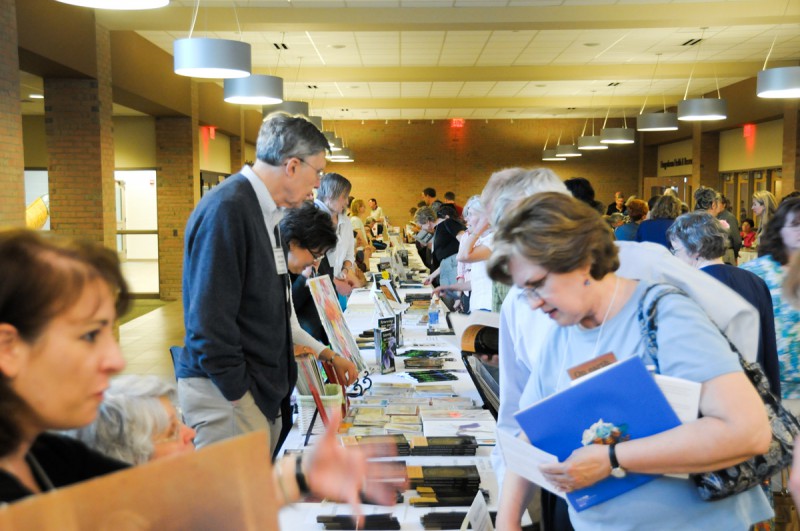 By the time this post runs, I’ll be in Grand Rapids at the Calvin Festival of Faith and Writing. Since I am now a mid-careerish, spiritually mature woman attending the event for the fourth time, I will certainly not embarrass myself by committing the following rookie atrocities*:
Forgetting Michigan is on Eastern Standard Time and becoming self-righteously flustered when I find out I’m late for the opening session because who does Michigan think she is, New York?
Introducing myself with “Vander” in front of my decidedly unDutch surname to get a laugh from all those Reformed folk.
Standing in line to talk to Greg Wolfe while trying to look like I’m not really standing in line, and when I get my turn, renewing my subscription to Image because I don’t know what else to say. Realizing that because of similar conference encounters, my issues should safely arrive through 2025.
Walking up to an editor busily unpacking boxes at her publisher’s table and thrusting a manuscript in her face because editors are hard up for manuscripts, desperately seek ways to fill their down time, and thrive on surprises.
Don’t get me wrong: the festival is not just about making an ass of yourself. I’ve met some of my best friends there in an almost eerie love-at-first-sight fashion. I’ve experienced the joy of walking into an auditorium to hear heroes I’ve already read widely, like Mary Karr and Parker Palmer, and wandering into sessions to discover fabulous new-to-me poets, like Robert Siegel and Barbara Crooker.
Most importantly, I’ve eaten lots of complimentary M&M’s at coffee breaks, and they seem to be injected with extra chocolate endorphins. Like the Olympiad, the period “between Calvins” is a time of remembrance and anticipation.
Yet underneath the festival, and, really, any event where two or more writers are gathered, simmers an undertone of anxiety. Anxiety about acceptance, security, jealousy, and competition. The angst doesn’t just come from the feelings themselves, but from knowing you have them in the first place, feeling guilty about them, and wondering if you will ever completely outgrow them.
Or maybe it’s just me.
While completing my MFA, all I wanted was to get a published. Finally, the summer after I graduated, I received an acceptance letter for a poem I had written about wildfires. For the six months or so until the issue came out, I felt secure and accomplished: I was going to be a published poet.
Then the issue arrived.
The typo was of the worst kind. My poem included the phrase “nervous half-sleep,” but the editors had printed “nervous half-sheep” instead. Need I describe the image? No, you already envisioned the jittery, dismembered beast for yourself.
So after that fiasco, I sought a “real” publication, one that didn’t make a mistake. (Half of them did.) Then I worked toward publication in journals with certain circulation numbers or recognizable names. I eventually hit those milestones but still didn’t feel validated as a poet.
A chapbook—with a real ISBN number!—is what I needed. Then I’d earn the label of “author.”
But not for long, because soon after the chapbook came out, people asked if I was working on an actual book next. And then I was plopping down $15-20 a pop for contests.
True, each accomplishment paves the way for the next. But those accomplishments buckle with botched contracts, textless spines, and Amazon rankings at #657,329,187. And for every book you publish, a thousand more look better, sell better, and win more awards. And even if you win most of the major awards available in this country, the majority of the population will never recognize your name.
But let’s say you remove the whole publication equation. You may feel truly satisfied with your numerous titles or not really care one way or another whether your work is in print. Can anything else trigger anxiety at a gathering of writers?
Yes. Oh, yes.
Do you have someone to eat lunch with? If not, why not? Why aren’t you better connected? What is wrong with you that you even care about connections? Don’t you care about people? Gosh, you’re a narcissist.
Should you regale the scholar with funny stories about your children to avoid talking about literary theory? Do you let on that you still haven’t read Moby Dick? Why do you always have basil in your teeth? What about the poet over there who is younger, prettier, and decked out with hipper earrings and scarves?
The eyes are never satisfied, Solomon says. He should know. He had a thousand wives and concubines. With each new woman, he probably believed, even in the smallest of ways, that this one—the one with the higher cheekbones, the softer wrists, or the thicker hair—would make all the difference.
A pastor once made a profound statement that has stayed with me longer than anything I’ve heard from the pulpit in fifteen years (although I obviously haven’t always heeded it): In the game of keeping up with the Joneses, let them win.
So this year, with God’s help, I am letting them win, all the writing Joneses out there. With his help, I am considering others better than myself. I am delighting in their laughter and quirks, their stories and poems, and their earrings and scarves, and worrying less about what they think of me. For when it comes right down to it, the “real” writing life is nothing more than scratching a pencil or clicking a keyboard in the still, silent room of God.
And that is more than enough.
*To read about more Festival atrocities, see TaniaVanderRunyan.com. For queries about her Image subscription subletting program, leave a comment below.
Tania Runyan is the author of the poetry collections Second Sky (Cascade Poiema Series), A Thousand Vessels, Simple Weight, and Delicious Air, which was awarded Book of the Year by the Conference on Christianity and Literature in 2007. Her book How to Read a Poem, an instructional guide based on Billy Collins’s “Introduction to Poetry,” was recently released by T.S. Poetry Press. Her poems have appeared in many publications, including Poetry, Image, Books & Culture, Harvard Divinity Bulletin, The Christian Century, Atlanta Review, Indiana Review, and the anthology In a Fine Frenzy: Poets Respond to Shakespeare. Tania was awarded an NEA Literature Fellowship in 2011. She tutors high school students and edits for Every Day Poems and Relief.
Calvin Festival of Faith and Writing
Previous Post

April 9, 2014
The Prodigal Bears His Scars
Next Post
April 11, 2014 Poetry at the Goodwill
Browse Our Archives
Select a Category A. G. Harmon Alissa Wilkinson Allison Backous Art Authors Brad Fruhauff Bradford Winters Bryan Bliss Caroline Langston Chad Thomas Johnston Chris Hoke Christiana N. Peterson Culture D.G. Myers D.L. Mayfield Daniel Bowman Jr. David Griffith Elizabeth Duffy Faith Film Greg Wolfe Guest Contributor Interview Jan Vallone Jeffrey Overstreet Jessica Eddings-Roeser Jessica Mesman Griffith Kelly Foster Lindsey Crittenden Morgan Meis music Natalie Vestin Nick Olson Peggy Rosenthal Personal Reflection Poetry Friday Reflection Relationships Review Richard Chess Richard Cole Sara Zarr Shannon Huffman Polson Sonya Bilocerkowycz Tania Runyan Tony Woodlief Topical Categories Uncategorized Vic Sizemore Writing
Select a Month October 2018 September 2018 August 2018 July 2018 June 2018 May 2018 April 2018 March 2018 February 2018 January 2018 December 2017 November 2017 October 2017 September 2017 August 2017 July 2017 June 2017 May 2017 April 2017 March 2017 February 2017 January 2017 December 2016 November 2016 October 2016 September 2016 August 2016 July 2016 June 2016 May 2016 April 2016 March 2016 February 2016 January 2016 December 2015 November 2015 October 2015 September 2015 August 2015 July 2015 June 2015 May 2015 April 2015 March 2015 February 2015 January 2015 December 2014 November 2014 October 2014 September 2014 August 2014 July 2014 June 2014 May 2014 April 2014 March 2014 February 2014 January 2014 December 2013 November 2013 October 2013 September 2013 August 2013 July 2013 June 2013 May 2013 April 2013 March 2013 February 2013 January 2013 December 2012 November 2012 October 2012 September 2012 August 2012 July 2012 June 2012 May 2012 February 2008
Follow Us!
TAKE THE
Religious Wisdom Quiz
How many chapters are in the book of Revelation?
Select your answer to see how you score.
30 12 24 22
Related posts from Good Letters

On Writing Odes: Taking Time to Celebrate


Poetry Friday: A Quick Interpretation of the Sixth...
TRENDING AT PATHEOS Catholic

Rejecting Doom: Christian Hope And Human Action
Christianity is a religion of hope. We are to have hope and...

It’s What Comes From Within Which Matters
One of the most difficult things for us to understand is why...

Why I Choose the Eucharist Over the Sermon
Choose the Eucharist, Not the Sermon What are we supposed to get...

5 Design Elements Found in Spiritually Rooted Homes
Putting Spirituality Into Home Decor Our homes are more than our living...

Credo: A Story of God Told with the...
About 10 years ago, I began to imagine a personal "Credo" that...

The Anatomy of Divine Revelation in Catholic Thought
The claim that God has made Himself known to human beings is...
view all Catholic blogs
Ad-Free & Subscriber Log-In Subscription Support
- About Us
- 2026 Calendar
- Videos
- Podcasts
- Library of World Religions
- Faith In Media Tracker
- Advertise With Us
- Write for Us
- Privacy Policy
- Terms of Service
- Do Not Sell My Data
- Contact Us
- Radiant Digital
- Manage Newsletter Subscriptions
- Unsubscribe From Notifications
- Sitemap
Copyright 2008-2026, Patheos. All rights reserved.
Subscription Support Ad-Free & Subscriber Log-In
Follow Patheos