
BuddhistCatholicContemplativeEvangelicalGeneral ChristianHinduJewishLatter-day SaintMuslimNew VisionsProgressive Christian
Beliefs
- Buddhist
- Catholic
- Contemplative
- Evangelical
- General Christian
- Hindu
- Jewish
- Latter-day Saint
- More Voices
- Muslim
- New Visions
- Pagan
- Progressive Christian
Topics
- Religion News
- Food and Religion
- Sports and Religion
- Religious Art
- Religious Music and Entertainment
- Religious Events
- History and Religion
- Style and Religion
- Politics and Religion
- Women in Religion
- Recreation Outdoors and Religion
- Business Finance and Religion
- Careers Workplace and Religion
- Education and Religion
- Family Parenting and Religion
- Health Fitness and Religion
- Home and Religion
- Relationships and Religion
- Technology and Religion
- Travel and Religion
Columnists
- Buddhist Columnists
- Business Finance and Religion Columnists
- Careers Workplace and Religion Columnists
- Catholic Columnists
- Contemplative Columnists
- Education and Religion Columnists
- Evangelists Columnists
- Family Parenting and Religion Columnists
- General Christian Columnists
- Health Fitness and Religion Columnists
- Hindu Columnists
- History and Religion Columnists
- Home and Religion Columnists
- Jewish Columnists
- More Voices Columnists
- Latter Day Columnists
- Muslim Columnists
- New Visions Columnists
- Nonreligious Columnists
- Pagan Columnists
- Politics and Religion Columnists
- Progressive Columnists
- Recreation Outdoors and Religion Columnists
- Relationships and Religion Columnists
- Religion News Columnists
- Religious Art Columnists
- Religious Events Columnists
- Religious Music and Entertainment Columnists
- Sports and Religion Columnists
- Style and Religion Columnists
- Technology and Religion Columnists
- Travel and Religion Columnists
- Women in Religion Columnists
Resource Library
- 2026 Calendar
- Library of World Religions
- The 100 Most Holy Places on Earth
- Patheos Answers
- Podcasts
- Videos
- Faith Leaders Database
- Anglican Episcopalian
- Bahai
- Baptist
- Buddhism
- Christianity
- Confucianism
- Eastern Orthodoxy
- Hinduism
- Holiness and Pentecostal
- ISKCON
- Islam
- Judaism
- Lutheran
- Methodist
- The Church of Jesus Christ of Latter-day Saints
- New Age
- Paganism
- Presbytarian and Reformed
- Protestantism
- Religion Behind the Scenes
- Roman Catholic
- Scientology
- Shia Islam
- Sikhism
- Sufism
- Sunni Islam
- Taoism
- Zen
- See all religions
Research Tools
 Ad-Free & Subscriber Log-In Subscription Support
Ad-Free & Subscriber Log-In Subscription Support
Follow Patheos 

- Trending:
- Forgiveness
- |
- Marriage
- |
- Consciousness
- |
- Death Penalty
- |
- Election
- |
- Halloween
 Good Letters
-
Contributors
- Home
- Catholic
- I Sing the Body Eclectic
I Sing the Body Eclectic
Last updated on: April 22, 2014 at 1:00 am by Bradford Winters
I Sing the Body Eclectic 2014-04-21T15:34:17-07:00 Bradford Winters
Patheos Explore the world's faith through different perspectives on religion and spirituality! Patheos has the views of the prevalent religions and spiritualities of the world.
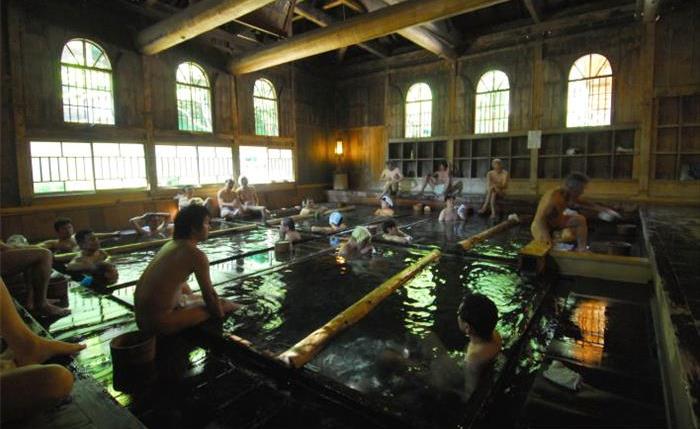 No doubt Walt Whitman would have sounded his barbaric yawp from the steaming rooftop pool of Spa Castle in Queens, had the multi-level Korean day spa been around the corner from his Brooklyn stomping grounds as it is today.
I’m not saying he would have retitled “Song of Myself” to “Song of Ourselves,” but I like to think that he might have been so inclined upon entering the ground-level indoor spa for the first time, onto a wondrous tiled cavern of heated pools, a sauna, steam room and cold plunge, open showers, a dousing shower, and sitting stations to shave or brush one’s teeth—with all manner of naked men roaming from one rite to the next.
(Women have their own identical spa on the ground level, the rest of the floors are unisex and require the oversized, undersexy shirt-and-shorts uniform found in the locker rooms.)
The first time I entered, before I even dipped my toe in the jasmine pool to test the temperature, I was already refreshed by the raw physical diversity that meets the eyes like a democratic antidote to the idolatrous fetishization of body type in today’s culture. Here was every shape and size, from tall to short and skinny to fat, from the comparatively hairless to bearlike monstrosities with throw rugs on their backs and big bushels of pubic hair; from those genetically endowed with a windsock for a penis, to those with a cigar stub.
In keeping with the no-fuss and semi-proletarian style of the place, a distinguishing Eastern feature unlike our more precious Western counterparts, the only question that attends all this anthropological and anatomical diversity is: Who cares?
At Spa Castle, where all the material trappings from the outside world that categorize us vanish in one’s digitized locker, no man is king more or less than any other, and no woman queen.
Recently, while in L.A. for work, a healthy combination of multiple deadlines and environmental road rage led me to Koreatown in search of a West Coast substitute. The subterranean pocket in a strip mall that I settled for was no castle, but it did the trick. It also gave occasion to some fitting meditation on the body in the last weeks of Lent before the dawn of Eastertide.
How is it that a religion like Christianity that stands on the bodily phenomena of the Incarnation and Resurrection, could, theologically speaking, often treat the human body with negligence at best and hostility at worst?
That’s a big question, and one I’m not prepared or qualified to answer here. No doubt a proper response would be a nuanced one filled with indications of the body given its celebratory due in theology. But still, ours is a religion prone to the chronic spiritual typo of “sin” and “skin.”
While most of us may not go to the same extreme as Lactantius, the early Church Father and advisor to Constantine who reviled “this contemptible little body in which we are draped,” all of us have likely struggled at one time and to one degree or another with how to regard our physical selves.
Let’s blame St. Paul, then, seeing what a favorite whipping post he is when it comes to our doctrinal inheritance. (Funny how such a dogmatic brute could be responsible for the most beloved passage on love ever written, read worldwide at weddings on a daily basis.) After all, doesn’t he condemn the body right there in Romans 7:18-19?
For I know that nothing good dwells within me, that is, in my flesh. I can will what is right, but I cannot do it. For I do not do the good I want, but the evil I do not want is what I do.
Well, no. Looks instead like he equates the flesh with the will. Elsewhere he equates the body with the temple of the Holy Spirit. And the Body of Christ—to tautological effect that should have removed any last doubt in the likes of the scholarly Lactantius—with the human body.
Those are some mighty metaphors. But I imagine I’m not alone in that for years I might as well have read that the body is not a temple but a Thermos, a repurposed coffee tin. Then I went back to read about the Temple and the Tabernacle in the Old Testament, about the extravagant glory that informed their design and decor. Like the glory of our own design, by way of Paul’s metaphor—we were “fearfully and wonderfully made” according to the author of Psalm 139.
Much doubt surrounds the provenance of the Gospel of Thomas, and the question of whether it’s a reliable source truly minted in the legacy of its apostolic namesake. But isn’t it fascinating that this infamous text of the Gnostic tradition, a belief system founded upon spiritual disdain for physical imprisonment in a human body, would contain this purported quote from Jesus:
If the body was made for the sake of the spirit, it is a miracle. But if the spirit was made for the sake of the body, it is a miracle of miracles.
While that might open a can of worms about primacy in the Temple-esque structure of our three-part being (spirit, soul and body), I find it hard not to respond with a qualified “Alleluia!” in this season of the Resurrection.
Four years ago my son was born on Good Friday, and when he first latched on to his mother’s breast I stood there amazed once again at what I had learned when our first daughter was born: that the aureole of tiny bumps around the female nipple emit the lingering scent of amniotic fluid from the womb to draw a newborn more by sense memory than by hunger.
Call it a hungry sense of home.
I guess it would make for another post entirely that the amnion has its etymological root in the Greek amnos, meaning “lamb.” Or, at least, an engaging conversation with my son at Spa Castle someday.
Bradford Winters is a screenwriter/producer in television whose work has included such series as Oz, Kings, Boss, and The Americans. His poems have appeared in Sewanee Theological Review, Spoon River Poetry Review, and Georgetown Review, among other journals. He lives in Brooklyn with his wife and three children.
Previous Post

April 21, 2014
An Hour Upon the Stage
Next Post
April 23, 2014 Crying Ocean
Browse Our Archives
Select a Category A. G. Harmon Alissa Wilkinson Allison Backous Art Authors Brad Fruhauff Bradford Winters Bryan Bliss Caroline Langston Chad Thomas Johnston Chris Hoke Christiana N. Peterson Culture D.G. Myers D.L. Mayfield Daniel Bowman Jr. David Griffith Elizabeth Duffy Faith Film Greg Wolfe Guest Contributor Interview Jan Vallone Jeffrey Overstreet Jessica Eddings-Roeser Jessica Mesman Griffith Kelly Foster Lindsey Crittenden Morgan Meis music Natalie Vestin Nick Olson Peggy Rosenthal Personal Reflection Poetry Friday Reflection Relationships Review Richard Chess Richard Cole Sara Zarr Shannon Huffman Polson Sonya Bilocerkowycz Tania Runyan Tony Woodlief Topical Categories Uncategorized Vic Sizemore Writing
Select a Month October 2018 September 2018 August 2018 July 2018 June 2018 May 2018 April 2018 March 2018 February 2018 January 2018 December 2017 November 2017 October 2017 September 2017 August 2017 July 2017 June 2017 May 2017 April 2017 March 2017 February 2017 January 2017 December 2016 November 2016 October 2016 September 2016 August 2016 July 2016 June 2016 May 2016 April 2016 March 2016 February 2016 January 2016 December 2015 November 2015 October 2015 September 2015 August 2015 July 2015 June 2015 May 2015 April 2015 March 2015 February 2015 January 2015 December 2014 November 2014 October 2014 September 2014 August 2014 July 2014 June 2014 May 2014 April 2014 March 2014 February 2014 January 2014 December 2013 November 2013 October 2013 September 2013 August 2013 July 2013 June 2013 May 2013 April 2013 March 2013 February 2013 January 2013 December 2012 November 2012 October 2012 September 2012 August 2012 July 2012 June 2012 May 2012 February 2008
Follow Us!
TAKE THE
Religious Wisdom Quiz
Who was Boaz's kinsman-redeemer?
Select your answer to see how you score.
Ruth Unnamed relative Elimelech Naomi
Related posts from Good Letters
Alleluia for the Easter Season

Pascha, the Resurrection, and Ricky Gervais
TRENDING AT PATHEOS Catholic

Rejecting Doom: Christian Hope And Human Action
Christianity is a religion of hope. We are to have hope and...

It’s What Comes From Within Which Matters
One of the most difficult things for us to understand is why...

Why I Choose the Eucharist Over the Sermon
Choose the Eucharist, Not the Sermon What are we supposed to get...

5 Design Elements Found in Spiritually Rooted Homes
Putting Spirituality Into Home Decor Our homes are more than our living...

Credo: A Story of God Told with the...
About 10 years ago, I began to imagine a personal "Credo" that...

The Anatomy of Divine Revelation in Catholic Thought
The claim that God has made Himself known to human beings is...
view all Catholic blogs
Ad-Free & Subscriber Log-In Subscription Support
- About Us
- 2026 Calendar
- Videos
- Podcasts
- Library of World Religions
- Faith In Media Tracker
- Advertise With Us
- Write for Us
- Privacy Policy
- Terms of Service
- Do Not Sell My Data
- Contact Us
- Radiant Digital
- Manage Newsletter Subscriptions
- Unsubscribe From Notifications
- Sitemap
Copyright 2008-2026, Patheos. All rights reserved.
Subscription Support Ad-Free & Subscriber Log-In
Follow Patheos