
BuddhistCatholicContemplativeEvangelicalGeneral ChristianHinduJewishLatter-day SaintMuslimNew VisionsProgressive Christian
Beliefs
- Buddhist
- Catholic
- Contemplative
- Evangelical
- General Christian
- Hindu
- Jewish
- Latter-day Saint
- More Voices
- Muslim
- New Visions
- Pagan
- Progressive Christian
Topics
- Religion News
- Food and Religion
- Sports and Religion
- Religious Art
- Religious Music and Entertainment
- Religious Events
- History and Religion
- Style and Religion
- Politics and Religion
- Women in Religion
- Recreation Outdoors and Religion
- Business Finance and Religion
- Careers Workplace and Religion
- Education and Religion
- Family Parenting and Religion
- Health Fitness and Religion
- Home and Religion
- Relationships and Religion
- Technology and Religion
- Travel and Religion
Columnists
- Buddhist Columnists
- Business Finance and Religion Columnists
- Careers Workplace and Religion Columnists
- Catholic Columnists
- Contemplative Columnists
- Education and Religion Columnists
- Evangelists Columnists
- Family Parenting and Religion Columnists
- General Christian Columnists
- Health Fitness and Religion Columnists
- Hindu Columnists
- History and Religion Columnists
- Home and Religion Columnists
- Jewish Columnists
- More Voices Columnists
- Latter Day Columnists
- Muslim Columnists
- New Visions Columnists
- Nonreligious Columnists
- Pagan Columnists
- Politics and Religion Columnists
- Progressive Columnists
- Recreation Outdoors and Religion Columnists
- Relationships and Religion Columnists
- Religion News Columnists
- Religious Art Columnists
- Religious Events Columnists
- Religious Music and Entertainment Columnists
- Sports and Religion Columnists
- Style and Religion Columnists
- Technology and Religion Columnists
- Travel and Religion Columnists
- Women in Religion Columnists
Resource Library
- 2026 Calendar
- Library of World Religions
- The 100 Most Holy Places on Earth
- Patheos Answers
- Podcasts
- Videos
- Faith Leaders Database
- Anglican Episcopalian
- Bahai
- Baptist
- Buddhism
- Christianity
- Confucianism
- Eastern Orthodoxy
- Hinduism
- Holiness and Pentecostal
- ISKCON
- Islam
- Judaism
- Lutheran
- Methodist
- The Church of Jesus Christ of Latter-day Saints
- New Age
- Paganism
- Presbytarian and Reformed
- Protestantism
- Religion Behind the Scenes
- Roman Catholic
- Scientology
- Shia Islam
- Sikhism
- Sufism
- Sunni Islam
- Taoism
- Zen
- See all religions
Research Tools
 Ad-Free & Subscriber Log-In Subscription Support
Ad-Free & Subscriber Log-In Subscription Support
Follow Patheos 

- Trending:
- Forgiveness
- |
- Marriage
- |
- Consciousness
- |
- Death Penalty
- |
- Election
- |
- Halloween
 Good Letters
-
Contributors
- Home
- Catholic
- Beauty’s Victory
Beauty’s Victory
Last updated on: July 20, 2015 at 12:42 pm by A. G. Harmon
Beauty’s Victory 2015-07-20T12:42:21-07:00 A. G. Harmon
Patheos Explore the world's faith through different perspectives on religion and spirituality! Patheos has the views of the prevalent religions and spiritualities of the world.
 I go on binges. For days, weeks, months—well, usually not months—but days and weeks anyhow, I get taken by something and it will be all that interests me for a while. I’ll plunge into Faulkner for a time, then breach, crest, and fall into Graham Greene.
Things don’t stay all that highbrow, either; I’m as apt to watch Duck Dynasty marathons as I am to read books. Then again, I might forswear all such pursuits and go into serious training to beat the last five folks who’ve registered their bragging rights on the gym treadmill.
I was well into an Anthony Burgess tear not long back before I got pulled off on another line. This time it was Nabokov. It started around Christmas and picked up when the holidays were over.
After Lolita (and the movie version), Pale Fire, The Defense (that movie version too—called The Luzhin Defence) and Pnin—which you have to re-read and ask yourself why you didn’t see X before, or notice Y—I stumbled upon an essay in the March 2014 edition of First Things by David Bentley Hart, entitled Nabokov’s Supernatural Secret.
I’d known about the author’s interest in the world of chess, for which he enjoyed constructing elaborate problems. I knew about his fascinating malady (if you can call it that), synesthesia¸ which makes a person see numbers, and sometimes letters, as colors. I also knew about Nabokov’s deep, lifelong pursuit of insects, particularly moths and butterflies. But what I learned from the essay was an inkling of perhaps what most attracted the writer to these things.
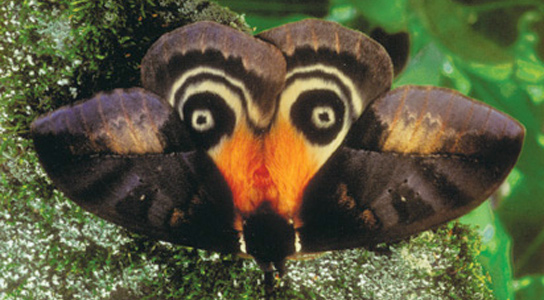
He was captivated with mimicry, says Hart, especially when nature went far beyond what “evolutionary imperatives” demanded—for example, when a butterfly’s shape and color mimicked more than just a beautiful leaf, but threw in amazing recreations of “grub-bored holes”—an extravagance that defied the level of defense that natural selection would require. Surely the praying mantis isn’t so visually adept that the shadings of the grub holes must come within a million degrees of similarity.
For Nabokov, this amounted to “a constant victory of the beautiful over the needful in nature.” In the “specular harmonies and morphological allusions that passed between species…he believed he had found signs of something like a conjuror’s pleasure in complex illusions. ‘I discovered in nature,’” he wrote, “‘the nonutilitarian delights that I sought in art. Both were a form of magic, both were a game of intricate enchantment and deception.’”
What seemed just outside the borders of nature, and just outside the frame of Nabokov’s art, was the realm of the spirits. That is the context, suggests Hart, lying behind the artist’s world, the one that surrounds it with a spectral luminescence—as quiet as sunlight falling, but just as bright and warm.
The man never spoke of such things, and seemed to find any overt commentary or expression to be distasteful. But it goes some ways towards accounting for the strangeness of his tales. The land of the souls, and their influence on the living, is never far from his imaginative universe. Sometimes his characters burst through the paper world in which they live and enter that land, like a Platonic prisoner finally free of his mortal chains, one who turns from the shadow-playing wall, faces the form-dancing fire. See Bend Sinister, for example.
I think Hart’s line that strikes me as the most resonant is this one: “the victory of the beautiful over the needful*.*” That is perhaps the best articulation of something that lurks behind the suspicions of even the most die-hard empiricists and materialists.
Why the beautiful? At least, why this much beauty? Why the luxury of it all? Why the splendor? There is a need in life, yes—to be protected, to be satisfied—nature serves us there. But to be awed? What need we of that?
To quote another great artist, Shakespeare has Lear answer his utilitarian-minded daughters’ insistence that he “needs not” the number of retainers that he enjoys, not when their own men could serve him just as well. Considering their household staffs, he needs not one hundred men, not fifty, not ten, not even one—or so they say.
“Reason not the need,” he replies.
Our basest beggars
Are in the poorest thing superfluous.
Allow not nature more than nature needs,
Man’s life’s as cheap as beast’s.
Aye, there’s the rub. Superfluity. The thing that captivated Shakespeare, Hopkins, a host of others—and Nabokov among them. But then, how could it not captivate a man for whom 5 looked red, and for whom the chrysalis was pregnant with the noumenon?
There is something about the inefficiency of beauty that speaks against the strategies of the purely empirical. I was never convinced by Dawkins’ Selfish Gene claim that all our poetry, our sacrifices and mercies, are merely a sinister plot to get our chromosomes a few more years on the materialist clock.
If you behold the icy majesty of Everest, the blustery effusion of Bridal Veil Falls—for that matter, if you ponder the vastness of an eternal space, one that expands to a point where blackness cracks its own sinews, or one that contracts to a point that blood swallows its own cells—this flood of plenitude resounds all the more. For beauty does not seek its adequate, proportionate level. It is not like water that will find a place to lie flat, or a temperature at which to freeze or boil. It always exceeds the mark; indeed, if it did not, would we even call it beauty?
So for me, a Nabokovian apostle, it just seems too simple, too reductionist, too stubborn, all in all, to defy the glories of the butterfly. It seems unwise to attribute its mimicry to nothing more than device—to blind oneself to the shimmering profligacy, to the reckless lavishness, to the spendthrift excess of a world far, far, more beautiful than it really need be.
This post was made possible through the support of a grant from The BioLogos Foundation’s Evolution and Christian Faith program. The opinions expressed are those of the author and do not necessarily reflect the views of BioLogos.
A.G. Harmon teaches Shakespeare, Law and Literature, Jurisprudence, and Writing at The Catholic University of America in Washington, D.C. His novel, A House All Stilled, won the 2001 Peter Taylor Prize for the Novel.
Previous Post

April 2, 2014
Against Gratitude
Next Post
April 4, 2014 The Notecards of Paradise: 25 Years of Image
Browse Our Archives
Select a Category A. G. Harmon Alissa Wilkinson Allison Backous Art Authors Brad Fruhauff Bradford Winters Bryan Bliss Caroline Langston Chad Thomas Johnston Chris Hoke Christiana N. Peterson Culture D.G. Myers D.L. Mayfield Daniel Bowman Jr. David Griffith Elizabeth Duffy Faith Film Greg Wolfe Guest Contributor Interview Jan Vallone Jeffrey Overstreet Jessica Eddings-Roeser Jessica Mesman Griffith Kelly Foster Lindsey Crittenden Morgan Meis music Natalie Vestin Nick Olson Peggy Rosenthal Personal Reflection Poetry Friday Reflection Relationships Review Richard Chess Richard Cole Sara Zarr Shannon Huffman Polson Sonya Bilocerkowycz Tania Runyan Tony Woodlief Topical Categories Uncategorized Vic Sizemore Writing
Select a Month October 2018 September 2018 August 2018 July 2018 June 2018 May 2018 April 2018 March 2018 February 2018 January 2018 December 2017 November 2017 October 2017 September 2017 August 2017 July 2017 June 2017 May 2017 April 2017 March 2017 February 2017 January 2017 December 2016 November 2016 October 2016 September 2016 August 2016 July 2016 June 2016 May 2016 April 2016 March 2016 February 2016 January 2016 December 2015 November 2015 October 2015 September 2015 August 2015 July 2015 June 2015 May 2015 April 2015 March 2015 February 2015 January 2015 December 2014 November 2014 October 2014 September 2014 August 2014 July 2014 June 2014 May 2014 April 2014 March 2014 February 2014 January 2014 December 2013 November 2013 October 2013 September 2013 August 2013 July 2013 June 2013 May 2013 April 2013 March 2013 February 2013 January 2013 December 2012 November 2012 October 2012 September 2012 August 2012 July 2012 June 2012 May 2012 February 2008
Follow Us!
TAKE THE
Religious Wisdom Quiz
What New Testament letter includes the "fruit of the Spirit"?
Select your answer to see how you score.
James Hebrews Ephesians Galatians
Related posts from Good Letters

The Crown and Victoria: Tales of Two Queens


TRENDING AT PATHEOS Catholic

Rejecting Doom: Christian Hope And Human Action
Christianity is a religion of hope. We are to have hope and...

It’s What Comes From Within Which Matters
One of the most difficult things for us to understand is why...

Why I Choose the Eucharist Over the Sermon
Choose the Eucharist, Not the Sermon What are we supposed to get...

5 Design Elements Found in Spiritually Rooted Homes
Putting Spirituality Into Home Decor Our homes are more than our living...

Credo: A Story of God Told with the...
About 10 years ago, I began to imagine a personal "Credo" that...

The Anatomy of Divine Revelation in Catholic Thought
The claim that God has made Himself known to human beings is...
view all Catholic blogs
Ad-Free & Subscriber Log-In Subscription Support
- About Us
- 2026 Calendar
- Videos
- Podcasts
- Library of World Religions
- Faith In Media Tracker
- Advertise With Us
- Write for Us
- Privacy Policy
- Terms of Service
- Do Not Sell My Data
- Contact Us
- Radiant Digital
- Manage Newsletter Subscriptions
- Unsubscribe From Notifications
- Sitemap
Copyright 2008-2026, Patheos. All rights reserved.
Subscription Support Ad-Free & Subscriber Log-In
Follow Patheos