
BuddhistCatholicContemplativeEvangelicalGeneral ChristianHinduJewishLatter-day SaintMuslimNew VisionsProgressive Christian
Beliefs
- Buddhist
- Catholic
- Contemplative
- Evangelical
- General Christian
- Hindu
- Jewish
- Latter-day Saint
- More Voices
- Muslim
- New Visions
- Pagan
- Progressive Christian
Topics
- Religion News
- Food and Religion
- Sports and Religion
- Religious Art
- Religious Music and Entertainment
- Religious Events
- History and Religion
- Style and Religion
- Politics and Religion
- Women in Religion
- Recreation Outdoors and Religion
- Business Finance and Religion
- Careers Workplace and Religion
- Education and Religion
- Family Parenting and Religion
- Health Fitness and Religion
- Home and Religion
- Relationships and Religion
- Technology and Religion
- Travel and Religion
Columnists
- Buddhist Columnists
- Business Finance and Religion Columnists
- Careers Workplace and Religion Columnists
- Catholic Columnists
- Contemplative Columnists
- Education and Religion Columnists
- Evangelists Columnists
- Family Parenting and Religion Columnists
- General Christian Columnists
- Health Fitness and Religion Columnists
- Hindu Columnists
- History and Religion Columnists
- Home and Religion Columnists
- Jewish Columnists
- More Voices Columnists
- Latter Day Columnists
- Muslim Columnists
- New Visions Columnists
- Nonreligious Columnists
- Pagan Columnists
- Politics and Religion Columnists
- Progressive Columnists
- Recreation Outdoors and Religion Columnists
- Relationships and Religion Columnists
- Religion News Columnists
- Religious Art Columnists
- Religious Events Columnists
- Religious Music and Entertainment Columnists
- Sports and Religion Columnists
- Style and Religion Columnists
- Technology and Religion Columnists
- Travel and Religion Columnists
- Women in Religion Columnists
Resource Library
- 2026 Calendar
- Library of World Religions
- The 100 Most Holy Places on Earth
- Patheos Answers
- Podcasts
- Videos
- Faith Leaders Database
- Anglican Episcopalian
- Bahai
- Baptist
- Buddhism
- Christianity
- Confucianism
- Eastern Orthodoxy
- Hinduism
- Holiness and Pentecostal
- ISKCON
- Islam
- Judaism
- Lutheran
- Methodist
- The Church of Jesus Christ of Latter-day Saints
- New Age
- Paganism
- Presbytarian and Reformed
- Protestantism
- Religion Behind the Scenes
- Roman Catholic
- Scientology
- Shia Islam
- Sikhism
- Sufism
- Sunni Islam
- Taoism
- Zen
- See all religions
Research Tools
 Ad-Free & Subscriber Log-In Subscription Support
Ad-Free & Subscriber Log-In Subscription Support
Follow Patheos 

- Trending:
- Forgiveness
- |
- Marriage
- |
- Consciousness
- |
- Death Penalty
- |
- Election
- |
- Halloween
 Good Letters
-
Contributors
- Home
- Catholic
- Scott Cairns and his Idiot Psalms
Scott Cairns and his Idiot Psalms
Last updated on: March 20, 2014 at 1:00 am by Guest Contributor
Scott Cairns and his Idiot Psalms 2014-03-20T00:45:11-07:00 Guest Contributor
Patheos Explore the world's faith through different perspectives on religion and spirituality! Patheos has the views of the prevalent religions and spiritualities of the world.
 Guest Post
By Angela Doll Carlson
W.H. Auden has said, “A poet is, before anything else, a person who is passionately in love with language.” Nowhere is this more evident than in the work of Scott Cairns. Whether they are the words from his poem, “Loves”:
I have kissed
his feet. I have looked long
into the trouble of his face
Or those he’s translated and adapted from the writings of the early saints in Endless Life:
The soul that looks
finally to God, conceives
a new mouth-watering
desire for His eternal beauty
Cairns’s work is at once embodied and ethereal, finding its roots in the ancient soil of rich language and reaching its branches into the lives of the common man. His poems greet the reader with a familiarity that allows the poet to draw us ever nearer so that at any moment he might whisper one great truth into the ear.
Beginning with Theology of Doubt in 1985, Scott Cairns has published a strong body of work, including stunning volumes of poetry such as Recovered Body, Compass of Affection, and Endless Life: Poems of the Mystics as well as his memoir, Short Trip to the Edge, a work that provides gracious insight into the poet’s journey into Eastern Orthodoxy.
If poetry, as Edgar Allen Poe suggests, “is the rhythmical creation of beauty in words” then Scott Cairns’s work makes this manifest.
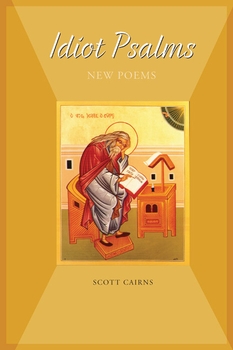
His latest book of poetry, Idiot Psalms from Paraclete Press drops effortlessly into that empty spot in the modern literary landscape that seems to have been waiting for its next taste of beauty. I’m honored to have had the opportunity to interview Cairns in the wake of its release.
Angela Doll Carlson: I ran across this quote from William Ernest Henley recently: “Essayists, like poets, are born and not made, and for one worth remembering, the world is confronted with a hundred not worth reading.” Would you agree that poets are born, not made?
Scott Cairns: I don’t really have a strong opinion about this, save my strong opinion that—regardless of how poets and essayists come to be—the issue of their being worth reading has far more to do with their manifesting the hard work of having read widely and well than it has to do with any genetic disposition. In my experience, the literary artist is first of all a reader. I’m talking about the necessary work of engaging the conversation before one presumes to enter it.
ADC: Not long ago my thirteen-year-old son asked why I’d buy a “whole book of poetry” when it was just one poem that caught my attention and it seemed to me that in this iTunes-kind of art-getting environment, that has to feel daunting to the publishing poet. Have you encountered this?
SC: Your son is not alone, nor is this an especially new phenomenon brought about by iTunes only. Even when I was in high school and college, most literary study of poetry focused upon single poems or those small samplings found in poetry anthologies, as opposed to poetry collections. This, of course, does not introduce a young reader to the primary artifact of poetry, which is the slim volume, the poet’s carefully constructed collection of poems.
Parents and guardians, then, need to help the young reader become acquainted with the actual artifacts of a given discipline. And it’s important that readers experience the larger context within which a discrete poem performs its work. Ideally, that young reader will stick with it long enough to see how even the single poetry collection is in conversation with that poet’s other collections, and also how that poet’s entire work is in conversation with the larger bodies of American, English, and international poetries.
ADC: You’ve been teasing out these Idiot Psalms, tucking them into readings here and there. It feels as though it took a long time for this collection to surface in book form? Is that right or is it just my own impatience at work?
SC: You’re right. Since 1985, I’ve put out a new collection every four or five years. This new book follows Compass of Affection, which came out in late 2006, which means Idiot Psalms has been nearly eight years in the making. Also since 2006, however, I’ve been working on other projects, the memoir, essays, a theological book, and a scattering of translations. To some extent, then, the poems took a back seat to the other projects for good spans of time during those eight years.
ADC: As I read through Idiot Psalms I’m tempted to say after every poem, “No, now…this is my favorite.” It feels more eclectic than your other books and yet beautifully cohesive at the same time. What is it about this collection?
SC: Well, as we’ve already noted, it was a long time in coming, and I pored over its shape during that longish time. I have a good dozen or so poems that didn’t fit in, so I didn’t force them in. I, too, like the arc of the collection, worked hard to make it seem right.
ADC: Along those lines, would you say Idiot Psalms themselves are the unifying presence here?
SC: I’d say that they help sustain a sense of coherence, but a good many tropes, gestures, even turns of phrase recurring in the other poems also serve to connect the dots.
ADC: And finally, why the title Idiot Psalms?
SC: Well, for starters, I like the title. Tonally, it captures a nice blend that feels right to me. Idiocy, of course, is a gesture regarding someone who is cut off from others, for good or ill; moreover, the Holy Fool is someone who is so engaged with the progress of others that he sacrifices his own well being, his own self-regard. I suppose I think of myself as something of an idiot hoping to become something of a fool, and a holy one at that.
Also, many poems in the collection are influenced formally by the Biblical Psalms, and others are influenced by similar contemplative disciplines. In any case, this idiot decided to call this particular book—a mix of lamentations and poems of praise—Idiot Psalms. And there you have it.
Angela Doll Carlson is a poet and essayist whose work has appeared most recently in the Burnside Writer’s Collective, St. Katherine Review, Ruminate Magazine blog and Art House America. Her first book, Nearly Orthodox: On Being a Modern Woman in an Ancient Tradition is due from Ancient Faith Press in July. Angela lives in Chicago with her husband and four outrageously spirited yet remarkably likable children.
Previous Post

March 19, 2014
Stumbling into the Waterfall: 25 Years of Image
Next Post
March 21, 2014 A Misguided Manual for Civilization
Browse Our Archives
Select a Category A. G. Harmon Alissa Wilkinson Allison Backous Art Authors Brad Fruhauff Bradford Winters Bryan Bliss Caroline Langston Chad Thomas Johnston Chris Hoke Christiana N. Peterson Culture D.G. Myers D.L. Mayfield Daniel Bowman Jr. David Griffith Elizabeth Duffy Faith Film Greg Wolfe Guest Contributor Interview Jan Vallone Jeffrey Overstreet Jessica Eddings-Roeser Jessica Mesman Griffith Kelly Foster Lindsey Crittenden Morgan Meis music Natalie Vestin Nick Olson Peggy Rosenthal Personal Reflection Poetry Friday Reflection Relationships Review Richard Chess Richard Cole Sara Zarr Shannon Huffman Polson Sonya Bilocerkowycz Tania Runyan Tony Woodlief Topical Categories Uncategorized Vic Sizemore Writing
Select a Month October 2018 September 2018 August 2018 July 2018 June 2018 May 2018 April 2018 March 2018 February 2018 January 2018 December 2017 November 2017 October 2017 September 2017 August 2017 July 2017 June 2017 May 2017 April 2017 March 2017 February 2017 January 2017 December 2016 November 2016 October 2016 September 2016 August 2016 July 2016 June 2016 May 2016 April 2016 March 2016 February 2016 January 2016 December 2015 November 2015 October 2015 September 2015 August 2015 July 2015 June 2015 May 2015 April 2015 March 2015 February 2015 January 2015 December 2014 November 2014 October 2014 September 2014 August 2014 July 2014 June 2014 May 2014 April 2014 March 2014 February 2014 January 2014 December 2013 November 2013 October 2013 September 2013 August 2013 July 2013 June 2013 May 2013 April 2013 March 2013 February 2013 January 2013 December 2012 November 2012 October 2012 September 2012 August 2012 July 2012 June 2012 May 2012 February 2008
Follow Us!
TAKE THE
Religious Wisdom Quiz
How many years did it take Solomon to build his palace?
Select your answer to see how you score.
15 years 13 years 7 years 10 years
Related posts from Good Letters


On Writing Odes: Taking Time to Celebrate

Poetry Friday: "The Burned Butterfly"

A Conversation with Alicia Ostriker: Part 1
TRENDING AT PATHEOS Catholic

Creation, Preservation, and Teleology in Catholic Theology
As I write this, it is very early Monday morning. Like millions...

The Parable Of The Sower And The Word...
One of Christ’s most famous parables is that of the sower who...

Rejecting Doom: Christian Hope And Human Action
Christianity is a religion of hope. We are to have hope and...

Why I Choose the Eucharist Over the Sermon
Choose the Eucharist, Not the Sermon What are we supposed to get...

5 Design Elements Found in Spiritually Rooted Homes
Putting Spirituality Into Home Decor Our homes are more than our living...

Credo: A Story of God Told with the...
About 10 years ago, I began to imagine a personal "Credo" that...
view all Catholic blogs
Ad-Free & Subscriber Log-In Subscription Support
- About Us
- 2026 Calendar
- Videos
- Podcasts
- Library of World Religions
- Faith In Media Tracker
- Advertise With Us
- Write for Us
- Privacy Policy
- Terms of Service
- Do Not Sell My Data
- Contact Us
- Radiant Digital
- Manage Newsletter Subscriptions
- Unsubscribe From Notifications
- Sitemap
Copyright 2008-2026, Patheos. All rights reserved.
Subscription Support Ad-Free & Subscriber Log-In
Follow Patheos