
BuddhistCatholicContemplativeEvangelicalGeneral ChristianHinduJewishLatter-day SaintMuslimNew VisionsProgressive Christian
Beliefs
- Buddhist
- Catholic
- Contemplative
- Evangelical
- General Christian
- Hindu
- Jewish
- Latter-day Saint
- More Voices
- Muslim
- New Visions
- Pagan
- Progressive Christian
Topics
- Religion News
- Food and Religion
- Sports and Religion
- Religious Art
- Religious Music and Entertainment
- Religious Events
- History and Religion
- Style and Religion
- Politics and Religion
- Women in Religion
- Recreation Outdoors and Religion
- Business Finance and Religion
- Careers Workplace and Religion
- Education and Religion
- Family Parenting and Religion
- Health Fitness and Religion
- Home and Religion
- Relationships and Religion
- Technology and Religion
- Travel and Religion
Columnists
- Buddhist Columnists
- Business Finance and Religion Columnists
- Careers Workplace and Religion Columnists
- Catholic Columnists
- Contemplative Columnists
- Education and Religion Columnists
- Evangelists Columnists
- Family Parenting and Religion Columnists
- General Christian Columnists
- Health Fitness and Religion Columnists
- Hindu Columnists
- History and Religion Columnists
- Home and Religion Columnists
- Jewish Columnists
- More Voices Columnists
- Latter Day Columnists
- Muslim Columnists
- New Visions Columnists
- Nonreligious Columnists
- Pagan Columnists
- Politics and Religion Columnists
- Progressive Columnists
- Recreation Outdoors and Religion Columnists
- Relationships and Religion Columnists
- Religion News Columnists
- Religious Art Columnists
- Religious Events Columnists
- Religious Music and Entertainment Columnists
- Sports and Religion Columnists
- Style and Religion Columnists
- Technology and Religion Columnists
- Travel and Religion Columnists
- Women in Religion Columnists
Resource Library
- 2026 Calendar
- Library of World Religions
- The 100 Most Holy Places on Earth
- Patheos Answers
- Podcasts
- Videos
- Faith Leaders Database
- Anglican Episcopalian
- Bahai
- Baptist
- Buddhism
- Christianity
- Confucianism
- Eastern Orthodoxy
- Hinduism
- Holiness and Pentecostal
- ISKCON
- Islam
- Judaism
- Lutheran
- Methodist
- The Church of Jesus Christ of Latter-day Saints
- New Age
- Paganism
- Presbytarian and Reformed
- Protestantism
- Religion Behind the Scenes
- Roman Catholic
- Scientology
- Shia Islam
- Sikhism
- Sufism
- Sunni Islam
- Taoism
- Zen
- See all religions
Research Tools
 Ad-Free & Subscriber Log-In Subscription Support
Ad-Free & Subscriber Log-In Subscription Support
Follow Patheos 

- Trending:
- Forgiveness
- |
- Marriage
- |
- Consciousness
- |
- Death Penalty
- |
- Election
- |
- Halloween
 Good Letters
-
Contributors
- Home
- Catholic
- Hearing Voices
Hearing Voices
Last updated on: March 4, 2014 at 1:00 am by Richard Chess
Hearing Voices 2014-02-26T17:58:43-07:00 Richard Chess
Patheos Explore the world's faith through different perspectives on religion and spirituality! Patheos has the views of the prevalent religions and spiritualities of the world.
 Let the words find you, you who have been hiding from them for so long.
That’s what I heard, that sentence.
Hear, O Israel: maybe because I’ve said those three words, Hear, O Israel, for as long as I can remember, I listened.
Maybe I was in the shower. Maybe I had just finished listening to a story on Weekend Edition, and I was turning, turning away, turning my attention but my attention hadn’t arrived at what it was seeking, hadn’t landed on what it would rest next. That’s when, in transition, I heard, Let the words find you, you who have been hiding from them for so long.
When I heard the words, I knew to write them down. I knew I would see if they would lead me to my next essay for “Good Letters.” As it turns out, they did. But not without frustrating me when, after a few lively and surprising exchanges between the voice that spoke the initial sentence and “my voice,” that first voice stopped speaking—stopped, I sensed, before our conversation had ended.
Stubborn, determined, impatient, I put words in its mouth. But when I did, I had nothing to say in return.
Finally, humbled, I waited and listened to the silence. Then, in its own words and, as it turns out, in its own good time, it spoke again.
Hear, O Israel. I’m listening. Where are you? Here I am.
And here, yes, here, is our conversation:
Let the words find you, you who have been hiding from them for so long.
Which words?
The words carried by the current of a river whose source is unknown—unknown, though many have sought it.
The river’s source may be hidden, but I am not. I am right here. Within range of a Jambox from which I hear an author reflecting on deadlines, illness, divorce. Her words find me shaving, showering, dressing for a cold day. Are these the words?
Fresh Air*. Listening to a podcast of yesterday’s interview while you prepare for this day is one way to hide.*
I hide from people, not voices. I have always tried to hide from people, behind a closed door, under a table. Even standing in a room full of people, conducting a discussion as if it were a symphony—surge of brass, bass, and kettle drum followed by willowy flute—or a minimalist pulse electronic, I am hiding. My disclosure is what they disclose: lively students, colleagues and friends, congregants who have all but ceased from creating neural pathways.
You hide in the voices of others.
Who are you?
I know your father, both of your fathers, Pharaoh and Joseph. I know your birth father, the one who spoke once before your memory was born and then was never heard again, and I know your flag father, the one who gave you a nation in (from) which to hide.
A nation, thus: an unbreachable wall to build.
It will be breached, just like the walls that secured your temple, the walls that enclosed the empty holiness of holiness.
Who are you?
I am unpublished, unsanctified, unborn. I meet none of your criteria for authority. Yet, I call you forth and you respond. I hold your attention.
I want to hide
from my body
but when I do
not answer
D’s call (caller ID)
my body doesn’t
answer the call,
when I close
the door to my
study so I can work
my body closes
the door to my study
and thinks whatever
I’m thinking, trying to
come up with a way
to solve the problem
of my body.
Every solution
I entertain, my body
entertains. We’re
inseparable, it seems.
I can’t even love
my wife in private,
I can’t love her
without my body,
the parts of my
body from which
I’d like to hide.
The body is a special case. To be remembered, and kept.
I know trouble
when I would be at ease
Word to word:
an infectious disease
or sanctuary: the book of praise, the book of pleas
I know the book of pleas, I know the book of praise, pages I turn and distractedly turn unless a word darts from the page to
your heart, where it hides among (from) the other worshippers
yes, and I would linger there, letting the clock self-erase, but around me worshippers keep tuning and fine tuning the service, leaning toward lunch or seeking the exact frequency at which angels—
The book’s too heavy to take flight. Its thousand wings do not suffice to lift and power it on its way.
How did you find me?
I never lost you. I have been with you all along.
Who are you?
I am the Voice of myriad voices.
You hide in others’ voices?
Live, not hide. If not in others’ voices, how could you hear me?
Are you dead or alive?
Alive. I live. As long as you can hear me, I live. But I cannot speak for you.
Richard Chess is the author of three books of poetry, Tekiah, Chair in the Desert, and Third Temple. Poems of his have appeared in Telling and Remembering: A Century of American Jewish Poetry, Bearing the Mystery: Twenty Years of IMAGE, and Best Spiritual Writing 2005. He is the Roy Carroll Professor of Honors Arts and Sciences at the University of North Carolina at Asheville. He is also the director of UNC Asheville’s Center for Jewish Studies.
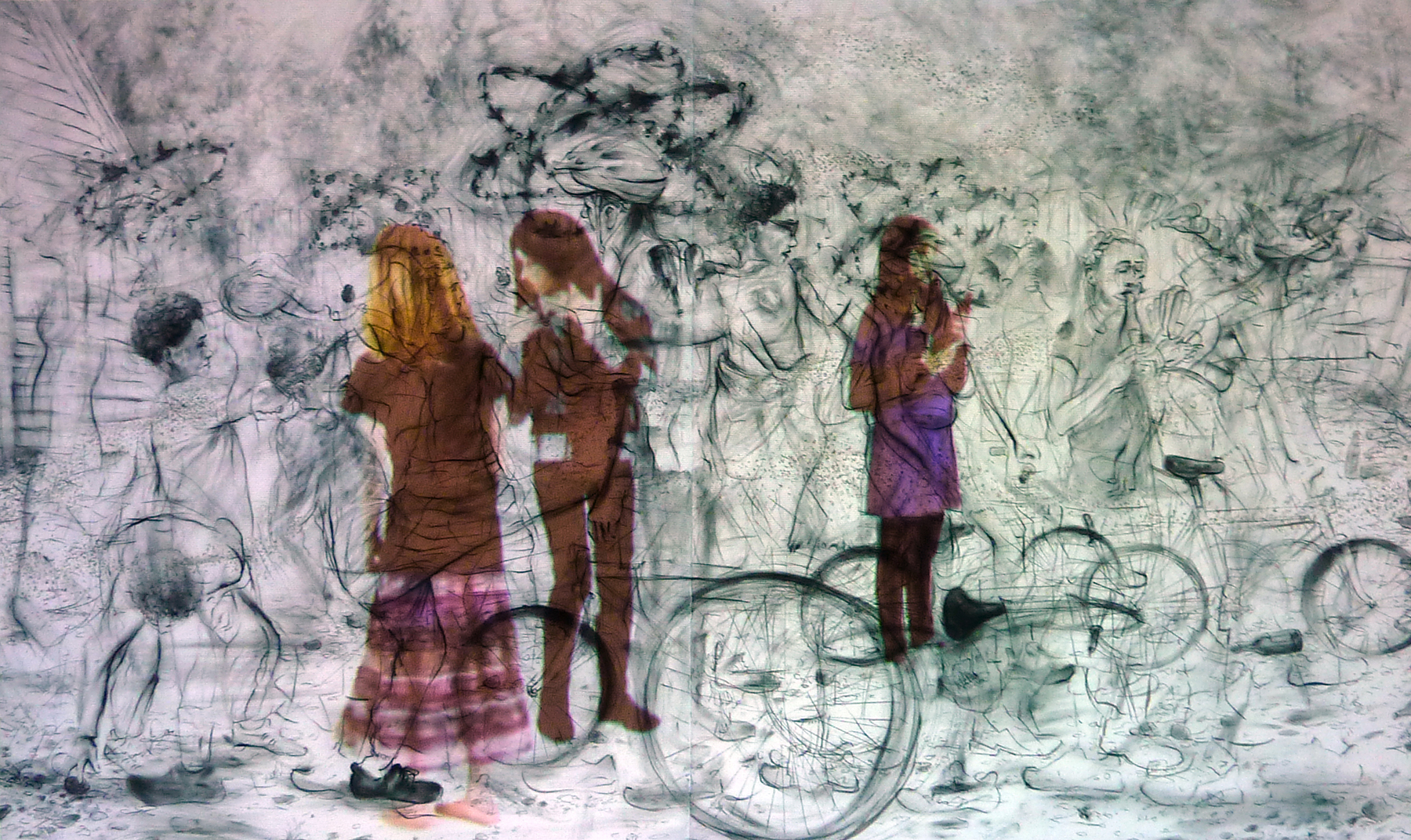
Image Used: Scott Kolbo, Alley Kids 01, video projection, ink, and charcoal on paper, 52″ x 83″2012
Previous Post

March 3, 2014
God For Us An Interview with Beth Bevis
Next Post
March 5, 2014 Risen Words
Browse Our Archives
Select a Category A. G. Harmon Alissa Wilkinson Allison Backous Art Authors Brad Fruhauff Bradford Winters Bryan Bliss Caroline Langston Chad Thomas Johnston Chris Hoke Christiana N. Peterson Culture D.G. Myers D.L. Mayfield Daniel Bowman Jr. David Griffith Elizabeth Duffy Faith Film Greg Wolfe Guest Contributor Interview Jan Vallone Jeffrey Overstreet Jessica Eddings-Roeser Jessica Mesman Griffith Kelly Foster Lindsey Crittenden Morgan Meis music Natalie Vestin Nick Olson Peggy Rosenthal Personal Reflection Poetry Friday Reflection Relationships Review Richard Chess Richard Cole Sara Zarr Shannon Huffman Polson Sonya Bilocerkowycz Tania Runyan Tony Woodlief Topical Categories Uncategorized Vic Sizemore Writing
Select a Month October 2018 September 2018 August 2018 July 2018 June 2018 May 2018 April 2018 March 2018 February 2018 January 2018 December 2017 November 2017 October 2017 September 2017 August 2017 July 2017 June 2017 May 2017 April 2017 March 2017 February 2017 January 2017 December 2016 November 2016 October 2016 September 2016 August 2016 July 2016 June 2016 May 2016 April 2016 March 2016 February 2016 January 2016 December 2015 November 2015 October 2015 September 2015 August 2015 July 2015 June 2015 May 2015 April 2015 March 2015 February 2015 January 2015 December 2014 November 2014 October 2014 September 2014 August 2014 July 2014 June 2014 May 2014 April 2014 March 2014 February 2014 January 2014 December 2013 November 2013 October 2013 September 2013 August 2013 July 2013 June 2013 May 2013 April 2013 March 2013 February 2013 January 2013 December 2012 November 2012 October 2012 September 2012 August 2012 July 2012 June 2012 May 2012 February 2008
Follow Us!
TAKE THE
Religious Wisdom Quiz
How many days was Jesus tempted in the wilderness?
Select your answer to see how you score.
40 days 50 days 60 days 30 days
Related posts from Good Letters

A Conversation with Alicia Ostriker: Part 2

Ready or Not for the Days of Awe

TRENDING AT PATHEOS Catholic

Rejecting Doom: Christian Hope And Human Action
Christianity is a religion of hope. We are to have hope and...

It’s What Comes From Within Which Matters
One of the most difficult things for us to understand is why...

Why I Choose the Eucharist Over the Sermon
Choose the Eucharist, Not the Sermon What are we supposed to get...

5 Design Elements Found in Spiritually Rooted Homes
Putting Spirituality Into Home Decor Our homes are more than our living...

Credo: A Story of God Told with the...
About 10 years ago, I began to imagine a personal "Credo" that...

The Anatomy of Divine Revelation in Catholic Thought
The claim that God has made Himself known to human beings is...
view all Catholic blogs
Ad-Free & Subscriber Log-In Subscription Support
- About Us
- 2026 Calendar
- Videos
- Podcasts
- Library of World Religions
- Faith In Media Tracker
- Advertise With Us
- Write for Us
- Privacy Policy
- Terms of Service
- Do Not Sell My Data
- Contact Us
- Radiant Digital
- Manage Newsletter Subscriptions
- Unsubscribe From Notifications
- Sitemap
Copyright 2008-2026, Patheos. All rights reserved.
Subscription Support Ad-Free & Subscriber Log-In
Follow Patheos