
BuddhistCatholicContemplativeEvangelicalGeneral ChristianHinduJewishLatter-day SaintMuslimNew VisionsProgressive Christian
Beliefs
- Buddhist
- Catholic
- Contemplative
- Evangelical
- General Christian
- Hindu
- Jewish
- Latter-day Saint
- More Voices
- Muslim
- New Visions
- Pagan
- Progressive Christian
Topics
- Religion News
- Food and Religion
- Sports and Religion
- Religious Art
- Religious Music and Entertainment
- Religious Events
- History and Religion
- Style and Religion
- Politics and Religion
- Women in Religion
- Recreation Outdoors and Religion
- Business Finance and Religion
- Careers Workplace and Religion
- Education and Religion
- Family Parenting and Religion
- Health Fitness and Religion
- Home and Religion
- Relationships and Religion
- Technology and Religion
- Travel and Religion
Columnists
- Buddhist Columnists
- Business Finance and Religion Columnists
- Careers Workplace and Religion Columnists
- Catholic Columnists
- Contemplative Columnists
- Education and Religion Columnists
- Evangelists Columnists
- Family Parenting and Religion Columnists
- General Christian Columnists
- Health Fitness and Religion Columnists
- Hindu Columnists
- History and Religion Columnists
- Home and Religion Columnists
- Jewish Columnists
- More Voices Columnists
- Latter Day Columnists
- Muslim Columnists
- New Visions Columnists
- Nonreligious Columnists
- Pagan Columnists
- Politics and Religion Columnists
- Progressive Columnists
- Recreation Outdoors and Religion Columnists
- Relationships and Religion Columnists
- Religion News Columnists
- Religious Art Columnists
- Religious Events Columnists
- Religious Music and Entertainment Columnists
- Sports and Religion Columnists
- Style and Religion Columnists
- Technology and Religion Columnists
- Travel and Religion Columnists
- Women in Religion Columnists
Resource Library
- 2026 Calendar
- Library of World Religions
- The 100 Most Holy Places on Earth
- Patheos Answers
- Podcasts
- Videos
- Faith Leaders Database
- Anglican Episcopalian
- Bahai
- Baptist
- Buddhism
- Christianity
- Confucianism
- Eastern Orthodoxy
- Hinduism
- Holiness and Pentecostal
- ISKCON
- Islam
- Judaism
- Lutheran
- Methodist
- The Church of Jesus Christ of Latter-day Saints
- New Age
- Paganism
- Presbytarian and Reformed
- Protestantism
- Religion Behind the Scenes
- Roman Catholic
- Scientology
- Shia Islam
- Sikhism
- Sufism
- Sunni Islam
- Taoism
- Zen
- See all religions
Research Tools
 Ad-Free & Subscriber Log-In Subscription Support
Ad-Free & Subscriber Log-In Subscription Support
Follow Patheos 

- Trending:
- Forgiveness
- |
- Marriage
- |
- Consciousness
- |
- Death Penalty
- |
- Election
- |
- Halloween
 Good Letters
-
Contributors
- Home
- Catholic
- Creation, Evolution, and the Over-Active Imagination, Part 2
Creation, Evolution, and the Over-Active Imagination, Part 2
Last updated on: July 20, 2015 at 12:58 pm by Guest Contributor
Creation, Evolution, and the Over-Active Imagination, Part 2 2015-07-20T12:58:32-07:00 Guest Contributor
Patheos Explore the world's faith through different perspectives on religion and spirituality! Patheos has the views of the prevalent religions and spiritualities of the world.
 Guest post
By Jeremy Begbie
In yesterday’s post I had to skip over a lot of detail and nuance, but only to make what I hope is a fair point: that behind much of the polemics of the evolutionism controversy lies an imagination that has got out of hand. The problem is not with the imaginative drive to find and construct patterns, which help us make sense of things, or the fact it often works with metaphors. The difficulties start when the imagination gets over-confident too quickly, ending up with patterns that extend beyond their proper use, and thus distort our view of reality.
How can artists of Christian faith help us here? At the very least, artists can help us imagine the universe as the creation of the God of Jesus Christ.
The Christian imagination is, or should be, in the business of discovery, disclosure—just as it constructs its visions, metaphorical or otherwise. (Just think of C. S. Lewis’s Screwtape Letters.) It cannot indulge in undisciplined fantasizing, only in disciplined truthfulness to the vision of the cosmos disclosed in life, death, and resurrection of Jesus.
In this light, with limited space, I close with four reflections.
First, artists need to be invited to explore the distinctive depths of the Christian tradition, and not settle for a shallow theology which stifles the magnificent vista which biblical faith makes possible.
So, for example, to say that God created all things out of nothing is not to claim God made everything “at a point in time”; it’s to say the entire universe (including time) depends on God at every point for its existence. God is not another cause on a time line; God is the one who creates time. A Christian account of creation is not a rival to a scientific account—for how could science ever establish the existence of the One on whom everything depends?
Science cannot account for the existence of the universe, nor for the fact that it is ordered—the Christian faith can indeed give an account of these things. In short, the Christian account of creation is both subtle and vast in its implications, and artists ought not to be content with anything less.
Second, artists can help remind us that Scripture is awash with “artistic” genres—myth, parable, narrative, extended metaphors, drama, and so on. To make that point with students I often point to Isaiah 40-55, where the prophet longs to jerk the imaginations of the exiled Jews in Babylon out of their apathy. He does not deliver a lecture on international relations; he offers streams of potent metaphors—law courts, rivers, plants breaking through dry earth, a mother in labor. That is how the Jews’ vibrant hope will be restored.
Third, artists can help rescue us from the bleak wilderness of “reductionism.” The creationist-evolutionist debate is bewitched by reductionism, the idea that one type of explanation can account for everything we encounter. So, for example, the creationist wants to shrink the notion of “truth” to what can be encapsulated in a certain kind of historical statement; the evolutionist (or at least one type of evolutionist) wants to explain the whole of human life in terms of genetic variation.
This kind of move may appeal to our sense of control—once we have the key to everything, we can control the world. This is the imagination run wild. But reductionism leads to a withered life. The arts, by their very nature are multiply allusive (as Calvin Seerveld puts it), always suggesting more than can be perceived at one level. The arts remind us that the world always exceeds our grasp, always eludes our control, that it is an arena of suggestiveness, in which, as Jacques Maritain said, things “give more than they have.”
The arts can’t prove reductionism is wrong, but the artist can bear witness to a world in which one type of explanation is never enough. Indeed, in this light, there are some respects in which creationists and evolutionists need each other; at their best they can prevent each other from succumbing to reductionism.
Fourth, artists can testify to the world’s good future. The problem with some forms of evolutionary theory is that when they get over-inflated by the imagination, they encourage a kind of optimism that suggests the world is progressively improving. Applied to the human sphere, humankind is thought to be on a steady march of moral betterment. Fortunately, this type of thinking is less popular than it used to be. Even so, many of us are slow to face up to the wider picture that the sciences do indeed unfold for us—that the cosmos is heading inexorably and predictably towards dissolution. In purely physical terms, the future is dark and hopeless.
The Christian hope, however, is not rooted in evolutionary optimism. It is grounded in God’s raising of Jesus from the dead, itself a promise of re-creation, a re-making of the cosmos (Rev. 21). Moreover, the claim is that foretastes of this new creation are possible here and now. Artists can help us counteract the facile optimism of the undisciplined, over-active imagination with evocations of what the dying and rising of Jesus actually promises for the future.
I came across a remarkable example of this the other day in a TV documentary about Auschwitz, a place devoid of all newness and creativity, flat with a grey sameness and horrific predictability. The virtuoso Maxim Vengerov played the entire Chaconne from J. S. Bach’s D Minor Partita for solo violin while walking around the death camp.
Significantly, some think Bach wrote this piece in the wake of the death of his wife. It is, in effect, a breath-taking musical protest against death—over sixty variations on one simple bass line and a set of chords; each variation is full of the unforeseen, alive with newness, and at the same time directly engaging dissonance. Into this site of mass annihilation, comes music which demonstrates an almost infinite possibility, one that is gloriously unpredictable.
Newness from beyond. A sonic preview of a world to come.
Jeremy S. Begbie is Thomas A. Langford Research Professor of Theology at Duke Divinity School, North Carolina. His particular research interest is the interplay between music and theology. He is also Senior Member at Wolfson College, Cambridge, and an Affiliated Lecturer in the Faculty of Music at the University of Cambridge. He is author of a number of books, including Theology, Music and Time (CUP), Resounding Truth: Christian Wisdom in the World of Music (Baker), and Music, Modernity, and God (OUP).
This post was made possible through the support of a grant from The BioLogos Foundation’s Evolution and Christian Faith program. The opinions expressed are those of the author and do not necessarily reflect the views of BioLogos.
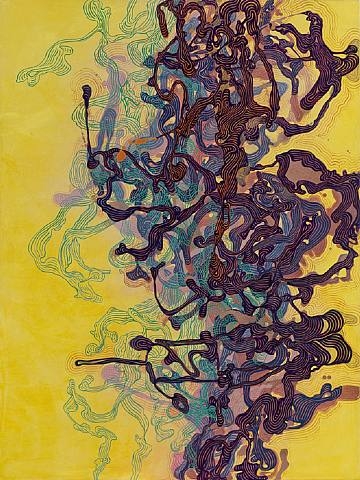
Image Used: Linnea Spransy, Maelstrom 2009, Acrylic on canvas 48 x 36 in, Byron Cohen Gallery
Previous Post

March 26, 2014
Creation, Evolution, and the Over-Active Imagination, Part 1
Next Post
March 28, 2014 Lectio Divina for a Life
Browse Our Archives
Select a Category A. G. Harmon Alissa Wilkinson Allison Backous Art Authors Brad Fruhauff Bradford Winters Bryan Bliss Caroline Langston Chad Thomas Johnston Chris Hoke Christiana N. Peterson Culture D.G. Myers D.L. Mayfield Daniel Bowman Jr. David Griffith Elizabeth Duffy Faith Film Greg Wolfe Guest Contributor Interview Jan Vallone Jeffrey Overstreet Jessica Eddings-Roeser Jessica Mesman Griffith Kelly Foster Lindsey Crittenden Morgan Meis music Natalie Vestin Nick Olson Peggy Rosenthal Personal Reflection Poetry Friday Reflection Relationships Review Richard Chess Richard Cole Sara Zarr Shannon Huffman Polson Sonya Bilocerkowycz Tania Runyan Tony Woodlief Topical Categories Uncategorized Vic Sizemore Writing
Select a Month October 2018 September 2018 August 2018 July 2018 June 2018 May 2018 April 2018 March 2018 February 2018 January 2018 December 2017 November 2017 October 2017 September 2017 August 2017 July 2017 June 2017 May 2017 April 2017 March 2017 February 2017 January 2017 December 2016 November 2016 October 2016 September 2016 August 2016 July 2016 June 2016 May 2016 April 2016 March 2016 February 2016 January 2016 December 2015 November 2015 October 2015 September 2015 August 2015 July 2015 June 2015 May 2015 April 2015 March 2015 February 2015 January 2015 December 2014 November 2014 October 2014 September 2014 August 2014 July 2014 June 2014 May 2014 April 2014 March 2014 February 2014 January 2014 December 2013 November 2013 October 2013 September 2013 August 2013 July 2013 June 2013 May 2013 April 2013 March 2013 February 2013 January 2013 December 2012 November 2012 October 2012 September 2012 August 2012 July 2012 June 2012 May 2012 February 2008
Follow Us!
TAKE THE
Religious Wisdom Quiz
Who was Jochebed?
Select your answer to see how you score.
David's mother Samuel's mother Moses' mother Jesus' mother
Related posts from Good Letters

The Stars of the Earth Cry Out


Poetry Friday: “The Ordinary Time”
TRENDING AT PATHEOS Catholic

Rejecting Doom: Christian Hope And Human Action
Christianity is a religion of hope. We are to have hope and...

It’s What Comes From Within Which Matters
One of the most difficult things for us to understand is why...

Why I Choose the Eucharist Over the Sermon
Choose the Eucharist, Not the Sermon What are we supposed to get...

5 Design Elements Found in Spiritually Rooted Homes
Putting Spirituality Into Home Decor Our homes are more than our living...

Credo: A Story of God Told with the...
About 10 years ago, I began to imagine a personal "Credo" that...

The Anatomy of Divine Revelation in Catholic Thought
The claim that God has made Himself known to human beings is...
view all Catholic blogs
Ad-Free & Subscriber Log-In Subscription Support
- About Us
- 2026 Calendar
- Videos
- Podcasts
- Library of World Religions
- Faith In Media Tracker
- Advertise With Us
- Write for Us
- Privacy Policy
- Terms of Service
- Do Not Sell My Data
- Contact Us
- Radiant Digital
- Manage Newsletter Subscriptions
- Unsubscribe From Notifications
- Sitemap
Copyright 2008-2026, Patheos. All rights reserved.
Subscription Support Ad-Free & Subscriber Log-In
Follow Patheos