
BuddhistCatholicContemplativeEvangelicalGeneral ChristianHinduJewishLatter-day SaintMuslimNew VisionsProgressive Christian
Beliefs
- Buddhist
- Catholic
- Contemplative
- Evangelical
- General Christian
- Hindu
- Jewish
- Latter-day Saint
- More Voices
- Muslim
- New Visions
- Pagan
- Progressive Christian
Topics
- Religion News
- Food and Religion
- Sports and Religion
- Religious Art
- Religious Music and Entertainment
- Religious Events
- History and Religion
- Style and Religion
- Politics and Religion
- Women in Religion
- Recreation Outdoors and Religion
- Business Finance and Religion
- Careers Workplace and Religion
- Education and Religion
- Family Parenting and Religion
- Health Fitness and Religion
- Home and Religion
- Relationships and Religion
- Technology and Religion
- Travel and Religion
Columnists
- Buddhist Columnists
- Business Finance and Religion Columnists
- Careers Workplace and Religion Columnists
- Catholic Columnists
- Contemplative Columnists
- Education and Religion Columnists
- Evangelists Columnists
- Family Parenting and Religion Columnists
- General Christian Columnists
- Health Fitness and Religion Columnists
- Hindu Columnists
- History and Religion Columnists
- Home and Religion Columnists
- Jewish Columnists
- More Voices Columnists
- Latter Day Columnists
- Muslim Columnists
- New Visions Columnists
- Nonreligious Columnists
- Pagan Columnists
- Politics and Religion Columnists
- Progressive Columnists
- Recreation Outdoors and Religion Columnists
- Relationships and Religion Columnists
- Religion News Columnists
- Religious Art Columnists
- Religious Events Columnists
- Religious Music and Entertainment Columnists
- Sports and Religion Columnists
- Style and Religion Columnists
- Technology and Religion Columnists
- Travel and Religion Columnists
- Women in Religion Columnists
Resource Library
- 2026 Calendar
- Library of World Religions
- The 100 Most Holy Places on Earth
- Patheos Answers
- Podcasts
- Videos
- Faith Leaders Database
- Anglican Episcopalian
- Bahai
- Baptist
- Buddhism
- Christianity
- Confucianism
- Eastern Orthodoxy
- Hinduism
- Holiness and Pentecostal
- ISKCON
- Islam
- Judaism
- Lutheran
- Methodist
- The Church of Jesus Christ of Latter-day Saints
- New Age
- Paganism
- Presbytarian and Reformed
- Protestantism
- Religion Behind the Scenes
- Roman Catholic
- Scientology
- Shia Islam
- Sikhism
- Sufism
- Sunni Islam
- Taoism
- Zen
- See all religions
Research Tools
 Ad-Free & Subscriber Log-In Subscription Support
Ad-Free & Subscriber Log-In Subscription Support
Follow Patheos 

- Trending:
- Forgiveness
- |
- Marriage
- |
- Consciousness
- |
- Death Penalty
- |
- Election
- |
- Halloween
 Good Letters
-
Contributors
- Home
- Catholic
- The Rich, the Poor, and Jesus
The Rich, the Poor, and Jesus
Last updated on: March 3, 2014 at 5:11 pm by Vic Sizemore
The Rich, the Poor, and Jesus 2014-03-03T17:11:22-07:00 Vic Sizemore
Patheos Explore the world's faith through different perspectives on religion and spirituality! Patheos has the views of the prevalent religions and spiritualities of the world.
 In November of 2013, Oxfam International released the results of a study that found an ever-growing concentration of the world’s wealth into the hands of a very few. The Irish Times quoted Oxfam chief executive Winnie Byanyima: “It is staggering that in the 21st century, half of the world’s population—that’s three and a half billion people—own no more than a tiny elite whose numbers [eighty-five souls] could all fit comfortably on a double-decker bus.”
The concerns of Oxfam over the findings are political inasmuch as this kind of wealth concentration rigs government processes in favor of the rich, which makes the divide between the haves and the have-nots permanent. This effectively destroys the reality of equal opportunity. Their research shows that “opportunity hoarding” is as rife as the hoarding of goods and resources.
The troubling nature of these findings seemed self-evident to me when I shared the Irish Times article about this report on social media. The response I got is a bit of a surprise. It didn’t surprise me that some people objected immediately to the conclusions of Oxfam. What surprised me was the visceral anger and resentment—with a tinge of hurt feelings even—coming from people I know who call themselves followers of Jesus Christ. They reacted as if I’d lobbed a Molotov cocktail into their living rooms.
I am not an activist. I am not involved in partisan politics in any way—I am political at all only inasmuch as I do vote. Is it possible to talk about the implications of this report without setting off an angry debate? I am truly puzzled about the rush of some Christians to defend wealth hoarders.
I understand where the antipathy toward social programs comes from. It began with the Social Gospel movement around the turn of the last century. Most associated with Washington Gladden and Walter Rauschenbusch, the Social Gospel was a theologically liberal replacement of sin-and-salvation preaching with a focus on living the teachings of Jesus practically in relation to the poor, the marginalized, and the disenfranchised. Reinhold Niebuhr took it a step further, argued that the aims of the Social Gospel should be sought by political means—and force, if necessary.
Fundamentalists rejected both of these notions, claiming that the sole commission of Christians was to save souls. This sentiment is evident in the words of the Fundamentalist preacher Vance Havner: “If they had a social gospel in the days of the prodigal son, somebody would have given him a bed and a sandwich and he never would have gone home.” Don’t let them get comfortable where they are, the thinking went. Make them as miserable as possible, so they will see their need to be born again.
The soul of the poor is their concern, not the physical well-being and comfort. I get that. What I don’t get is where this urgent, almost panicked, need to defend the rich comes from.
Jesus does talk about being reborn. Nicodemus comes to him by night (John 3:1-21) and Jesus says to him “You must be born again.” From there he doesn’t mention any kind of sinner’s prayer or confession however—he talks about deeds and tells Nicodemus “everyone that doeth evil hateth the light…. But he that doeth truth cometh to the light, that his deeds may be made manifest, that they are wrought of God.” What are the deeds Jesus speaks of, and do they have anything to do with the rich and the poor?
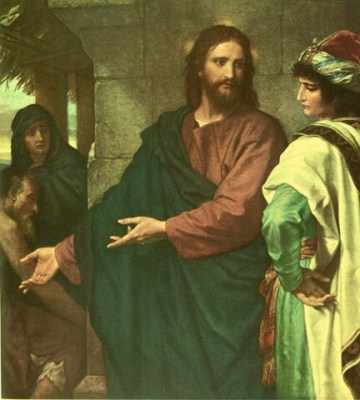
Judging by the rest of the red-letter parts of the gospels, yes, a little bit, they do. One example: Jesus tells the rich young ruler, something so important that it appears in all three synoptic gospels (Matthew 19:21, Mark 10:21, and Luke 18:22)? “Sell what thou hast and give it to the poor.”
The response of some to the Oxfam post was tinged with real outrage: “Do we take rich peoples’ money and give it to poor people? Do we raid rich nations and give it to poor nations?” This is followed by the argument that, “Fifty years of the war on poverty should show that [giving money to the poor] is wrong.”
In a blog post for ABC Religion and Ethics, Stanley Hauerwas interacts with Robert Lupton’s book Toxic Charity: How Churches and Charities Hurt Those They Help. Of all the real problems the book discusses, the one I hear most often is that charity will “erode the work ethic of those being helped with the result that their dependency is deepened.”
Hauerwas admits that problems exist, but he doesn’t let Christians off the hook. His conclusion is not that you do not give, but that you don’t simply throw money at the problem. It comes down to relationships: “The challenge is to be with the poor. To be with the poor means one must first learn to listen to the poor and, by listening, to discover that the poor are not without resources for survival. That means, at the very least, if you want to be with the poor a commitment of time is required for the building of trust necessary to sustain honest relationships.”
To the discussion following my post of the Oxfam report, my nephew commented with the simple letters—though they’ve become a cliché, are they not still relevant?—WWJD?
Vic Sizemore earned his MFA in fiction from Seattle Pacific University in 2009. His fiction and nonfiction are published or forthcoming in Story Quarterly, Southern Humanities Review, PANK Magazine, Pembroke, Saint Katherine Review, Rock & Sling and elsewhere. An excerpt from his novel The Calling was a finalist for the Sherwood Anderson Award; other excerpts from The Calling are published in Portland Review and are forthcoming serially in Connecticut Review. His short story “Hush Little Baby” won the 28th New Millennium Writings Award for Fiction. Sizemore teaches at Central Virginia Community College.
Previous Post

February 21, 2014
What Our Children See
Next Post
February 25, 2014 Letting It All Hang Out
Browse Our Archives
Select a Category A. G. Harmon Alissa Wilkinson Allison Backous Art Authors Brad Fruhauff Bradford Winters Bryan Bliss Caroline Langston Chad Thomas Johnston Chris Hoke Christiana N. Peterson Culture D.G. Myers D.L. Mayfield Daniel Bowman Jr. David Griffith Elizabeth Duffy Faith Film Greg Wolfe Guest Contributor Interview Jan Vallone Jeffrey Overstreet Jessica Eddings-Roeser Jessica Mesman Griffith Kelly Foster Lindsey Crittenden Morgan Meis music Natalie Vestin Nick Olson Peggy Rosenthal Personal Reflection Poetry Friday Reflection Relationships Review Richard Chess Richard Cole Sara Zarr Shannon Huffman Polson Sonya Bilocerkowycz Tania Runyan Tony Woodlief Topical Categories Uncategorized Vic Sizemore Writing
Select a Month October 2018 September 2018 August 2018 July 2018 June 2018 May 2018 April 2018 March 2018 February 2018 January 2018 December 2017 November 2017 October 2017 September 2017 August 2017 July 2017 June 2017 May 2017 April 2017 March 2017 February 2017 January 2017 December 2016 November 2016 October 2016 September 2016 August 2016 July 2016 June 2016 May 2016 April 2016 March 2016 February 2016 January 2016 December 2015 November 2015 October 2015 September 2015 August 2015 July 2015 June 2015 May 2015 April 2015 March 2015 February 2015 January 2015 December 2014 November 2014 October 2014 September 2014 August 2014 July 2014 June 2014 May 2014 April 2014 March 2014 February 2014 January 2014 December 2013 November 2013 October 2013 September 2013 August 2013 July 2013 June 2013 May 2013 April 2013 March 2013 February 2013 January 2013 December 2012 November 2012 October 2012 September 2012 August 2012 July 2012 June 2012 May 2012 February 2008
Follow Us!
TAKE THE
Religious Wisdom Quiz
What did Jesus heal on a man lowered through a roof in Capernaum?
Select your answer to see how you score.
Dumbness Paralysis Blindness Leprosy
Related posts from Good Letters

Morning in a Forgotten Neighborhood



TRENDING AT PATHEOS Catholic

Rejecting Doom: Christian Hope And Human Action
Christianity is a religion of hope. We are to have hope and...

It’s What Comes From Within Which Matters
One of the most difficult things for us to understand is why...

Why I Choose the Eucharist Over the Sermon
Choose the Eucharist, Not the Sermon What are we supposed to get...

5 Design Elements Found in Spiritually Rooted Homes
Putting Spirituality Into Home Decor Our homes are more than our living...

Credo: A Story of God Told with the...
About 10 years ago, I began to imagine a personal "Credo" that...

The Anatomy of Divine Revelation in Catholic Thought
The claim that God has made Himself known to human beings is...
view all Catholic blogs
Ad-Free & Subscriber Log-In Subscription Support
- About Us
- 2026 Calendar
- Videos
- Podcasts
- Library of World Religions
- Faith In Media Tracker
- Advertise With Us
- Write for Us
- Privacy Policy
- Terms of Service
- Do Not Sell My Data
- Contact Us
- Radiant Digital
- Manage Newsletter Subscriptions
- Unsubscribe From Notifications
- Sitemap
Copyright 2008-2026, Patheos. All rights reserved.
Subscription Support Ad-Free & Subscriber Log-In
Follow Patheos