
BuddhistCatholicContemplativeEvangelicalGeneral ChristianHinduJewishLatter-day SaintMuslimNew VisionsProgressive Christian
Beliefs
- Buddhist
- Catholic
- Contemplative
- Evangelical
- General Christian
- Hindu
- Jewish
- Latter-day Saint
- More Voices
- Muslim
- New Visions
- Pagan
- Progressive Christian
Topics
- Religion News
- Food and Religion
- Sports and Religion
- Religious Art
- Religious Music and Entertainment
- Religious Events
- History and Religion
- Style and Religion
- Politics and Religion
- Women in Religion
- Recreation Outdoors and Religion
- Business Finance and Religion
- Careers Workplace and Religion
- Education and Religion
- Family Parenting and Religion
- Health Fitness and Religion
- Home and Religion
- Relationships and Religion
- Technology and Religion
- Travel and Religion
Columnists
- Buddhist Columnists
- Business Finance and Religion Columnists
- Careers Workplace and Religion Columnists
- Catholic Columnists
- Contemplative Columnists
- Education and Religion Columnists
- Evangelists Columnists
- Family Parenting and Religion Columnists
- General Christian Columnists
- Health Fitness and Religion Columnists
- Hindu Columnists
- History and Religion Columnists
- Home and Religion Columnists
- Jewish Columnists
- More Voices Columnists
- Latter Day Columnists
- Muslim Columnists
- New Visions Columnists
- Nonreligious Columnists
- Pagan Columnists
- Politics and Religion Columnists
- Progressive Columnists
- Recreation Outdoors and Religion Columnists
- Relationships and Religion Columnists
- Religion News Columnists
- Religious Art Columnists
- Religious Events Columnists
- Religious Music and Entertainment Columnists
- Sports and Religion Columnists
- Style and Religion Columnists
- Technology and Religion Columnists
- Travel and Religion Columnists
- Women in Religion Columnists
Resource Library
- 2026 Calendar
- Library of World Religions
- The 100 Most Holy Places on Earth
- Patheos Answers
- Podcasts
- Videos
- Faith Leaders Database
- Anglican Episcopalian
- Bahai
- Baptist
- Buddhism
- Christianity
- Confucianism
- Eastern Orthodoxy
- Hinduism
- Holiness and Pentecostal
- ISKCON
- Islam
- Judaism
- Lutheran
- Methodist
- The Church of Jesus Christ of Latter-day Saints
- New Age
- Paganism
- Presbytarian and Reformed
- Protestantism
- Religion Behind the Scenes
- Roman Catholic
- Scientology
- Shia Islam
- Sikhism
- Sufism
- Sunni Islam
- Taoism
- Zen
- See all religions
Research Tools
 Ad-Free & Subscriber Log-In Subscription Support
Ad-Free & Subscriber Log-In Subscription Support
Follow Patheos 

- Trending:
- Forgiveness
- |
- Marriage
- |
- Consciousness
- |
- Death Penalty
- |
- Election
- |
- Halloween
 Good Letters
-
Contributors
- Home
- Catholic
- The Beltway Catechesis
The Beltway Catechesis
Last updated on: February 18, 2014 at 1:00 am by Caroline Langston
The Beltway Catechesis 2014-02-13T16:16:09-07:00 Caroline Langston
Patheos Explore the world's faith through different perspectives on religion and spirituality! Patheos has the views of the prevalent religions and spiritualities of the world.
 Now that our son is almost ten, he has begun to feel his oats a bit: In the middle of fourth grade, he has begun to log a few life achievements that both we, and he, are proud: he has surmounted some of his attention problems and can stay focused on the tasks at hand—reading about military history, remembering to take out the trash, remembering to modulate his quick-start anger before it bursts from his lips.
He has also learned to complain about having to go to church. Sunday mornings in our house arrive drowsily and sun-soaked, the tendrils of smoke from the censer we always light curling up the stairs.
But by the time we are actually ready to walk out the door, between him and his little sister, it is all over but the shouting. In my daughter’s case, her complaints are minor, and classic: the ill-fitting patent leather shoes, her grumpiness at being told that taking a Bitty Baby stroller to the Divine Liturgy is inadvisable.
My son’s complaints are more subtle, and dangerous. Only occasionally will he trot out the old chestnut, “God is just an idea that somebody made up way back when,” because he knows that I know that at least for now, he doesn’t believe it: For any and all problems he has with God, I have seen him sincerely implore, and sincerely repent, before the invisible and ever-present altar of the Divine.
One of our dearest neighbors, a reader of this blog, has been in treatment for breast cancer these past six or so months, and when we say prayers at night, he always remembers to lift her name like a found jewel. And he was thankful when her chemotherapy regimen came to an end.
He also knows that, in these secular times—some of my best friends are atheists!—I would never respond to that claim in the way my own mother, lightly religious herself but steeped in Southern Baptist tradition, exclaimed: “The very idea! You ought to be ashamed of yourself.”
“Yep,” I say, casually. “Lots of people don’t believe in God. We do, though.” And while he may end up faithless later, he’s living in our house now.
At other times, my response won’t be a light one, but will instead be brimming with passion: Because of course there’s physics! The mysteries of evolution! The world is charged with the grandeur of God!
Believe it or not, the more complicated question is not about the existence of God, but about why it is important to go to church at all. My husband is Catholic and I’m a convert to Orthodoxy—neither of which are “just believe in your heart” kinds of faiths—but the question of why it is important to actually go to church seems to be the one that is more pressing, and relevant.
Let me tell you, when we are trying to get them kicking and screaming out of the door on Sunday morning, I have sympathy for anyone who decided that arguing about church attendance wasn’t worth it, and just decided to throw in the towel.
And sometimes it has involved literal kicking and screaming—out to and into the car, and around the Capital Beltway nearly twenty-seven miles from our house to the Antiochian Orthodox Church we attend in the Montgomery county suburbs. “Damn you,” I said one Sunday morning to one of my children, and I have shouted the F word, and punched on the accelerator while changing lanes.
If this were a movie, this would be the moment that would expose the yawning irony between my pious hopes and the less than beautiful reality of family life. “Shut up and worship the birth of Jesus Christ!” Christine Baranski’s character gripes (I’m paraphrasing) at her children on Christmas in the hilarious 1995 movie The Ref, and the implied take-away from that scene and similar scenes in other movies— would seem to be the essential hypocrisy of any kind of religious indoctrination.
What do these movies want, I wonder? I guess the “authentic” move at this point would be to throw the towel in and, what? Agree that, Yes, Mommy has been an inflexible hypocrite. Let us enjoy this Sunday morning with a walk in the park and a movie afterward. Be spiritual but not religious. You can decide for yourself when you grow up.
Well, too effing bad, I think. The notion that any of us is, or can be, anything other than a hypocrite, seems to be a legacy of good old American Puritanism, in its secular form: That by our ethics and good will alone, we can be perfected.
Instead, I am a sinner.
And as such I need more than the thought experiments of ethics and sentimentality. I need the Body and Blood of Jesus. You can’t get that anywhere else but church, I tell my son.
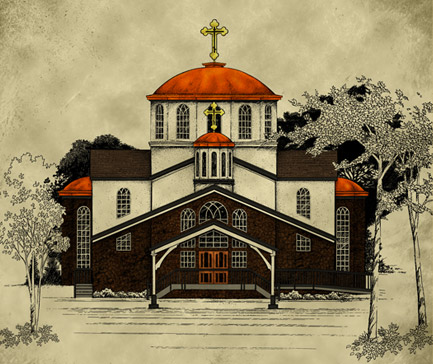
I have noticed that by the time we are halfway around the Beltway, their griping has stopped. After we have arrived at church, at last, the gold-touched dome with its cross scraping the sky looms over us as we shepherd each other inside.My son lopes away from me, off behind the altar screen where there are no girls.
Half of success is just showing up. My daughter and I light a candle.
When someone dies, we are served Kolliva, made of wheat berries and powdered sugar.
I am building an architecture of the invisible.
When and if they reject it, my children will still remember the Blood of Christ coursing through their bodies; their half-asleep noses will distinguish incense in their dark and dreamlike rooms.
That’s not nothing.
The colors of the icons will still shine, in the afterimages of their eyes.
A native of Yazoo City, Mississippi, Caroline Langston is a convert to the Eastern Orthodox Church. She is a widely published writer and essayist, a winner of the Pushcart Prize, and a commentator for NPR’s “All Things Considered.”
Previous Post

February 14, 2014
My Valentine
Next Post
February 19, 2014 Pope Francis’s Beauty and Art
Browse Our Archives
Select a Category A. G. Harmon Alissa Wilkinson Allison Backous Art Authors Brad Fruhauff Bradford Winters Bryan Bliss Caroline Langston Chad Thomas Johnston Chris Hoke Christiana N. Peterson Culture D.G. Myers D.L. Mayfield Daniel Bowman Jr. David Griffith Elizabeth Duffy Faith Film Greg Wolfe Guest Contributor Interview Jan Vallone Jeffrey Overstreet Jessica Eddings-Roeser Jessica Mesman Griffith Kelly Foster Lindsey Crittenden Morgan Meis music Natalie Vestin Nick Olson Peggy Rosenthal Personal Reflection Poetry Friday Reflection Relationships Review Richard Chess Richard Cole Sara Zarr Shannon Huffman Polson Sonya Bilocerkowycz Tania Runyan Tony Woodlief Topical Categories Uncategorized Vic Sizemore Writing
Select a Month October 2018 September 2018 August 2018 July 2018 June 2018 May 2018 April 2018 March 2018 February 2018 January 2018 December 2017 November 2017 October 2017 September 2017 August 2017 July 2017 June 2017 May 2017 April 2017 March 2017 February 2017 January 2017 December 2016 November 2016 October 2016 September 2016 August 2016 July 2016 June 2016 May 2016 April 2016 March 2016 February 2016 January 2016 December 2015 November 2015 October 2015 September 2015 August 2015 July 2015 June 2015 May 2015 April 2015 March 2015 February 2015 January 2015 December 2014 November 2014 October 2014 September 2014 August 2014 July 2014 June 2014 May 2014 April 2014 March 2014 February 2014 January 2014 December 2013 November 2013 October 2013 September 2013 August 2013 July 2013 June 2013 May 2013 April 2013 March 2013 February 2013 January 2013 December 2012 November 2012 October 2012 September 2012 August 2012 July 2012 June 2012 May 2012 February 2008
Follow Us!
TAKE THE
Religious Wisdom Quiz
Which religious tradition sees the Genesis flood story as parallel to the Epic of Gilgamesh?
Select your answer to see how you score.
Ancient Mesopotamian religion Zoroastrianism Greek mythology Hinduism
Related posts from Good Letters


Leonard Cohen’s Holy and Broken Hallelujah

Ready or Not for the Days of Awe

TRENDING AT PATHEOS Catholic

Rejecting Doom: Christian Hope And Human Action
Christianity is a religion of hope. We are to have hope and...

It’s What Comes From Within Which Matters
One of the most difficult things for us to understand is why...

Why I Choose the Eucharist Over the Sermon
Choose the Eucharist, Not the Sermon What are we supposed to get...

5 Design Elements Found in Spiritually Rooted Homes
Putting Spirituality Into Home Decor Our homes are more than our living...

Credo: A Story of God Told with the...
About 10 years ago, I began to imagine a personal "Credo" that...

The Anatomy of Divine Revelation in Catholic Thought
The claim that God has made Himself known to human beings is...
view all Catholic blogs
Ad-Free & Subscriber Log-In Subscription Support
- About Us
- 2026 Calendar
- Videos
- Podcasts
- Library of World Religions
- Faith In Media Tracker
- Advertise With Us
- Write for Us
- Privacy Policy
- Terms of Service
- Do Not Sell My Data
- Contact Us
- Radiant Digital
- Manage Newsletter Subscriptions
- Unsubscribe From Notifications
- Sitemap
Copyright 2008-2026, Patheos. All rights reserved.
Subscription Support Ad-Free & Subscriber Log-In
Follow Patheos