
BuddhistCatholicContemplativeEvangelicalGeneral ChristianHinduJewishLatter-day SaintMuslimNew VisionsProgressive Christian
Beliefs
- Buddhist
- Catholic
- Contemplative
- Evangelical
- General Christian
- Hindu
- Jewish
- Latter-day Saint
- More Voices
- Muslim
- New Visions
- Pagan
- Progressive Christian
Topics
- Religion News
- Food and Religion
- Sports and Religion
- Religious Art
- Religious Music and Entertainment
- Religious Events
- History and Religion
- Style and Religion
- Politics and Religion
- Women in Religion
- Recreation Outdoors and Religion
- Business Finance and Religion
- Careers Workplace and Religion
- Education and Religion
- Family Parenting and Religion
- Health Fitness and Religion
- Home and Religion
- Relationships and Religion
- Technology and Religion
- Travel and Religion
Columnists
- Buddhist Columnists
- Business Finance and Religion Columnists
- Careers Workplace and Religion Columnists
- Catholic Columnists
- Contemplative Columnists
- Education and Religion Columnists
- Evangelists Columnists
- Family Parenting and Religion Columnists
- General Christian Columnists
- Health Fitness and Religion Columnists
- Hindu Columnists
- History and Religion Columnists
- Home and Religion Columnists
- Jewish Columnists
- More Voices Columnists
- Latter Day Columnists
- Muslim Columnists
- New Visions Columnists
- Nonreligious Columnists
- Pagan Columnists
- Politics and Religion Columnists
- Progressive Columnists
- Recreation Outdoors and Religion Columnists
- Relationships and Religion Columnists
- Religion News Columnists
- Religious Art Columnists
- Religious Events Columnists
- Religious Music and Entertainment Columnists
- Sports and Religion Columnists
- Style and Religion Columnists
- Technology and Religion Columnists
- Travel and Religion Columnists
- Women in Religion Columnists
Resource Library
- 2026 Calendar
- Library of World Religions
- The 100 Most Holy Places on Earth
- Patheos Answers
- Podcasts
- Videos
- Faith Leaders Database
- Anglican Episcopalian
- Bahai
- Baptist
- Buddhism
- Christianity
- Confucianism
- Eastern Orthodoxy
- Hinduism
- Holiness and Pentecostal
- ISKCON
- Islam
- Judaism
- Lutheran
- Methodist
- The Church of Jesus Christ of Latter-day Saints
- New Age
- Paganism
- Presbytarian and Reformed
- Protestantism
- Religion Behind the Scenes
- Roman Catholic
- Scientology
- Shia Islam
- Sikhism
- Sufism
- Sunni Islam
- Taoism
- Zen
- See all religions
Research Tools
 Ad-Free & Subscriber Log-In Subscription Support
Ad-Free & Subscriber Log-In Subscription Support
Follow Patheos 

- Trending:
- Forgiveness
- |
- Marriage
- |
- Consciousness
- |
- Death Penalty
- |
- Election
- |
- Halloween
 Good Letters
-
Contributors
- Home
- Catholic
- Fear Factor
Fear Factor
Last updated on: February 4, 2014 at 1:00 am by Tania Runyan
Fear Factor 2014-01-31T17:34:55-07:00 Tania Runyan
Patheos Explore the world's faith through different perspectives on religion and spirituality! Patheos has the views of the prevalent religions and spiritualities of the world.
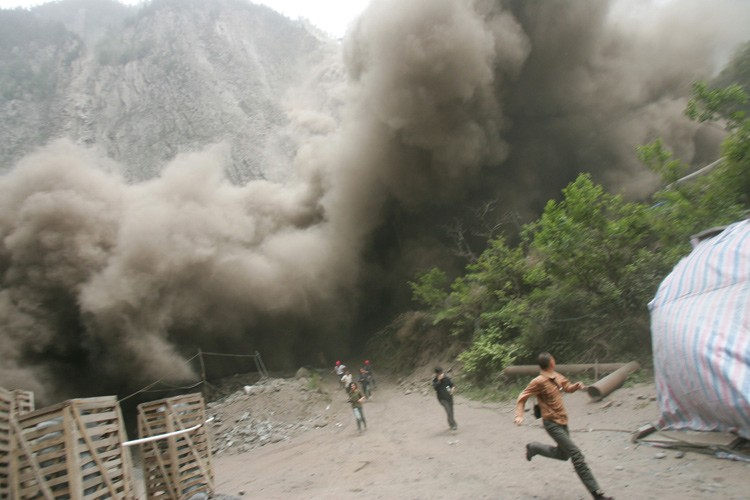 For a young woman beset with all manner of insecurities, the early nineties in southern California were the perfect storm. Or fire. Or fault.
During my college years at the University of California, Riverside, I often felt my center could not hold. But because I didn’t know how to deal with the center, I focused on everything outside it—the more explosive, the better: Desert Storm, the LA Riots, fires, and, of course, earthquakes.
I walked dutifully to class amidst yelling protestors and swirling ashes from one disaster to another, nerves on edge. But when the Landers quake hit one hundred miles east of campus in the summer of 1992, my anxiety went wild. For years, we’d been told the Big One was coming, and coming soon. I convinced myself Landers harbingered the coming California apocalypse.
I’d heard about liquefaction, when an earthquake turns the ground into quicksand swallowing buildings and cars. I saw myself pinned under five floors of books at my library job with no one to hear my cries. I recalled the harrowing stories of the Nimitz Freeway collapse in the San Francisco quake of 1989, how rescue workers had to saw through a dead woman to get to a living child, how the whimpers of dying people haunted the night. That summer, I panicked when traffic kept me under a bridge for more than a second, and I scanned every building I entered for ominous shelves and chandeliers. My imagination shook the floor several times a day.
Like Anne Lamott and her “butt mind,” described in Traveling Mercies as her monitoring, evaluating, and comparing other’s asses to her own at a daily, obsessive level, I had “quake mind” through and through.
Some of this obsession makes sense to me now. I was twenty, navigating my place in a newly divorced family. I was dating someone I’d decided to marry, and we couldn’t figure out how to unravel our anxieties together. I’d already changed my major twice, and for the first time, I was trying to live a life of faith.
That summer, the smog seemed to parallel my inability to think or breathe. I traveled to a Bible retreat in Yosemite in order to escape. But the entire drive up, I felt my heart tumble off every mountain turn. I hiked with “grizzly mind.” I jotted down notes in the margins of Mark’s gospel, trembling over the end of my days.
Soon after getting married and graduating, my husband and I moved to the Midwest. While I still insist that earthquakes had nothing to do with the move (I had applied to MFA programs in the Northwest, too), they probably influenced my subconscious desire to flee the fearful self I had known. When we entered the town limits of Bowling Green, Ohio—as un-southern California a place can get—I exhaled in peace. I knew nothing about this place, just that it was flat, quiet, and calm. And far from my old life.
“Don’t you realize,” a therapist once asked me, “that you cause yourself pain when you worry about suffering? You don’t know if you’re ever going to face a disaster. But you’re suffering for certain right now.”
In A Prayer Journal, Flannery O’Connor writes, “I do not know you God because I am in the way. Please help push myself aside.” While O’Connor refers to her writing ambition here, her words speak to my fixation with control.
Earthquakes scare me more than tornadoes or hurricanes because they come with no warning. People who leave voice mails saying, “I need to talk to you about something” incapacitate me. Waiting for biopsy results sends me into a Googling tailspin. The need for control has even impacted positive life experiences. I had to know when, where, and how my husband was going to propose, for the thought of any kind of surprise nauseated me.
How do I push myself aside? How do I lose my life and find it? And why do some of us have more trouble with this than others?
Worry is my way of taking charge, in which I can call the shots of how, when, and where I worry. Aerophobes (me included) can relate to the feeling of “keeping the plane in the air” by perseverating over every bump in flight. Relaxation techniques? Terrifying. All that deep breathing, muscle loosening, and beach-visualization makes me feel like I’m in freefall*.*
Mayday! Mayday! We’re losing her! Pump in the worry! Quick!
But all that control takes energy, energy I no longer have to give. Whether I live in a fault zone or not, the anxiety wants to creep in: the icy road, the headachy child, the husband who doesn’t answer the phone.
In order to push myself aside and let God in, I have to take hold of the center first so I know what I’m pushing aside (and not pushing down—there is a difference). Have I aligned that center with the love of God, placed my security there? If so, pushing myself aside is not martyrdom, but freedom, for he’s there anyway. But the alignment is a process, not a one-time resolution or prayer. Like shifting plates, we move alongside God, settling, readjusting, shaking up our lives.
When my family visits the California high desert and my father and stepmother, we drive through the Cajon Pass between the San Bernardino and San Gabriel Mountains. We drive over the giant rift and collision of rocks known as the San Andreas Fault, the very embodiment of my obsessive fear over twenty years ago.
My adrenaline still kicks up a notch as we pass, but I try to replace quake mind with God mind. I try to see the geology as God sees it: You are beautiful. If it weren’t for you, we wouldn’t have these mountains. Deep inside the earth you are ready to move. Go where you will. I release you. But maybe just not yet.
Tania Runyan is the author of the poetry collections Second Sky (Cascade Poiema Series), A Thousand Vessels, Simple Weight, and Delicious Air, which was awarded Book of the Year by the Conference on Christianity and Literature in 2007. Her book How to Read a Poem, an instructional guide based on Billy Collins’s “Introduction to Poetry,” was recently released by T.S. Poetry Press. Her poems have appeared in many publications, including Poetry, Image, Books & Culture, Harvard Divinity Bulletin, The Christian Century, Atlanta Review, Indiana Review, and the anthology In a Fine Frenzy: Poets Respond to Shakespeare. Tania was awarded an NEA Literature Fellowship in 2011. She tutors high school students and edits for Every Day Poems and Relief.
Previous Post

February 3, 2014
Asher Lev’s Gift to Me
Next Post
February 5, 2014 Searching for a Rabbi
Browse Our Archives
Select a Category A. G. Harmon Alissa Wilkinson Allison Backous Art Authors Brad Fruhauff Bradford Winters Bryan Bliss Caroline Langston Chad Thomas Johnston Chris Hoke Christiana N. Peterson Culture D.G. Myers D.L. Mayfield Daniel Bowman Jr. David Griffith Elizabeth Duffy Faith Film Greg Wolfe Guest Contributor Interview Jan Vallone Jeffrey Overstreet Jessica Eddings-Roeser Jessica Mesman Griffith Kelly Foster Lindsey Crittenden Morgan Meis music Natalie Vestin Nick Olson Peggy Rosenthal Personal Reflection Poetry Friday Reflection Relationships Review Richard Chess Richard Cole Sara Zarr Shannon Huffman Polson Sonya Bilocerkowycz Tania Runyan Tony Woodlief Topical Categories Uncategorized Vic Sizemore Writing
Select a Month October 2018 September 2018 August 2018 July 2018 June 2018 May 2018 April 2018 March 2018 February 2018 January 2018 December 2017 November 2017 October 2017 September 2017 August 2017 July 2017 June 2017 May 2017 April 2017 March 2017 February 2017 January 2017 December 2016 November 2016 October 2016 September 2016 August 2016 July 2016 June 2016 May 2016 April 2016 March 2016 February 2016 January 2016 December 2015 November 2015 October 2015 September 2015 August 2015 July 2015 June 2015 May 2015 April 2015 March 2015 February 2015 January 2015 December 2014 November 2014 October 2014 September 2014 August 2014 July 2014 June 2014 May 2014 April 2014 March 2014 February 2014 January 2014 December 2013 November 2013 October 2013 September 2013 August 2013 July 2013 June 2013 May 2013 April 2013 March 2013 February 2013 January 2013 December 2012 November 2012 October 2012 September 2012 August 2012 July 2012 June 2012 May 2012 February 2008
Follow Us!
TAKE THE
Religious Wisdom Quiz
What was the primary trade good in Biblical times?
Select your answer to see how you score.
Olive oil Purple cloth Spices Wheat
Related posts from Good Letters

On Writing Odes: Taking Time to Celebrate
Poetry Friday: A Quick Interpretation of the Sixth...

TRENDING AT PATHEOS Catholic

Rejecting Doom: Christian Hope And Human Action
Christianity is a religion of hope. We are to have hope and...

It’s What Comes From Within Which Matters
One of the most difficult things for us to understand is why...

Why I Choose the Eucharist Over the Sermon
Choose the Eucharist, Not the Sermon What are we supposed to get...

5 Design Elements Found in Spiritually Rooted Homes
Putting Spirituality Into Home Decor Our homes are more than our living...

Credo: A Story of God Told with the...
About 10 years ago, I began to imagine a personal "Credo" that...

The Anatomy of Divine Revelation in Catholic Thought
The claim that God has made Himself known to human beings is...
view all Catholic blogs
Ad-Free & Subscriber Log-In Subscription Support
- About Us
- 2026 Calendar
- Videos
- Podcasts
- Library of World Religions
- Faith In Media Tracker
- Advertise With Us
- Write for Us
- Privacy Policy
- Terms of Service
- Do Not Sell My Data
- Contact Us
- Radiant Digital
- Manage Newsletter Subscriptions
- Unsubscribe From Notifications
- Sitemap
Copyright 2008-2026, Patheos. All rights reserved.
Subscription Support Ad-Free & Subscriber Log-In
Follow Patheos