
BuddhistCatholicContemplativeEvangelicalGeneral ChristianHinduJewishLatter-day SaintMuslimNew VisionsProgressive Christian
Beliefs
- Buddhist
- Catholic
- Contemplative
- Evangelical
- General Christian
- Hindu
- Jewish
- Latter-day Saint
- More Voices
- Muslim
- New Visions
- Pagan
- Progressive Christian
Topics
- Religion News
- Food and Religion
- Sports and Religion
- Religious Art
- Religious Music and Entertainment
- Religious Events
- History and Religion
- Style and Religion
- Politics and Religion
- Women in Religion
- Recreation Outdoors and Religion
- Business Finance and Religion
- Careers Workplace and Religion
- Education and Religion
- Family Parenting and Religion
- Health Fitness and Religion
- Home and Religion
- Relationships and Religion
- Technology and Religion
- Travel and Religion
Columnists
- Buddhist Columnists
- Business Finance and Religion Columnists
- Careers Workplace and Religion Columnists
- Catholic Columnists
- Contemplative Columnists
- Education and Religion Columnists
- Evangelists Columnists
- Family Parenting and Religion Columnists
- General Christian Columnists
- Health Fitness and Religion Columnists
- Hindu Columnists
- History and Religion Columnists
- Home and Religion Columnists
- Jewish Columnists
- More Voices Columnists
- Latter Day Columnists
- Muslim Columnists
- New Visions Columnists
- Nonreligious Columnists
- Pagan Columnists
- Politics and Religion Columnists
- Progressive Columnists
- Recreation Outdoors and Religion Columnists
- Relationships and Religion Columnists
- Religion News Columnists
- Religious Art Columnists
- Religious Events Columnists
- Religious Music and Entertainment Columnists
- Sports and Religion Columnists
- Style and Religion Columnists
- Technology and Religion Columnists
- Travel and Religion Columnists
- Women in Religion Columnists
Resource Library
- 2026 Calendar
- Library of World Religions
- The 100 Most Holy Places on Earth
- Patheos Answers
- Podcasts
- Videos
- Faith Leaders Database
- Anglican Episcopalian
- Bahai
- Baptist
- Buddhism
- Christianity
- Confucianism
- Eastern Orthodoxy
- Hinduism
- Holiness and Pentecostal
- ISKCON
- Islam
- Judaism
- Lutheran
- Methodist
- The Church of Jesus Christ of Latter-day Saints
- New Age
- Paganism
- Presbytarian and Reformed
- Protestantism
- Religion Behind the Scenes
- Roman Catholic
- Scientology
- Shia Islam
- Sikhism
- Sufism
- Sunni Islam
- Taoism
- Zen
- See all religions
Research Tools
 Ad-Free & Subscriber Log-In Subscription Support
Ad-Free & Subscriber Log-In Subscription Support
Follow Patheos 

- Trending:
- Forgiveness
- |
- Marriage
- |
- Consciousness
- |
- Death Penalty
- |
- Election
- |
- Halloween
 Good Letters
-
Contributors
- Home
- Catholic
- Pleasure Milker
Pleasure Milker
Last updated on: January 16, 2014 at 1:00 am by Guest Contributor
Pleasure Milker 2014-01-10T18:04:05-07:00 Guest Contributor
Patheos Explore the world's faith through different perspectives on religion and spirituality! Patheos has the views of the prevalent religions and spiritualities of the world.
 Guest post by Jen Hinst-White
The mind is always elsewhere, won’t stay put.
Whose merciful hands, then,
Could bind us to our longing?
—Katy Didden, “The Penitentes’ Morada”
In my early twenties I used to daydream of the perfect job to complement writing. The criteria were these:
It had to be part-time; I wanted hours leftover to write at my desk.
It need not be high-paying; I was a budgeter, lived simply.
And then this: It should require the use of my body—offer some light physical labor to complement the labors of the mind. Potter’s assistant, garden nursery worker, sign-maker. I imagined spending several hours in pleasant, undemanding tedium, savoring the useful work of my hands. Then I would go home, shower, and pour stories onto the page, as if from a bottomless pot of coffee that had been percolating while I worked.
When I think back on this daydreamed job, it’s not my own romantic notions that I rue, but my failure to try them. Instead I took the good jobs that came along: fulltime or nearly so, my hands not tending saplings or wedging clay but tapping keyboards.
Seven-or-so years later, deep into marriage and mortgage, pregnant with our first child, it occurred to me that motherhood might be that ideal complement to writing. Certainly it was physical. I’d done my share of babysitting and generally, after the first hour, did find it tedious—so there was the tedium I’d been seeking.
But would it be pleasurable? “It’s different with your own child,” my mother reassured me.
We live on Long Island, we have Italian blood, familial devotion is among the cardinal virtues; so how many disclaimers do I have to offer before I can admit the truth without feeling traitorous? I love my son—intensely; I am grateful, but the pleasures of caring for a child come packaged in more boredom than I could have dreamed. I quell tantrums. I roll toy trains back and forth on a wooden track. I run the washing machine again
Later I shepherd him into socks and shoes, gather our stale bread, and push the stroller two miles to the duck pond. I like to walk, I like the molting October trees, I treasure this small boy, but as we walk I am not at peace.
A more enlightened mind, I think, could savor these tasks: Brother Lawrence, a seventeenth-century French monk, said he felt the presence of the Holy even more while chopping vegetables than during the hour of prayer.
I remind myself of the daydream-jobs of my early twenties. Don’t run from tedium, I think. Seek it out. Maybe ideas will come.
But I am restless anyway. Who knows why desire lights on the things it does, but all at once what I want something very specific: a piece of good news. A letter in my mailbox. An email saying…what? I almost don’t care. Surprise me.
I am pregnant again, and so achingly tired at the end of each day that when I try to read, I fall asleep over my books. But right now I don’t want words for words’ sake. Listen, books of the world—be an urgent midnight phone call or do not trouble my nightstand.
And one comes. A friend texts me a link to a poem by a poet I’ve never read, Katy Didden, and it is so good, the idea in this poem so large and wild, that I buy her book, The Glacier’s Wake. It speaks of giant things: glaciers, lava, new islands erupting. Also small improbable things: the musings of insects on weddings. Also, yearning.
Some of the poems have notes like New Year’s Eve, Buenos Aires or Serifos Island, Cyclades, Greece and I feel grateful for the reminder that the world is large, and people with the capacity for wonder are traveling it.
This is the beginning of “Pleasure Milker,” the poem my friend sent me:
—Iguazu Falls, Argentina
You’re the kind who stands still
in front of awful things and squints
as though you could see into
the god chambers of every atom in every
drop of water….
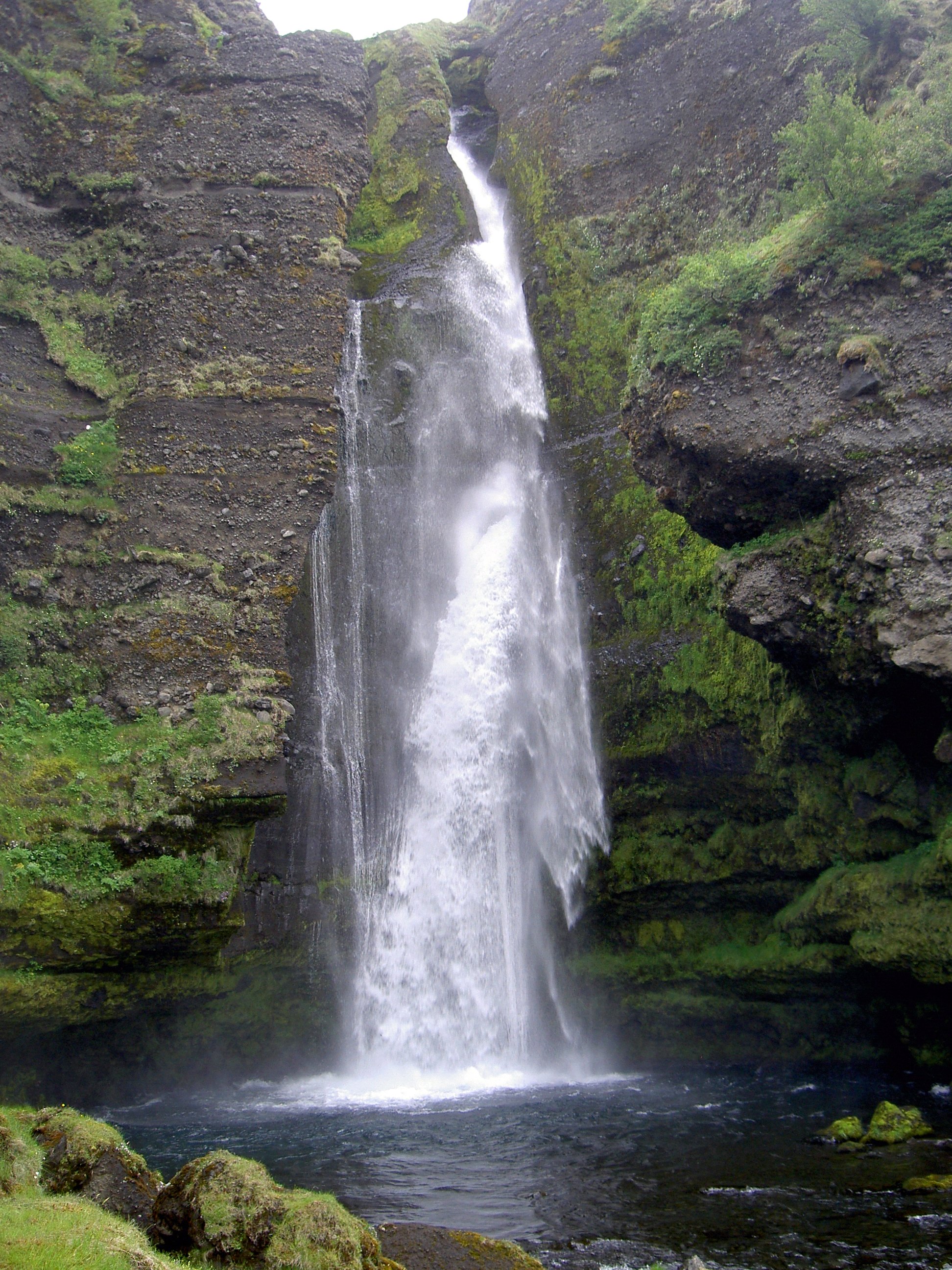
The “you,” the titular pleasure milker, is a kind of seer—not of the future, but of the ancient past. Crying out in awe (“O! Maw of Fog”), the pleasure milker “peels the surface” of the waterfall, and in it, sees the beginnings of the earth itself.
This earth is a girl. She shudders in her orbit. She begins to sprout life. The eons flicker forth…and then, “slick with rain,” the pleasure milker travels back to the world we see with ordinary eyes. Back to the waterfall.
…By now, drenched
as a fern, you resurface to the thundering
gush of falls. You filmy pilgrim,
you pleasure milker, you open your mouth
to sing as though it were a living thing.
I read this poem three times before it opens up for me, before I understand who the pleasure milker is. And I want to be that person, the one who can stand still, staring into falling water, and travel back in time to the earth’s infancy and see wonders of astronomy and geology unfolding. See, and then sing.
As soon as the wish appears, I know that I already have what I ask—or if not this particular, extraordinary species of wonder, then at least something in the same genus. I feel it roiling when I’m in a new place, or with a new human being. (Oh, the unfair hopes I pin on this new baby I’m growing. Please let it be different this time.)
The pleasure milker sees the world’s wild birth in an Argentinian waterfall. But we are pilgrims to quieter waters—duck pond. Scum-laced. Humble home of turtles.
To see, and then sing: What impossible alchemy has to occur in my brain before I can do this with my familiar house? My familiar hours? Whose merciful hands—in the poet’s words—could bind me to my longing?
Whoever you are: Do it, do it. Drive me deep into everything that’s close at hand, until the close-at-hand yields up its marvels.
Jen Hinst-White recently finished her first novel, Inklings, the story of an aspiring female tattooist in the early 1980s. Her writing has been published (or is forthcoming) in The Common, Big Fiction, Cactus Heart, HoldADoor.com and elsewhere. She holds an MFA from the Bennington Writing Seminars. Her website is jenhinstwhite.com.
Previous Post

January 15, 2014
Waking My Mother: Lost and Found
Next Post
January 17, 2014 Rose By Any Other Name
Browse Our Archives
Select a Category A. G. Harmon Alissa Wilkinson Allison Backous Art Authors Brad Fruhauff Bradford Winters Bryan Bliss Caroline Langston Chad Thomas Johnston Chris Hoke Christiana N. Peterson Culture D.G. Myers D.L. Mayfield Daniel Bowman Jr. David Griffith Elizabeth Duffy Faith Film Greg Wolfe Guest Contributor Interview Jan Vallone Jeffrey Overstreet Jessica Eddings-Roeser Jessica Mesman Griffith Kelly Foster Lindsey Crittenden Morgan Meis music Natalie Vestin Nick Olson Peggy Rosenthal Personal Reflection Poetry Friday Reflection Relationships Review Richard Chess Richard Cole Sara Zarr Shannon Huffman Polson Sonya Bilocerkowycz Tania Runyan Tony Woodlief Topical Categories Uncategorized Vic Sizemore Writing
Select a Month October 2018 September 2018 August 2018 July 2018 June 2018 May 2018 April 2018 March 2018 February 2018 January 2018 December 2017 November 2017 October 2017 September 2017 August 2017 July 2017 June 2017 May 2017 April 2017 March 2017 February 2017 January 2017 December 2016 November 2016 October 2016 September 2016 August 2016 July 2016 June 2016 May 2016 April 2016 March 2016 February 2016 January 2016 December 2015 November 2015 October 2015 September 2015 August 2015 July 2015 June 2015 May 2015 April 2015 March 2015 February 2015 January 2015 December 2014 November 2014 October 2014 September 2014 August 2014 July 2014 June 2014 May 2014 April 2014 March 2014 February 2014 January 2014 December 2013 November 2013 October 2013 September 2013 August 2013 July 2013 June 2013 May 2013 April 2013 March 2013 February 2013 January 2013 December 2012 November 2012 October 2012 September 2012 August 2012 July 2012 June 2012 May 2012 February 2008
Follow Us!
TAKE THE
Religious Wisdom Quiz
What animal did Balaam's donkey see that Balaam could not?
Select your answer to see how you score.
A lion A snake A storm An angel
Related posts from Good Letters


On Writing Odes: Taking Time to Celebrate

Poetry Friday: "The Burned Butterfly"

A Conversation with Alicia Ostriker: Part 1
TRENDING AT PATHEOS Catholic

Rejecting Doom: Christian Hope And Human Action
Christianity is a religion of hope. We are to have hope and...

It’s What Comes From Within Which Matters
One of the most difficult things for us to understand is why...

Why I Choose the Eucharist Over the Sermon
Choose the Eucharist, Not the Sermon What are we supposed to get...

5 Design Elements Found in Spiritually Rooted Homes
Putting Spirituality Into Home Decor Our homes are more than our living...

Credo: A Story of God Told with the...
About 10 years ago, I began to imagine a personal "Credo" that...

The Anatomy of Divine Revelation in Catholic Thought
The claim that God has made Himself known to human beings is...
view all Catholic blogs
Ad-Free & Subscriber Log-In Subscription Support
- About Us
- 2026 Calendar
- Videos
- Podcasts
- Library of World Religions
- Faith In Media Tracker
- Advertise With Us
- Write for Us
- Privacy Policy
- Terms of Service
- Do Not Sell My Data
- Contact Us
- Radiant Digital
- Manage Newsletter Subscriptions
- Unsubscribe From Notifications
- Sitemap
Copyright 2008-2026, Patheos. All rights reserved.
Subscription Support Ad-Free & Subscriber Log-In
Follow Patheos