
BuddhistCatholicContemplativeEvangelicalGeneral ChristianHinduJewishLatter-day SaintMuslimNew VisionsProgressive Christian
Beliefs
- Buddhist
- Catholic
- Contemplative
- Evangelical
- General Christian
- Hindu
- Jewish
- Latter-day Saint
- More Voices
- Muslim
- New Visions
- Pagan
- Progressive Christian
Topics
- Religion News
- Food and Religion
- Sports and Religion
- Religious Art
- Religious Music and Entertainment
- Religious Events
- History and Religion
- Style and Religion
- Politics and Religion
- Women in Religion
- Recreation Outdoors and Religion
- Business Finance and Religion
- Careers Workplace and Religion
- Education and Religion
- Family Parenting and Religion
- Health Fitness and Religion
- Home and Religion
- Relationships and Religion
- Technology and Religion
- Travel and Religion
Columnists
- Buddhist Columnists
- Business Finance and Religion Columnists
- Careers Workplace and Religion Columnists
- Catholic Columnists
- Contemplative Columnists
- Education and Religion Columnists
- Evangelists Columnists
- Family Parenting and Religion Columnists
- General Christian Columnists
- Health Fitness and Religion Columnists
- Hindu Columnists
- History and Religion Columnists
- Home and Religion Columnists
- Jewish Columnists
- More Voices Columnists
- Latter Day Columnists
- Muslim Columnists
- New Visions Columnists
- Nonreligious Columnists
- Pagan Columnists
- Politics and Religion Columnists
- Progressive Columnists
- Recreation Outdoors and Religion Columnists
- Relationships and Religion Columnists
- Religion News Columnists
- Religious Art Columnists
- Religious Events Columnists
- Religious Music and Entertainment Columnists
- Sports and Religion Columnists
- Style and Religion Columnists
- Technology and Religion Columnists
- Travel and Religion Columnists
- Women in Religion Columnists
Resource Library
- 2026 Calendar
- Library of World Religions
- The 100 Most Holy Places on Earth
- Patheos Answers
- Podcasts
- Videos
- Faith Leaders Database
- Anglican Episcopalian
- Bahai
- Baptist
- Buddhism
- Christianity
- Confucianism
- Eastern Orthodoxy
- Hinduism
- Holiness and Pentecostal
- ISKCON
- Islam
- Judaism
- Lutheran
- Methodist
- The Church of Jesus Christ of Latter-day Saints
- New Age
- Paganism
- Presbytarian and Reformed
- Protestantism
- Religion Behind the Scenes
- Roman Catholic
- Scientology
- Shia Islam
- Sikhism
- Sufism
- Sunni Islam
- Taoism
- Zen
- See all religions
Research Tools
 Ad-Free & Subscriber Log-In Subscription Support
Ad-Free & Subscriber Log-In Subscription Support
Follow Patheos 

- Trending:
- Forgiveness
- |
- Marriage
- |
- Consciousness
- |
- Death Penalty
- |
- Election
- |
- Halloween
 Good Letters
-
Contributors
- Home
- Catholic
- Beyond Sight: The Imago Dei Project
Beyond Sight: The Imago Dei Project
Last updated on: July 20, 2015 at 12:45 pm by Guest Contributor
Beyond Sight: The Imago Dei Project 2015-07-20T12:45:42-07:00 Guest Contributor
Patheos Explore the world's faith through different perspectives on religion and spirituality! Patheos has the views of the prevalent religions and spiritualities of the world.
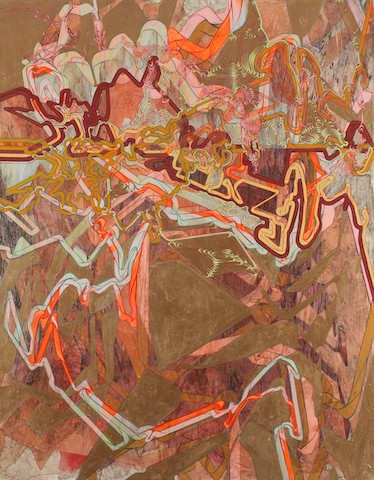 Guest post by Stuart Scadron-Wattles
“The problem is that people are no longer seeing,” said Linnéa Spransy, a visual artist who currently lives and works in Los Angeles.
“It goes way beyond seeing,” replied the biologist Calvin DeWitt, as he turned towards her. “We are not pondering. That’s what Psalm 111 encourages us to do, and we don’t do it.”
Cal DeWitt is an environmental scientist and a professor emeritus at the University of Wisconsin who had been invited by Image to spend a weekend with nine artists and a theologian to ponder creation and evolution.
The gathering was an unlikely one, sponsored by the unusual pairing of Image, an arts organization, and the BioLogos Foundation, which is dedicated to science education.
The hoped-for set of conversations would initiate a three-year project to involve artists in exploring the tensions and resonances of evolutionary theory and a faith-based approach to creation.
Cal DeWitt was very familiar with the problem: as a Christian, he had often faced the problem of elucidating evolutionary theory to other Christians, only to find opposition to the science he presented.
“I blame this on our historic ‘top-down’ theology,” he remarked during his opening presentation. “We refuse to view the facts of nature as the acts of God. Truth cannot be an enemy of truth. God is not divided against himself. A physical fact is as sacred as a moral principle.”
The room became silent.
“I really don’t think that we should correct people’s thinking,” he added, “I think we should ‘be still and know’…. The real problem that Christians are having is this: In the light of all of this evidence, do we matter? Science cannot answer that question.”
Jeremy Begbie, a well-known theologian from Cambridge and Duke universities as well as a professionally trained concert pianist, was seated in a wingback chair, typing energetically into his laptop. His presentation on the following day would begin with and elaborate on the premise of that last statement.
Image had gathered this group on Whidbey Island, north of Seattle, an area with which Cal DeWitt was very familiar—it was here that he had founded the Pacific Rim Institute in 2009, dedicated to providing field studies for Christian students via the Au Sable Institute of Environmental Studies.
After explaining the physical limitations of human sight, Cal began to show LIDAR (Light Distance and Ranging) images of Whidbey Island—satellite images that substitute a visible color for specific wavelengths, allowing one, for instance, to see how the retreating glacier had formed the land beneath the vegetation in undulating patterns.
While he spoke on the need to update the case for Darwin (“we need a term for evolution that is not ‘evolution’”), he was clearly more comfortable discussing the observations of environmental science.
The afternoon session had been set aside for the artists. Most of them did not know one another, and Image had requested that they bring some representation of their work, by way of introduction. As Linnéa Spransy took us through several slides of her paintings and installations, she began talking about her process.
“I’m obsessed by rules,” she said, in what would turn out to be a characteristically quiet voice: “My pieces are all based on mathematical relationships, formulas that dictate where lines will go. I create these formulas and then follow them where they lead. I never know where they are going to go, really.”
She displayed a piece in process that still had certain points marked, as centers from which calculations could be made. “The centers are removed for the final work. Later, with some pieces, I’ll introduce an element of chaos,” she added, pointing to an area of one of her works that showed some abrupt density of form and color, but otherwise, seemed a part of the whole.
One of Linnéa’s installations was connected with a piece of performance art, in which the performance artist meditated for several hours near the visual work in progress and wore biometric devices that converted her breathing rate, pulse, and brain activity into mathematical information. Linnéa then translated that data into further work on the visual piece, which in turn affected the next round of meditation.
The evolutionary/interactive nature of the project was obvious; while everyone absorbed it, no one remarked upon it.
A striking moment occurred when Linnéa clicked to the next slide, and a familiar set of patterns appeared. We had seen them earlier that morning, on one of Cal’s LIDAR images. One tends not to think of retreating glaciers as following formulas, but there it was.
Across separations of time, media, scale, and—most of all—intentionality, painter and glacier seemed to have stumbled upon the same set of formulas.
It was the beginning of what would become a set of powerful resonances throughout the weekend.
Stuart Scadron-Wattles has at various times been a director, a playwright, an actor, and essayist, and still is a bit more trouble than he is worth. He is currently the director of resource development for Image*.*
Linnéa Spransy will be leading the painting seminar at Image’s Glen West Workshop this summer.
Art Pictured: Linnéa Spransy Parallelism*, 2012, Sumi ink & acrylic on canvas, 45 x 35 in.*
Previous Post

January 27, 2014
The Parent State
Next Post
January 30, 2014 The Second Coming of Flannery O’Connor
Browse Our Archives
Select a Category A. G. Harmon Alissa Wilkinson Allison Backous Art Authors Brad Fruhauff Bradford Winters Bryan Bliss Caroline Langston Chad Thomas Johnston Chris Hoke Christiana N. Peterson Culture D.G. Myers D.L. Mayfield Daniel Bowman Jr. David Griffith Elizabeth Duffy Faith Film Greg Wolfe Guest Contributor Interview Jan Vallone Jeffrey Overstreet Jessica Eddings-Roeser Jessica Mesman Griffith Kelly Foster Lindsey Crittenden Morgan Meis music Natalie Vestin Nick Olson Peggy Rosenthal Personal Reflection Poetry Friday Reflection Relationships Review Richard Chess Richard Cole Sara Zarr Shannon Huffman Polson Sonya Bilocerkowycz Tania Runyan Tony Woodlief Topical Categories Uncategorized Vic Sizemore Writing
Select a Month October 2018 September 2018 August 2018 July 2018 June 2018 May 2018 April 2018 March 2018 February 2018 January 2018 December 2017 November 2017 October 2017 September 2017 August 2017 July 2017 June 2017 May 2017 April 2017 March 2017 February 2017 January 2017 December 2016 November 2016 October 2016 September 2016 August 2016 July 2016 June 2016 May 2016 April 2016 March 2016 February 2016 January 2016 December 2015 November 2015 October 2015 September 2015 August 2015 July 2015 June 2015 May 2015 April 2015 March 2015 February 2015 January 2015 December 2014 November 2014 October 2014 September 2014 August 2014 July 2014 June 2014 May 2014 April 2014 March 2014 February 2014 January 2014 December 2013 November 2013 October 2013 September 2013 August 2013 July 2013 June 2013 May 2013 April 2013 March 2013 February 2013 January 2013 December 2012 November 2012 October 2012 September 2012 August 2012 July 2012 June 2012 May 2012 February 2008
Follow Us!
TAKE THE
Religious Wisdom Quiz
True or False: Job's three friends were named Eliphaz, Bildad, and Zophar.
Select your answer to see how you score.
FALSE TRUE
Related posts from Good Letters

The Stars of the Earth Cry Out


Poetry Friday: “The Ordinary Time”
TRENDING AT PATHEOS Catholic

The Parable Of The Sower And The Word...
One of Christ’s most famous parables is that of the sower who...

Rejecting Doom: Christian Hope And Human Action
Christianity is a religion of hope. We are to have hope and...

Why I Choose the Eucharist Over the Sermon
Choose the Eucharist, Not the Sermon What are we supposed to get...

5 Design Elements Found in Spiritually Rooted Homes
Putting Spirituality Into Home Decor Our homes are more than our living...

Credo: A Story of God Told with the...
About 10 years ago, I began to imagine a personal "Credo" that...

The Anatomy of Divine Revelation in Catholic Thought
The claim that God has made Himself known to human beings is...
view all Catholic blogs
Ad-Free & Subscriber Log-In Subscription Support
- About Us
- 2026 Calendar
- Videos
- Podcasts
- Library of World Religions
- Faith In Media Tracker
- Advertise With Us
- Write for Us
- Privacy Policy
- Terms of Service
- Do Not Sell My Data
- Contact Us
- Radiant Digital
- Manage Newsletter Subscriptions
- Unsubscribe From Notifications
- Sitemap
Copyright 2008-2026, Patheos. All rights reserved.
Subscription Support Ad-Free & Subscriber Log-In
Follow Patheos