
BuddhistCatholicContemplativeEvangelicalGeneral ChristianHinduJewishLatter-day SaintMuslimNew VisionsProgressive Christian
Beliefs
- Buddhist
- Catholic
- Contemplative
- Evangelical
- General Christian
- Hindu
- Jewish
- Latter-day Saint
- More Voices
- Muslim
- New Visions
- Pagan
- Progressive Christian
Topics
- Religion News
- Food and Religion
- Sports and Religion
- Religious Art
- Religious Music and Entertainment
- Religious Events
- History and Religion
- Style and Religion
- Politics and Religion
- Women in Religion
- Recreation Outdoors and Religion
- Business Finance and Religion
- Careers Workplace and Religion
- Education and Religion
- Family Parenting and Religion
- Health Fitness and Religion
- Home and Religion
- Relationships and Religion
- Technology and Religion
- Travel and Religion
Columnists
- Buddhist Columnists
- Business Finance and Religion Columnists
- Careers Workplace and Religion Columnists
- Catholic Columnists
- Contemplative Columnists
- Education and Religion Columnists
- Evangelists Columnists
- Family Parenting and Religion Columnists
- General Christian Columnists
- Health Fitness and Religion Columnists
- Hindu Columnists
- History and Religion Columnists
- Home and Religion Columnists
- Jewish Columnists
- More Voices Columnists
- Latter Day Columnists
- Muslim Columnists
- New Visions Columnists
- Nonreligious Columnists
- Pagan Columnists
- Politics and Religion Columnists
- Progressive Columnists
- Recreation Outdoors and Religion Columnists
- Relationships and Religion Columnists
- Religion News Columnists
- Religious Art Columnists
- Religious Events Columnists
- Religious Music and Entertainment Columnists
- Sports and Religion Columnists
- Style and Religion Columnists
- Technology and Religion Columnists
- Travel and Religion Columnists
- Women in Religion Columnists
Resource Library
- 2026 Calendar
- Library of World Religions
- The 100 Most Holy Places on Earth
- Patheos Answers
- Podcasts
- Videos
- Faith Leaders Database
- Anglican Episcopalian
- Bahai
- Baptist
- Buddhism
- Christianity
- Confucianism
- Eastern Orthodoxy
- Hinduism
- Holiness and Pentecostal
- ISKCON
- Islam
- Judaism
- Lutheran
- Methodist
- The Church of Jesus Christ of Latter-day Saints
- New Age
- Paganism
- Presbytarian and Reformed
- Protestantism
- Religion Behind the Scenes
- Roman Catholic
- Scientology
- Shia Islam
- Sikhism
- Sufism
- Sunni Islam
- Taoism
- Zen
- See all religions
Research Tools
 Ad-Free & Subscriber Log-In Subscription Support
Ad-Free & Subscriber Log-In Subscription Support
Follow Patheos 

- Trending:
- Forgiveness
- |
- Marriage
- |
- Consciousness
- |
- Death Penalty
- |
- Election
- |
- Halloween
 Good Letters
-
Contributors
- Home
- Catholic
- Writing My Mother’s Icon
Writing My Mother’s Icon
Last updated on: December 12, 2013 at 10:05 am by Allison Backous Troy
Writing My Mother’s Icon 2013-12-12T10:05:03-07:00 Allison Backous Troy
Patheos Explore the world's faith through different perspectives on religion and spirituality! Patheos has the views of the prevalent religions and spiritualities of the world.
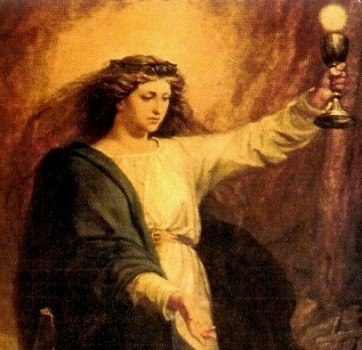 Blessed Santa Barbara, / Your story is written in the sky, / With paper and holy water.
December 4 marked the feast day of St. Barbara. An early martyr, St. Barbara announced her faith to her pagan father by having three windows—a sign of the Trinity—cut into a wall of her private bath. It is said that the torches St. Barbara’s father used to torture her would extinguish themselves before they could be pressed against her skin.
My mother, also named Barbara, spent her summers cleaning the rooms of my grandfather’s motel; memories of the task still make her shudder. My grandfather refused to wash sheets or towels, and was either too drunk or angry for my mother to ask for a clean washrag.
“I cannot stand dirt,” she says, filling her sink with soapy water, reaching for the spoon I used to spoon sugar into her coffee. Her cigarette rests on the sink’s aluminum edge, its ash hovering over the sudsy water, which she will use to wash the spoon and the rest of the day’s dishes. It is a better spot for the cigarette than the counter by the stove, which, she has mentioned, is now miraculously free of grease stains.
“Baby oil! A little bit just rubs the grease away,” she exclaims, somehow forgetting how flammable baby oil is, how easily it could set her small kitchen ablaze, the file cabinet holding her life’s paperwork sidled next to the stove, the first thing to go should the oil spark.
If I were to hold my mother up to her unofficial patron, I would see two women whose lives were vastly different, one a patron of those who work with explosives, the other always on the verge of exploding—the dishes clanging together in her hands, her jaw set against whatever she believed was working against her: my father’s obstinate silence, the weight of our poverty, the childhood memories that she drank to avoid.
But the memories and her marriage to my father were too large a strain for her to hold anything together, and believing that she didn’t belong to my father or to us, she took a lover, left my father, and plummeted my siblings and me into years of abuse and neglect, her lover’s words turned sour by his fists and wandering hands, her ability to care for us compromised by her desire to be loved and known in the way she saw fit.
Iconographers believe that they are “writing,” or translating, the saint’s life into a story that, through the power of image, draws us into that life. The intention is holiness: the icon is a window into the particular movements of a holy person’s spiritual journey, and by approaching the icon with reverence, your own journey becomes more visible, more easily known and understood.
But the more I approach my mother’s life, the less I understand. During the long night stretches of nursing my son, I brood over what I remember, worrying that the same anger rising in me is what rose in my mother, that it will someday uproot me the way it continues to uproot her, our phone calls filled with her complaints about gangbanger neighbors, the length of time it has taken for me to return her last phone call.
What holds true about the writing of icons is what holds true for us: the icon is a glimpse into the fullness of the kingdom of God, and what we behold in paint and wood is what we must behold in each other. If St. Barbara is holy, it is Christ dwelling in the particulars of her life that makes her holy; it is Christ who watches us as we kiss and kneel and pray.
Do I doubt that God dwells in the particulars of my mother’s life? Do I look for vindication that she is a terrible person, or at least, that she has been a terrible mother, my own heart still racing in fear every time I hear her voice on the other line? Is it impossible, now, for me to see God in her?
It has occurred to me that, in writing about my family life, I am trying to write our icon, and that it will possibly remain unfinished in my sight, that what I perceive as impassable anger will, at the end, be transformed into something I can only long for, blind and unbelieving as I am.
In traditional iconography, it is common to depict the saint with defining artifacts from her life. St. Barbara is often shown holding a small tower, a representation of the actual tower in which her father locked her during her girlhood.
What are the artifacts of my mother’s life? Cigarettes, Heineken bottles, suicide notes my siblings found tucked beneath piles of mail?
Or would an icon of my mother show her holding flower seeds, blooms sprouting out of the paper seed packets, her hands stretched out and open?
For while it is true that my mother hates dirt, she also loves it, loves to save whatever flowers are wilting in the grocery store garden section and plant them in her yard. She waters whatever grows: morning glories, pansies, sunflowers with monstrous heads.
“Look at these guys!” she exclaims, waving a hand toward the kitchen window, the sunflowers peeking in. “They just spring right out of the ground! I love them!”
I could be jealous of the flowers, envious of how they elicit so much care from my mother. But what can I say? She presses a large paper bag of wildflower seeds into my hands; the seeds are old, but “plant them anyway,” she says, “just see what blooms.”
I keep the seeds with me for years, and finally plant them on a whim, digging two long furrows up the walkway to my front door.
And my yard explodes with blossoms of blue and white, flowers I cannot name but which remain standing after the first snowfall, their faces turned toward my windows, watching.
Previous Post

December 11, 2013
The Sabbath and Liberal Arts Education, Part 3
Next Post
December 13, 2013 An Almost Human Happiness
Browse Our Archives
Select a Category A. G. Harmon Alissa Wilkinson Allison Backous Art Authors Brad Fruhauff Bradford Winters Bryan Bliss Caroline Langston Chad Thomas Johnston Chris Hoke Christiana N. Peterson Culture D.G. Myers D.L. Mayfield Daniel Bowman Jr. David Griffith Elizabeth Duffy Faith Film Greg Wolfe Guest Contributor Interview Jan Vallone Jeffrey Overstreet Jessica Eddings-Roeser Jessica Mesman Griffith Kelly Foster Lindsey Crittenden Morgan Meis music Natalie Vestin Nick Olson Peggy Rosenthal Personal Reflection Poetry Friday Reflection Relationships Review Richard Chess Richard Cole Sara Zarr Shannon Huffman Polson Sonya Bilocerkowycz Tania Runyan Tony Woodlief Topical Categories Uncategorized Vic Sizemore Writing
Select a Month October 2018 September 2018 August 2018 July 2018 June 2018 May 2018 April 2018 March 2018 February 2018 January 2018 December 2017 November 2017 October 2017 September 2017 August 2017 July 2017 June 2017 May 2017 April 2017 March 2017 February 2017 January 2017 December 2016 November 2016 October 2016 September 2016 August 2016 July 2016 June 2016 May 2016 April 2016 March 2016 February 2016 January 2016 December 2015 November 2015 October 2015 September 2015 August 2015 July 2015 June 2015 May 2015 April 2015 March 2015 February 2015 January 2015 December 2014 November 2014 October 2014 September 2014 August 2014 July 2014 June 2014 May 2014 April 2014 March 2014 February 2014 January 2014 December 2013 November 2013 October 2013 September 2013 August 2013 July 2013 June 2013 May 2013 April 2013 March 2013 February 2013 January 2013 December 2012 November 2012 October 2012 September 2012 August 2012 July 2012 June 2012 May 2012 February 2008
Follow Us!
TAKE THE
Religious Wisdom Quiz
Proverbs warns against what kind of woman as a symbol of temptation?
Select your answer to see how you score.
Widow Queen Adulterous woman Mother-in-law
Related posts from Good Letters

Maya Angelou’s Caged Bird and Me

Marital Anger and Icelandic Rock Spirits
TRENDING AT PATHEOS Catholic

Rejecting Doom: Christian Hope And Human Action
Christianity is a religion of hope. We are to have hope and...

It’s What Comes From Within Which Matters
One of the most difficult things for us to understand is why...

Why I Choose the Eucharist Over the Sermon
Choose the Eucharist, Not the Sermon What are we supposed to get...

5 Design Elements Found in Spiritually Rooted Homes
Putting Spirituality Into Home Decor Our homes are more than our living...

Credo: A Story of God Told with the...
About 10 years ago, I began to imagine a personal "Credo" that...

The Anatomy of Divine Revelation in Catholic Thought
The claim that God has made Himself known to human beings is...
view all Catholic blogs
Ad-Free & Subscriber Log-In Subscription Support
- About Us
- 2026 Calendar
- Videos
- Podcasts
- Library of World Religions
- Faith In Media Tracker
- Advertise With Us
- Write for Us
- Privacy Policy
- Terms of Service
- Do Not Sell My Data
- Contact Us
- Radiant Digital
- Manage Newsletter Subscriptions
- Unsubscribe From Notifications
- Sitemap
Copyright 2008-2026, Patheos. All rights reserved.
Subscription Support Ad-Free & Subscriber Log-In
Follow Patheos