
BuddhistCatholicContemplativeEvangelicalGeneral ChristianHinduJewishLatter-day SaintMuslimNew VisionsProgressive Christian
Beliefs
- Buddhist
- Catholic
- Contemplative
- Evangelical
- General Christian
- Hindu
- Jewish
- Latter-day Saint
- More Voices
- Muslim
- New Visions
- Pagan
- Progressive Christian
Topics
- Religion News
- Food and Religion
- Sports and Religion
- Religious Art
- Religious Music and Entertainment
- Religious Events
- History and Religion
- Style and Religion
- Politics and Religion
- Women in Religion
- Recreation Outdoors and Religion
- Business Finance and Religion
- Careers Workplace and Religion
- Education and Religion
- Family Parenting and Religion
- Health Fitness and Religion
- Home and Religion
- Relationships and Religion
- Technology and Religion
- Travel and Religion
Columnists
- Buddhist Columnists
- Business Finance and Religion Columnists
- Careers Workplace and Religion Columnists
- Catholic Columnists
- Contemplative Columnists
- Education and Religion Columnists
- Evangelists Columnists
- Family Parenting and Religion Columnists
- General Christian Columnists
- Health Fitness and Religion Columnists
- Hindu Columnists
- History and Religion Columnists
- Home and Religion Columnists
- Jewish Columnists
- More Voices Columnists
- Latter Day Columnists
- Muslim Columnists
- New Visions Columnists
- Nonreligious Columnists
- Pagan Columnists
- Politics and Religion Columnists
- Progressive Columnists
- Recreation Outdoors and Religion Columnists
- Relationships and Religion Columnists
- Religion News Columnists
- Religious Art Columnists
- Religious Events Columnists
- Religious Music and Entertainment Columnists
- Sports and Religion Columnists
- Style and Religion Columnists
- Technology and Religion Columnists
- Travel and Religion Columnists
- Women in Religion Columnists
Resource Library
- 2026 Calendar
- Library of World Religions
- The 100 Most Holy Places on Earth
- Patheos Answers
- Podcasts
- Videos
- Faith Leaders Database
- Anglican Episcopalian
- Bahai
- Baptist
- Buddhism
- Christianity
- Confucianism
- Eastern Orthodoxy
- Hinduism
- Holiness and Pentecostal
- ISKCON
- Islam
- Judaism
- Lutheran
- Methodist
- The Church of Jesus Christ of Latter-day Saints
- New Age
- Paganism
- Presbytarian and Reformed
- Protestantism
- Religion Behind the Scenes
- Roman Catholic
- Scientology
- Shia Islam
- Sikhism
- Sufism
- Sunni Islam
- Taoism
- Zen
- See all religions
Research Tools
 Ad-Free & Subscriber Log-In Subscription Support
Ad-Free & Subscriber Log-In Subscription Support
Follow Patheos 

- Trending:
- Forgiveness
- |
- Marriage
- |
- Consciousness
- |
- Death Penalty
- |
- Election
- |
- Halloween
 Good Letters
-
Contributors
- Home
- Catholic
- Sleeping Beauty, Part 2
Sleeping Beauty, Part 2
Last updated on: June 11, 2014 at 6:28 pm by Jan Vallone
Sleeping Beauty, Part 2 2014-06-11T18:28:16-07:00 Jan Vallone
Patheos Explore the world's faith through different perspectives on religion and spirituality! Patheos has the views of the prevalent religions and spiritualities of the world.
Today’s post, an excerpt from Pieces of Someday: One Woman’s Search for Meaning in Lawyering, Family, Italy, Church, and a Tiny Jewish High School, is continued from yesterday.
In my twenties, it was Holly Brown I longed to be. We two were medical lab techs then working at UNC. Every morning she’d sashay to her bench, flicking her Farrah Fawcett mane: “Good mornin’ y’all.”
As jasmine-gardenia perfume gusted from Holly’s curly halo, the male techs would look up from their microscopes, dropping jaws to gawk. In my corner, I’d reach for the radio, turn up the volume of Bruce Springsteen: Show a little faith there’s magic in the night / You ain’t a beauty but hey you’re alright.
But I wasn’t all right. So I spent a few days’ salary to reinvent myself as Holly. As I sat before a salon mirror, Jean Paul pumped the swivel chair, raising the object of his art. He shampooed my hair in awapuhi—wafting ginger scent—parted it into sections, paper-wrapped each around a rod. He squeezed on glycerol monothioglycolate, plastic-capped my head. He helmeted me with a dryer and toggled on the heat.
My scalp prickled and crawled. My ears sizzled like bacon. But the dryer drone fired my fantasies as I flipped through an issue of Vogue: Maybe the lab crew will realize I’m a dove and Holly’s a crow.
Jean Paul rinsed my head to stop the process. He cut and blew dry my hair. Then he swiveled my chair towards the mirror—voilà: Christ, I have a fro.
I’m embarrassed to admit that in my thirties, my desire was to look like Princess Di—the ultra-toned body, bright smile. The lash-brushing bangs and royal rose-petal skin. So I went to aerobics, tried Pearl Drops, scrubbed my face, cut my hair Diana-style.
But somehow I contracted the chickenpox, pox upon pox upon pox. They healed leaving scars on my chin, causing me to turn from every mirror. The marks seemed to shout from my jaw, “See how repulsive she is!”
What would Princess Di do about such horrid imperfections?
I made an appointment with Dr. Fleisch, a well-known dermatologist. He suggested dermabrasion. If I elected the surgery, he’d give me medication to relax. Then he’d cleanse my face with antiseptic, apply a spray to insta-freeze my skin. That done, he’d use a rotary tool to sand off several epidermal layers.
Post-op, the site would be raw, requiring pain relievers. My face would take three months to heal, need sun-shields for six to eight. Luckily, side effects were few—infections, fever blisters, scars, thickened skin, splotchy pigmentation.
I squirmed as Dr. Fleisch disclosed the details, asked if many patients chose the surgery.
“It’s a commoner procedure.”
So I knew that Di would never do it; I’d have to research something else.
Why should physical beauty be the object of lifelong yearning? Trigger decades of envy and grief? Prompt cosmetics, surgery, false hope? And why, even into my forties, did I still pine to be a dove among the crows?
How I fussed on a trip to Palermo, Sicily, before visiting my step-grandmother. The last time I’d seen Mimma, I was barely into my twenties. Now she was eighty-six and I a wife, the mother of two teens. Still, I slathered my wrinkles with creams, bleached my teeth, tinted my hair. I wore capris to mask my thighs, long sleeves to hide my arms.
And what did Mimma do when we showed her a Polaroid we’d taken after she’d scaled two flights like a jilly-goat to fetch her brother for lunch? After she served us a four-course meal she’d cooked and served herself? After she toured us around the apartment she still dusted, swept, and mopped? She shook her head at the photo and covered her image with her hand. “O Dio, I old.”
A short walk from Mimma’s apartment is the Convento dei Cappuccini. In 1599 the monks noticed something strange: their catacombs released mysterious vapors that mummified the dead. When the monks announced the discovery, they set off a public frenzy. People clamored to be buried there to preserve their beauty after death.
In the catacombs’ long dank corridors rest eight thousand corpses. Each is suspended by the neck like a lamb hanging at the butcher’s, each wearing Sunday’s best clothes. A monk hovers in a cassock, penance rope around his neck. A woman wafts hoop-skirted, wielding a parasol. A soldier sentries in uniform and a wide three-cornered hat.
There’s a special section for children. The last catacombed corpse was a girl who died of croup in 1920. Frocked flouncily in pink, ringlets gathered in a bow, she rests in a transparent casket.
The monks call the girl Sleeping Beauty, but there’s little beauty in the crypt. Sleeping Beauty’s skin is doll-waxy, her hair faded, dull, limp. And the flesh of the corpses around her is either mummified or gone. Many faces grimace, some mouthing Edvard Munch screams, the husks of their decaying bodies coated with decades of dust.
But I couldn’t tell Kalindah about the catacombs.
Or that Debbie went skating with her boyfriend on a lake near her college dorm and drowned falling through the ice.
Or that Angela discovered stage three cancer and lost her breasts and hair.
Or that my mother developed a neuroma that twisted and paralyzed her face.
Or that Prince Charles divorced Diana, who died in a car crash shortly after.
Or that when I thought about the women whose beauty I envied all my life, I closed my eyes and thanked God for my wrinkles.
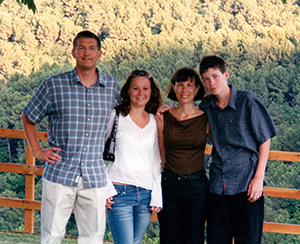
Instead, I pulled a snapshot from my wallet—my family in the Sicilian sun. “Kalindah, you’re fine just as you are. Look, let me show you something. These are the people I love most in the world: My husband—we’ve been married twenty-three years. My daughter—she’s your age. My son, who’s two years younger. And Kalindah, when I was sixteen, I didn’t know a single one of them.”
Kalindah took the photo from my hands, studied it a moment, looked up. “Your daughter’s really pretty. She looks a lot like you.”
Jan Vallone is the author of Pieces of Someday: One Woman’s Search for Meaning in Lawyering Family, Italy, Church, and a Tiny Jewish High School which was released in December, 2013, and won the Reader Views Reviewers’ Choice Award. Her stories have appeared in The Seattle Times, Catholic Digest, Guideposts Magazine, English Journal, Chicken Soup for the Soul, Writing it Real, and Curriculum in Context. She teaches writing and literature at Seattle Pacific University.
Previous Post

December 17, 2013
Sleeping Beauty, Part 1
Next Post
December 19, 2013 Blow on the Coal of the Heart
Browse Our Archives
Select a Category A. G. Harmon Alissa Wilkinson Allison Backous Art Authors Brad Fruhauff Bradford Winters Bryan Bliss Caroline Langston Chad Thomas Johnston Chris Hoke Christiana N. Peterson Culture D.G. Myers D.L. Mayfield Daniel Bowman Jr. David Griffith Elizabeth Duffy Faith Film Greg Wolfe Guest Contributor Interview Jan Vallone Jeffrey Overstreet Jessica Eddings-Roeser Jessica Mesman Griffith Kelly Foster Lindsey Crittenden Morgan Meis music Natalie Vestin Nick Olson Peggy Rosenthal Personal Reflection Poetry Friday Reflection Relationships Review Richard Chess Richard Cole Sara Zarr Shannon Huffman Polson Sonya Bilocerkowycz Tania Runyan Tony Woodlief Topical Categories Uncategorized Vic Sizemore Writing
Select a Month October 2018 September 2018 August 2018 July 2018 June 2018 May 2018 April 2018 March 2018 February 2018 January 2018 December 2017 November 2017 October 2017 September 2017 August 2017 July 2017 June 2017 May 2017 April 2017 March 2017 February 2017 January 2017 December 2016 November 2016 October 2016 September 2016 August 2016 July 2016 June 2016 May 2016 April 2016 March 2016 February 2016 January 2016 December 2015 November 2015 October 2015 September 2015 August 2015 July 2015 June 2015 May 2015 April 2015 March 2015 February 2015 January 2015 December 2014 November 2014 October 2014 September 2014 August 2014 July 2014 June 2014 May 2014 April 2014 March 2014 February 2014 January 2014 December 2013 November 2013 October 2013 September 2013 August 2013 July 2013 June 2013 May 2013 April 2013 March 2013 February 2013 January 2013 December 2012 November 2012 October 2012 September 2012 August 2012 July 2012 June 2012 May 2012 February 2008
Follow Us!
TAKE THE
Religious Wisdom Quiz
What Christian group is known for their "Circuit Riders" in history?
Select your answer to see how you score.
Baptists Lutherans Anglicans Methodists
Related posts from Good Letters


Marital Anger and Icelandic Rock Spirits

The Marvelous Mrs. Maisel's Hidden Identity

TRENDING AT PATHEOS Catholic

Rejecting Doom: Christian Hope And Human Action
Christianity is a religion of hope. We are to have hope and...

It’s What Comes From Within Which Matters
One of the most difficult things for us to understand is why...

Why I Choose the Eucharist Over the Sermon
Choose the Eucharist, Not the Sermon What are we supposed to get...

5 Design Elements Found in Spiritually Rooted Homes
Putting Spirituality Into Home Decor Our homes are more than our living...

Credo: A Story of God Told with the...
About 10 years ago, I began to imagine a personal "Credo" that...

The Anatomy of Divine Revelation in Catholic Thought
The claim that God has made Himself known to human beings is...
view all Catholic blogs
Ad-Free & Subscriber Log-In Subscription Support
- About Us
- 2026 Calendar
- Videos
- Podcasts
- Library of World Religions
- Faith In Media Tracker
- Advertise With Us
- Write for Us
- Privacy Policy
- Terms of Service
- Do Not Sell My Data
- Contact Us
- Radiant Digital
- Manage Newsletter Subscriptions
- Unsubscribe From Notifications
- Sitemap
Copyright 2008-2026, Patheos. All rights reserved.
Subscription Support Ad-Free & Subscriber Log-In
Follow Patheos