
BuddhistCatholicContemplativeEvangelicalGeneral ChristianHinduJewishLatter-day SaintMuslimNew VisionsProgressive Christian
Beliefs
- Buddhist
- Catholic
- Contemplative
- Evangelical
- General Christian
- Hindu
- Jewish
- Latter-day Saint
- More Voices
- Muslim
- New Visions
- Pagan
- Progressive Christian
Topics
- Religion News
- Food and Religion
- Sports and Religion
- Religious Art
- Religious Music and Entertainment
- Religious Events
- History and Religion
- Style and Religion
- Politics and Religion
- Women in Religion
- Recreation Outdoors and Religion
- Business Finance and Religion
- Careers Workplace and Religion
- Education and Religion
- Family Parenting and Religion
- Health Fitness and Religion
- Home and Religion
- Relationships and Religion
- Technology and Religion
- Travel and Religion
Columnists
- Buddhist Columnists
- Business Finance and Religion Columnists
- Careers Workplace and Religion Columnists
- Catholic Columnists
- Contemplative Columnists
- Education and Religion Columnists
- Evangelists Columnists
- Family Parenting and Religion Columnists
- General Christian Columnists
- Health Fitness and Religion Columnists
- Hindu Columnists
- History and Religion Columnists
- Home and Religion Columnists
- Jewish Columnists
- More Voices Columnists
- Latter Day Columnists
- Muslim Columnists
- New Visions Columnists
- Nonreligious Columnists
- Pagan Columnists
- Politics and Religion Columnists
- Progressive Columnists
- Recreation Outdoors and Religion Columnists
- Relationships and Religion Columnists
- Religion News Columnists
- Religious Art Columnists
- Religious Events Columnists
- Religious Music and Entertainment Columnists
- Sports and Religion Columnists
- Style and Religion Columnists
- Technology and Religion Columnists
- Travel and Religion Columnists
- Women in Religion Columnists
Resource Library
- 2026 Calendar
- Library of World Religions
- The 100 Most Holy Places on Earth
- Patheos Answers
- Podcasts
- Videos
- Faith Leaders Database
- Anglican Episcopalian
- Bahai
- Baptist
- Buddhism
- Christianity
- Confucianism
- Eastern Orthodoxy
- Hinduism
- Holiness and Pentecostal
- ISKCON
- Islam
- Judaism
- Lutheran
- Methodist
- The Church of Jesus Christ of Latter-day Saints
- New Age
- Paganism
- Presbytarian and Reformed
- Protestantism
- Religion Behind the Scenes
- Roman Catholic
- Scientology
- Shia Islam
- Sikhism
- Sufism
- Sunni Islam
- Taoism
- Zen
- See all religions
Research Tools
 Ad-Free & Subscriber Log-In Subscription Support
Ad-Free & Subscriber Log-In Subscription Support
Follow Patheos 

- Trending:
- Forgiveness
- |
- Marriage
- |
- Consciousness
- |
- Death Penalty
- |
- Election
- |
- Halloween
 Good Letters
-
Contributors
- Home
- Catholic
- Rich in Rituals
Rich in Rituals
Last updated on: December 6, 2013 at 1:00 am by Shannon Huffman Polson
Rich in Rituals 2013-12-05T17:25:15-07:00 Shannon Huffman Polson
Patheos Explore the world's faith through different perspectives on religion and spirituality! Patheos has the views of the prevalent religions and spiritualities of the world.
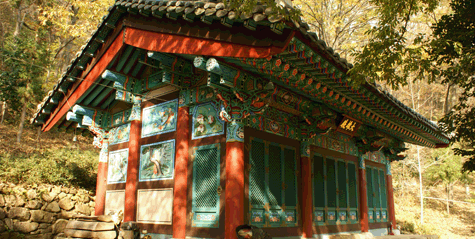 I spent fifteen months in South Korea once on a military base we knew would be one of the first targets of the North Koreans in event of attack. They were hard months. I was time-zones away from people and places that I loved.
Our tiny base was located on the edge of the city of Ch’un Ch’on in the Gangwon region, famous for the Han and Soyang Rivers and a number of lakes and small islands. It’s a destination for residents of Seoul located two hours by train to the south. What I remember most are the mountains of the Taebaek range, gentle contours turning declivitous when you ventured among them. Narrow and unimproved trails led past Buddhist temples with painted story cycles brilliantly rendered in colors not meant to blend in but to inspire.
On occasion I came across a tiny old woman who hiked up in high heels to take care of the temple. She would smile and nod, and I would do the same, separated by culture and language but brought together by the mountains, a place we both thought was holy. Further along these trails, along the ridges and hilltops, were trenches and fighting positions from the Korean War.
On the base, differences not similarities, were in constant relief as we stumbled to navigate unknown customs to accomplish the smallest tasks. Our unit attempted solidarity by moving through holidays with mess hall meals. We officers wore class-A uniforms to serve the soldiers. They were traditional gestures that did little to ease the sense of separation.
And then, when I least expected it, came a moment of grace. A fellow officer who was Korean-American had family living in the city nearby. One fall weekend, he invited me and a few others to join him at his family’s home for Chuseok, a festival of the harvest scheduled by the lunar calendar.
We arrived at their apartment in the morning. Several women dressed in traditional Korean clothing giggled in the kitchen over piles of food they had prepared over the previous several days, and from the volume and variety of the fare, one assumed preparation went well into the nights. We did not share a common language, and so we guests smiled and stood respectfully at the sides of the room.
Chuseok began with a ceremony called charye performed by the men in the living room. They knelt on a mat in front of a low table, on which the women had placed extensive offerings of food. A script written in Korean formed the backdrop for the table; I understood this listed the names of the family’s ancestors. The men executed a series of formal bows so deep their heads touched the floor. One man performed a series of complex motions using chopsticks and pouring rice wine.
Over the next several hours we shared the food the women set out. I remember the men eating first, and then the guests, and I hope the women eventually enjoyed some of what they had made, too. I remember clear rice noodles with a strong garlic flavor and a bit of sweetness, the sweet and tender bulgogi I had come to love, and songpyeon, steamed rice cakes filled with any number of fillings from red bean to crushed nuts. I declined the strong soju which flowed freely following enthusiastic toasts, and which my gender permitted me to refuse.
It was a leisurely meal; afterwards the family put on casual clothes and we piled into a minivan to drive out to a hillside cemetery surrounded by forest where the family’s ancestors were buried. The men performed a simpler but similar ceremony with food and rice wine on the grave. I took a photograph of a little boy standing in front of a lovely stone marker, his round face reflected in the smooth surface of the stone. At the end of the day, we returned to our base. I went back to my empty apartment with the lingering warmth of a connection I had not felt in a long time.
I remember that visit with the Lee family and the mountains of Korea every holiday season. My rituals of remembrance are more modest: in the morning I light a candle remembering my father and stepmother whom I lost eight years ago. We alternate holiday meals between houses: my mother’s, my father-in-law’s, and ours for holiday feasts. We say a prayer of thanks and remembrance.
This week I read a short magazine article by an avowed atheist doing research for a TV series on the Bible. She climbs to the top of what is believed to be Mt. Sinai, noting that archaeologists disagree on whether or not it is the actual Mt. Sinai referred to in the Bible. She feels fatigue in her legs, hears the sounds of birds and the muezzin below, she sees a woman hold up a small Bible to the rising sun, she watches Muslims pray at their mosque. She will never join the ranks of the religious, she assures the reader, but sees how generations have come here in belief, how the ages continue to move through this holy place, even as one generation turns to dust.
Her proclamation is curious; such bald assurance in the face of wonder and devotion, such unwillingness to explore what is different and unknown. Sometimes I think it’s the definitions for God the believing and the unbelieving adopt that cause the problem. Perhaps it’s the attempt to define God at all. I wonder if part of God isn’t in the march of the generations, in that felt connection, and if our shared meaning behind our different rituals acknowledges what we know to be true though cannot see.
It was a culture from which I was alien, a shared celebration, despite two disparate cultures, that illuminated new depths of my own traditions and brought me deeper into gratitude. That is the way I feel our world connected, the meaning of familiar enriched, the way I feel God among peoples and nations through the heart and the soul. As Advent reminds me, I will have to wait to understand what it all means.
Previous Post

December 5, 2013
This Great Hunger
Next Post
December 9, 2013 Going Home by a Different Way: The Image Fall Appeal
Browse Our Archives
Select a Category A. G. Harmon Alissa Wilkinson Allison Backous Art Authors Brad Fruhauff Bradford Winters Bryan Bliss Caroline Langston Chad Thomas Johnston Chris Hoke Christiana N. Peterson Culture D.G. Myers D.L. Mayfield Daniel Bowman Jr. David Griffith Elizabeth Duffy Faith Film Greg Wolfe Guest Contributor Interview Jan Vallone Jeffrey Overstreet Jessica Eddings-Roeser Jessica Mesman Griffith Kelly Foster Lindsey Crittenden Morgan Meis music Natalie Vestin Nick Olson Peggy Rosenthal Personal Reflection Poetry Friday Reflection Relationships Review Richard Chess Richard Cole Sara Zarr Shannon Huffman Polson Sonya Bilocerkowycz Tania Runyan Tony Woodlief Topical Categories Uncategorized Vic Sizemore Writing
Select a Month October 2018 September 2018 August 2018 July 2018 June 2018 May 2018 April 2018 March 2018 February 2018 January 2018 December 2017 November 2017 October 2017 September 2017 August 2017 July 2017 June 2017 May 2017 April 2017 March 2017 February 2017 January 2017 December 2016 November 2016 October 2016 September 2016 August 2016 July 2016 June 2016 May 2016 April 2016 March 2016 February 2016 January 2016 December 2015 November 2015 October 2015 September 2015 August 2015 July 2015 June 2015 May 2015 April 2015 March 2015 February 2015 January 2015 December 2014 November 2014 October 2014 September 2014 August 2014 July 2014 June 2014 May 2014 April 2014 March 2014 February 2014 January 2014 December 2013 November 2013 October 2013 September 2013 August 2013 July 2013 June 2013 May 2013 April 2013 March 2013 February 2013 January 2013 December 2012 November 2012 October 2012 September 2012 August 2012 July 2012 June 2012 May 2012 February 2008
Follow Us!
TAKE THE
Religious Wisdom Quiz
Who was Boaz's kinsman-redeemer?
Select your answer to see how you score.
Ruth Unnamed relative Elimelech Naomi
Related posts from Good Letters

Wabi-Sabi: Living with Beauty and Ugliness
TRENDING AT PATHEOS Catholic

Rejecting Doom: Christian Hope And Human Action
Christianity is a religion of hope. We are to have hope and...

It’s What Comes From Within Which Matters
One of the most difficult things for us to understand is why...

Why I Choose the Eucharist Over the Sermon
Choose the Eucharist, Not the Sermon What are we supposed to get...

5 Design Elements Found in Spiritually Rooted Homes
Putting Spirituality Into Home Decor Our homes are more than our living...

Credo: A Story of God Told with the...
About 10 years ago, I began to imagine a personal "Credo" that...

The Anatomy of Divine Revelation in Catholic Thought
The claim that God has made Himself known to human beings is...
view all Catholic blogs
Ad-Free & Subscriber Log-In Subscription Support
- About Us
- 2026 Calendar
- Videos
- Podcasts
- Library of World Religions
- Faith In Media Tracker
- Advertise With Us
- Write for Us
- Privacy Policy
- Terms of Service
- Do Not Sell My Data
- Contact Us
- Radiant Digital
- Manage Newsletter Subscriptions
- Unsubscribe From Notifications
- Sitemap
Copyright 2008-2026, Patheos. All rights reserved.
Subscription Support Ad-Free & Subscriber Log-In
Follow Patheos