
BuddhistCatholicContemplativeEvangelicalGeneral ChristianHinduJewishLatter-day SaintMuslimNew VisionsProgressive Christian
Beliefs
- Buddhist
- Catholic
- Contemplative
- Evangelical
- General Christian
- Hindu
- Jewish
- Latter-day Saint
- More Voices
- Muslim
- New Visions
- Pagan
- Progressive Christian
Topics
- Religion News
- Food and Religion
- Sports and Religion
- Religious Art
- Religious Music and Entertainment
- Religious Events
- History and Religion
- Style and Religion
- Politics and Religion
- Women in Religion
- Recreation Outdoors and Religion
- Business Finance and Religion
- Careers Workplace and Religion
- Education and Religion
- Family Parenting and Religion
- Health Fitness and Religion
- Home and Religion
- Relationships and Religion
- Technology and Religion
- Travel and Religion
Columnists
- Buddhist Columnists
- Business Finance and Religion Columnists
- Careers Workplace and Religion Columnists
- Catholic Columnists
- Contemplative Columnists
- Education and Religion Columnists
- Evangelists Columnists
- Family Parenting and Religion Columnists
- General Christian Columnists
- Health Fitness and Religion Columnists
- Hindu Columnists
- History and Religion Columnists
- Home and Religion Columnists
- Jewish Columnists
- More Voices Columnists
- Latter Day Columnists
- Muslim Columnists
- New Visions Columnists
- Nonreligious Columnists
- Pagan Columnists
- Politics and Religion Columnists
- Progressive Columnists
- Recreation Outdoors and Religion Columnists
- Relationships and Religion Columnists
- Religion News Columnists
- Religious Art Columnists
- Religious Events Columnists
- Religious Music and Entertainment Columnists
- Sports and Religion Columnists
- Style and Religion Columnists
- Technology and Religion Columnists
- Travel and Religion Columnists
- Women in Religion Columnists
Resource Library
- 2026 Calendar
- Library of World Religions
- The 100 Most Holy Places on Earth
- Patheos Answers
- Podcasts
- Videos
- Faith Leaders Database
- Anglican Episcopalian
- Bahai
- Baptist
- Buddhism
- Christianity
- Confucianism
- Eastern Orthodoxy
- Hinduism
- Holiness and Pentecostal
- ISKCON
- Islam
- Judaism
- Lutheran
- Methodist
- The Church of Jesus Christ of Latter-day Saints
- New Age
- Paganism
- Presbytarian and Reformed
- Protestantism
- Religion Behind the Scenes
- Roman Catholic
- Scientology
- Shia Islam
- Sikhism
- Sufism
- Sunni Islam
- Taoism
- Zen
- See all religions
Research Tools
 Ad-Free & Subscriber Log-In Subscription Support
Ad-Free & Subscriber Log-In Subscription Support
Follow Patheos 

- Trending:
- Forgiveness
- |
- Marriage
- |
- Consciousness
- |
- Death Penalty
- |
- Election
- |
- Halloween
 Good Letters
-
Contributors
- Home
- Catholic
- Blue Christmas
Blue Christmas
Last updated on: December 20, 2013 at 1:32 am by Peggy Rosenthal
Blue Christmas 2013-12-20T01:32:32-07:00 Peggy Rosenthal
Patheos Explore the world's faith through different perspectives on religion and spirituality! Patheos has the views of the prevalent religions and spiritualities of the world.
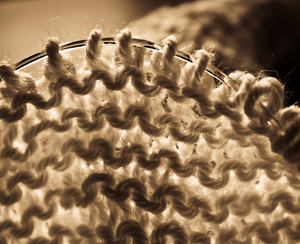 A few years ago, I learned about a church—an Evangelical Free Church—that holds an annual evening service called Blue Christmas on December 21, the longest night of the year. It’s a service welcoming all who feel “blue” at Christmas-time, whether because of a personal loss or illness or addiction or any other sorrow. Anyone present at the service who requests prayers is wrapped in one of the shawls that the church’s prayer shawl group has been knitting all year. The shawl is theirs to keep, a constant reminder of God’s enfolding and healing love.
As soon as I heard about this service, I wanted to go. At the time, I was writing a book that became Knit One, Purl a Prayer: A Spirituality of Knitting, which includes discussion of the prayer shawl ministries that have sprung up at churches of all denominations around the country. The specifics of prayer shawl ministries differ, but in general knitters from the church gather regularly to knit shawls to give to people who are suffering in some way. The shawl, knit with prayer, is meant to wrap the recipient in God’s love.
I thought that describing the Blue Christmas service would be a great way to end my book. So I contacted the church’s prayer shawl coordinator, Debbie, who warmly invited me to attend.
But by the time December 21 arrived, I was dreading going to the evening’s Blue Christmas service—because I was feeling particularly fragile at that time. I’d started some chemo, which had wrecked my sleep for weeks. A zombie, I got rattled by every little thing. So I definitely didn’t feel up to a Big Thing like an entirely unknown form of worship. I’m a Catholic, and I’d never experienced Evangelical worship. Sleep deprived exhaustion had drained me of all my usual adventurousness.
Yet I had to go. Debbie was expecting me…and I did still want to write about this worship service for my book.
So I went out into the darkest night of the year, notebook in hand. I entered the gathering congregation and sat at the end of a row of chairs near the door, so that I could slip out if I got too tired or overwhelmed.
The rows of chairs were arranged in an arc around a microphone and a round table of candles. Some were lit; others were dark. Completing the arc’s circle was a group of four young-adult musicians. The one at the keyboard, Debbie’s daughter Chelsea, turned out to be the worship leader for the evening. After singing opening songs about life’s burdens and God’s healing love, she invited those present to come to the mike, tell why they were there, and light a candle symbolizing God’s light shining in our darkness.
Gradually, people came forward. Most lit a candle for a friend or relative who had just lost a spouse or been diagnosed with a serious illness. A few told their own stories, their own needs.
Feeling desperately needy myself, I unexpectedly found myself walking to the microphone.
A quiver in my voice, I spoke about the leukemia I’d been diagnosed with several years before, about how the unlit candles on the table symbolized for me the dark and scared places inside me that didn’t wholly trust that God would see me through this illness. I lit a candle in prayer that I might more fully trust in the light of God’s love. Then I walked back to my seat.
After more music, interlaced with spontaneous Scripture quotes that wowed me (Catholics just don’t quote Scripture off the top like that), Chelsea said that members of the congregation were available to come join anyone who needed special prayers. “You will be given a hand-knit shawl, and as you are wrapped in the shawl, be wrapped in love and be blessed,” she said. Several hands went up, people carrying shawls quietly approached them, and small groups of prayer fluidly formed.
Happily resting in the prayer-filled quiet, I didn’t raise my hand. Yet a young couple sitting a few empty seats away from me slid closer and asked if I’d like them to pray for me. I nodded a grateful yes. Sitting on either side of me, they each took one of my hands. The young man spoke a long and beautiful spontaneous prayer for our deep trust that our lives are in God’s embrace and for my peace during the course of the leukemia. Then his wife got up, went to the table of shawls, and brought one to me.
So I went home that evening gifted with a prayer shawl.
The next week I asked Debbie about this young couple. “They’re recently married,” she said, “and he has just been deployed to Afghanistan. It’s a hard time for them.”
Every night since the Blue Christmas service, when I get into bed, I wrap myself in the shawl. I pray aloud:
“Wrapped in your love, oh God, knit into this shawl, I ask you to bless the knitter of this shawl, bless Debbie and Chelsea, bless the young woman who gave me this shawl. Keep her husband safe. May I live his prayer to trust in you.”
Then I offer thanksgiving for all the people whose lives have blessed mine that day.
Now I live across the country from Debbie’s church. But each December 21, I pray for all those gathered at the Blue Christmas service, and for everyone who feels blue in the holiday season.
Peggy Rosenthal is director of Poetry Retreats and writes widely on poetry as a spiritual resource. Her books include Praying through Poetry: Hope for Violent Times(Franciscan Media), and The Poets’ Jesus (Oxford). See Amazon for full list. She also teaches an online course, “Poetry as a Spiritual Practice,” through Image’s Glen Online program*.*
Previous Post

December 19, 2013
Blow on the Coal of the Heart
Next Post
December 23, 2013 Christmas Past
Browse Our Archives
Select a Category A. G. Harmon Alissa Wilkinson Allison Backous Art Authors Brad Fruhauff Bradford Winters Bryan Bliss Caroline Langston Chad Thomas Johnston Chris Hoke Christiana N. Peterson Culture D.G. Myers D.L. Mayfield Daniel Bowman Jr. David Griffith Elizabeth Duffy Faith Film Greg Wolfe Guest Contributor Interview Jan Vallone Jeffrey Overstreet Jessica Eddings-Roeser Jessica Mesman Griffith Kelly Foster Lindsey Crittenden Morgan Meis music Natalie Vestin Nick Olson Peggy Rosenthal Personal Reflection Poetry Friday Reflection Relationships Review Richard Chess Richard Cole Sara Zarr Shannon Huffman Polson Sonya Bilocerkowycz Tania Runyan Tony Woodlief Topical Categories Uncategorized Vic Sizemore Writing
Select a Month October 2018 September 2018 August 2018 July 2018 June 2018 May 2018 April 2018 March 2018 February 2018 January 2018 December 2017 November 2017 October 2017 September 2017 August 2017 July 2017 June 2017 May 2017 April 2017 March 2017 February 2017 January 2017 December 2016 November 2016 October 2016 September 2016 August 2016 July 2016 June 2016 May 2016 April 2016 March 2016 February 2016 January 2016 December 2015 November 2015 October 2015 September 2015 August 2015 July 2015 June 2015 May 2015 April 2015 March 2015 February 2015 January 2015 December 2014 November 2014 October 2014 September 2014 August 2014 July 2014 June 2014 May 2014 April 2014 March 2014 February 2014 January 2014 December 2013 November 2013 October 2013 September 2013 August 2013 July 2013 June 2013 May 2013 April 2013 March 2013 February 2013 January 2013 December 2012 November 2012 October 2012 September 2012 August 2012 July 2012 June 2012 May 2012 February 2008
Follow Us!
TAKE THE
Religious Wisdom Quiz
I killed 600 Philistines with nothing but an oxgoad. Who am I?
Select your answer to see how you score.
Samson Shamgar Gideon Ehud
Related posts from Good Letters

Poetry Friday: "The Burned Butterfly"


Leonard Cohen’s Holy and Broken Hallelujah

Ready or Not for the Days of Awe
TRENDING AT PATHEOS Catholic

Rejecting Doom: Christian Hope And Human Action
Christianity is a religion of hope. We are to have hope and...

It’s What Comes From Within Which Matters
One of the most difficult things for us to understand is why...

Why I Choose the Eucharist Over the Sermon
Choose the Eucharist, Not the Sermon What are we supposed to get...

5 Design Elements Found in Spiritually Rooted Homes
Putting Spirituality Into Home Decor Our homes are more than our living...

Credo: A Story of God Told with the...
About 10 years ago, I began to imagine a personal "Credo" that...

The Anatomy of Divine Revelation in Catholic Thought
The claim that God has made Himself known to human beings is...
view all Catholic blogs
Ad-Free & Subscriber Log-In Subscription Support
- About Us
- 2026 Calendar
- Videos
- Podcasts
- Library of World Religions
- Faith In Media Tracker
- Advertise With Us
- Write for Us
- Privacy Policy
- Terms of Service
- Do Not Sell My Data
- Contact Us
- Radiant Digital
- Manage Newsletter Subscriptions
- Unsubscribe From Notifications
- Sitemap
Copyright 2008-2026, Patheos. All rights reserved.
Subscription Support Ad-Free & Subscriber Log-In
Follow Patheos