
BuddhistCatholicContemplativeEvangelicalGeneral ChristianHinduJewishLatter-day SaintMuslimNew VisionsProgressive Christian
Beliefs
- Buddhist
- Catholic
- Contemplative
- Evangelical
- General Christian
- Hindu
- Jewish
- Latter-day Saint
- More Voices
- Muslim
- New Visions
- Pagan
- Progressive Christian
Topics
- Religion News
- Food and Religion
- Sports and Religion
- Religious Art
- Religious Music and Entertainment
- Religious Events
- History and Religion
- Style and Religion
- Politics and Religion
- Women in Religion
- Recreation Outdoors and Religion
- Business Finance and Religion
- Careers Workplace and Religion
- Education and Religion
- Family Parenting and Religion
- Health Fitness and Religion
- Home and Religion
- Relationships and Religion
- Technology and Religion
- Travel and Religion
Columnists
- Buddhist Columnists
- Business Finance and Religion Columnists
- Careers Workplace and Religion Columnists
- Catholic Columnists
- Contemplative Columnists
- Education and Religion Columnists
- Evangelists Columnists
- Family Parenting and Religion Columnists
- General Christian Columnists
- Health Fitness and Religion Columnists
- Hindu Columnists
- History and Religion Columnists
- Home and Religion Columnists
- Jewish Columnists
- More Voices Columnists
- Latter Day Columnists
- Muslim Columnists
- New Visions Columnists
- Nonreligious Columnists
- Pagan Columnists
- Politics and Religion Columnists
- Progressive Columnists
- Recreation Outdoors and Religion Columnists
- Relationships and Religion Columnists
- Religion News Columnists
- Religious Art Columnists
- Religious Events Columnists
- Religious Music and Entertainment Columnists
- Sports and Religion Columnists
- Style and Religion Columnists
- Technology and Religion Columnists
- Travel and Religion Columnists
- Women in Religion Columnists
Resource Library
- 2026 Calendar
- Library of World Religions
- The 100 Most Holy Places on Earth
- Patheos Answers
- Podcasts
- Videos
- Faith Leaders Database
- Anglican Episcopalian
- Bahai
- Baptist
- Buddhism
- Christianity
- Confucianism
- Eastern Orthodoxy
- Hinduism
- Holiness and Pentecostal
- ISKCON
- Islam
- Judaism
- Lutheran
- Methodist
- The Church of Jesus Christ of Latter-day Saints
- New Age
- Paganism
- Presbytarian and Reformed
- Protestantism
- Religion Behind the Scenes
- Roman Catholic
- Scientology
- Shia Islam
- Sikhism
- Sufism
- Sunni Islam
- Taoism
- Zen
- See all religions
Research Tools
 Ad-Free & Subscriber Log-In Subscription Support
Ad-Free & Subscriber Log-In Subscription Support
Follow Patheos 

- Trending:
- Forgiveness
- |
- Marriage
- |
- Consciousness
- |
- Death Penalty
- |
- Election
- |
- Halloween
 Good Letters
-
Contributors
- Home
- Catholic
- The Lost Girl Lets Go
The Lost Girl Lets Go
Last updated on: November 26, 2013 at 1:00 am by Caroline Langston
The Lost Girl Lets Go 2013-11-25T16:43:16-07:00 Caroline Langston
Patheos Explore the world's faith through different perspectives on religion and spirituality! Patheos has the views of the prevalent religions and spiritualities of the world.
 There’s something about the midday nature of the appointment that gives it a furtive cast: The putting on of mom-like clothes, stockings and “better” shoes, garnet lip gloss and a comb pulled through my hair, to give the appearance that I am a more organized person than I actually am.
The keys clatter in the quiet as I lock the door, get in the car, and drive out of the neighborhood, careful to make sure I have the directions and the insurance card.
All the empty houses appear deserted and drowsy: everyone’s at work or school, and even the homeschoolers are hard at work by the kitchen table, their younger siblings laid down for early afternoon naps.
Then I’m on the ribbon of highway that carves through the as-yet-ungentrified decay of Washington, D.C.’s East Side—blessedly empty, with neither traffic nor construction, the now-obsolete RFK Stadium spun out on the right like a spectacular piece of road kill.
I love the steadying narcotic of driving like this: “[T]he freeways become a special way of being alive…the extreme concentration required in Los Angeles seems to bring on a state of heightened awareness that some locals find mystical” reads a quote from Reyner Banham’s Los Angeles: The Architecture of Four Ecologies, which I found in an essay on Joan Didion, whose novel Play It As It Lays is what I am trying to remember as I plow through the Nation’s Capital.
Then, before I know it—because there is no traffic—I’ve spun off myself—off a cloverleaf and onto a surface road that is clustered with mid-century, mid-rise apartment towers. Collectively, there are perhaps hundreds of these, off every exit of the Beltway, and aside from the barest variations—Virginia looks marginally newer and more big-boxy, Maryland grittier and more industrial—you could be in Chevy Chase or Springfield and not know the difference.
I park in the flat lot of one of these, its asphalt glittering, venture through the hushed and mirrored lobby and past the office door, and proffer my insurance card to the woman behind the desk.
This is an intake appointment with a psychiatrist on behalf of my son, for whom we have finally decided, after a year, to seek ADHD medication. It’s an in-network practice, thank God, so there are no Waldorf toys, Ski magazines, or Scandinavian teak. It strikes me as I wait that there are probably psychiatrists’ offices like these in every one of these mid-rise apartment buildings off the Beltway, and the thought both amuses and troubles me.
I sit amid this feeling of being nowhere and no-place, oddly happy: It is the kind of environment where I feel perfectly at home. Then the doctor beckons me through the door into his office: I sink into the chair opposite his desk, into the bourbony light cast through the half-closed blinds. I begin recounting family history and the results of the neuropsych evaluation.
I look at him, crouched over the pad on which he’s taking notes, and with a rush find myself falling in love: He is septuagenarian, with a kindly face, no doubt in his last years of practice. There is a yellowed diploma from an Ivy League university on the wall, and on top of one of the desk’s piles is an unexpected NIV Bible.
It’s true, I’m happily married, but now I want to hold his hands, to feel those cushioned doctor palms on my bare shoulders. The crinkles at the edges of his eyes make me want to weep.
Everyone who has read anything I have written has heard that my father died when I was young—ad nauseam, a critic once emailed me—and that is true, I know, but the lines between fathers and would-be lovers have never been entirely clear to me. If there is one thing I know how to be, it is the lost daughter, and I have replicated fathers in the oddest of authorities, from philosophy professors to car mechanics.
I am held steady now, I think, savoring the momentary stasis. It is as though the fragmentary pieces of myself have floated back together in the amber light. “I’ll see you back with your son on Thursday,” he says. I float from the office and back out into the still-bright afternoon.
With your son. And this is where, suddenly, I find the image of myself that I’ve so neatly nurtured—that Didion persona, that lost and desperate daughter—flirts a little too closely with the idea of “performing femininity” that theorist Judith Butler outlined in Gender Trouble, which I learned about in a Bookslut article about, guess who, Joan Didion: “…gender is an identity tenuously constituted in time, instituted in an exterior space through a stylized repetition of acts.”
It is a vanity, I realize now, that scrap of girl I carry like a carapace over the unformed woman that I am. And that it is time to let that girl go; it is time, as Paul said, to put away childish things. It is the great fortune I will need to give away to get to the Kingdom. I am now, instead, the mother with rounded hips to tote burdens, and I will guide the steering wheel confidently under my hands, my son by my side, two days hence.
It is my ascesis to overcome my childhood. To be supplanted and subsumed by the little boy with the kshatriya temperament and the boundless will, which with wisdom my husband and I must seek to form.
But it is sad, nonetheless, to let that conception go—it is like the persona of John Berryman’s “The Ball Poem,” this time female:
Soon part of me will explore the deep and dark
Floor of the harbor…I am everywhere,
I suffer and move, my mind and my heart move
With all that move me, under the water
Or whistling, I am not a little [girl].
A native of Yazoo City, Mississippi, Caroline Langston is a convert to the Eastern Orthodox Church. She is a widely published writer and essayist, a winner of the Pushcart Prize, and a commentator for NPR’s “All Things Considered.”
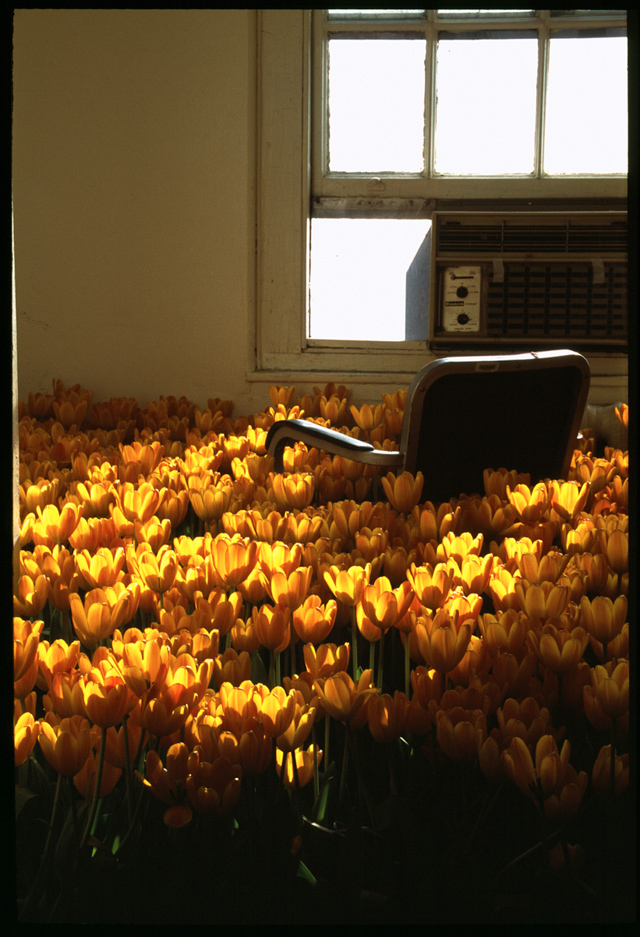
Art Pictured: Anna Schuleit Haber. BLOOM, 2003. 28,000 flowers in bloom. Recorded sound. Installation at the Massachusetts Mental Health Center.
Previous Post

November 25, 2013
My Soul Thirsts
Next Post
November 27, 2013 The Sabbath and Liberal Arts Education, Part 2
Browse Our Archives
Select a Category A. G. Harmon Alissa Wilkinson Allison Backous Art Authors Brad Fruhauff Bradford Winters Bryan Bliss Caroline Langston Chad Thomas Johnston Chris Hoke Christiana N. Peterson Culture D.G. Myers D.L. Mayfield Daniel Bowman Jr. David Griffith Elizabeth Duffy Faith Film Greg Wolfe Guest Contributor Interview Jan Vallone Jeffrey Overstreet Jessica Eddings-Roeser Jessica Mesman Griffith Kelly Foster Lindsey Crittenden Morgan Meis music Natalie Vestin Nick Olson Peggy Rosenthal Personal Reflection Poetry Friday Reflection Relationships Review Richard Chess Richard Cole Sara Zarr Shannon Huffman Polson Sonya Bilocerkowycz Tania Runyan Tony Woodlief Topical Categories Uncategorized Vic Sizemore Writing
Select a Month October 2018 September 2018 August 2018 July 2018 June 2018 May 2018 April 2018 March 2018 February 2018 January 2018 December 2017 November 2017 October 2017 September 2017 August 2017 July 2017 June 2017 May 2017 April 2017 March 2017 February 2017 January 2017 December 2016 November 2016 October 2016 September 2016 August 2016 July 2016 June 2016 May 2016 April 2016 March 2016 February 2016 January 2016 December 2015 November 2015 October 2015 September 2015 August 2015 July 2015 June 2015 May 2015 April 2015 March 2015 February 2015 January 2015 December 2014 November 2014 October 2014 September 2014 August 2014 July 2014 June 2014 May 2014 April 2014 March 2014 February 2014 January 2014 December 2013 November 2013 October 2013 September 2013 August 2013 July 2013 June 2013 May 2013 April 2013 March 2013 February 2013 January 2013 December 2012 November 2012 October 2012 September 2012 August 2012 July 2012 June 2012 May 2012 February 2008
Follow Us!
TAKE THE
Religious Wisdom Quiz
Who betrayed Jesus for thirty pieces of silver?
Select your answer to see how you score.
James Peter Judas Saul
Related posts from Good Letters




The Summer I Wasn’t Attacked By a Shark
TRENDING AT PATHEOS Catholic

Rejecting Doom: Christian Hope And Human Action
Christianity is a religion of hope. We are to have hope and...

It’s What Comes From Within Which Matters
One of the most difficult things for us to understand is why...

Why I Choose the Eucharist Over the Sermon
Choose the Eucharist, Not the Sermon What are we supposed to get...

5 Design Elements Found in Spiritually Rooted Homes
Putting Spirituality Into Home Decor Our homes are more than our living...

Credo: A Story of God Told with the...
About 10 years ago, I began to imagine a personal "Credo" that...

The Anatomy of Divine Revelation in Catholic Thought
The claim that God has made Himself known to human beings is...
view all Catholic blogs
Ad-Free & Subscriber Log-In Subscription Support
- About Us
- 2026 Calendar
- Videos
- Podcasts
- Library of World Religions
- Faith In Media Tracker
- Advertise With Us
- Write for Us
- Privacy Policy
- Terms of Service
- Do Not Sell My Data
- Contact Us
- Radiant Digital
- Manage Newsletter Subscriptions
- Unsubscribe From Notifications
- Sitemap
Copyright 2008-2026, Patheos. All rights reserved.
Subscription Support Ad-Free & Subscriber Log-In
Follow Patheos