
BuddhistCatholicContemplativeEvangelicalGeneral ChristianHinduJewishLatter-day SaintMuslimNew VisionsProgressive Christian
Beliefs
- Buddhist
- Catholic
- Contemplative
- Evangelical
- General Christian
- Hindu
- Jewish
- Latter-day Saint
- More Voices
- Muslim
- New Visions
- Pagan
- Progressive Christian
Topics
- Religion News
- Food and Religion
- Sports and Religion
- Religious Art
- Religious Music and Entertainment
- Religious Events
- History and Religion
- Style and Religion
- Politics and Religion
- Women in Religion
- Recreation Outdoors and Religion
- Business Finance and Religion
- Careers Workplace and Religion
- Education and Religion
- Family Parenting and Religion
- Health Fitness and Religion
- Home and Religion
- Relationships and Religion
- Technology and Religion
- Travel and Religion
Columnists
- Buddhist Columnists
- Business Finance and Religion Columnists
- Careers Workplace and Religion Columnists
- Catholic Columnists
- Contemplative Columnists
- Education and Religion Columnists
- Evangelists Columnists
- Family Parenting and Religion Columnists
- General Christian Columnists
- Health Fitness and Religion Columnists
- Hindu Columnists
- History and Religion Columnists
- Home and Religion Columnists
- Jewish Columnists
- More Voices Columnists
- Latter Day Columnists
- Muslim Columnists
- New Visions Columnists
- Nonreligious Columnists
- Pagan Columnists
- Politics and Religion Columnists
- Progressive Columnists
- Recreation Outdoors and Religion Columnists
- Relationships and Religion Columnists
- Religion News Columnists
- Religious Art Columnists
- Religious Events Columnists
- Religious Music and Entertainment Columnists
- Sports and Religion Columnists
- Style and Religion Columnists
- Technology and Religion Columnists
- Travel and Religion Columnists
- Women in Religion Columnists
Resource Library
- 2026 Calendar
- Library of World Religions
- The 100 Most Holy Places on Earth
- Patheos Answers
- Podcasts
- Videos
- Faith Leaders Database
- Anglican Episcopalian
- Bahai
- Baptist
- Buddhism
- Christianity
- Confucianism
- Eastern Orthodoxy
- Hinduism
- Holiness and Pentecostal
- ISKCON
- Islam
- Judaism
- Lutheran
- Methodist
- The Church of Jesus Christ of Latter-day Saints
- New Age
- Paganism
- Presbytarian and Reformed
- Protestantism
- Religion Behind the Scenes
- Roman Catholic
- Scientology
- Shia Islam
- Sikhism
- Sufism
- Sunni Islam
- Taoism
- Zen
- See all religions
Research Tools
 Ad-Free & Subscriber Log-In Subscription Support
Ad-Free & Subscriber Log-In Subscription Support
Follow Patheos 

- Trending:
- Forgiveness
- |
- Marriage
- |
- Consciousness
- |
- Death Penalty
- |
- Election
- |
- Halloween
 Good Letters
-
Contributors
- Home
- Catholic
- The Final Roll Call
The Final Roll Call
Last updated on: October 30, 2016 at 4:36 pm by Shannon Huffman Polson
The Final Roll Call 2016-10-30T16:36:28-07:00 Shannon Huffman Polson
Patheos Explore the world's faith through different perspectives on religion and spirituality! Patheos has the views of the prevalent religions and spiritualities of the world.
 As a little girl, I remember watching the grownups in my hometown Episcopal church cross themselves, and feeling like there was a secret I was not yet privy to but wanted to know. Sometime in high school, I started crossing myself at will, at the “Father, Son, and Holy Spirit” mentions, but also before and after communion, and whenever I thought it might fit.
The first time I felt silly. After that—though I didn’t understand why—I liked this small movement, this physical manifestation of something that must be outside, but seemed also inside, something I wanted to be a part of.
When I was in the Army, my friend Darren died. We were both helicopter pilots, had met in flight school where I remember him not only tall, blond, and always smiling, but playing the guitar. We crossed paths as our units transferred responsibility supporting the Dayton Peace Accords in Bosnia; but he didn’t die in a helicopter. He died on his way to school, riding his motorcycle along a four lane street in early morning, thirty-five miles an hour, when a truck turned in front of him.
Darren laid his bike on the road to slide under the truck; he was wearing full leather and a helmet. By the time the driver realized what was happening, he stopped the truck on top of Darren’s chest. Darren was Medevaced to the hospital and then transferred to Tucson, still breathing, but when they cracked his ribs to assess and repair whatever damage lay beneath, the tiny bit of pressure holding together a torn aorta released, and he died on the table.
Darren was married to a teacher and they looked a bit like Greek gods, with an impossibly compelling lack of awareness of their beauty. They were kind and funny and as real as anyone I’d ever known.
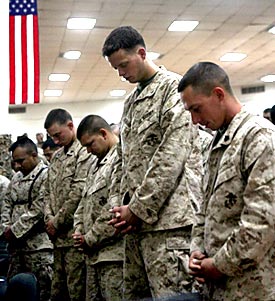
A friend and I sang at Darren’s memorial service in the post’s simple chapel made of clapboard with clear windows shaped for stained glass. We sang Jesu, Joy of Man’s Desiring, which we learned in Bosnia in a little church choir that met in a tent in the middle of Tuzla West. It was a simple memorial service. And then, though we were in a military academic setting and not in combat, because we were part of this larger brother and sisterhood, came the roll call.
According to US Army Field Manual FM 7-21.13, the Final Roll Call “has its origin in the accountability roll call conducted by the unit First Sergeant following combat.” This is how I remember it.
The chaplain gave a benediction at the front of the chapel. Next to him stood the battlefield cross, a rifle facing down into boots topped with a helmet and Darren’s dog tags next to a large framed picture of him smiling. The congregation was mostly uniformed, but people in civilian clothes, Darren’s wife and parents and other family, were there, too.
Following the chaplain’s prayer, the silence started to open up the space where our sadness would gush out; the First Sergeant stood up in that silence and in a voice suddenly striking called out a name, loud, clear:
“Captain James!”
A uniformed soldier snapped to attention among the congregants.
“Here First Sergeant!” The response cut through the air, shattering the settling stillness.
“Captain Marks!”
Another rigid figure stood at attention on the other side of the chapel, and the calls and responses volley back and forth like gunshots across a canyon, seeming to build in momentum as the echoes built on new reports.
“Here First Sergeant!”
“Captain Taylor!”
“Here First Sergeant!”
“Captain Van Zee!”
Instead of an answer, silence.
“Captain Van Zee!” The First Sergeant’s voice crescendoed.
The silence trembled now.
“Captain Darren Howard Van Zee!”
Silence threatened to slay each person in that chapel. The First Sergeant executed a movement as sharp as his verbal commands, swiveling 180 degrees to face the commander.
“Captain Van Zee, missing from roll call. “ He reported with a salute, a quick snap of his arm.
“Strike him from the rolls,” The commander responded.
Traditionally a trumpet plays a few long notes signaling the end of a day, or the end of a life at this point in a memorial service, and I suspect it did then, though I can’t recall, because in those last few words everything collapsed inside of me and I wept.
In these memorials, part of us weeps for the person remembered. Part weeps for all those who have died. And these many years later, I am grateful for the service. I am grateful for the roll call. Rituals tell us who we are, and what we are part of when everything dissolves around us. They tell us we matter. Rituals connect the sacred to the profane, remind us of the divinity in the quotidian, and provide us structure when we are unmoored.
The meaning of the roll call, like the meaning of any ritual, is in the doing.
No longer in the military, ritual for me now is the priest holding up the chalice and the host on a Sunday. It is my family holding hands to bow our heads before dinner. It is the kiss on my child’s head before he turns to walk into preschool.
Ritual matters most within community: within the brother and sisterhood of arms, within the relations of a family. It can separate or bring together, with a power bigger than human intellect and understanding.
Eckhart Tolle says that ritual is a way to enter stillness. Abraham Verghese notes simply that rituals are about transformation. Ritual is a cornerstone of anthropological thought, says Kevin Carrico in Cultural Anthropology.
Whether ritual is about stillness or transformation or both, it is at least a way to stretch into that liminal space between the body and the spirit. Those times when the flesh is lacking, ritual points inward and upward, offering a whisper of the divine.
Shannon Huffman Polson is the author of North of Hope: A Daughter’s Arctic Journey. Her essays and articles have appeared in a number of literary and commercial magazines including Huffington Post, High Country News, Adventum, Cirque Journal and Alaska and Seattle Magazines. She can be found writing or with her her family in Seattle or Alaska, and always at her website, Facebook, and Twitter.
Previous Post

November 15, 2013
Francis and the Via Negativa Part 2
Next Post
November 19, 2013 Scientific Privilege
Browse Our Archives
Select a Category A. G. Harmon Alissa Wilkinson Allison Backous Art Authors Brad Fruhauff Bradford Winters Bryan Bliss Caroline Langston Chad Thomas Johnston Chris Hoke Christiana N. Peterson Culture D.G. Myers D.L. Mayfield Daniel Bowman Jr. David Griffith Elizabeth Duffy Faith Film Greg Wolfe Guest Contributor Interview Jan Vallone Jeffrey Overstreet Jessica Eddings-Roeser Jessica Mesman Griffith Kelly Foster Lindsey Crittenden Morgan Meis music Natalie Vestin Nick Olson Peggy Rosenthal Personal Reflection Poetry Friday Reflection Relationships Review Richard Chess Richard Cole Sara Zarr Shannon Huffman Polson Sonya Bilocerkowycz Tania Runyan Tony Woodlief Topical Categories Uncategorized Vic Sizemore Writing
Select a Month October 2018 September 2018 August 2018 July 2018 June 2018 May 2018 April 2018 March 2018 February 2018 January 2018 December 2017 November 2017 October 2017 September 2017 August 2017 July 2017 June 2017 May 2017 April 2017 March 2017 February 2017 January 2017 December 2016 November 2016 October 2016 September 2016 August 2016 July 2016 June 2016 May 2016 April 2016 March 2016 February 2016 January 2016 December 2015 November 2015 October 2015 September 2015 August 2015 July 2015 June 2015 May 2015 April 2015 March 2015 February 2015 January 2015 December 2014 November 2014 October 2014 September 2014 August 2014 July 2014 June 2014 May 2014 April 2014 March 2014 February 2014 January 2014 December 2013 November 2013 October 2013 September 2013 August 2013 July 2013 June 2013 May 2013 April 2013 March 2013 February 2013 January 2013 December 2012 November 2012 October 2012 September 2012 August 2012 July 2012 June 2012 May 2012 February 2008
Follow Us!
TAKE THE
Religious Wisdom Quiz
What body part did Peter cut off a servant during Jesus’ arrest?
Select your answer to see how you score.
Hand Ear Finger Nose
Related posts from Good Letters


Meditations of a Library Assistant in the BS...

Wabi-Sabi: Living with Beauty and Ugliness

The Summer I Wasn’t Attacked By a Shark
TRENDING AT PATHEOS Catholic

Rejecting Doom: Christian Hope And Human Action
Christianity is a religion of hope. We are to have hope and...

It’s What Comes From Within Which Matters
One of the most difficult things for us to understand is why...

Why I Choose the Eucharist Over the Sermon
Choose the Eucharist, Not the Sermon What are we supposed to get...

5 Design Elements Found in Spiritually Rooted Homes
Putting Spirituality Into Home Decor Our homes are more than our living...

Credo: A Story of God Told with the...
About 10 years ago, I began to imagine a personal "Credo" that...

The Anatomy of Divine Revelation in Catholic Thought
The claim that God has made Himself known to human beings is...
view all Catholic blogs
Ad-Free & Subscriber Log-In Subscription Support
- About Us
- 2026 Calendar
- Videos
- Podcasts
- Library of World Religions
- Faith In Media Tracker
- Advertise With Us
- Write for Us
- Privacy Policy
- Terms of Service
- Do Not Sell My Data
- Contact Us
- Radiant Digital
- Manage Newsletter Subscriptions
- Unsubscribe From Notifications
- Sitemap
Copyright 2008-2026, Patheos. All rights reserved.
Subscription Support Ad-Free & Subscriber Log-In
Follow Patheos