
BuddhistCatholicContemplativeEvangelicalGeneral ChristianHinduJewishLatter-day SaintMuslimNew VisionsProgressive Christian
Beliefs
- Buddhist
- Catholic
- Contemplative
- Evangelical
- General Christian
- Hindu
- Jewish
- Latter-day Saint
- More Voices
- Muslim
- New Visions
- Pagan
- Progressive Christian
Topics
- Religion News
- Food and Religion
- Sports and Religion
- Religious Art
- Religious Music and Entertainment
- Religious Events
- History and Religion
- Style and Religion
- Politics and Religion
- Women in Religion
- Recreation Outdoors and Religion
- Business Finance and Religion
- Careers Workplace and Religion
- Education and Religion
- Family Parenting and Religion
- Health Fitness and Religion
- Home and Religion
- Relationships and Religion
- Technology and Religion
- Travel and Religion
Columnists
- Buddhist Columnists
- Business Finance and Religion Columnists
- Careers Workplace and Religion Columnists
- Catholic Columnists
- Contemplative Columnists
- Education and Religion Columnists
- Evangelists Columnists
- Family Parenting and Religion Columnists
- General Christian Columnists
- Health Fitness and Religion Columnists
- Hindu Columnists
- History and Religion Columnists
- Home and Religion Columnists
- Jewish Columnists
- More Voices Columnists
- Latter Day Columnists
- Muslim Columnists
- New Visions Columnists
- Nonreligious Columnists
- Pagan Columnists
- Politics and Religion Columnists
- Progressive Columnists
- Recreation Outdoors and Religion Columnists
- Relationships and Religion Columnists
- Religion News Columnists
- Religious Art Columnists
- Religious Events Columnists
- Religious Music and Entertainment Columnists
- Sports and Religion Columnists
- Style and Religion Columnists
- Technology and Religion Columnists
- Travel and Religion Columnists
- Women in Religion Columnists
Resource Library
- 2026 Calendar
- Library of World Religions
- The 100 Most Holy Places on Earth
- Patheos Answers
- Podcasts
- Videos
- Faith Leaders Database
- Anglican Episcopalian
- Bahai
- Baptist
- Buddhism
- Christianity
- Confucianism
- Eastern Orthodoxy
- Hinduism
- Holiness and Pentecostal
- ISKCON
- Islam
- Judaism
- Lutheran
- Methodist
- The Church of Jesus Christ of Latter-day Saints
- New Age
- Paganism
- Presbytarian and Reformed
- Protestantism
- Religion Behind the Scenes
- Roman Catholic
- Scientology
- Shia Islam
- Sikhism
- Sufism
- Sunni Islam
- Taoism
- Zen
- See all religions
Research Tools
 Ad-Free & Subscriber Log-In Subscription Support
Ad-Free & Subscriber Log-In Subscription Support
Follow Patheos 

- Trending:
- Forgiveness
- |
- Marriage
- |
- Consciousness
- |
- Death Penalty
- |
- Election
- |
- Halloween
 Good Letters
-
Contributors
- Home
- Catholic
- Requiescat in Pace
Requiescat in Pace
Last updated on: May 28, 2014 at 3:52 pm by Jan Vallone
Requiescat in Pace 2014-05-28T15:52:26-07:00 Jan Vallone
Patheos Explore the world's faith through different perspectives on religion and spirituality! Patheos has the views of the prevalent religions and spiritualities of the world.
 Give them rest, O Lord, and let perpetual light shine on them. The just will live in memory everlasting and will not be in fear of ill report.
Thus begins the Solemn Requiem Mass that some Roman Catholics say on All Souls’ Day, when the Church prays for the dead. Historically, the Catholic tradition grew from a Jewish practice first performed after a battle described in the Second Book of Maccabees.
According to the Maccabean story, so many faithful soldiers perished in the fray that their leader Judas fretted for their souls. Desiring to atone for their sins and ensure their resurrection, he took up a collection, amassing two thousand silver drachmas, which he sent to Jerusalem. In a similar way, modern Catholics combine their prayers, hoping to expiate sins and usher souls from purgatory to heaven.
While the custom of praying for the dead is ancient, there was no official Catholic celebration until late in the tenth century, when a French pilgrim returning from the Holy Land was shipwrecked on a craggy island. There he met a hermit who told him of a chasm in the rocks through which continuously rose the groans of the suffering souls in purgatory.
From the fissure also erupted the intermittent curses of the demons that supervised the dead. These devils reviled the monks of Cluny, France, whose prayers were especially potent and were depleting purgatory’s ranks.
Prompted by the hermit, the pilgrim hurried off to Cluny and begged the abbot and brothers there to redouble their supplications so every soul in purgatory could stop suffering and pass to paradise. Thus, the second of November became All Souls’ Day, an annual day of prayer, a custom that spread throughout France and Europe, reaching Rome in the fourteenth century.
My church, Blessed Sacrament in Seattle, celebrates each All Souls’ Day with a Solemn Requiem Mass according to the Dominican Rite. The Mass is said at night in Latin and includes Dominican chanting and polyphonic hymns.
A black casket is placed upon the altar surrounded by six man-tall candles that burn throughout the rite. Inside the otherwise-empty coffin are the names of the parishioners’ deceased, hundreds and hundreds of names, among them those of my parents and grandparents and many others I have loved.
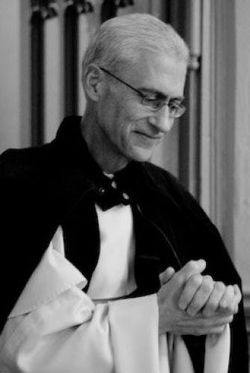
Also among the names is that of a priest, Father Tom Kraft. Tall, with salt-and-pepper hair, a jack-o-lantern smile and deep gray eyes, he said all the Masses I attended when I first joined the church. Every single Sunday, he talked and sang of God and placed communion in my hands with a grace that moved me greatly.
Still, I never said a word to Father Tom until his last second of November, when I wrote him a letter. Now, on every All Souls’ Day, I pray to always say I love you to the living, not wait to pray for the dead.
November 2, 2008
Dear Father Tom—
If I had a magic wand, I would wave it and there would be peace, and no poverty or illness, and you would be well.
But I don’t have a magic wand, which is why I started going to Blessed Sacrament the week after Easter this year, after a thirty-year almost-total lapse in church attendance. I chose Blessed Sacrament because I liked the bricks and steeple, and it’s close enough to walk there from my house.
What I found at Blessed Sacrament was more than bricks. I found music so soulful I ache, stained glass so lovely I fly, and a sweet, consistent community that sounds like they mean it when they shake my hand and wish me peace. They look right into my eyes and I look back.
I also found you, a priest who smiles and glows from the altar, like the prayers, songs, readings, and community all really mean something, and like God is actually up there, or even better, down here with us. And when I walk home each Sunday, the sky and flowers and leaves somehow seem more vivid, and the homeless make me bleed even more than they usually do.
It’s probably for this reason that I thought of you a few weeks ago. My son Sean is a sophomore in college who will defend just about anyone, regardless of race, ethnicity, social status, or sexual orientation. The only people he doesn’t understand are those with religion.
As far as Sean can tell, God is an excuse for committing atrocities who allows people to go to church on Sunday, then spend the remainder of the week denigrating Arabs, Latinos, Asians, African-Americans, the poor, the disabled, and gays. To my son, religion is a show without interiority.
This, I think, was one of many reasons that the recent death of Sean’s friend Luke shattered Sean as it did. Luke was a good, caring person, and Sean kept on repeating that Luke didn’t deserve to die at age nineteen. Sean also didn’t want to believe that he’d never see his friend’s face again or hear his voice.
So I wished I could send Sean to you because I had a feeling you could open a window that would enable him to hope that someday he would see Luke, and maybe even God.
I didn’t know when Luke died—I didn’t know until today—that you are fighting cancer, or that you have a CaringBridge blog-site with 911 letters and almost 25,000 hits, all expressing the same prayer—that you go on glowing from the altar. I can’t predict the future, but I know one thing for sure, one way or another you will.
I miss you, Father Tom.
Jan Vallone is the author of Pieces of Someday, a memoir, which won the Reader Views Reviewers Choice Award and will be re-released in fall, 2013. Her stories have appeared in The Seattle Times, Catholic Digest, Guideposts Magazine, English Journal, Chicken Soup for the Soul, Writing it Real, and Curriculum in Context. Once a lawyer at a large law firm, and later an English teacher at a tiny yeshiva high school, she now teaches writing and literature at Seattle Pacific University.
Previous Post

October 31, 2013
The Sabbath and Liberal Arts Education
Next Post
November 4, 2013 What We Wish For, What We Think Is True, Part 1
Browse Our Archives
Select a Category A. G. Harmon Alissa Wilkinson Allison Backous Art Authors Brad Fruhauff Bradford Winters Bryan Bliss Caroline Langston Chad Thomas Johnston Chris Hoke Christiana N. Peterson Culture D.G. Myers D.L. Mayfield Daniel Bowman Jr. David Griffith Elizabeth Duffy Faith Film Greg Wolfe Guest Contributor Interview Jan Vallone Jeffrey Overstreet Jessica Eddings-Roeser Jessica Mesman Griffith Kelly Foster Lindsey Crittenden Morgan Meis music Natalie Vestin Nick Olson Peggy Rosenthal Personal Reflection Poetry Friday Reflection Relationships Review Richard Chess Richard Cole Sara Zarr Shannon Huffman Polson Sonya Bilocerkowycz Tania Runyan Tony Woodlief Topical Categories Uncategorized Vic Sizemore Writing
Select a Month October 2018 September 2018 August 2018 July 2018 June 2018 May 2018 April 2018 March 2018 February 2018 January 2018 December 2017 November 2017 October 2017 September 2017 August 2017 July 2017 June 2017 May 2017 April 2017 March 2017 February 2017 January 2017 December 2016 November 2016 October 2016 September 2016 August 2016 July 2016 June 2016 May 2016 April 2016 March 2016 February 2016 January 2016 December 2015 November 2015 October 2015 September 2015 August 2015 July 2015 June 2015 May 2015 April 2015 March 2015 February 2015 January 2015 December 2014 November 2014 October 2014 September 2014 August 2014 July 2014 June 2014 May 2014 April 2014 March 2014 February 2014 January 2014 December 2013 November 2013 October 2013 September 2013 August 2013 July 2013 June 2013 May 2013 April 2013 March 2013 February 2013 January 2013 December 2012 November 2012 October 2012 September 2012 August 2012 July 2012 June 2012 May 2012 February 2008
Follow Us!
TAKE THE
Religious Wisdom Quiz
How did Jesus heal the mute and deaf man in Decapolis?
Select your answer to see how you score.
Gave bread Put fingers in ears and touched tongue Said "Go in peace" Anointed his head
Related posts from Good Letters

Poetry Friday: "The Burned Butterfly"

Wabi-Sabi: Living with Beauty and Ugliness
TRENDING AT PATHEOS Catholic

Rejecting Doom: Christian Hope And Human Action
Christianity is a religion of hope. We are to have hope and...

It’s What Comes From Within Which Matters
One of the most difficult things for us to understand is why...

Why I Choose the Eucharist Over the Sermon
Choose the Eucharist, Not the Sermon What are we supposed to get...

5 Design Elements Found in Spiritually Rooted Homes
Putting Spirituality Into Home Decor Our homes are more than our living...

Credo: A Story of God Told with the...
About 10 years ago, I began to imagine a personal "Credo" that...

The Anatomy of Divine Revelation in Catholic Thought
The claim that God has made Himself known to human beings is...
view all Catholic blogs
Ad-Free & Subscriber Log-In Subscription Support
- About Us
- 2026 Calendar
- Videos
- Podcasts
- Library of World Religions
- Faith In Media Tracker
- Advertise With Us
- Write for Us
- Privacy Policy
- Terms of Service
- Do Not Sell My Data
- Contact Us
- Radiant Digital
- Manage Newsletter Subscriptions
- Unsubscribe From Notifications
- Sitemap
Copyright 2008-2026, Patheos. All rights reserved.
Subscription Support Ad-Free & Subscriber Log-In
Follow Patheos