
BuddhistCatholicContemplativeEvangelicalGeneral ChristianHinduJewishLatter-day SaintMuslimNew VisionsProgressive Christian
Beliefs
- Buddhist
- Catholic
- Contemplative
- Evangelical
- General Christian
- Hindu
- Jewish
- Latter-day Saint
- More Voices
- Muslim
- New Visions
- Pagan
- Progressive Christian
Topics
- Religion News
- Food and Religion
- Sports and Religion
- Religious Art
- Religious Music and Entertainment
- Religious Events
- History and Religion
- Style and Religion
- Politics and Religion
- Women in Religion
- Recreation Outdoors and Religion
- Business Finance and Religion
- Careers Workplace and Religion
- Education and Religion
- Family Parenting and Religion
- Health Fitness and Religion
- Home and Religion
- Relationships and Religion
- Technology and Religion
- Travel and Religion
Columnists
- Buddhist Columnists
- Business Finance and Religion Columnists
- Careers Workplace and Religion Columnists
- Catholic Columnists
- Contemplative Columnists
- Education and Religion Columnists
- Evangelists Columnists
- Family Parenting and Religion Columnists
- General Christian Columnists
- Health Fitness and Religion Columnists
- Hindu Columnists
- History and Religion Columnists
- Home and Religion Columnists
- Jewish Columnists
- More Voices Columnists
- Latter Day Columnists
- Muslim Columnists
- New Visions Columnists
- Nonreligious Columnists
- Pagan Columnists
- Politics and Religion Columnists
- Progressive Columnists
- Recreation Outdoors and Religion Columnists
- Relationships and Religion Columnists
- Religion News Columnists
- Religious Art Columnists
- Religious Events Columnists
- Religious Music and Entertainment Columnists
- Sports and Religion Columnists
- Style and Religion Columnists
- Technology and Religion Columnists
- Travel and Religion Columnists
- Women in Religion Columnists
Resource Library
- 2026 Calendar
- Library of World Religions
- The 100 Most Holy Places on Earth
- Patheos Answers
- Podcasts
- Videos
- Faith Leaders Database
- Anglican Episcopalian
- Bahai
- Baptist
- Buddhism
- Christianity
- Confucianism
- Eastern Orthodoxy
- Hinduism
- Holiness and Pentecostal
- ISKCON
- Islam
- Judaism
- Lutheran
- Methodist
- The Church of Jesus Christ of Latter-day Saints
- New Age
- Paganism
- Presbytarian and Reformed
- Protestantism
- Religion Behind the Scenes
- Roman Catholic
- Scientology
- Shia Islam
- Sikhism
- Sufism
- Sunni Islam
- Taoism
- Zen
- See all religions
Research Tools
 Ad-Free & Subscriber Log-In Subscription Support
Ad-Free & Subscriber Log-In Subscription Support
Follow Patheos 

- Trending:
- Forgiveness
- |
- Marriage
- |
- Consciousness
- |
- Death Penalty
- |
- Election
- |
- Halloween
 Good Letters
-
Contributors
- Home
- Catholic
- In a Thin Place
In a Thin Place
Last updated on: November 12, 2013 at 4:04 pm by Bradford Winters
In a Thin Place 2013-11-12T16:04:32-07:00 Bradford Winters
Patheos Explore the world's faith through different perspectives on religion and spirituality! Patheos has the views of the prevalent religions and spiritualities of the world.
 “What is a thin place?” the friendly female voice asks in the YouTube video that I watch before departure for a family sabbatical to Ireland. At the moment I’m between a rock and a hard place on a hot day in Brooklyn, trying to get ready. But on this break, the misty montage and soothing harp get me as ready for thin places as I am for thick stouts.
“In simple terms,” she continues, “a thin place is a place where the veil between this world and the eternal world is thin.”
Then here I come.
First stop, Scotland—not short on thin places in its own right.
Standing at the prow of a car ferry between the mainland and the Isle of Mull, I feel such a charge of heritage in my blood, such an ancient sense of potential for roots ancestral as well as etymological vis-à-vis power, that I fancy St. Columba might have felt something similar at the prow of a carragh on his voyages to evangelize the heathen.
Columba and me: blood brothers, to be sure.
Mindie Burgoyne, the voice of that video and indispensible guide to Ireland’s thin places via her website, would dispute even the slightest suggestion that a car ferry has any right to be called a thin place:
“Thin places should not be confused with thin moments, those being times when that mysterious power is felt during a particular experience or synchronistic course of events… A thin place is simply that—a PLACE where the veil is thin.”
Fair enough. But I did have a MOMENT. Even one as laughable as it was epiphanic.
I wonder how she might answer Eric Weiner’s claim in a New York Times article about thin places, that Hong Kong International Airport is one of them.
Either way, soon enough I’m in a thin place, alright: Iona, operations base of Columba and subsequent generations of his monastic progeny.
Hemingway might have slept there—and there and there and there—but Columba wrote here: at Torr an Aba, Hill of the Abbot, I stand where his hilltop writing hut once stood.
All that remains of it now is the air….
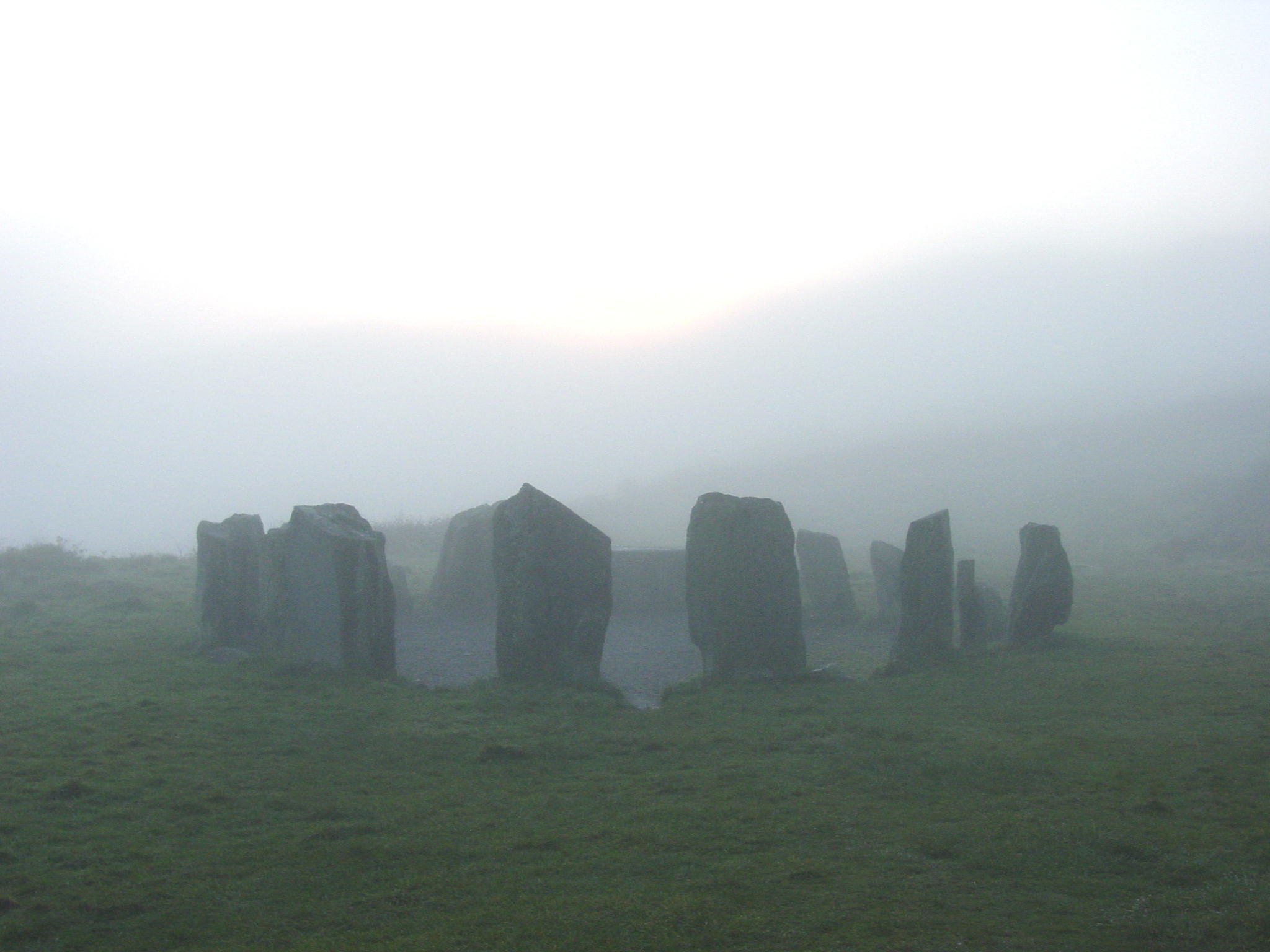
If Drombeg Stone Circle is a thin place, could it be an equally thick one as well?
The most famous stone circle in Ireland, it happens to be located the next town over from where we are living in West Cork until Christmas.
To walk through the circle at Drombeg, from the portal stones to the altar-stone on an axis that lines up with sundown on the winter solstice, is to feel an undeniable charge surging through the ground, or the air, or both.
But I’m not sure it isn’t a darker charge than Burgoyne would admit in her unqualified celebration of places like this. After all, the only human remains found at Drombeg were the cremated bones of an adolescent—here in the middle of the circle where rituals were performed, a stone’s throw from my own children now rolling in the grass.
I move past the assortment of today’s offerings in the same spot—beads, coins, sections of a pomegranate—and happily discover a purple cross of blackberry juice smeared on the altar-stone.
Oh, sweet Jesus. Talk to me….
Two days later, I return to Drombeg alone at daybreak. The visit left its mark on me, as much for the timing as for the place itself: in the context of recently birthed insights into certain issues that have saddled me for far too long, there was good cause over the weekend to consider the subject of child sacrifice in a personal, figurative light.
Far be it from me to say what those issues are here, the Internet being a place so thin it doesn’t even exist.
Not to make any facile equations on metaphorical grounds, but didn’t we all undergo sacrifice as children in one form or another, victims of the broken world into which we were born? Is there anyone whose total wellbeing wasn’t offered up in ways great or small to the gods of circumstance beyond our prepubescent control?
Call me crazy, yet here I am anyway back at Drombeg before sunup, in the spirit of belief that restitution can and should be made for the sake—sorry, cynics, there’s no other way to say it— of the inner child.
“Practice resurrection,” Wendell Berry writes. And so I face east toward sunrise at the altar-stone, not west at sunset as my Druid counterparts once did.
The purple cross was washed away by the weekend rain….
Not that my particular experience at Drombeg stands for those at other thin places I have been to in Ireland. Burgoyne has seen far more of the country than I have, but her claim that Dingle Peninsula is the most mystical place here is not a hard one to support after taking a family trip there. Visit the Gallarus Oratory and you’ll see what we mean.
Before leaving New York, I happened to learn in a course on spiritual listening that the four prophetic schools of ancient Israel—at Ramah, Gilgal, Bethel, and Jericho—were located in places where, “as the Irish or Scots would put it, the air is thin.”
Of course they were.
Of course they are.
If heaven and earth, according to the Celts, are only three feet apart, that is roughly the distance from my heart to the stone circle on my ring finger: four pairs of our matching birthstones, a ruby and an emerald apiece.
Thankfully it indicates neither a place nor a moment, but rather a purpose and a promise.
Love.
It always comes back to love.
Something to fall in—therefore something to rise in.
Bradford Winters is a screenwriter/producer in television whose work has included such series as Oz, Kings, Boss, and The Americans. His poems have appeared in Sewanee Theological Review, Spoon River Poetry Review, and Georgetown Review, among other journals. He lives in Brooklyn with his wife and three children.
Previous Post

November 8, 2013
I Am Not a Mother: I Am a Human Being
Next Post
November 13, 2013 I Don’t Have Time
Browse Our Archives
Select a Category A. G. Harmon Alissa Wilkinson Allison Backous Art Authors Brad Fruhauff Bradford Winters Bryan Bliss Caroline Langston Chad Thomas Johnston Chris Hoke Christiana N. Peterson Culture D.G. Myers D.L. Mayfield Daniel Bowman Jr. David Griffith Elizabeth Duffy Faith Film Greg Wolfe Guest Contributor Interview Jan Vallone Jeffrey Overstreet Jessica Eddings-Roeser Jessica Mesman Griffith Kelly Foster Lindsey Crittenden Morgan Meis music Natalie Vestin Nick Olson Peggy Rosenthal Personal Reflection Poetry Friday Reflection Relationships Review Richard Chess Richard Cole Sara Zarr Shannon Huffman Polson Sonya Bilocerkowycz Tania Runyan Tony Woodlief Topical Categories Uncategorized Vic Sizemore Writing
Select a Month October 2018 September 2018 August 2018 July 2018 June 2018 May 2018 April 2018 March 2018 February 2018 January 2018 December 2017 November 2017 October 2017 September 2017 August 2017 July 2017 June 2017 May 2017 April 2017 March 2017 February 2017 January 2017 December 2016 November 2016 October 2016 September 2016 August 2016 July 2016 June 2016 May 2016 April 2016 March 2016 February 2016 January 2016 December 2015 November 2015 October 2015 September 2015 August 2015 July 2015 June 2015 May 2015 April 2015 March 2015 February 2015 January 2015 December 2014 November 2014 October 2014 September 2014 August 2014 July 2014 June 2014 May 2014 April 2014 March 2014 February 2014 January 2014 December 2013 November 2013 October 2013 September 2013 August 2013 July 2013 June 2013 May 2013 April 2013 March 2013 February 2013 January 2013 December 2012 November 2012 October 2012 September 2012 August 2012 July 2012 June 2012 May 2012 February 2008
Follow Us!
TAKE THE
Religious Wisdom Quiz
True or False: Timothy was instructed to avoid godless chatter and opposing ideas of what is falsely called knowledge.
Select your answer to see how you score.
TRUE FALSE
Related posts from Good Letters
The Liturgy of the Stars: Part 2

Finding My Sister in Young Adult Novels

TRENDING AT PATHEOS Catholic

Rejecting Doom: Christian Hope And Human Action
Christianity is a religion of hope. We are to have hope and...

It’s What Comes From Within Which Matters
One of the most difficult things for us to understand is why...

Why I Choose the Eucharist Over the Sermon
Choose the Eucharist, Not the Sermon What are we supposed to get...

5 Design Elements Found in Spiritually Rooted Homes
Putting Spirituality Into Home Decor Our homes are more than our living...

Credo: A Story of God Told with the...
About 10 years ago, I began to imagine a personal "Credo" that...

The Anatomy of Divine Revelation in Catholic Thought
The claim that God has made Himself known to human beings is...
view all Catholic blogs
Ad-Free & Subscriber Log-In Subscription Support
- About Us
- 2026 Calendar
- Videos
- Podcasts
- Library of World Religions
- Faith In Media Tracker
- Advertise With Us
- Write for Us
- Privacy Policy
- Terms of Service
- Do Not Sell My Data
- Contact Us
- Radiant Digital
- Manage Newsletter Subscriptions
- Unsubscribe From Notifications
- Sitemap
Copyright 2008-2026, Patheos. All rights reserved.
Subscription Support Ad-Free & Subscriber Log-In
Follow Patheos