
BuddhistCatholicContemplativeEvangelicalGeneral ChristianHinduJewishLatter-day SaintMuslimNew VisionsProgressive Christian
Beliefs
- Buddhist
- Catholic
- Contemplative
- Evangelical
- General Christian
- Hindu
- Jewish
- Latter-day Saint
- More Voices
- Muslim
- New Visions
- Pagan
- Progressive Christian
Topics
- Religion News
- Food and Religion
- Sports and Religion
- Religious Art
- Religious Music and Entertainment
- Religious Events
- History and Religion
- Style and Religion
- Politics and Religion
- Women in Religion
- Recreation Outdoors and Religion
- Business Finance and Religion
- Careers Workplace and Religion
- Education and Religion
- Family Parenting and Religion
- Health Fitness and Religion
- Home and Religion
- Relationships and Religion
- Technology and Religion
- Travel and Religion
Columnists
- Buddhist Columnists
- Business Finance and Religion Columnists
- Careers Workplace and Religion Columnists
- Catholic Columnists
- Contemplative Columnists
- Education and Religion Columnists
- Evangelists Columnists
- Family Parenting and Religion Columnists
- General Christian Columnists
- Health Fitness and Religion Columnists
- Hindu Columnists
- History and Religion Columnists
- Home and Religion Columnists
- Jewish Columnists
- More Voices Columnists
- Latter Day Columnists
- Muslim Columnists
- New Visions Columnists
- Nonreligious Columnists
- Pagan Columnists
- Politics and Religion Columnists
- Progressive Columnists
- Recreation Outdoors and Religion Columnists
- Relationships and Religion Columnists
- Religion News Columnists
- Religious Art Columnists
- Religious Events Columnists
- Religious Music and Entertainment Columnists
- Sports and Religion Columnists
- Style and Religion Columnists
- Technology and Religion Columnists
- Travel and Religion Columnists
- Women in Religion Columnists
Resource Library
- 2026 Calendar
- Library of World Religions
- The 100 Most Holy Places on Earth
- Patheos Answers
- Podcasts
- Videos
- Faith Leaders Database
- Anglican Episcopalian
- Bahai
- Baptist
- Buddhism
- Christianity
- Confucianism
- Eastern Orthodoxy
- Hinduism
- Holiness and Pentecostal
- ISKCON
- Islam
- Judaism
- Lutheran
- Methodist
- The Church of Jesus Christ of Latter-day Saints
- New Age
- Paganism
- Presbytarian and Reformed
- Protestantism
- Religion Behind the Scenes
- Roman Catholic
- Scientology
- Shia Islam
- Sikhism
- Sufism
- Sunni Islam
- Taoism
- Zen
- See all religions
Research Tools
 Ad-Free & Subscriber Log-In Subscription Support
Ad-Free & Subscriber Log-In Subscription Support
Follow Patheos 

- Trending:
- Forgiveness
- |
- Marriage
- |
- Consciousness
- |
- Death Penalty
- |
- Election
- |
- Halloween
 Good Letters
-
Contributors
- Home
- Catholic
- I Don’t Have Time
I Don’t Have Time
Last updated on: November 13, 2013 at 1:00 am by Peggy Rosenthal
I Don’t Have Time 2013-11-12T17:53:49-07:00 Peggy Rosenthal
Patheos Explore the world's faith through different perspectives on religion and spirituality! Patheos has the views of the prevalent religions and spiritualities of the world.
 In our current Western culture, we think we have control of time. With our watches and clocks we regulate our lives: meetings set at a certain hour (see you at noon!), alarms wake us at the set minute, we schedule bedtimes and lunch breaks. In the U.S. we even change the time by one hour twice a year. What hubris.
Not so in other cultures. Living in New Mexico years ago, I remember going to a Pueblo tribe’s festival. We Anglos arrived and waited impatiently as our precious time passed. When would the event get started? “When the time is right,” a woman of the tribe told us.
And the end of Ramadan for Muslims everywhere: it’s determined by a sighting of the new moon. I ask my Muslim friends who have invited me to share their breaking of the Ramadan fast “what time will it be?”…
Time’s flux. Though we Westerners try with all our might to pin it down, the effort is fruitless. Or, as the contemporary Mexican poet Javiar Sicilia puts it in “The Track in the Wilderness”:
time is not time
but the vast emptiness from which things flow.
Sicilia’s poem, in the current issue of Image (#78), is a profound meditation on our perceptions of time. The poem begins with the speaker and a female companion walking down a beach along the “track of time,” toward a huge red rock that later in the poem becomes a cave and then the dark void from which issues “the resounding language of God.
we saw, under that red rock,
time stopping in the song of the sea and its recurring voice,
between the ruach of Yahweh and the hour of this now,
before the travelers’ breakfast,
the hollow words,
the yellow fog in the window
and the din of a thousand worlds ending;
before yes and no,
before a thousand I-love-you’s
and eating a bit of bread with our coffee,
in that gaping hollow in the void
under this red rock, you and I saw time stop.
The entire 240-line poem does, in its way, make time stop. And it does so by interweaving recurrent images: from this scene, from Dante, from T.S. Eliot, from the gospel episode of Jesus on the road to Emmaus.
But what can it mean to “stop time”? In the poem, it comes to mean, I’d say, an opening up of time into the eternal—by the discovery of the Risen Christ (called only “the third one”) walking along the beach with the speaker and his companion. Time as we ordinarily experience it, rushing onward toward only our deaths, is “stopped” when we notice that the “gaping hollow in the void” is God.
Reading Sicilia’s poem has led me to experiment with perceptions of time. Looking up at the sky through tree branches that were filled with green, then a few months later orange, then bare, then snow-covered, I consciously think: for me, this is a moment; but since God is in this moment, it is somehow eternal. Or, practicing deep yoga breaths, I think: this is the Holy Spirit breathing in me.
Or I ponder the wonderful passage from Simone Weil which Sicilia takes as his poem’s epigraph, a passage where she says that “what we call time” is God’s “waiting.” I remember her elaborating elsewhere: God waits in eternity for us to merely turn our eyes toward him.
Could I ever be so free of self, and so free of self-imposed scheduling, that I could truly turn my eyes toward God?
Each morning for twenty minutes I give it a try. I sit and pray to let all in me that’s not God drop away. And then within two minutes I’m daydreaming. Do I have enough potatoes to make that soup recipe for supper?
But maybe turning my eyes toward God won’t happen during that intentional effort each morning. Maybe it could happen if I give an instinctive “yes” to a request from someone I don’t like much, a request that will inconvenience me. That might be an emptying of self such as Sicilia’s poem evokes:
Impoverish yourself, Daughter of Man,
until you are emptiness,
for what is created then, to your astonishment,
is the empty space the god makes, retreating,
for what you see on Christmas Day
is the muteness of the god in his word;
what you see at Easter-time
is the empty space the god makes, renouncing,
and what you are not is the only thing you are
and where you are not, only there can life be.
This is not an easy, feel-good religious practice that Sicilia, with Weil, is envisioning. There’s no wiggle room in that “what you are not is the only thing you are.”
God is waiting for me to be what I (my treasured self-constructed self) am not. And this waiting is “what we call time.”
The phone rings. It’s a friend, asking to have lunch together on Thursday. I look at my calendar. “Oh dear, I don’t have time that day.”
“I” don’t “have time”? Time isn’t mine, so I never “have” it. God, in his waiting, cringes.
Peggy Rosenthal is director of Poetry Retreats and writes widely on poetry as a spiritual resource. Her books include Praying through Poetry: Hope for Violent Times (Franciscan Media), and The Poets’ Jesus (Oxford). See Amazon for full list. She also teaches an online course, “Poetry as a Spiritual Practice,” through Image’s Glen Online program*.*
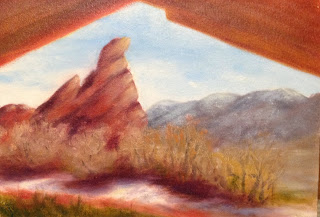
Art Pictured: Ruth Ann Sturgill. #58 Snow in the Shadows, 8 x 10″, oil plein air.
Previous Post

November 12, 2013
In a Thin Place
Next Post
November 14, 2013 Francis and the Via Negativa Part 1
Browse Our Archives
Select a Category A. G. Harmon Alissa Wilkinson Allison Backous Art Authors Brad Fruhauff Bradford Winters Bryan Bliss Caroline Langston Chad Thomas Johnston Chris Hoke Christiana N. Peterson Culture D.G. Myers D.L. Mayfield Daniel Bowman Jr. David Griffith Elizabeth Duffy Faith Film Greg Wolfe Guest Contributor Interview Jan Vallone Jeffrey Overstreet Jessica Eddings-Roeser Jessica Mesman Griffith Kelly Foster Lindsey Crittenden Morgan Meis music Natalie Vestin Nick Olson Peggy Rosenthal Personal Reflection Poetry Friday Reflection Relationships Review Richard Chess Richard Cole Sara Zarr Shannon Huffman Polson Sonya Bilocerkowycz Tania Runyan Tony Woodlief Topical Categories Uncategorized Vic Sizemore Writing
Select a Month October 2018 September 2018 August 2018 July 2018 June 2018 May 2018 April 2018 March 2018 February 2018 January 2018 December 2017 November 2017 October 2017 September 2017 August 2017 July 2017 June 2017 May 2017 April 2017 March 2017 February 2017 January 2017 December 2016 November 2016 October 2016 September 2016 August 2016 July 2016 June 2016 May 2016 April 2016 March 2016 February 2016 January 2016 December 2015 November 2015 October 2015 September 2015 August 2015 July 2015 June 2015 May 2015 April 2015 March 2015 February 2015 January 2015 December 2014 November 2014 October 2014 September 2014 August 2014 July 2014 June 2014 May 2014 April 2014 March 2014 February 2014 January 2014 December 2013 November 2013 October 2013 September 2013 August 2013 July 2013 June 2013 May 2013 April 2013 March 2013 February 2013 January 2013 December 2012 November 2012 October 2012 September 2012 August 2012 July 2012 June 2012 May 2012 February 2008
Follow Us!
TAKE THE
Religious Wisdom Quiz
Who said, "You are the Christ, the Son of the living God"?
Select your answer to see how you score.
Paul James John Peter
Related posts from Good Letters



On Writing Odes: Taking Time to Celebrate

Poetry Friday: "The Burned Butterfly"
TRENDING AT PATHEOS Catholic

Rejecting Doom: Christian Hope And Human Action
Christianity is a religion of hope. We are to have hope and...

It’s What Comes From Within Which Matters
One of the most difficult things for us to understand is why...

Why I Choose the Eucharist Over the Sermon
Choose the Eucharist, Not the Sermon What are we supposed to get...

5 Design Elements Found in Spiritually Rooted Homes
Putting Spirituality Into Home Decor Our homes are more than our living...

Credo: A Story of God Told with the...
About 10 years ago, I began to imagine a personal "Credo" that...

The Anatomy of Divine Revelation in Catholic Thought
The claim that God has made Himself known to human beings is...
view all Catholic blogs
Ad-Free & Subscriber Log-In Subscription Support
- About Us
- 2026 Calendar
- Videos
- Podcasts
- Library of World Religions
- Faith In Media Tracker
- Advertise With Us
- Write for Us
- Privacy Policy
- Terms of Service
- Do Not Sell My Data
- Contact Us
- Radiant Digital
- Manage Newsletter Subscriptions
- Unsubscribe From Notifications
- Sitemap
Copyright 2008-2026, Patheos. All rights reserved.
Subscription Support Ad-Free & Subscriber Log-In
Follow Patheos