
BuddhistCatholicContemplativeEvangelicalGeneral ChristianHinduJewishLatter-day SaintMuslimNew VisionsProgressive Christian
Beliefs
- Buddhist
- Catholic
- Contemplative
- Evangelical
- General Christian
- Hindu
- Jewish
- Latter-day Saint
- More Voices
- Muslim
- New Visions
- Pagan
- Progressive Christian
Topics
- Religion News
- Food and Religion
- Sports and Religion
- Religious Art
- Religious Music and Entertainment
- Religious Events
- History and Religion
- Style and Religion
- Politics and Religion
- Women in Religion
- Recreation Outdoors and Religion
- Business Finance and Religion
- Careers Workplace and Religion
- Education and Religion
- Family Parenting and Religion
- Health Fitness and Religion
- Home and Religion
- Relationships and Religion
- Technology and Religion
- Travel and Religion
Columnists
- Buddhist Columnists
- Business Finance and Religion Columnists
- Careers Workplace and Religion Columnists
- Catholic Columnists
- Contemplative Columnists
- Education and Religion Columnists
- Evangelists Columnists
- Family Parenting and Religion Columnists
- General Christian Columnists
- Health Fitness and Religion Columnists
- Hindu Columnists
- History and Religion Columnists
- Home and Religion Columnists
- Jewish Columnists
- More Voices Columnists
- Latter Day Columnists
- Muslim Columnists
- New Visions Columnists
- Nonreligious Columnists
- Pagan Columnists
- Politics and Religion Columnists
- Progressive Columnists
- Recreation Outdoors and Religion Columnists
- Relationships and Religion Columnists
- Religion News Columnists
- Religious Art Columnists
- Religious Events Columnists
- Religious Music and Entertainment Columnists
- Sports and Religion Columnists
- Style and Religion Columnists
- Technology and Religion Columnists
- Travel and Religion Columnists
- Women in Religion Columnists
Resource Library
- 2026 Calendar
- Library of World Religions
- The 100 Most Holy Places on Earth
- Patheos Answers
- Podcasts
- Videos
- Faith Leaders Database
- Anglican Episcopalian
- Bahai
- Baptist
- Buddhism
- Christianity
- Confucianism
- Eastern Orthodoxy
- Hinduism
- Holiness and Pentecostal
- ISKCON
- Islam
- Judaism
- Lutheran
- Methodist
- The Church of Jesus Christ of Latter-day Saints
- New Age
- Paganism
- Presbytarian and Reformed
- Protestantism
- Religion Behind the Scenes
- Roman Catholic
- Scientology
- Shia Islam
- Sikhism
- Sufism
- Sunni Islam
- Taoism
- Zen
- See all religions
Research Tools
 Ad-Free & Subscriber Log-In Subscription Support
Ad-Free & Subscriber Log-In Subscription Support
Follow Patheos 

- Trending:
- Forgiveness
- |
- Marriage
- |
- Consciousness
- |
- Death Penalty
- |
- Election
- |
- Halloween
 Good Letters
-
Contributors
- Home
- Catholic
- Why Should Darkness Seem Truer Than Light?
Why Should Darkness Seem Truer Than Light?
Last updated on: October 31, 2013 at 5:35 pm by Chad Thomas Johnston
Why Should Darkness Seem Truer Than Light? 2013-10-31T17:35:22-07:00 Chad Thomas Johnston
Patheos Explore the world's faith through different perspectives on religion and spirituality! Patheos has the views of the prevalent religions and spiritualities of the world.
 In her memoir, Pieces of Someday, my friend and periodic “Good Letters” guest writer Jan Vallone shares the story of the time her writing instructor—“an aging Clint Eastwood” named Professor Véreux—questioned the integrity of her writing. After class one day, he pulled Jan aside to discuss her most recent assignment one-on-one.
“I’m returning your memoir,” he said. “The ending is dishonest.”
Of course, since the piece Jan had submitted was a work of non-fiction—a memoir—I found Professor Véreux’s conclusion questionable at best. How could he possibly know whether Jan was telling the truth or not?
Jan found herself at the receiving end of this criticism when she enrolled in a summer writing program at the Bread Loaf School of English in Ripton, Vermont. The assignment that drew Professor Véreux’s fire focused on Jan’s time as an English teacher at a Jewish high school—a yeshiva—and her interactions with a troubled student named Kalindah.
In the end of the story, Jan succeeds in reaching this unreachable student, and shines much-needed light into Kalindah’s darkness. More than a mere writing instructor in this story, Jan becomes a channel for the flow of God’s grace.
Professor Véreux, however, called the ending “saccharine.” He even criticized Jan’s teaching, at least as she represents it in the story. At one point, she offers Kalindah encouragement, telling her, “You’re fine just as you are.”
“What you said to her—a teacher should never say that,” Professor Véreux said.
When reflecting on these cutting comments, Jan writes, “Why do so many people view cynicism as wisdom, joy as foolishness?” I have long wondered the same thing myself.
Jan rewrote the piece accordingly, this time opting for “bitter irony” to accommodate her instructor’s skepticism.
“The last section is a big improvement over the earlier version,” he wrote in his comments on the story—no doubt because the darkness somehow seems truer than the light.
My blood boiled when I read Jan’s narrative. Writing memoir places the author squarely in the cross-hairs of the critic in a way that writing fiction simply does not. A critique of a personal essay all too easily becomes a critique of the person who wrote it.
In describing the end of Jan’s story as “dishonest,” Professor Véreux calls into question Jan’s ability to truthfully extrapolate meaning from her own subjective reality. In his estimate, the inspirational well from which she draws her water is poisoned—unfit for a reader’s consumption.
After reading Jan’s account, I wanted to cast Professor Véreux into outer darkness, where there is weeping and gnashing of teeth. Of course, with his temperament, such a place would probably feel like home.
While I would never deny the reality of suffering in this world or argue that one should simply paint over it with a superficial coat of optimism, I am troubled by the assumption underlying Professor Véreux’s critique: that darker stories somehow seem truer than those that smack of hope.
Even though I am disturbed by this, I cannot escape this mentality myself. If I receive nine compliments about my writing and one disparaging remark, the former seldom outweigh the latter in my mind. How does the lone critical comment negate the disproportionately large percentage of favorable feedback?
Do negative comments seem truer simply because they cause people pain? A wound lingers longer than a caress, after all.
Or do the darker things seem truer to us because we spend so much time in the shadows? John 3:19 says, “Light has come into the world, but people loved darkness instead of light because their deeds were evil” (NIV). In the end, perhaps the darkness in our own hearts causes us to see the world, and even life itself, as bleak—a place where stories of grace seem dishonest because they do not reflect reality as we know it.
If this is true, our subjective experiences of the world may predispose us to reject the very stories that have the power to transform us—to change how we see and experience our fellow human beings and even God. If we cannot conceive of love, grace, or mercy, how can we accept them when we encounter them?
It may be that the death and resurrection of Jesus embody the darkness we know so well, while transforming it into something paradoxical like obsidian—pitch black volcanic glass that reflects light. In this sense, the story of Christ’s sacrifice may function like a “black mirror,” to appropriate the title of a song from the Arcade Fire’s Neon Bible album, confronting us with the love of God and our own depravity at once.
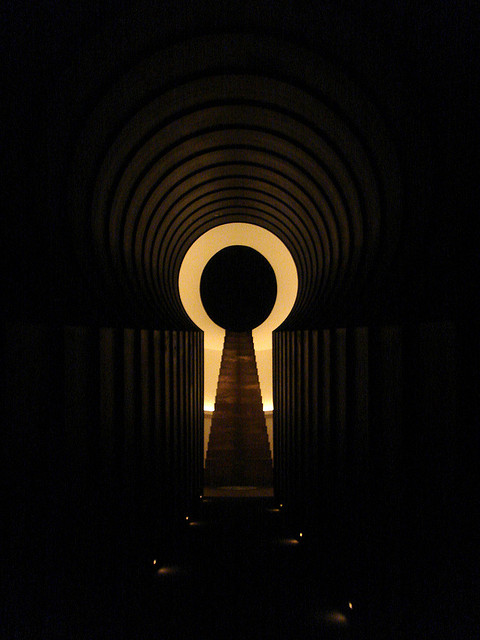
Those of us who hope in the Light of the World can never really deny the reality of the darkness then, because we have seen it within ourselves. For people like Jan and me, who attempt to write about such things, we can only offer our hope in stories that shine like solitary beams of sunlight through key holes in otherwise dim rooms—faith as the substance of things hoped for in the form of particle and wave.
There will never be a shortage of skeptics who will mistake the light shining from a story like Jan’s for a lie. “The ending is dishonest,” they will say. “Too good to be true.” But Jan’s story gives me hope: Even though Professor Véreux’s critique prompted her to rewrite the ending of her story, it could never undo what she did for Kalindah—and this is the ending that matters.
In the end, it may not matter if the darkness seems truer than the light to those who wish to snuff out the candles of hope we harbor in our hearts—the flames we offer to our neighbors, heart to heart and wick to wick. If we insist on shining on and defying the darkness, we will glow like stars in the velvet void at night, and our beauty will be difficult to deny.
Chad Thomas Johnston is a slayer of word dragons who resides in Lawrence, Kansas, with his wife Rebekah, their daughter Evangeline, and five felines. He is a regular contributor to “Good Letters*.”* His writings have also appeared in The Baylor Lariat and at CollapseBoard.com, home to ex-Melody Maker critic/Nirvana-biographer Everett True. In May of 2013, eLectio Publishing released Johnston’s writing debut, a whimsical memoir titled Nightmarriage.
Art Pictured: James Turrell. Roden Crater
Previous Post

October 14, 2013
Nothing Can Stay, Gold or Not
Next Post
October 16, 2013 How to Write in a Sick Person’s Body
Browse Our Archives
Select a Category A. G. Harmon Alissa Wilkinson Allison Backous Art Authors Brad Fruhauff Bradford Winters Bryan Bliss Caroline Langston Chad Thomas Johnston Chris Hoke Christiana N. Peterson Culture D.G. Myers D.L. Mayfield Daniel Bowman Jr. David Griffith Elizabeth Duffy Faith Film Greg Wolfe Guest Contributor Interview Jan Vallone Jeffrey Overstreet Jessica Eddings-Roeser Jessica Mesman Griffith Kelly Foster Lindsey Crittenden Morgan Meis music Natalie Vestin Nick Olson Peggy Rosenthal Personal Reflection Poetry Friday Reflection Relationships Review Richard Chess Richard Cole Sara Zarr Shannon Huffman Polson Sonya Bilocerkowycz Tania Runyan Tony Woodlief Topical Categories Uncategorized Vic Sizemore Writing
Select a Month October 2018 September 2018 August 2018 July 2018 June 2018 May 2018 April 2018 March 2018 February 2018 January 2018 December 2017 November 2017 October 2017 September 2017 August 2017 July 2017 June 2017 May 2017 April 2017 March 2017 February 2017 January 2017 December 2016 November 2016 October 2016 September 2016 August 2016 July 2016 June 2016 May 2016 April 2016 March 2016 February 2016 January 2016 December 2015 November 2015 October 2015 September 2015 August 2015 July 2015 June 2015 May 2015 April 2015 March 2015 February 2015 January 2015 December 2014 November 2014 October 2014 September 2014 August 2014 July 2014 June 2014 May 2014 April 2014 March 2014 February 2014 January 2014 December 2013 November 2013 October 2013 September 2013 August 2013 July 2013 June 2013 May 2013 April 2013 March 2013 February 2013 January 2013 December 2012 November 2012 October 2012 September 2012 August 2012 July 2012 June 2012 May 2012 February 2008
Follow Us!
TAKE THE
Religious Wisdom Quiz
Who was the tax collector that Jesus called to follow Him?
Select your answer to see how you score.
Levi Matthew Zacchaeus Nicodemus
Related posts from Good Letters

On Writing Odes: Taking Time to Celebrate


A Conversation with Barbara Brown Taylor

TRENDING AT PATHEOS Catholic

Rejecting Doom: Christian Hope And Human Action
Christianity is a religion of hope. We are to have hope and...

It’s What Comes From Within Which Matters
One of the most difficult things for us to understand is why...

Why I Choose the Eucharist Over the Sermon
Choose the Eucharist, Not the Sermon What are we supposed to get...

5 Design Elements Found in Spiritually Rooted Homes
Putting Spirituality Into Home Decor Our homes are more than our living...

Credo: A Story of God Told with the...
About 10 years ago, I began to imagine a personal "Credo" that...

The Anatomy of Divine Revelation in Catholic Thought
The claim that God has made Himself known to human beings is...
view all Catholic blogs
Ad-Free & Subscriber Log-In Subscription Support
- About Us
- 2026 Calendar
- Videos
- Podcasts
- Library of World Religions
- Faith In Media Tracker
- Advertise With Us
- Write for Us
- Privacy Policy
- Terms of Service
- Do Not Sell My Data
- Contact Us
- Radiant Digital
- Manage Newsletter Subscriptions
- Unsubscribe From Notifications
- Sitemap
Copyright 2008-2026, Patheos. All rights reserved.
Subscription Support Ad-Free & Subscriber Log-In
Follow Patheos