
BuddhistCatholicContemplativeEvangelicalGeneral ChristianHinduJewishLatter-day SaintMuslimNew VisionsProgressive Christian
Beliefs
- Buddhist
- Catholic
- Contemplative
- Evangelical
- General Christian
- Hindu
- Jewish
- Latter-day Saint
- More Voices
- Muslim
- New Visions
- Pagan
- Progressive Christian
Topics
- Religion News
- Food and Religion
- Sports and Religion
- Religious Art
- Religious Music and Entertainment
- Religious Events
- History and Religion
- Style and Religion
- Politics and Religion
- Women in Religion
- Recreation Outdoors and Religion
- Business Finance and Religion
- Careers Workplace and Religion
- Education and Religion
- Family Parenting and Religion
- Health Fitness and Religion
- Home and Religion
- Relationships and Religion
- Technology and Religion
- Travel and Religion
Columnists
- Buddhist Columnists
- Business Finance and Religion Columnists
- Careers Workplace and Religion Columnists
- Catholic Columnists
- Contemplative Columnists
- Education and Religion Columnists
- Evangelists Columnists
- Family Parenting and Religion Columnists
- General Christian Columnists
- Health Fitness and Religion Columnists
- Hindu Columnists
- History and Religion Columnists
- Home and Religion Columnists
- Jewish Columnists
- More Voices Columnists
- Latter Day Columnists
- Muslim Columnists
- New Visions Columnists
- Nonreligious Columnists
- Pagan Columnists
- Politics and Religion Columnists
- Progressive Columnists
- Recreation Outdoors and Religion Columnists
- Relationships and Religion Columnists
- Religion News Columnists
- Religious Art Columnists
- Religious Events Columnists
- Religious Music and Entertainment Columnists
- Sports and Religion Columnists
- Style and Religion Columnists
- Technology and Religion Columnists
- Travel and Religion Columnists
- Women in Religion Columnists
Resource Library
- 2026 Calendar
- Library of World Religions
- The 100 Most Holy Places on Earth
- Patheos Answers
- Podcasts
- Videos
- Faith Leaders Database
- Anglican Episcopalian
- Bahai
- Baptist
- Buddhism
- Christianity
- Confucianism
- Eastern Orthodoxy
- Hinduism
- Holiness and Pentecostal
- ISKCON
- Islam
- Judaism
- Lutheran
- Methodist
- The Church of Jesus Christ of Latter-day Saints
- New Age
- Paganism
- Presbytarian and Reformed
- Protestantism
- Religion Behind the Scenes
- Roman Catholic
- Scientology
- Shia Islam
- Sikhism
- Sufism
- Sunni Islam
- Taoism
- Zen
- See all religions
Research Tools
 Ad-Free & Subscriber Log-In Subscription Support
Ad-Free & Subscriber Log-In Subscription Support
Follow Patheos 

- Trending:
- Forgiveness
- |
- Marriage
- |
- Consciousness
- |
- Death Penalty
- |
- Election
- |
- Halloween
 Good Letters
-
Contributors
- Home
- Catholic
- Eve, the Apple, and the Need To Know: The Imago Dei Project
Eve, the Apple, and the Need To Know: The Imago Dei Project
Last updated on: July 20, 2015 at 12:46 pm by Shannon Huffman Polson
Eve, the Apple, and the Need To Know: The Imago Dei Project 2015-07-20T12:46:26-07:00 Shannon Huffman Polson
Patheos Explore the world's faith through different perspectives on religion and spirituality! Patheos has the views of the prevalent religions and spiritualities of the world.
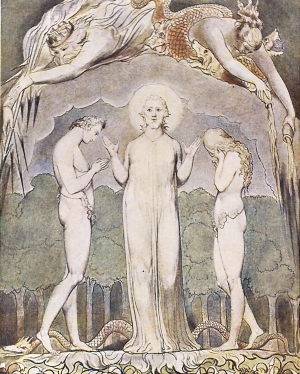
I’ve been thinking about Genesis lately. In this past month, the lectionary included Eve’s succumbing to the serpent and my study group talked about the troubling fallout in perceptions of gender roles, about what might have happened if Eve hadn’t eaten the apple, about a human tendency toward disobedience.
Today I’m thinking about certainty. Eve and Adam didn’t happen to simply miss curfew, or miss an animal-naming deadline; they ate of the tree of knowledge. Another discussion might consider the aspects of good and evil implicit in this knowledge, but I’m struck by the concept of desiring knowledge so much we are willing to face God’s punishment.
Most of my conscious life I’m hoping for, even demanding certainty. I want to know the one right school to send my kids to, the one right way to raise them, the one right way to eat, the one right way to exercise. My demand for certainty yields little but frustration. The time I spend with art I’m willing to know a little bit less. I read a collection of short stories for a class this past weekend, and turn over the possibilities for each narrative in my head.
Leon Kass found much to turn over reading Genesis. A professor at the University of Chicago, he began his study for general interest, and it became an obsession. What he had planned as a diversion became the near-700 page The Beginning of Wisdom. His 700 pages do not find much in the way of certainty. Instead, Kass suggests Genesis is rife with lacunae offering up and even demanding exploration, offering a narrative of metaphysical and ethical truths. A midrash he mentions in a footnote explains the significance of starting Genesis with bet, a letter closed on three sides and open to the direction of the text, so the reader is permitted only to investigate the time of the world’s creation into the time that we live. Each letter itself has meaning, bringing the level of significance from grand theory to minute detail, wider and deeper than literature lovers even know to look.
But uncertainty poses a problem for both the Bible’s supporters and detractors. Maimonides suggested that any conflict between faith and science was due to a misinterpretation of the Bible. In the current debate, both literalists in the realm of scripture and opponents of the same text make similar errors in relating supposed certainties in text to supposed certainties of science. Biblical literalists claim contradictions between science and the Bible disprove science. Opponents suggest the Biblical stories are simplistic and contradictory; science is the domain of rational thought, and as rational beings, science trumps sacred texts.
Kass’s reading of Genesis, drawing on the work of a number of scholars, illuminates the opportunity for endless study and interpretation. Scientific theories do likewise. In 2004 Stephen Hawking shocked the world by reversing his thinking about black holes. For three decades he had held that black holes destroyed all molecular traces of their contents. Thirty years later, he decided he was wrong. What is most stunning about this is not his reversal but that he had continued searching. Finding inconsistencies in his earlier findings (subatomic theory suggests matter cannot be created or destroyed), he continued to filter through data until he flipped his theory on its head. One imagines he works on it to this day.
This year, Peter Higgs and Francois Englert discovered the Higgs boson particle. It is the last ingredient needed to confirm the Standard Model which has ruled physics for the last fifty years. The New York Times reported: “For scientists, the discovery of the Higgs affirmed the view of a cosmos ruled by laws of almost diamond-like elegance and simplicity, but in which everything interesting — like us— is a result of lapses or flaws in that elegance.” Duke Magazine continues to explain that “the discovery also helps scientists explain what happened in the very early universe- 100 trillionth of a second after it exploded into existence- why it evolved the way it did, and even why it evolved at all.”
Lay proponents of science suppose a field of certainty, but these physicists prefer doubt. Notable in the articles are the words: so far. Their experimentation continues. Notable also: the word “help,” modifying “explain.” Notable also: 100-trillionth of a second after. Notable also: Hawking’s reversal of the black hole theory (among others).
Those upholding Biblical literalism want to exploit the holes in scientific theories, using them to suggest that science is false. With evolution in particular, there are too many gaps, the discussion goes. The findings are still uncertain.
Marcel Gleiser, a physicist at Dartmouth, suggests science is in fact about courting the mystery of the unknown. “I think that once you adopt that there is only one way of understanding the complexity of things you are emptying humanity of its value, the plurality of visions,” he says. “Science is powerful…but there are other ways of knowing. To say that there is only one way of understanding the mind… is impoverishing the richness of human culture.” Perhaps it is not only scientists, but readers of sacred texts, who might ponder his words.
Recently, Pope Francis suggested that “if a person says that he met God with total certainty and is not touched by a margin of uncertainty, then this is not good…. You must leave room for the Lord, not for our certainties; we must be humble.” In seeking God in all things, “there is still an area of uncertainty {una zona di incertezza}. There must be.”
James Gleick, author of Chaos, reflects on this statement on his blog: “For me, this is where religion and science can clasp hands.” The discomfort and anxiety of uncertainty may be the apple’s legacy we are least wont to accept; uncertainty makes us afraid.
When it comes to certainty, neither faith nor its lack offers what we crave. The Pope’s statement may lead to the principle connecting good faith and good science: a spirit of humility. Unknowing is what allows for the suspense and the joy of discovery, the continuous search, and new understandings.
Shannon Huffman Polson is the author of North of Hope: A Daughter’s Arctic Journey. Her essays and articles have appeared in a number of literary and commercial magazines including Huffington Post, High Country News, Adventum, Cirque Journal and Alaska and Seattle Magazines. She can be found writing or with her her family in Seattle or Alaska, and always at her website, Facebook, and Twitter.
This post was made possible through the support of a grant from The BioLogos Foundation’s Evolution and Christian Faith program. The opinions expressed are those of the author and do not necessarily reflect the views of BioLogos.
Previous Post

October 28, 2013
My Brother John: A Eulogy for the Living
Next Post
October 30, 2013 You Can’t Hide from Winter
Browse Our Archives
Select a Category A. G. Harmon Alissa Wilkinson Allison Backous Art Authors Brad Fruhauff Bradford Winters Bryan Bliss Caroline Langston Chad Thomas Johnston Chris Hoke Christiana N. Peterson Culture D.G. Myers D.L. Mayfield Daniel Bowman Jr. David Griffith Elizabeth Duffy Faith Film Greg Wolfe Guest Contributor Interview Jan Vallone Jeffrey Overstreet Jessica Eddings-Roeser Jessica Mesman Griffith Kelly Foster Lindsey Crittenden Morgan Meis music Natalie Vestin Nick Olson Peggy Rosenthal Personal Reflection Poetry Friday Reflection Relationships Review Richard Chess Richard Cole Sara Zarr Shannon Huffman Polson Sonya Bilocerkowycz Tania Runyan Tony Woodlief Topical Categories Uncategorized Vic Sizemore Writing
Select a Month October 2018 September 2018 August 2018 July 2018 June 2018 May 2018 April 2018 March 2018 February 2018 January 2018 December 2017 November 2017 October 2017 September 2017 August 2017 July 2017 June 2017 May 2017 April 2017 March 2017 February 2017 January 2017 December 2016 November 2016 October 2016 September 2016 August 2016 July 2016 June 2016 May 2016 April 2016 March 2016 February 2016 January 2016 December 2015 November 2015 October 2015 September 2015 August 2015 July 2015 June 2015 May 2015 April 2015 March 2015 February 2015 January 2015 December 2014 November 2014 October 2014 September 2014 August 2014 July 2014 June 2014 May 2014 April 2014 March 2014 February 2014 January 2014 December 2013 November 2013 October 2013 September 2013 August 2013 July 2013 June 2013 May 2013 April 2013 March 2013 February 2013 January 2013 December 2012 November 2012 October 2012 September 2012 August 2012 July 2012 June 2012 May 2012 February 2008
Follow Us!
TAKE THE
Religious Wisdom Quiz
Who denied knowing Jesus three times before the rooster crowed?
Select your answer to see how you score.
Andrew Judas Peter James
Related posts from Good Letters

Wabi-Sabi: Living with Beauty and Ugliness



TRENDING AT PATHEOS Catholic

Rejecting Doom: Christian Hope And Human Action
Christianity is a religion of hope. We are to have hope and...

It’s What Comes From Within Which Matters
One of the most difficult things for us to understand is why...

Why I Choose the Eucharist Over the Sermon
Choose the Eucharist, Not the Sermon What are we supposed to get...

5 Design Elements Found in Spiritually Rooted Homes
Putting Spirituality Into Home Decor Our homes are more than our living...

Credo: A Story of God Told with the...
About 10 years ago, I began to imagine a personal "Credo" that...

The Anatomy of Divine Revelation in Catholic Thought
The claim that God has made Himself known to human beings is...
view all Catholic blogs
Ad-Free & Subscriber Log-In Subscription Support
- About Us
- 2026 Calendar
- Videos
- Podcasts
- Library of World Religions
- Faith In Media Tracker
- Advertise With Us
- Write for Us
- Privacy Policy
- Terms of Service
- Do Not Sell My Data
- Contact Us
- Radiant Digital
- Manage Newsletter Subscriptions
- Unsubscribe From Notifications
- Sitemap
Copyright 2008-2026, Patheos. All rights reserved.
Subscription Support Ad-Free & Subscriber Log-In
Follow Patheos