
BuddhistCatholicContemplativeEvangelicalGeneral ChristianHinduJewishLatter-day SaintMuslimNew VisionsProgressive Christian
Beliefs
- Buddhist
- Catholic
- Contemplative
- Evangelical
- General Christian
- Hindu
- Jewish
- Latter-day Saint
- More Voices
- Muslim
- New Visions
- Pagan
- Progressive Christian
Topics
- Religion News
- Food and Religion
- Sports and Religion
- Religious Art
- Religious Music and Entertainment
- Religious Events
- History and Religion
- Style and Religion
- Politics and Religion
- Women in Religion
- Recreation Outdoors and Religion
- Business Finance and Religion
- Careers Workplace and Religion
- Education and Religion
- Family Parenting and Religion
- Health Fitness and Religion
- Home and Religion
- Relationships and Religion
- Technology and Religion
- Travel and Religion
Columnists
- Buddhist Columnists
- Business Finance and Religion Columnists
- Careers Workplace and Religion Columnists
- Catholic Columnists
- Contemplative Columnists
- Education and Religion Columnists
- Evangelists Columnists
- Family Parenting and Religion Columnists
- General Christian Columnists
- Health Fitness and Religion Columnists
- Hindu Columnists
- History and Religion Columnists
- Home and Religion Columnists
- Jewish Columnists
- More Voices Columnists
- Latter Day Columnists
- Muslim Columnists
- New Visions Columnists
- Nonreligious Columnists
- Pagan Columnists
- Politics and Religion Columnists
- Progressive Columnists
- Recreation Outdoors and Religion Columnists
- Relationships and Religion Columnists
- Religion News Columnists
- Religious Art Columnists
- Religious Events Columnists
- Religious Music and Entertainment Columnists
- Sports and Religion Columnists
- Style and Religion Columnists
- Technology and Religion Columnists
- Travel and Religion Columnists
- Women in Religion Columnists
Resource Library
- 2026 Calendar
- Library of World Religions
- The 100 Most Holy Places on Earth
- Patheos Answers
- Podcasts
- Videos
- Faith Leaders Database
- Anglican Episcopalian
- Bahai
- Baptist
- Buddhism
- Christianity
- Confucianism
- Eastern Orthodoxy
- Hinduism
- Holiness and Pentecostal
- ISKCON
- Islam
- Judaism
- Lutheran
- Methodist
- The Church of Jesus Christ of Latter-day Saints
- New Age
- Paganism
- Presbytarian and Reformed
- Protestantism
- Religion Behind the Scenes
- Roman Catholic
- Scientology
- Shia Islam
- Sikhism
- Sufism
- Sunni Islam
- Taoism
- Zen
- See all religions
Research Tools
 Ad-Free & Subscriber Log-In Subscription Support
Ad-Free & Subscriber Log-In Subscription Support
Follow Patheos 

- Trending:
- Forgiveness
- |
- Marriage
- |
- Consciousness
- |
- Death Penalty
- |
- Election
- |
- Halloween
 Good Letters
-
Contributors
- Home
- Catholic
- Conscience: An Epitaph
Conscience: An Epitaph
Last updated on: September 26, 2013 at 10:32 pm by A. G. Harmon
Conscience: An Epitaph 2013-09-26T22:32:57-07:00 A. G. Harmon
Patheos Explore the world's faith through different perspectives on religion and spirituality! Patheos has the views of the prevalent religions and spiritualities of the world.
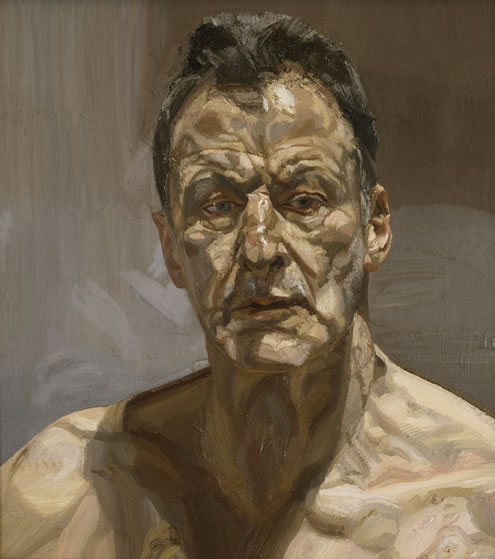
Lucian Freud, Reflection (Self-portrait), 1985.
Time melts as it’s made, said Anthony Burgess. Each moment is both increase and surcease, the tip of the fountain, bubbling, collapsing—itself upon itself—at once always there and then never there at all. Like ice in a country made of steam, it lives and dies in the rift.
Wrapped within our youth, we do not see this, or if we do, it is of no consequence. We purchase the perjury of our stature and trust the deceit of our mass. We weigh ourselves, take our measure, and assume our heft and reach too great for a world so flat. In our young fancies, we are the stuff of marble, and cannot feel time’s rain wear upon us, both outside and in.
We would not care about time at all but for what it does. And what it does is always a shock. For in spite of what we believe of ourselves, one inauspicious morning, or one historic dusk, without notice, the cold, flat mirror resolves to house a stranger—an unwanted guest that will not leave, that lingers like a bad taste, intruding in pools of water, in store-front reflections, and in the sheen of another’s eye.
It grows only bolder as the years fall away, until at some point what stares back is a joke too scandalous for the telling. Our eyes refuse it, renounce the reflected whole for only the part that requires our ministry: the thinning hair, the yellowed teeth, the unshaven jaw, and pocked flesh. No longer do we stand back from the glass, admire and appraise. A portion of what we were becomes more than enough.
Thus, time is the negative reality with which we are most familiar—negative in that we know it, and believe in it, though we cannot experience it through our senses. Like famine, we can only witness its effects, the way it plows through the common world in silence, in pressureless invisibility. Its wake is even mightier than that of the universe, which graciously explodes in dazzling displays of light and fire, which courteously implodes in terrible holes of darkness and depth.
Conversely, time has no manners. It asks no permissions, rings no bells. And yet, it is the reason, the cause, of the exploding and the collapse. It signs its name in the spectacle of its spoil.
But no matter our youthful agnosticism, we are all converts to time in the end. Its negative apotheosis is too clear to leave anyone at peace in his doubts. It forces its creed upon us, drives us to our knees, and makes each of us into one of its rotting temples, its latest parish of waste.
It would seem, therefore, that we who have such sad and intimate familiarity with the negative reality of time could also appreciate the negative reality of evil. Its effects are no less great, and of far vaster devastation. Time’s is a neutral church. Though its flock is a forced gathering, it does not, need not, evangelize. It requires nothing of its adherents, save a Quaker-like stillness as it works its unholy way. Its only objective is to wear us down, body and spirit, until we lie in its graveyard of stones, between our paltry parentheses of dates.
But evil is a proselytizer. It shouts and storms its path through reality, bumping and thumping as it goes. There is no plane so cosmic that its blood cannot purple it, and no room so small that its calumny will not deface. Unlike time, evil’s is a creative, not a nullifying, force. Productive, efficient, it can make galaxies out of our meanest vices. Our treasons and savageries, ever so petty, are always beachheads—a Normandy upon whose landfall empires are built. Evil takes every form, speaks every tongue.
And yet, with all this to witness, with all the histories it has authored, it is hardly mentioned these days. The great irony, of course, is that we are its native congregants, its born disciples, but to confess or speak of it is to be rejected as primitive. To ascribe its label is to be set down as a self-appointed judge, a hypocrite, a simplifier, or all three. It seems no act is worthy of being called evil; an act is only a consequence—a retaliation—a response to some provocation, centuries old and multi-determined.
The papers bring news of an aged veteran beaten to death for his wallet, of an infant shot in the face, point-blank, and experts rush in to direct our attention to everything but the malevolent wills that said yes to such acts. Explanations become alibis, and “full” understandings of troubled pasts and broken homes, however tragic, imply that no individual choice is free.
I watch a talking head, with multiple degrees, explain that Good/Evil is a false dichotomy, the marked vocabulary of a dated orthodoxy: “It is much more complicated than that.” So even when innocence is murdered, slain before milk has wet its mouth, we’re taught that there are “conditions” to consider. Sophistication qualifies the palette and all fades to gray.
When reality is exchanged for relativity, conscience dies. Every circumstance calls for compromise, concession; things that once were not to be borne are now contexts that must be accommodated. There is nothing worth denouncing because there are no terms that call for denunciation. So there can be no convictions or conquests worth the candle; all are recused; none can say.
We are not “losing the language of evil,” as some idiot academic would have it. We are losing the gumption to call it such. And when nerve dies, the rest follows, until there is nothing left but a timeless hollow that once had the cheek to call itself a man.
Hamlet was wrong, it seems, but he would’ve had to live in our day to learn it. Conscience does not make cowards of us all; it is the death of conscience that does that.
Previous Post

September 25, 2013
All I Needed to Know I Learned from the Phonebook
Next Post
September 29, 2013 Wabi-sabi: Living with Beauty and Ugliness
Browse Our Archives
Select a Category A. G. Harmon Alissa Wilkinson Allison Backous Art Authors Brad Fruhauff Bradford Winters Bryan Bliss Caroline Langston Chad Thomas Johnston Chris Hoke Christiana N. Peterson Culture D.G. Myers D.L. Mayfield Daniel Bowman Jr. David Griffith Elizabeth Duffy Faith Film Greg Wolfe Guest Contributor Interview Jan Vallone Jeffrey Overstreet Jessica Eddings-Roeser Jessica Mesman Griffith Kelly Foster Lindsey Crittenden Morgan Meis music Natalie Vestin Nick Olson Peggy Rosenthal Personal Reflection Poetry Friday Reflection Relationships Review Richard Chess Richard Cole Sara Zarr Shannon Huffman Polson Sonya Bilocerkowycz Tania Runyan Tony Woodlief Topical Categories Uncategorized Vic Sizemore Writing
Select a Month October 2018 September 2018 August 2018 July 2018 June 2018 May 2018 April 2018 March 2018 February 2018 January 2018 December 2017 November 2017 October 2017 September 2017 August 2017 July 2017 June 2017 May 2017 April 2017 March 2017 February 2017 January 2017 December 2016 November 2016 October 2016 September 2016 August 2016 July 2016 June 2016 May 2016 April 2016 March 2016 February 2016 January 2016 December 2015 November 2015 October 2015 September 2015 August 2015 July 2015 June 2015 May 2015 April 2015 March 2015 February 2015 January 2015 December 2014 November 2014 October 2014 September 2014 August 2014 July 2014 June 2014 May 2014 April 2014 March 2014 February 2014 January 2014 December 2013 November 2013 October 2013 September 2013 August 2013 July 2013 June 2013 May 2013 April 2013 March 2013 February 2013 January 2013 December 2012 November 2012 October 2012 September 2012 August 2012 July 2012 June 2012 May 2012 February 2008
Follow Us!
TAKE THE
Religious Wisdom Quiz
How many New Testament books were written by John?
Select your answer to see how you score.
5 6 4 3
Related posts from Good Letters


A Conversation with Alicia Ostriker: Part 1

A Conversation with Alicia Ostriker: Part 2

TRENDING AT PATHEOS Catholic

Rejecting Doom: Christian Hope And Human Action
Christianity is a religion of hope. We are to have hope and...

It’s What Comes From Within Which Matters
One of the most difficult things for us to understand is why...

Why I Choose the Eucharist Over the Sermon
Choose the Eucharist, Not the Sermon What are we supposed to get...

5 Design Elements Found in Spiritually Rooted Homes
Putting Spirituality Into Home Decor Our homes are more than our living...

Credo: A Story of God Told with the...
About 10 years ago, I began to imagine a personal "Credo" that...

The Anatomy of Divine Revelation in Catholic Thought
The claim that God has made Himself known to human beings is...
view all Catholic blogs
Ad-Free & Subscriber Log-In Subscription Support
- About Us
- 2026 Calendar
- Videos
- Podcasts
- Library of World Religions
- Faith In Media Tracker
- Advertise With Us
- Write for Us
- Privacy Policy
- Terms of Service
- Do Not Sell My Data
- Contact Us
- Radiant Digital
- Manage Newsletter Subscriptions
- Unsubscribe From Notifications
- Sitemap
Copyright 2008-2026, Patheos. All rights reserved.
Subscription Support Ad-Free & Subscriber Log-In
Follow Patheos