
BuddhistCatholicContemplativeEvangelicalGeneral ChristianHinduJewishLatter-day SaintMuslimNew VisionsProgressive Christian
Beliefs
- Buddhist
- Catholic
- Contemplative
- Evangelical
- General Christian
- Hindu
- Jewish
- Latter-day Saint
- More Voices
- Muslim
- New Visions
- Pagan
- Progressive Christian
Topics
- Religion News
- Food and Religion
- Sports and Religion
- Religious Art
- Religious Music and Entertainment
- Religious Events
- History and Religion
- Style and Religion
- Politics and Religion
- Women in Religion
- Recreation Outdoors and Religion
- Business Finance and Religion
- Careers Workplace and Religion
- Education and Religion
- Family Parenting and Religion
- Health Fitness and Religion
- Home and Religion
- Relationships and Religion
- Technology and Religion
- Travel and Religion
Columnists
- Buddhist Columnists
- Business Finance and Religion Columnists
- Careers Workplace and Religion Columnists
- Catholic Columnists
- Contemplative Columnists
- Education and Religion Columnists
- Evangelists Columnists
- Family Parenting and Religion Columnists
- General Christian Columnists
- Health Fitness and Religion Columnists
- Hindu Columnists
- History and Religion Columnists
- Home and Religion Columnists
- Jewish Columnists
- More Voices Columnists
- Latter Day Columnists
- Muslim Columnists
- New Visions Columnists
- Nonreligious Columnists
- Pagan Columnists
- Politics and Religion Columnists
- Progressive Columnists
- Recreation Outdoors and Religion Columnists
- Relationships and Religion Columnists
- Religion News Columnists
- Religious Art Columnists
- Religious Events Columnists
- Religious Music and Entertainment Columnists
- Sports and Religion Columnists
- Style and Religion Columnists
- Technology and Religion Columnists
- Travel and Religion Columnists
- Women in Religion Columnists
Resource Library
- 2026 Calendar
- Library of World Religions
- The 100 Most Holy Places on Earth
- Patheos Answers
- Podcasts
- Videos
- Faith Leaders Database
- Anglican Episcopalian
- Bahai
- Baptist
- Buddhism
- Christianity
- Confucianism
- Eastern Orthodoxy
- Hinduism
- Holiness and Pentecostal
- ISKCON
- Islam
- Judaism
- Lutheran
- Methodist
- The Church of Jesus Christ of Latter-day Saints
- New Age
- Paganism
- Presbytarian and Reformed
- Protestantism
- Religion Behind the Scenes
- Roman Catholic
- Scientology
- Shia Islam
- Sikhism
- Sufism
- Sunni Islam
- Taoism
- Zen
- See all religions
Research Tools
 Ad-Free & Subscriber Log-In Subscription Support
Ad-Free & Subscriber Log-In Subscription Support
Follow Patheos 

- Trending:
- Forgiveness
- |
- Marriage
- |
- Consciousness
- |
- Death Penalty
- |
- Election
- |
- Halloween
 Good Letters
-
Contributors
- Home
- Catholic
- Chrysalis, Catacomb, Cloud Part 2
Chrysalis, Catacomb, Cloud Part 2
Last updated on: January 4, 2014 at 5:36 pm by Guest Contributor
Chrysalis, Catacomb, Cloud Part 2 2014-01-04T17:36:49-07:00 Guest Contributor
Patheos Explore the world's faith through different perspectives on religion and spirituality! Patheos has the views of the prevalent religions and spiritualities of the world.
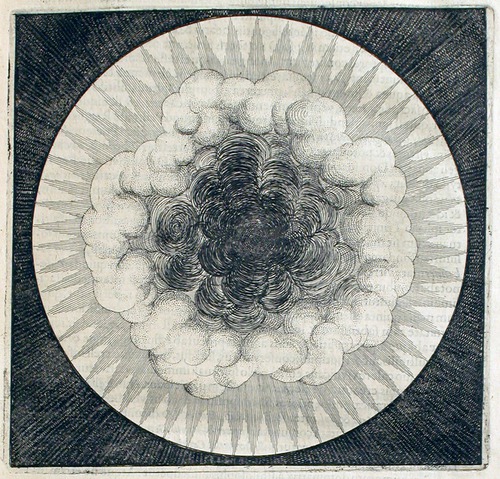
R. Fludd, Utriusque Cosmi (1617)
Guest Post
Jen Hinst-White
Continued from yesterday.
Rob goes to bed; I go to my desk and light white candles. Someone I know makes a yearly Lenten project of holding a poetry contest, soliciting translations of psalms from friends. The timing is good; I need a quiet task. Which psalm, then?
Years ago I memorized Psalm 25, and it’s become my favorite ground to walk in the book of Psalms. It’s the one I return to, a beggar’s song of waiting and yearning and aloneness.
Plus—it’s got tricks built in. In Hebrew, this psalm is an acrostic, with the first letter of each line spelling out the Hebrew alphabet. Why the acrostic? Maybe for easy recall when you have no presence of mind. Ache and longing made manageable by mnemonics.
To you, O Lord, I lift up my soul.
O my God, in you I trust;
do not let me be put to shame;
do not let my enemies exult over me.
Do not let those who wait for you be put to shame;
let them be ashamed who are wantonly treacherous.
Make me to know your ways, O Lord;
teach me your paths.
Lead me in your truth, and teach me,
for you are the God of my salvation;
for you I wait all day long.
I muddle around in this for a few hours:
At your hangar door I toss me: a paper plane.
Bring me in from the rain—take me ragged, and keep me
all clear of the suck of the great turbines
Collect me and read me, wee stormied scrap,
and scrap those still scrapping us windward,
O God—
Don’t forget. Fold aright, and write New on my wing—
make limp paper sing—here, then, the wait—
but love’s side-lying
Eight guides all your flights. Right? Remind me. Remind me.
Find me kindly. Not back in my writhing, wriggling loose of my binding—
forgive me, still wild—
God of the Polestar. Pilot Bridegroom. Pied Guider.
He gathers scorched ribbons for the tails of his kites.
If he finds paper squares, he folds cranes for his skies,
and so newsprint shares airspace with stars.
I get stuck at verse nine for an hour or so and I know there are no more words coming tonight, but I can’t leave the desk. I don’t want to go to bed because I don’t want to get up in the morning.
Around one-thirty, Rob comes downstairs looking for me. “I was worried,” he says. Then: “I feel like I’m going to throw up.” He goes and sits on the floor of the bathroom across the hall.
“Do you want me to stay with you?” I rub my face. I can hardly see.
“Get some sleep,” he says.
When I was twelve years old, I used to go once a week to the middle school guidance counselor’s office. Her office was the size of a large closet, and I liked it—cozy. Wood paneling, no windows, carpet like that of a cat’s scratching post. Nature posters. The counselor was plump and bronzy blond.
All my hours in that room have layered themselves into one blurry hour, as if time stopped whenever I walked through her door. I don’t remember anything I said, or she said. Except for one conversation. I remember I said: “I wish they would just decide yes or no.”
My parents couldn’t make up their minds about whether to stay together. When I was nine, they sat us down in their bedroom, my brother and me, and said they were getting divorced.
Then, some months later, they sat us down at a Chinese restaurant and said they were going to stay married, after all.
Then my father started taking a lot of business trips to California, and sometimes a woman would call.
Then my parents planned a family vacation for Easter break. We drove down the East Coast through Maryland, Virginia, Georgia. They held it together until Disney World, I think, and then an argument boiled over in the middle of a souvenir shop. My mother walked out, my father stood there; I froze, not knowing if I should stay with him or follow her.
“You’d rather they get divorced than keep you wondering anymore,” the counselor said.
“Yes,” I said.
I drive to work on my few hours’ sleep, feeling hollow. Am I a chrysalis or a catacomb? At six weeks, there should be a heartbeat.
I pray I will miscarry quickly.
Then I am quiet for a while, because my own prayer strikes me as strange. I’d choose death over possibility? Just to avoid the waiting?
“Thin places” are geographical. They are spiritual doorways in physical space. But they have a chronological cousin: liminal spaces. Liminal spaces are waiting times, doorway times—thin places measured in days, not square miles. In an essay called “Grieving as Sacred Space,” written after 9/11, Richard Rohr describes them in this way:
“Limina” is the Latin word for threshold, the space betwixt and between. Liminal space, therefore, is a unique spiritual position where human beings hate to be but where the biblical God is always leading them…. It is no fun. Think of Israel in the desert, Joseph in the pit, Jonah in the belly, the three Marys tending the tomb.
If you are not trained in how to hold anxiety, how to live with ambiguity, how to entrust and wait—you will run—or more likely, you will “explain”…anything to flee from this terrible cloud of unknowing.
“I want to give you the benefit of the doubt,” the doctor said to me.
Jen Hinst-White recently finished her first novel, Inkliings, the story of an aspiring female tattooist in the early 1980s. Her writing has been published (or is forthcoming) in The Common, Big Fiction, Cactus Heart, HoldADoor.com and elsewhere. She holds an MFA from the Bennington Writing Seminars. Her website is jenhinstwhite.com.
This paraphrase of Psalm 25 was first published as the winning poem in the 2013 Works and Days Psalm Translation Contest (matthewlandrum.com). Grateful acknowledgment to Matthew Landrum for permission to republish it as part of this essay.
Previous Post

September 12, 2013
Chrysalis, Catacomb, Cloud Part 1
Next Post
September 16, 2013 Confession: Yom Kippur 5774
Browse Our Archives
Select a Category A. G. Harmon Alissa Wilkinson Allison Backous Art Authors Brad Fruhauff Bradford Winters Bryan Bliss Caroline Langston Chad Thomas Johnston Chris Hoke Christiana N. Peterson Culture D.G. Myers D.L. Mayfield Daniel Bowman Jr. David Griffith Elizabeth Duffy Faith Film Greg Wolfe Guest Contributor Interview Jan Vallone Jeffrey Overstreet Jessica Eddings-Roeser Jessica Mesman Griffith Kelly Foster Lindsey Crittenden Morgan Meis music Natalie Vestin Nick Olson Peggy Rosenthal Personal Reflection Poetry Friday Reflection Relationships Review Richard Chess Richard Cole Sara Zarr Shannon Huffman Polson Sonya Bilocerkowycz Tania Runyan Tony Woodlief Topical Categories Uncategorized Vic Sizemore Writing
Select a Month October 2018 September 2018 August 2018 July 2018 June 2018 May 2018 April 2018 March 2018 February 2018 January 2018 December 2017 November 2017 October 2017 September 2017 August 2017 July 2017 June 2017 May 2017 April 2017 March 2017 February 2017 January 2017 December 2016 November 2016 October 2016 September 2016 August 2016 July 2016 June 2016 May 2016 April 2016 March 2016 February 2016 January 2016 December 2015 November 2015 October 2015 September 2015 August 2015 July 2015 June 2015 May 2015 April 2015 March 2015 February 2015 January 2015 December 2014 November 2014 October 2014 September 2014 August 2014 July 2014 June 2014 May 2014 April 2014 March 2014 February 2014 January 2014 December 2013 November 2013 October 2013 September 2013 August 2013 July 2013 June 2013 May 2013 April 2013 March 2013 February 2013 January 2013 December 2012 November 2012 October 2012 September 2012 August 2012 July 2012 June 2012 May 2012 February 2008
Follow Us!
TAKE THE
Religious Wisdom Quiz
Where did David spare Saul's life when he found him in a cave?
Select your answer to see how you score.
Gilgal Hebron Bethlehem En Gedi
Related posts from Good Letters

The Stars of the Earth Cry Out


Poetry Friday: “The Ordinary Time”
TRENDING AT PATHEOS Catholic

Rejecting Doom: Christian Hope And Human Action
Christianity is a religion of hope. We are to have hope and...

It’s What Comes From Within Which Matters
One of the most difficult things for us to understand is why...

Why I Choose the Eucharist Over the Sermon
Choose the Eucharist, Not the Sermon What are we supposed to get...

5 Design Elements Found in Spiritually Rooted Homes
Putting Spirituality Into Home Decor Our homes are more than our living...

Credo: A Story of God Told with the...
About 10 years ago, I began to imagine a personal "Credo" that...

The Anatomy of Divine Revelation in Catholic Thought
The claim that God has made Himself known to human beings is...
view all Catholic blogs
Ad-Free & Subscriber Log-In Subscription Support
- About Us
- 2026 Calendar
- Videos
- Podcasts
- Library of World Religions
- Faith In Media Tracker
- Advertise With Us
- Write for Us
- Privacy Policy
- Terms of Service
- Do Not Sell My Data
- Contact Us
- Radiant Digital
- Manage Newsletter Subscriptions
- Unsubscribe From Notifications
- Sitemap
Copyright 2008-2026, Patheos. All rights reserved.
Subscription Support Ad-Free & Subscriber Log-In
Follow Patheos