
BuddhistCatholicContemplativeEvangelicalGeneral ChristianHinduJewishLatter-day SaintMuslimNew VisionsProgressive Christian
Beliefs
- Buddhist
- Catholic
- Contemplative
- Evangelical
- General Christian
- Hindu
- Jewish
- Latter-day Saint
- More Voices
- Muslim
- New Visions
- Pagan
- Progressive Christian
Topics
- Religion News
- Food and Religion
- Sports and Religion
- Religious Art
- Religious Music and Entertainment
- Religious Events
- History and Religion
- Style and Religion
- Politics and Religion
- Women in Religion
- Recreation Outdoors and Religion
- Business Finance and Religion
- Careers Workplace and Religion
- Education and Religion
- Family Parenting and Religion
- Health Fitness and Religion
- Home and Religion
- Relationships and Religion
- Technology and Religion
- Travel and Religion
Columnists
- Buddhist Columnists
- Business Finance and Religion Columnists
- Careers Workplace and Religion Columnists
- Catholic Columnists
- Contemplative Columnists
- Education and Religion Columnists
- Evangelists Columnists
- Family Parenting and Religion Columnists
- General Christian Columnists
- Health Fitness and Religion Columnists
- Hindu Columnists
- History and Religion Columnists
- Home and Religion Columnists
- Jewish Columnists
- More Voices Columnists
- Latter Day Columnists
- Muslim Columnists
- New Visions Columnists
- Nonreligious Columnists
- Pagan Columnists
- Politics and Religion Columnists
- Progressive Columnists
- Recreation Outdoors and Religion Columnists
- Relationships and Religion Columnists
- Religion News Columnists
- Religious Art Columnists
- Religious Events Columnists
- Religious Music and Entertainment Columnists
- Sports and Religion Columnists
- Style and Religion Columnists
- Technology and Religion Columnists
- Travel and Religion Columnists
- Women in Religion Columnists
Resource Library
- 2026 Calendar
- Library of World Religions
- The 100 Most Holy Places on Earth
- Patheos Answers
- Podcasts
- Videos
- Faith Leaders Database
- Anglican Episcopalian
- Bahai
- Baptist
- Buddhism
- Christianity
- Confucianism
- Eastern Orthodoxy
- Hinduism
- Holiness and Pentecostal
- ISKCON
- Islam
- Judaism
- Lutheran
- Methodist
- The Church of Jesus Christ of Latter-day Saints
- New Age
- Paganism
- Presbytarian and Reformed
- Protestantism
- Religion Behind the Scenes
- Roman Catholic
- Scientology
- Shia Islam
- Sikhism
- Sufism
- Sunni Islam
- Taoism
- Zen
- See all religions
Research Tools
 Ad-Free & Subscriber Log-In Subscription Support
Ad-Free & Subscriber Log-In Subscription Support
Follow Patheos 

- Trending:
- Forgiveness
- |
- Marriage
- |
- Consciousness
- |
- Death Penalty
- |
- Election
- |
- Halloween
 Good Letters
-
Contributors
- Home
- Catholic
- The Mill and the Cross
The Mill and the Cross
Last updated on: August 26, 2013 at 1:00 am by A. G. Harmon
The Mill and the Cross 2013-08-22T16:32:24-07:00 A. G. Harmon
Patheos Explore the world's faith through different perspectives on religion and spirituality! Patheos has the views of the prevalent religions and spiritualities of the world.
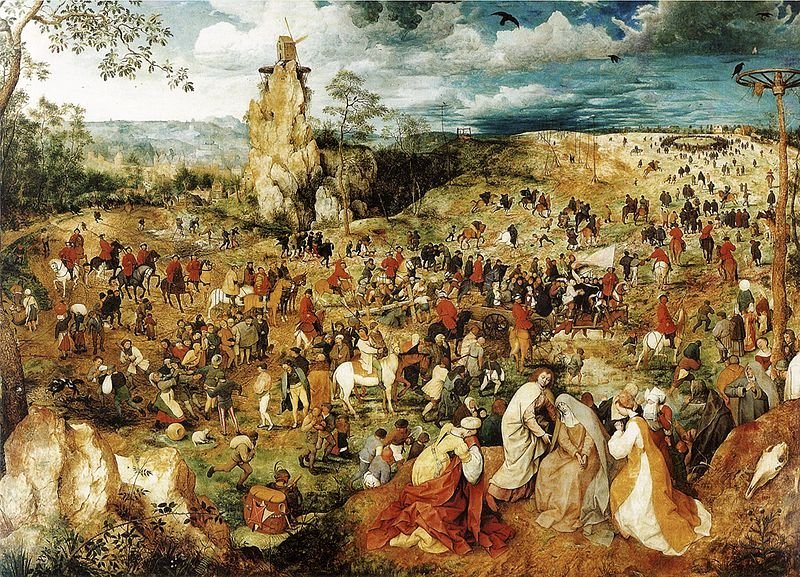 In Breughel’s panoramic painting, “The Procession to Calvary,” the fallen Savior, collapsed under the cross beam, is mostly ignored. Although he’s right in the center of things, nobody pays him too much mind. Instead, the fantastic landscape that surrounds him churns with a thousand wheels of activity, each cog connected to the other, spinning upon its fellows like the clockwork mill that sits atop a monument of stone, high above.

Breughel seems to have loved this approach, philosopher artist that he was. It made a lifetime of statements for him: E.g., “Yes, a winged man is falling from the heavens over there to my right, but I’ve got forty acres to plow and my feet are killing me.” Historic things can happen throughout a day, implies Brueghel; still, the pot boils, the baby cries, and the cow bellows to be milked; our attentions go elsewhere. The eschaton might begin its fateful crack right next door, but chances are we’ll be tying our shoelaces when it does. One of Breughel’s modern descendants is the Englishman Stanley Spencer, who used Cookham village to stand in for the world, going about its hum-drum business as its creator ambles by on the road to reality’s inversion.

While even children can enjoy the great Fleming, since Breughel’s canvases are like Rube Goldberg contraptions, surprising in their humor and complexity, great thinkers have considered his works masterpieces of contemplation. Precise as his technical detail may be, it is surpassed by how much thought he puts into his compositions. His works stand alone, immediately recognizable notwithstanding their influence on the later surrealists and symbolists, who are perhaps better known now.
There can be no vaster appreciation for what Brueghel accomplished in “The Procession” than Polish director Lech Majewski’s film, The Mill and the Cross. Inspired by art critic Michael Francis Gibson’s book of the same title, Majewski’s work has been shown in museums, and rightly so, for it belongs in a museum itself. It is not so much a movie as it is a painted film.
Under Majewski’s direction, Brueghel’s canvas is infused and lifted into the world of movement and time—but exists in a mode still uncannily faithful to both the plastic arts and to the theatrical. The painting is resurrected like a lovely, expectation-raising home screen of an interactive computer program (the film lays to rest any doubt that computer design is an artistic medium). There is not a shot that is not also a portrait. Honoring Brueghel’s genius, Majewski displays his own in a work that defies genre—not just film, but art itself.
Like so many great Polish filmmakers—Kieślowski and Zanussi, to name two—he is above the foolishness of modern secular separatism. Whatever these men personally believe, they know what the civilized world owes to Christianity. Consequently, their contributions draw deeply upon that horde to make serious humanistic statements.
To that end, The Mill and the Cross isn’t so much a movie as a philosophical discourse on art, religion, and man’s curse (distorting any great idea into an instrument of torture: in Breughel’s time, the Spaniard’s religious persecution of the Flemish). The director is not so much interested in narrative—there is very little in the film—but in explaining the picture’s meaning. So the audience is brought inside it, as Brueghel himself (Rutger Hauer) describes the process to the donor who has commissioned the piece (Michael York).
“I will work like the spider,” he says, “anchoring the viewer.” That he does, spinning out from the figure of the fallen Christ to the large, rude world that blunders about him even as he transforms it. The analogy is apt, as the spider’s web is in the shape of a Catherine’s Wheel, another central feature of torture that echoes in the small Calvaries standing about the countryside.
The mill, high above, is the process of life, he explains. It resembles a church, with its sail-like arms forming the great cross. The miller, barely visible, is God, producing the bread of life. The left side of the canvas is filled with other positive symbols—the circular city—a tall green tree—the clear sky. But as we move to the right, the skies cloud, and the people form circles of death, swarming like flies to the distant ring of Golgotha.
The only other major character is the Virgin Mary (Charlotte Rampling). She is mystified by the ordinariness of the day, which is painfully ominous. She narrates that those who had welcomed her son, glory-born and glory-fated, or so it had always seemed, are now calling for his death. Still, the day is so slow, the landscape so deliberate and honest, that it reassures her; nothing is going to happen, she repeats.
At one point, the donor complains that if time could be stopped, we could wrestle down the injustice and cruelty, speak its name to its face, and break its spell. Brueghel implies with a look that he can do all of this—by means of the painting; and so it happens, majestically.
But Brueghel doesn’t suggest that art eliminates tragedy; after all, this painting has hung for five centuries, viewed by millions of people. The film even ends by pulling back from the landscape of the painting to place it within the landscape of the museum. Despite all the showings and lectures about it, its lesson is never learned.
Or perhaps a different one is, implies Majewski: the ruthlessness of routine carries on even as evil’s name is spoken. Life’s grinding, plodding bigness—its ordinariness—keeps us from noticing where we are or what goes on around us.
It seems there’s always a reveille of sorts; a clarion. And sometimes we stop. Our eyes fix, we hear it, and we notice the context, gravity, and law of what we’re doing. Sometimes. But mostly that’s not so; mostly we just ignore it, as the Savior passes by.
A.G. Harmon teaches Shakespeare, Law and Literature, Jurisprudence, and Writing at The Catholic University of America in Washington, D.C. His novel, A House All Stilled, won the 2001 Peter Taylor Prize for the Novel.
Art above: Pieter Brueghel, The Procession to Calvary, 1564.
Previous Post

August 23, 2013
Words for Good and Evil, Part II
Next Post
August 27, 2013 I Hate Summer
Browse Our Archives
Select a Category A. G. Harmon Alissa Wilkinson Allison Backous Art Authors Brad Fruhauff Bradford Winters Bryan Bliss Caroline Langston Chad Thomas Johnston Chris Hoke Christiana N. Peterson Culture D.G. Myers D.L. Mayfield Daniel Bowman Jr. David Griffith Elizabeth Duffy Faith Film Greg Wolfe Guest Contributor Interview Jan Vallone Jeffrey Overstreet Jessica Eddings-Roeser Jessica Mesman Griffith Kelly Foster Lindsey Crittenden Morgan Meis music Natalie Vestin Nick Olson Peggy Rosenthal Personal Reflection Poetry Friday Reflection Relationships Review Richard Chess Richard Cole Sara Zarr Shannon Huffman Polson Sonya Bilocerkowycz Tania Runyan Tony Woodlief Topical Categories Uncategorized Vic Sizemore Writing
Select a Month October 2018 September 2018 August 2018 July 2018 June 2018 May 2018 April 2018 March 2018 February 2018 January 2018 December 2017 November 2017 October 2017 September 2017 August 2017 July 2017 June 2017 May 2017 April 2017 March 2017 February 2017 January 2017 December 2016 November 2016 October 2016 September 2016 August 2016 July 2016 June 2016 May 2016 April 2016 March 2016 February 2016 January 2016 December 2015 November 2015 October 2015 September 2015 August 2015 July 2015 June 2015 May 2015 April 2015 March 2015 February 2015 January 2015 December 2014 November 2014 October 2014 September 2014 August 2014 July 2014 June 2014 May 2014 April 2014 March 2014 February 2014 January 2014 December 2013 November 2013 October 2013 September 2013 August 2013 July 2013 June 2013 May 2013 April 2013 March 2013 February 2013 January 2013 December 2012 November 2012 October 2012 September 2012 August 2012 July 2012 June 2012 May 2012 February 2008
Follow Us!
TAKE THE
Religious Wisdom Quiz
In the Lord's Prayer, what do Christians ask for daily?
Select your answer to see how you score.
Fame Daily bread Riches Long life
Related posts from Good Letters

Leonard Cohen’s Holy and Broken Hallelujah

Ready or Not for the Days of Awe


TRENDING AT PATHEOS Catholic

Rejecting Doom: Christian Hope And Human Action
Christianity is a religion of hope. We are to have hope and...

It’s What Comes From Within Which Matters
One of the most difficult things for us to understand is why...

Why I Choose the Eucharist Over the Sermon
Choose the Eucharist, Not the Sermon What are we supposed to get...

5 Design Elements Found in Spiritually Rooted Homes
Putting Spirituality Into Home Decor Our homes are more than our living...

Credo: A Story of God Told with the...
About 10 years ago, I began to imagine a personal "Credo" that...

The Anatomy of Divine Revelation in Catholic Thought
The claim that God has made Himself known to human beings is...
view all Catholic blogs
Ad-Free & Subscriber Log-In Subscription Support
- About Us
- 2026 Calendar
- Videos
- Podcasts
- Library of World Religions
- Faith In Media Tracker
- Advertise With Us
- Write for Us
- Privacy Policy
- Terms of Service
- Do Not Sell My Data
- Contact Us
- Radiant Digital
- Manage Newsletter Subscriptions
- Unsubscribe From Notifications
- Sitemap
Copyright 2008-2026, Patheos. All rights reserved.
Subscription Support Ad-Free & Subscriber Log-In
Follow Patheos