
BuddhistCatholicContemplativeEvangelicalGeneral ChristianHinduJewishLatter-day SaintMuslimNew VisionsProgressive Christian
Beliefs
- Buddhist
- Catholic
- Contemplative
- Evangelical
- General Christian
- Hindu
- Jewish
- Latter-day Saint
- More Voices
- Muslim
- New Visions
- Pagan
- Progressive Christian
Topics
- Religion News
- Food and Religion
- Sports and Religion
- Religious Art
- Religious Music and Entertainment
- Religious Events
- History and Religion
- Style and Religion
- Politics and Religion
- Women in Religion
- Recreation Outdoors and Religion
- Business Finance and Religion
- Careers Workplace and Religion
- Education and Religion
- Family Parenting and Religion
- Health Fitness and Religion
- Home and Religion
- Relationships and Religion
- Technology and Religion
- Travel and Religion
Columnists
- Buddhist Columnists
- Business Finance and Religion Columnists
- Careers Workplace and Religion Columnists
- Catholic Columnists
- Contemplative Columnists
- Education and Religion Columnists
- Evangelists Columnists
- Family Parenting and Religion Columnists
- General Christian Columnists
- Health Fitness and Religion Columnists
- Hindu Columnists
- History and Religion Columnists
- Home and Religion Columnists
- Jewish Columnists
- More Voices Columnists
- Latter Day Columnists
- Muslim Columnists
- New Visions Columnists
- Nonreligious Columnists
- Pagan Columnists
- Politics and Religion Columnists
- Progressive Columnists
- Recreation Outdoors and Religion Columnists
- Relationships and Religion Columnists
- Religion News Columnists
- Religious Art Columnists
- Religious Events Columnists
- Religious Music and Entertainment Columnists
- Sports and Religion Columnists
- Style and Religion Columnists
- Technology and Religion Columnists
- Travel and Religion Columnists
- Women in Religion Columnists
Resource Library
- 2026 Calendar
- Library of World Religions
- The 100 Most Holy Places on Earth
- Patheos Answers
- Podcasts
- Videos
- Faith Leaders Database
- Anglican Episcopalian
- Bahai
- Baptist
- Buddhism
- Christianity
- Confucianism
- Eastern Orthodoxy
- Hinduism
- Holiness and Pentecostal
- ISKCON
- Islam
- Judaism
- Lutheran
- Methodist
- The Church of Jesus Christ of Latter-day Saints
- New Age
- Paganism
- Presbytarian and Reformed
- Protestantism
- Religion Behind the Scenes
- Roman Catholic
- Scientology
- Shia Islam
- Sikhism
- Sufism
- Sunni Islam
- Taoism
- Zen
- See all religions
Research Tools
 Ad-Free & Subscriber Log-In Subscription Support
Ad-Free & Subscriber Log-In Subscription Support
Follow Patheos 

- Trending:
- Forgiveness
- |
- Marriage
- |
- Consciousness
- |
- Death Penalty
- |
- Election
- |
- Halloween
 Good Letters
-
Contributors
- Home
- Catholic
- The March on Washington: A Personal Anniversary
The March on Washington: A Personal Anniversary
Last updated on: January 16, 2015 at 3:46 pm by Guest Contributor
The March on Washington: A Personal Anniversary 2015-01-16T15:46:03-07:00 Guest Contributor
Patheos Explore the world's faith through different perspectives on religion and spirituality! Patheos has the views of the prevalent religions and spiritualities of the world.
 Guest Post
By Christine A. Scheller
“Many of our white brothers…have come to realize that their destiny is tied up with our destiny. They have come to realize that their freedom is inextricably bound to our freedom.”
— Martin Luther King, Jr., August 28, 1963
I was born on the first anniversary of the day these words were spoken. My black son was buried on the fortieth anniversary of the day their author was silenced. I’ve been pondering this bit of providence ever since.
I didn’t expect to mother a black child and certainly didn’t expect that brilliant, beautiful child to kill himself in the year America’s first black president was elected on a message of hope and change.
Growing up in a small, lily-white New Jersey town, I briefly had a black friend. One day, she came home from school with me and my mother advised me that it would be best if she was gone before my late father got there. My father had grown up in Newark and had gotten beaten up regularly by black boys, my mother says, at least until he became a gang leader and Golden Gloves boxing champion. (Men who worked with my late father in urban ministry in the 1960s have told me they never saw any hint of racism in his interactions with people of all races and ethnicities. I believe that like all of us, he was a product of his time and place, a man who sometimes rose above his circumstances and sometimes did not.)
The afterschool play-date was my formal introduction to the concept of race and it was startling. I had no idea what it meant. All I know is that the girl, whose name I don’t recall, disappears from my memory after that.
In college, where I got pregnant, I hung out with the African students because, like them, I was an outsider at our Mennonite school. When my son was born, my family and friends embraced us both, which is not to say any of us possessed anything like racial awareness. Early in my son’s life (I’m ashamed to admit this) I made sure people knew his paternity-denying father was African and educated so that they wouldn’t think I—daughter of an actual one-time ghetto thug—had slept with one.
Pretty quickly I realized the moral bankruptcy of my reasoning and thus began a long, slow racial awakening that happened only because I had accidentally, providentially, conceived a black child. As that beloved child grew into manhood, I came to understand something of what it means to be black and male in America.
I learned it in stores when his white brother was not followed and he was. I learned it when job openings were filled until his white friends applied for them. I learned it when he was harassed by the police and when he grew uncomfortable with the portrayal of the Bailey family maid in our favorite Christmas film, “It’s a Wonderful Life.” And then finally, I learned it from black friends—listening to them, reading them, laughing and crying with them.
Now here I am on the fiftieth anniversary of the March on Washington, deeply, painfully, personally aware of the injustice black and brown Americans experience still, but absent the person who gave birth to my distress. I feel, quite often, like a limousine liberal whose concern is manufactured, inauthentic, merely theoretical. And yet, my fundamental way of being in the world was so altered by giving birth to that child, by mothering him, by learning through him the awful dark roots of my own privilege, and by losing him, that when I see a black boy between the ages of two and twenty-nine my impulse is exactly the opposite of the fraud’s feigned interest.
I know that much of what I feel is nothing more than a grieving mother’s incessant longing for her child, but he was half white and this never happens when I encounter white boys. I also realize that it can be seen as dehumanizing in its own sad way—a negative of “they all look alike.” Having analyzed it ad nauseam, however, I’ve concluded that it is most likely the common lot of anyone who has raised and buried an African American son.
I was born on the first anniversary of the Rev. Dr. Martin Luther King Jr.’s iconic speech, in the year Lyndon B. Johnson signed the Civil Rights Act into law. In the year America elected its first black president, my beautiful black son refused to believe it could happen. He was laid to rest on the fortieth anniversary of the day America’s racist core rose up and issued another grasping, violent “No!” to Rev. King and civil rights.
Perhaps these facts hold meaning only for me. Perhaps they’re merely coincidental and I’m just a sentimental, middle-aged white woman caught up in a vortex of her own grief. But I like to think our lives have meaning, that the times we’re born into and the things that happen to us require something of us, that our circumstances are the seedbeds of our spiritual callings.
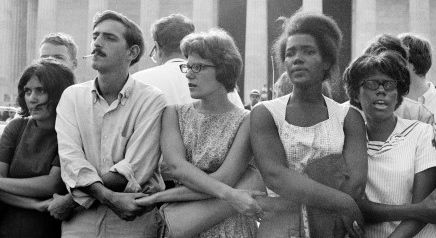
So, on this day, I’ll take my place on the Mall in Washington D.C., and along with a great cloud of witnesses, I’ll pray for a future in which children like my late son will truly cease to be judged by the color of their skin. I’ll vow once again to use whatever meager resources I have to make sure the check those marchers came to D.C. to cash fifty years ago is made good, that finally “black men as well as white men, would be guaranteed the unalienable rights of life, liberty, and the pursuit of happiness.”
Christine A. Scheller is a widely published writer who spends her weekdays advancing dialogue about science, ethics, and religion in Washington, D.C., and her weekends tending her garden at the Jersey Shore. Her award-winning essays have been included in anthologies like “Suffering Redeemed: Stories of Grace in the Midst of Personal Tragedy.” Follow her on Twitter @cascheller for live updates from the Mall.
Previous Post

August 27, 2013
I Hate Summer
Next Post
August 29, 2013 Falling Upward: Don Draper Meets Richard Rohr
Browse Our Archives
Select a Category A. G. Harmon Alissa Wilkinson Allison Backous Art Authors Brad Fruhauff Bradford Winters Bryan Bliss Caroline Langston Chad Thomas Johnston Chris Hoke Christiana N. Peterson Culture D.G. Myers D.L. Mayfield Daniel Bowman Jr. David Griffith Elizabeth Duffy Faith Film Greg Wolfe Guest Contributor Interview Jan Vallone Jeffrey Overstreet Jessica Eddings-Roeser Jessica Mesman Griffith Kelly Foster Lindsey Crittenden Morgan Meis music Natalie Vestin Nick Olson Peggy Rosenthal Personal Reflection Poetry Friday Reflection Relationships Review Richard Chess Richard Cole Sara Zarr Shannon Huffman Polson Sonya Bilocerkowycz Tania Runyan Tony Woodlief Topical Categories Uncategorized Vic Sizemore Writing
Select a Month October 2018 September 2018 August 2018 July 2018 June 2018 May 2018 April 2018 March 2018 February 2018 January 2018 December 2017 November 2017 October 2017 September 2017 August 2017 July 2017 June 2017 May 2017 April 2017 March 2017 February 2017 January 2017 December 2016 November 2016 October 2016 September 2016 August 2016 July 2016 June 2016 May 2016 April 2016 March 2016 February 2016 January 2016 December 2015 November 2015 October 2015 September 2015 August 2015 July 2015 June 2015 May 2015 April 2015 March 2015 February 2015 January 2015 December 2014 November 2014 October 2014 September 2014 August 2014 July 2014 June 2014 May 2014 April 2014 March 2014 February 2014 January 2014 December 2013 November 2013 October 2013 September 2013 August 2013 July 2013 June 2013 May 2013 April 2013 March 2013 February 2013 January 2013 December 2012 November 2012 October 2012 September 2012 August 2012 July 2012 June 2012 May 2012 February 2008
Follow Us!
TAKE THE
Religious Wisdom Quiz
According to Jesus, how should we treat our neighbor?
Select your answer to see how you score.
With suspicion With anger Ignore them As ourselves
Related posts from Good Letters

The Stars of the Earth Cry Out



Poetry Friday: “The Ordinary Time”
TRENDING AT PATHEOS Catholic

Rejecting Doom: Christian Hope And Human Action
Christianity is a religion of hope. We are to have hope and...

It’s What Comes From Within Which Matters
One of the most difficult things for us to understand is why...

Why I Choose the Eucharist Over the Sermon
Choose the Eucharist, Not the Sermon What are we supposed to get...

5 Design Elements Found in Spiritually Rooted Homes
Putting Spirituality Into Home Decor Our homes are more than our living...

Credo: A Story of God Told with the...
About 10 years ago, I began to imagine a personal "Credo" that...

The Anatomy of Divine Revelation in Catholic Thought
The claim that God has made Himself known to human beings is...
view all Catholic blogs
Ad-Free & Subscriber Log-In Subscription Support
- About Us
- 2026 Calendar
- Videos
- Podcasts
- Library of World Religions
- Faith In Media Tracker
- Advertise With Us
- Write for Us
- Privacy Policy
- Terms of Service
- Do Not Sell My Data
- Contact Us
- Radiant Digital
- Manage Newsletter Subscriptions
- Unsubscribe From Notifications
- Sitemap
Copyright 2008-2026, Patheos. All rights reserved.
Subscription Support Ad-Free & Subscriber Log-In
Follow Patheos