
BuddhistCatholicContemplativeEvangelicalGeneral ChristianHinduJewishLatter-day SaintMuslimNew VisionsProgressive Christian
Beliefs
- Buddhist
- Catholic
- Contemplative
- Evangelical
- General Christian
- Hindu
- Jewish
- Latter-day Saint
- More Voices
- Muslim
- New Visions
- Pagan
- Progressive Christian
Topics
- Religion News
- Food and Religion
- Sports and Religion
- Religious Art
- Religious Music and Entertainment
- Religious Events
- History and Religion
- Style and Religion
- Politics and Religion
- Women in Religion
- Recreation Outdoors and Religion
- Business Finance and Religion
- Careers Workplace and Religion
- Education and Religion
- Family Parenting and Religion
- Health Fitness and Religion
- Home and Religion
- Relationships and Religion
- Technology and Religion
- Travel and Religion
Columnists
- Buddhist Columnists
- Business Finance and Religion Columnists
- Careers Workplace and Religion Columnists
- Catholic Columnists
- Contemplative Columnists
- Education and Religion Columnists
- Evangelists Columnists
- Family Parenting and Religion Columnists
- General Christian Columnists
- Health Fitness and Religion Columnists
- Hindu Columnists
- History and Religion Columnists
- Home and Religion Columnists
- Jewish Columnists
- More Voices Columnists
- Latter Day Columnists
- Muslim Columnists
- New Visions Columnists
- Nonreligious Columnists
- Pagan Columnists
- Politics and Religion Columnists
- Progressive Columnists
- Recreation Outdoors and Religion Columnists
- Relationships and Religion Columnists
- Religion News Columnists
- Religious Art Columnists
- Religious Events Columnists
- Religious Music and Entertainment Columnists
- Sports and Religion Columnists
- Style and Religion Columnists
- Technology and Religion Columnists
- Travel and Religion Columnists
- Women in Religion Columnists
Resource Library
- 2026 Calendar
- Library of World Religions
- The 100 Most Holy Places on Earth
- Patheos Answers
- Podcasts
- Videos
- Faith Leaders Database
- Anglican Episcopalian
- Bahai
- Baptist
- Buddhism
- Christianity
- Confucianism
- Eastern Orthodoxy
- Hinduism
- Holiness and Pentecostal
- ISKCON
- Islam
- Judaism
- Lutheran
- Methodist
- The Church of Jesus Christ of Latter-day Saints
- New Age
- Paganism
- Presbytarian and Reformed
- Protestantism
- Religion Behind the Scenes
- Roman Catholic
- Scientology
- Shia Islam
- Sikhism
- Sufism
- Sunni Islam
- Taoism
- Zen
- See all religions
Research Tools
 Ad-Free & Subscriber Log-In Subscription Support
Ad-Free & Subscriber Log-In Subscription Support
Follow Patheos 

- Trending:
- Forgiveness
- |
- Marriage
- |
- Consciousness
- |
- Death Penalty
- |
- Election
- |
- Halloween
 Good Letters
-
Contributors
- Home
- Catholic
- The Bible as Icon
The Bible as Icon
Last updated on: August 9, 2013 at 1:00 am by Caroline Langston
The Bible as Icon 2013-08-08T14:13:02-07:00 Caroline Langston
Patheos Explore the world's faith through different perspectives on religion and spirituality! Patheos has the views of the prevalent religions and spiritualities of the world.
 For Vic Sizemore
With six children in a Southern Baptist family in the 1970s, we could easily have had a dozen Bibles in the house: There was the giant, gray Family Bible with the embossed cover that resided on the bottom shelf of the living room, which nobody ever read. And there was a scattering of those palm-sized New Testament and Psalms around the place, like silverfish in a drawer—always white or pale green, with ersatz gold leafing that would flake off under the prodding of a fingernail.
There was a Novum Testamentum from when my oldest sister took Latin in college, sandwiched on a shelf. I also always liked the ones from the Gideons (do the Gideons even still exist?) that had translations of John 3:16 in the back. My favorite: Sinhalese.
The vast majority, though, were what could be termed “presentation Bibles.” Invariably from Broadman Press (headquartered in Nashville, the Baptist Vatican), either slick shoe-polish black or steak-slab red “bonded leather” (Ooh, baby!), these had been awarded as part of Sunday School or scripture memorization schemes, and always had about them the whiff of bribery, with the name of the person to whom the Bible was “dedicated” written in ostentatious cursive in the front. “The Words of Christ Are in Red,” it was noted, and in the back was a sheaf of Biblical maps, the topography of the Exodus and Paul’s missionary journeys rendered in Sweet Tart pink and blue.
I received my Red Letter Edition from the hand of the Reverend James F. Yates some time in second grade, on one of the Sundays I was actually compelled to show up for Sunday school. Brother Yates was a towering figure in the Southern Baptist Convention in the years before what was later termed the “1978 conservative takeover.” In the little speech that accompanied the gift, he charged us all to read our Bibles so much that they would end up looking wrecked.
That was a tall order in my family’s household. As I’ve said before, we weren’t those kind of Baptists. I could count on one hand—one finger, even—the Bibles that actually had a broken spine in our house: The one into which my mother stuffed the yellowed wedding announcements and “Along the RFD” columns from the Clarion-Ledger newspaper.
But I believed in Jesus. Overnight, as though descending into a cataclysm of words, I became someone who was charged with reading those words, the Word, every day.
Reading the Bible was what real Christians did; it was a key metonymy indicating that the reader truly did have a “personal relationship with Jesus Christ”—unlike those nominal schlubs who thought that showing up at 11 a.m. on Sunday and “being a good person” (Oh, the nerve of that!) were enough to merit the Kingdom.
Reading the Bible, meanwhile, took place in “quiet times” that optimally occurred first thing in the morning. (It was often hotly debated whether it actually “counted” otherwise.) I smile at that term “quiet times” now; it has a condescending euphemistic sound of something that might be sold in the drugstore Family Planning aisle.
The talk about quiet time, for my friends at church and then in fellowship groups as I went through college and after, was how hard it was to actually have them. Too easy to get distracted by Morning Zoo radio and then, when we were older, by NPR, or The New York Times. A day in which I plowed through another chapter of Ezekiel or practiced memorizing a Psalm or Proverb was a victory achieved.
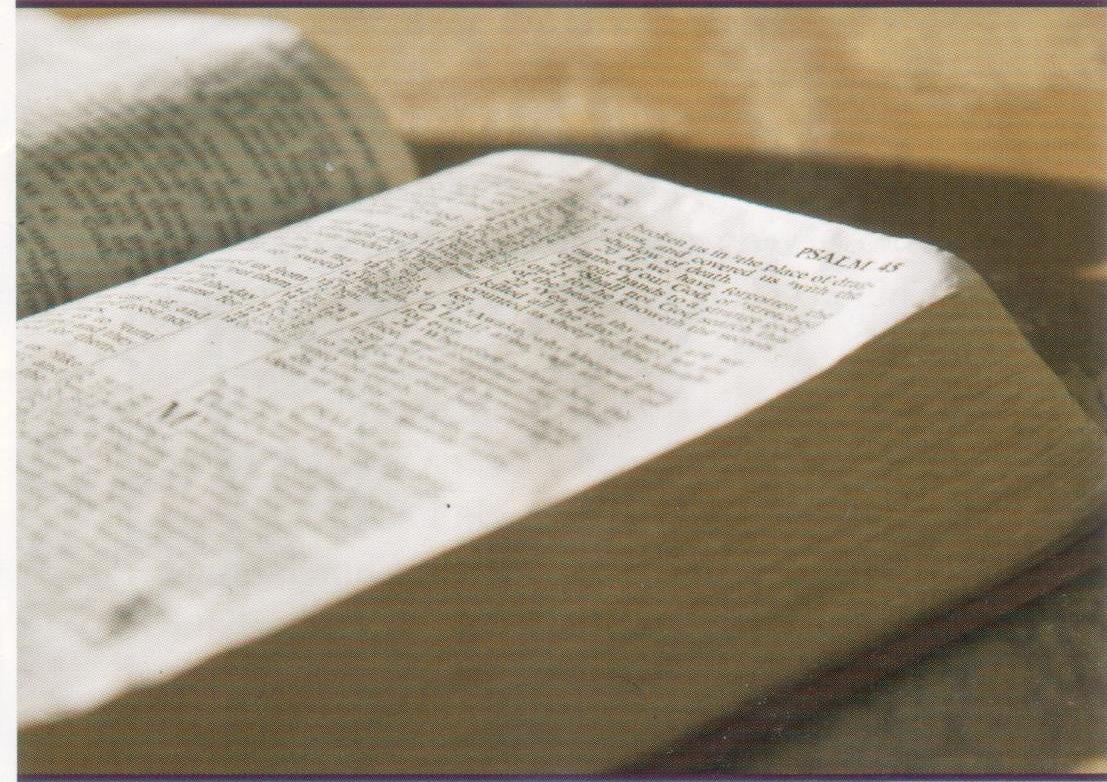
I look back at the Bible I owned then, a New American Standard as big as a clock radio—or at least as big as clock radios used to be. (Are there even still clock radios? Or is everything phones now?) The leather covers are torn as though by an act of violence, and to look at it, I took seriously the Jewish sage Yochanan Ben Bag Bag’s oft-quoted dictum to “Turn it and turn it, for everything is in it.” (Though he was speaking strictly about the Hebrew Scriptures.) The thin pages are wrinkled from reading, and the margins are laced with blue ballpoint commentary I can now barely read. Verse upon verse is underlined.
I jest about the Bible culture I received along with the faith, the ways the Bible itself (and I mean the object) became an icon (and far too often, an idol) expressive of our belief and hopes—and ultimately our pride. I do not, though, believe any less in the value of daily Bible readings, read—yes—every morning.
Now I read the Bible on my phone instead: Yes, via a simple online sign-up through the Greek Orthodox Archdiocese of North America, I have the daily readings of Epistle and Gospel delivered to the glowing blue virtual lozenge I hold in my hand.
The “real” Bible, meanwhile—the one with gold leaf and bonded leather—rests atop a table at my home altar, under an icon of Jesus washing the disciples’ feet. I have taught my children to search out chapter and verse, and am working on having them memorize the order of the books, but the Bible is something chanted for them, breathed in and out of the Liturgical year, and witnessed in brilliant egg tempera on frescoes, not a legal document leafed and interleafed for illustrations and exceptions.
Their understanding of the Bible both predates the West and postdates logo-centric culture.
And the crazy truth of it is, I read the Bible more now: its narratives and discontinuous continuities inspire me, serving as greater and more effective boundaries to my ethical imagination. The Bible is, for me, no longer a matter of concepts, but of the person whom they picture—I cannot imagine anything more evangelical, and Orthodox, and Catholic, all at once.
It is the unseen Image breathing at the center. It is the reality that I think disenchanted American youth seek when they set out, almost as by default, for the truth at the heart of eastern meditation.
It’s here too, I want to say. Here. Now. Here. Ever.
A native of Yazoo City, Mississippi, Caroline Langston is a convert to the Eastern Orthodox Church. She is a widely published writer and essayist, a winner of the Pushcart Prize, and a commentator for NPR’s “All Things Considered.”
Previous Post

August 8, 2013
Black Boy, 2013
Next Post
August 11, 2013 A Single Share
Browse Our Archives
Select a Category A. G. Harmon Alissa Wilkinson Allison Backous Art Authors Brad Fruhauff Bradford Winters Bryan Bliss Caroline Langston Chad Thomas Johnston Chris Hoke Christiana N. Peterson Culture D.G. Myers D.L. Mayfield Daniel Bowman Jr. David Griffith Elizabeth Duffy Faith Film Greg Wolfe Guest Contributor Interview Jan Vallone Jeffrey Overstreet Jessica Eddings-Roeser Jessica Mesman Griffith Kelly Foster Lindsey Crittenden Morgan Meis music Natalie Vestin Nick Olson Peggy Rosenthal Personal Reflection Poetry Friday Reflection Relationships Review Richard Chess Richard Cole Sara Zarr Shannon Huffman Polson Sonya Bilocerkowycz Tania Runyan Tony Woodlief Topical Categories Uncategorized Vic Sizemore Writing
Select a Month October 2018 September 2018 August 2018 July 2018 June 2018 May 2018 April 2018 March 2018 February 2018 January 2018 December 2017 November 2017 October 2017 September 2017 August 2017 July 2017 June 2017 May 2017 April 2017 March 2017 February 2017 January 2017 December 2016 November 2016 October 2016 September 2016 August 2016 July 2016 June 2016 May 2016 April 2016 March 2016 February 2016 January 2016 December 2015 November 2015 October 2015 September 2015 August 2015 July 2015 June 2015 May 2015 April 2015 March 2015 February 2015 January 2015 December 2014 November 2014 October 2014 September 2014 August 2014 July 2014 June 2014 May 2014 April 2014 March 2014 February 2014 January 2014 December 2013 November 2013 October 2013 September 2013 August 2013 July 2013 June 2013 May 2013 April 2013 March 2013 February 2013 January 2013 December 2012 November 2012 October 2012 September 2012 August 2012 July 2012 June 2012 May 2012 February 2008
Follow Us!
TAKE THE
Religious Wisdom Quiz
Where was Jesus' first miracle performed?
Select your answer to see how you score.
Capernaum Cana Nazareth Jerusalem
Related posts from Good Letters


Leonard Cohen’s Holy and Broken Hallelujah

Ready or Not for the Days of Awe

TRENDING AT PATHEOS Catholic

Rejecting Doom: Christian Hope And Human Action
Christianity is a religion of hope. We are to have hope and...

It’s What Comes From Within Which Matters
One of the most difficult things for us to understand is why...

Why I Choose the Eucharist Over the Sermon
Choose the Eucharist, Not the Sermon What are we supposed to get...

5 Design Elements Found in Spiritually Rooted Homes
Putting Spirituality Into Home Decor Our homes are more than our living...

Credo: A Story of God Told with the...
About 10 years ago, I began to imagine a personal "Credo" that...

The Anatomy of Divine Revelation in Catholic Thought
The claim that God has made Himself known to human beings is...
view all Catholic blogs
Ad-Free & Subscriber Log-In Subscription Support
- About Us
- 2026 Calendar
- Videos
- Podcasts
- Library of World Religions
- Faith In Media Tracker
- Advertise With Us
- Write for Us
- Privacy Policy
- Terms of Service
- Do Not Sell My Data
- Contact Us
- Radiant Digital
- Manage Newsletter Subscriptions
- Unsubscribe From Notifications
- Sitemap
Copyright 2008-2026, Patheos. All rights reserved.
Subscription Support Ad-Free & Subscriber Log-In
Follow Patheos