
BuddhistCatholicContemplativeEvangelicalGeneral ChristianHinduJewishLatter-day SaintMuslimNew VisionsProgressive Christian
Beliefs
- Buddhist
- Catholic
- Contemplative
- Evangelical
- General Christian
- Hindu
- Jewish
- Latter-day Saint
- More Voices
- Muslim
- New Visions
- Pagan
- Progressive Christian
Topics
- Religion News
- Food and Religion
- Sports and Religion
- Religious Art
- Religious Music and Entertainment
- Religious Events
- History and Religion
- Style and Religion
- Politics and Religion
- Women in Religion
- Recreation Outdoors and Religion
- Business Finance and Religion
- Careers Workplace and Religion
- Education and Religion
- Family Parenting and Religion
- Health Fitness and Religion
- Home and Religion
- Relationships and Religion
- Technology and Religion
- Travel and Religion
Columnists
- Buddhist Columnists
- Business Finance and Religion Columnists
- Careers Workplace and Religion Columnists
- Catholic Columnists
- Contemplative Columnists
- Education and Religion Columnists
- Evangelists Columnists
- Family Parenting and Religion Columnists
- General Christian Columnists
- Health Fitness and Religion Columnists
- Hindu Columnists
- History and Religion Columnists
- Home and Religion Columnists
- Jewish Columnists
- More Voices Columnists
- Latter Day Columnists
- Muslim Columnists
- New Visions Columnists
- Nonreligious Columnists
- Pagan Columnists
- Politics and Religion Columnists
- Progressive Columnists
- Recreation Outdoors and Religion Columnists
- Relationships and Religion Columnists
- Religion News Columnists
- Religious Art Columnists
- Religious Events Columnists
- Religious Music and Entertainment Columnists
- Sports and Religion Columnists
- Style and Religion Columnists
- Technology and Religion Columnists
- Travel and Religion Columnists
- Women in Religion Columnists
Resource Library
- 2026 Calendar
- Library of World Religions
- The 100 Most Holy Places on Earth
- Patheos Answers
- Podcasts
- Videos
- Faith Leaders Database
- Anglican Episcopalian
- Bahai
- Baptist
- Buddhism
- Christianity
- Confucianism
- Eastern Orthodoxy
- Hinduism
- Holiness and Pentecostal
- ISKCON
- Islam
- Judaism
- Lutheran
- Methodist
- The Church of Jesus Christ of Latter-day Saints
- New Age
- Paganism
- Presbytarian and Reformed
- Protestantism
- Religion Behind the Scenes
- Roman Catholic
- Scientology
- Shia Islam
- Sikhism
- Sufism
- Sunni Islam
- Taoism
- Zen
- See all religions
Research Tools
 Ad-Free & Subscriber Log-In Subscription Support
Ad-Free & Subscriber Log-In Subscription Support
Follow Patheos 

- Trending:
- Forgiveness
- |
- Marriage
- |
- Consciousness
- |
- Death Penalty
- |
- Election
- |
- Halloween
 Good Letters
-
Contributors
- Home
- Catholic
- Sorting Through the Past
Sorting Through the Past
Last updated on: August 13, 2013 at 1:00 am by A. G. Harmon
Sorting Through the Past 2013-08-12T12:20:19-07:00 A. G. Harmon
Patheos Explore the world's faith through different perspectives on religion and spirituality! Patheos has the views of the prevalent religions and spiritualities of the world.
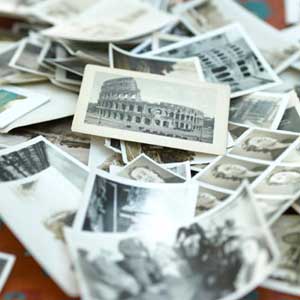 I’ve been cleaning out an attic—not my own—along with drawers, closets, shelves, storehouses, and barns —also, not my own, or at least not primarily. I don’t live here anymore, though I’ve always called this place home.
I’m doing these things in preparation for the sale of a farm that has been lived in continuously, and happily, for forty years. During that time, the house accumulated the contents of others’ houses, boxed up and moved in when the people who owned them grew sick and old and eventually died. Life was too busy to sort through all of it, so generation piled upon generation, like the Iron Age after the Bronze.
In the heat of a Southern summer, in the eaves of the old house, dimly lit and with little ventilation, old cardboard boxes must be gone through. They crumble and split at the touch, disintegrating like frail pastilles. The close air is heavy with the scent of insulation, musty paper, aged cloth, bitter red coins, and for some reason, the contents of ladies’ purses that I remember from my youth—the patent leather kind with hard metal clasps: Kleenex, face powder, rouge, lipstick, and mints.
This is a delicate business. Decisions have to be made. After all, someone saved these things; even the slightest sense of duty to the past can tug hard at the conscience. Who am I to discard what has been kept for seventy years or more? I’m the kind to keep, in fact, and when there’s no clock running on your right to a place, you can keep on keeping.
But now there is indeed a clock, and a realtor owns it; hard as it is to fathom, others will come to consider this farm with an eye to purchase, and they will want to see its “potential.” They will want to see how much empty space there is, how vast the nothingness can be, cleared of history’s clutter. They will want the live oaks out of the way so they can get a view of how much grass might accumulate; square footage, you know; it’s all about square footage.
So as to the things kept; something’s got to go. Somebody has to draw the line. And it seems that somebody has come down to me.
With a box full of black garbage bags, I begin the task. There are some easy choices. Nothing that relates to a living person is thrown away. Those are tied to pasts larger than my own, to branches of memory I cannot value. What appears to me a record of no great moment, a trophy or laurel wreath of no lustrous renown, might have untold significance to those absent. Such things go into newer boxes, and await other afternoons in other attics to come.
The trouble I have is with things that were kept by those now dead; some of them long dead. What if I’m throwing away the last token of some monumental fervor or love? But untethered from a living heart and tongue, there’s no way of knowing, which tells a great deal about the inscrutability of the material world. An object can be fraught with consequence or have none at all, and it all turns upon the fulcrum of a lived experience. There is a note of triage about such tasks as mine—what to save; what to let slip away.
Such metaphoric battlefields as this pull mightily upon the scruples. It can seem callous, slightful, to cast away clippings, medals, report cards. Something as insignificant as a shopping list—unintentionally saved—or a short note or check register in the hand of a grandmother gone some thirty-five years now—can give much pause.
Handwriting is a hard thing I’ve learned. Like the recorded voice or the photographed image, it is as close as we can come to the reality of a human that once was, of a pulse that once beat quickly. I was one of the things that gave these people purpose—their intentions and plans were made around me and for me. For the leaf to say to the root, “I have no need of what you needed,” seems insolent; ungrateful.
But it’s only a shopping list; only a check register. I get too philosophical. There’s no time for sentiment. Shake it off; go on.
Christmas and birthday cards can be harder still, connected as they are to emotions that survive loss. But there are hundreds of them, and any inscriptions inside make the decisions more difficult. When it comes to handwritten letters, which are both an archive for reminiscence and artifact for beautiful civilities now passed—the choices grow treacherous.
Nevertheless, some things I cannot do. For example, anything related to the boy I was named after, who died when he was twenty-two, I have to keep. I’ve already lost too many of his things along the way, fool that I am, so I overcompensate. I’ll deal with that another time; only so much practicality can be mustered.
Other things, I make myself do.
For if you swallow big and take a deep breath, a sweep of an arm can shuffle away moth-chewn tuxedoes and ball gowns, kept for decades. Off go schoolbooks, board games. One hard snatch can pull down portieres that have dry-rotted, and a good swift kick can break apart the rest, if it’s wooden, and held together only by your own reluctance to do the deed.
To everything there is a season, I say tritely as I work. All will be well yet, and the pile grows high.
But still, beneath my breath, I find myself asking as I did as a child, with regard to puppies that had died, or on behalf of colts and calves that had slipped away—that God, despite himself, and in his great and infinite mercy, might somehow let there be a kind of rough heaven, even for these ordinary things of everyday use.
A.G. Harmon teaches Shakespeare, Law and Literature, Jurisprudence, and Writing at The Catholic University of America in Washington, D.C. His novel, A House All Stilled, won the 2001 Peter Taylor Prize for the Novel.
Previous Post

August 11, 2013
A Single Share
Next Post
August 14, 2013 Becoming Baroque
Browse Our Archives
Select a Category A. G. Harmon Alissa Wilkinson Allison Backous Art Authors Brad Fruhauff Bradford Winters Bryan Bliss Caroline Langston Chad Thomas Johnston Chris Hoke Christiana N. Peterson Culture D.G. Myers D.L. Mayfield Daniel Bowman Jr. David Griffith Elizabeth Duffy Faith Film Greg Wolfe Guest Contributor Interview Jan Vallone Jeffrey Overstreet Jessica Eddings-Roeser Jessica Mesman Griffith Kelly Foster Lindsey Crittenden Morgan Meis music Natalie Vestin Nick Olson Peggy Rosenthal Personal Reflection Poetry Friday Reflection Relationships Review Richard Chess Richard Cole Sara Zarr Shannon Huffman Polson Sonya Bilocerkowycz Tania Runyan Tony Woodlief Topical Categories Uncategorized Vic Sizemore Writing
Select a Month October 2018 September 2018 August 2018 July 2018 June 2018 May 2018 April 2018 March 2018 February 2018 January 2018 December 2017 November 2017 October 2017 September 2017 August 2017 July 2017 June 2017 May 2017 April 2017 March 2017 February 2017 January 2017 December 2016 November 2016 October 2016 September 2016 August 2016 July 2016 June 2016 May 2016 April 2016 March 2016 February 2016 January 2016 December 2015 November 2015 October 2015 September 2015 August 2015 July 2015 June 2015 May 2015 April 2015 March 2015 February 2015 January 2015 December 2014 November 2014 October 2014 September 2014 August 2014 July 2014 June 2014 May 2014 April 2014 March 2014 February 2014 January 2014 December 2013 November 2013 October 2013 September 2013 August 2013 July 2013 June 2013 May 2013 April 2013 March 2013 February 2013 January 2013 December 2012 November 2012 October 2012 September 2012 August 2012 July 2012 June 2012 May 2012 February 2008
Follow Us!
TAKE THE
Religious Wisdom Quiz
What does Jude say certain individuals have secretly slipped in to do?
Select your answer to see how you score.
Change the grace of God into a license for immorality Deny the resurrection Persecute believers Steal from the church
Related posts from Good Letters




TRENDING AT PATHEOS Catholic

Rejecting Doom: Christian Hope And Human Action
Christianity is a religion of hope. We are to have hope and...

It’s What Comes From Within Which Matters
One of the most difficult things for us to understand is why...

Why I Choose the Eucharist Over the Sermon
Choose the Eucharist, Not the Sermon What are we supposed to get...

5 Design Elements Found in Spiritually Rooted Homes
Putting Spirituality Into Home Decor Our homes are more than our living...

Credo: A Story of God Told with the...
About 10 years ago, I began to imagine a personal "Credo" that...

The Anatomy of Divine Revelation in Catholic Thought
The claim that God has made Himself known to human beings is...
view all Catholic blogs
Ad-Free & Subscriber Log-In Subscription Support
- About Us
- 2026 Calendar
- Videos
- Podcasts
- Library of World Religions
- Faith In Media Tracker
- Advertise With Us
- Write for Us
- Privacy Policy
- Terms of Service
- Do Not Sell My Data
- Contact Us
- Radiant Digital
- Manage Newsletter Subscriptions
- Unsubscribe From Notifications
- Sitemap
Copyright 2008-2026, Patheos. All rights reserved.
Subscription Support Ad-Free & Subscriber Log-In
Follow Patheos