
BuddhistCatholicContemplativeEvangelicalGeneral ChristianHinduJewishLatter-day SaintMuslimNew VisionsProgressive Christian
Beliefs
- Buddhist
- Catholic
- Contemplative
- Evangelical
- General Christian
- Hindu
- Jewish
- Latter-day Saint
- More Voices
- Muslim
- New Visions
- Pagan
- Progressive Christian
Topics
- Religion News
- Food and Religion
- Sports and Religion
- Religious Art
- Religious Music and Entertainment
- Religious Events
- History and Religion
- Style and Religion
- Politics and Religion
- Women in Religion
- Recreation Outdoors and Religion
- Business Finance and Religion
- Careers Workplace and Religion
- Education and Religion
- Family Parenting and Religion
- Health Fitness and Religion
- Home and Religion
- Relationships and Religion
- Technology and Religion
- Travel and Religion
Columnists
- Buddhist Columnists
- Business Finance and Religion Columnists
- Careers Workplace and Religion Columnists
- Catholic Columnists
- Contemplative Columnists
- Education and Religion Columnists
- Evangelists Columnists
- Family Parenting and Religion Columnists
- General Christian Columnists
- Health Fitness and Religion Columnists
- Hindu Columnists
- History and Religion Columnists
- Home and Religion Columnists
- Jewish Columnists
- More Voices Columnists
- Latter Day Columnists
- Muslim Columnists
- New Visions Columnists
- Nonreligious Columnists
- Pagan Columnists
- Politics and Religion Columnists
- Progressive Columnists
- Recreation Outdoors and Religion Columnists
- Relationships and Religion Columnists
- Religion News Columnists
- Religious Art Columnists
- Religious Events Columnists
- Religious Music and Entertainment Columnists
- Sports and Religion Columnists
- Style and Religion Columnists
- Technology and Religion Columnists
- Travel and Religion Columnists
- Women in Religion Columnists
Resource Library
- 2026 Calendar
- Library of World Religions
- The 100 Most Holy Places on Earth
- Patheos Answers
- Podcasts
- Videos
- Faith Leaders Database
- Anglican Episcopalian
- Bahai
- Baptist
- Buddhism
- Christianity
- Confucianism
- Eastern Orthodoxy
- Hinduism
- Holiness and Pentecostal
- ISKCON
- Islam
- Judaism
- Lutheran
- Methodist
- The Church of Jesus Christ of Latter-day Saints
- New Age
- Paganism
- Presbytarian and Reformed
- Protestantism
- Religion Behind the Scenes
- Roman Catholic
- Scientology
- Shia Islam
- Sikhism
- Sufism
- Sunni Islam
- Taoism
- Zen
- See all religions
Research Tools
 Ad-Free & Subscriber Log-In Subscription Support
Ad-Free & Subscriber Log-In Subscription Support
Follow Patheos 

- Trending:
- Forgiveness
- |
- Marriage
- |
- Consciousness
- |
- Death Penalty
- |
- Election
- |
- Halloween
 Good Letters
-
Contributors
- Home
- Catholic
- In Praise of the Printed Book, Part 1
In Praise of the Printed Book, Part 1
Last updated on: August 1, 2013 at 12:56 am by Guest Contributor
In Praise of the Printed Book, Part 1 2013-08-01T00:56:06-07:00 Guest Contributor
Patheos Explore the world's faith through different perspectives on religion and spirituality! Patheos has the views of the prevalent religions and spiritualities of the world.
 By Warren Farha
Guest Post
Note: This post and the one following it have been condensed from an address given by the author.
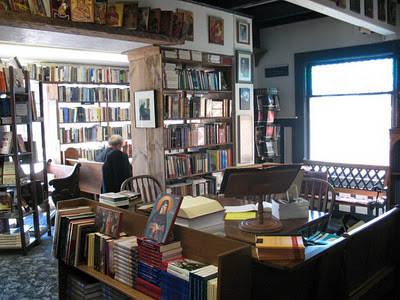
I’ve been charged today with the task of explaining in some coherent form “why books?”—that is, paper and ink between covers—rather than “books” in some digital format. This is a visceral issue for me and not just because my vocation is the selling of conventional books. It touches me at points of my development as a human being.
The very first book I remember reading is as a four-year-old who could not yet really read, narrating the story as best I could by looking at and interpreting the interspersed illustrations (wood-cut engraving style drawings). It was one of the small bookshelf of books my family owned called The Real Book about the Wild West, by Adolph Regli.
I remember hours lying on our green-carpeted living room floor with this book, in my initial stages of reading. There were of course hours more with this book after I really could read, absorbing the engrossing narratives and unconsciously developing a love for history.
At age seven, in second grade, I happened to check out from the school library George Washington, by the wonderful Norwegian husband and wife author/illustrator team of Edgar and Ingri d’Aulaire (their Abraham Lincoln won the Caldecott in 1939). The book’s combination of unforgettably vivid lithographed color illustrations and unabashed hero-worship and patriotism conveyed in a compelling narrative captivated me.
Fast-forward ten years: I was a high school junior, a cradle Orthodox Christian, caught up in the Jesus Movement of the early 1970s. I had a newfound enthusiasm for the faith, but few intellectual resources with which to undergird it. But I was a reader, and in a footnote I saw a reference to a book by C.S. Lewis called Mere Christianity.
I bought and read Mere Christianity—a cheap, mass-market paperback, green and white, the text of which I boldly underlined in blue ink. This book immeasurably formed my apprehension of the content and extent of Christian faith, excited my imagination, and expanded my comprehension of Christianity’s vastness and wisdom.
I went on to read a good portion of the Lewis corpus. It opened to me worlds of discovery not only in Christian apologetics, but in philosophy, mythology, literary criticism, and memoir. The foundations, as it turned out, of my bookstore.
A year later, I received a book by an Orthodox seminarian who’d been assigned for a summer to our local parish. He quickly became a mentor, and brought my Orthodox roots into closer connection with my Jesus Movement enthusiasms.
It was this book, For the Life of the World, by Alexander Schmemann (silver-covered with a lovely inscription on the title page from the giver), that interpreted all of salvation history through the lens of the liturgy. It laid down a template by which to worship, by which to comprehend worship, by which to aspire to a way of living as a fully human being.
One more way station, ten years later: I was married, working, but laid up for a few weeks with a slipped disc, contentedly lying in bed, enduring the pain with the prescribed Percodan. I read Dom Gregory Dix’s monumental The Shape of the Liturgy, learning that Schmemann’s For the Life of the World meditations converged with the actual history of the liturgy.
Dix’s reading of “every sentence of every Christian author extant from the period of Nicaea”—an astounding claim given the enormous number of books from the period—resulted in a book that permanently enriched my participation in the life of the Church.
I could go on. And I’m certain each of you has a comparable set of books and memories that have indelibly shaped your lives. But I hope you catch my meaning. Books—real, discrete objects—have been my own personal Bethels, “stones” that marked specific epiphanies for me. The object and the experience they mediated are inseparable.
Of course, there is also much to praise about physical books along more pedestrian lines, as marvelous technological objects in themselves. Listen to Robert Darnton, Renaissance scholar and director of the Harvard Library system, from his essay “E-Books and Old Books” in his The Case for Books:
Consider the book. It has extraordinary staying power. Ever since the invention of the codex sometime close to the birth of Christ, it has proven to be a marvelous machine—great for packaging information, convenient to thumb through, comfortable to curl up with, superb for storage, and remarkably resistant to damage. It does not need to be upgraded or downloaded, accessed or booted, plugged into circuits or extracted from webs. Its design makes it a delight to the eye. Its shape makes it a pleasure to hold in the hand. And its handiness has made it the basic tool of learning for thousands of years.
So now we turn from physical books to the digital world in which we have been immersed for the last twenty years or so. The blindingly rapid rise of the Internet is as momentous as Gutenberg’s press and the Industrial Revolution and all the electronic and communications revolutions that followed.
Nothing’s been the same since the Internet arrived: we do business, buy and sell, pay and receive, communicate, organize our schedules, and read differently now. It is changing in breathtaking ways the structure of our whole civilization.
Paleontologist Scott Sampson, in a short reflection in a collection called Is the Internet Changing the Way You Think? sums up the fundamental pro and con of the Internet as the Great Source for Information and the Great Distraction fostering compulsions to stay connected. On the pro side, we must give the Internet its due. It is marvelous and almost magical, multiplying many times the store of knowledge available to anyone in mere moments, facilitating communication beyond our wildest imaginations, and simplifying and accelerating hosts of previously tedious tasks.
Yes, the Internet is a wondrous tool, indeed. The problem is—as is the case with many new technologies—we forget the Net is a tool. Instead of using the tool, the tool begins to use us. We become unconscious of being used, as we are numbed by immersion in a new kind of technological miasma.
To be continued tomorrow.
Warren Farha is a lifelong, contented resident of Wichita, Kansas, son of a Lebanese immigrant’s son and a Kansas farm girl. He grew up in his father’s business, until a pivotal moment in 1987 led him into a new vocation of bookstore owner. The bookstore in mind was interdisciplinary featuring classic, perennially important books in literature, theology, history, the arts, and children’s literature, one that also brought his native Orthodox faith into wider contemporary intellectual and cultural conversations. Eighth Day Books is now almost twenty-five years old. Warren shares this endeavor with his beloved wife Chris, three grown children, and a host of past and present friends.
Previous Post

July 31, 2013
Cutting Away the Noise
Next Post
August 2, 2013 In Praise of the Printed Book, Part 2
Browse Our Archives
Select a Category A. G. Harmon Alissa Wilkinson Allison Backous Art Authors Brad Fruhauff Bradford Winters Bryan Bliss Caroline Langston Chad Thomas Johnston Chris Hoke Christiana N. Peterson Culture D.G. Myers D.L. Mayfield Daniel Bowman Jr. David Griffith Elizabeth Duffy Faith Film Greg Wolfe Guest Contributor Interview Jan Vallone Jeffrey Overstreet Jessica Eddings-Roeser Jessica Mesman Griffith Kelly Foster Lindsey Crittenden Morgan Meis music Natalie Vestin Nick Olson Peggy Rosenthal Personal Reflection Poetry Friday Reflection Relationships Review Richard Chess Richard Cole Sara Zarr Shannon Huffman Polson Sonya Bilocerkowycz Tania Runyan Tony Woodlief Topical Categories Uncategorized Vic Sizemore Writing
Select a Month October 2018 September 2018 August 2018 July 2018 June 2018 May 2018 April 2018 March 2018 February 2018 January 2018 December 2017 November 2017 October 2017 September 2017 August 2017 July 2017 June 2017 May 2017 April 2017 March 2017 February 2017 January 2017 December 2016 November 2016 October 2016 September 2016 August 2016 July 2016 June 2016 May 2016 April 2016 March 2016 February 2016 January 2016 December 2015 November 2015 October 2015 September 2015 August 2015 July 2015 June 2015 May 2015 April 2015 March 2015 February 2015 January 2015 December 2014 November 2014 October 2014 September 2014 August 2014 July 2014 June 2014 May 2014 April 2014 March 2014 February 2014 January 2014 December 2013 November 2013 October 2013 September 2013 August 2013 July 2013 June 2013 May 2013 April 2013 March 2013 February 2013 January 2013 December 2012 November 2012 October 2012 September 2012 August 2012 July 2012 June 2012 May 2012 February 2008
Follow Us!
TAKE THE
Religious Wisdom Quiz
Which prophet's wife died as a sign to Israel, and he was told not to mourn?
Select your answer to see how you score.
Amos Ezekiel Daniel Obadiah
Related posts from Good Letters

The Stars of the Earth Cry Out



Poetry Friday: “The Ordinary Time”
TRENDING AT PATHEOS Catholic

The Parable Of The Sower And The Word...
One of Christ’s most famous parables is that of the sower who...

Rejecting Doom: Christian Hope And Human Action
Christianity is a religion of hope. We are to have hope and...

Why I Choose the Eucharist Over the Sermon
Choose the Eucharist, Not the Sermon What are we supposed to get...

5 Design Elements Found in Spiritually Rooted Homes
Putting Spirituality Into Home Decor Our homes are more than our living...

Credo: A Story of God Told with the...
About 10 years ago, I began to imagine a personal "Credo" that...

The Anatomy of Divine Revelation in Catholic Thought
The claim that God has made Himself known to human beings is...
view all Catholic blogs
Ad-Free & Subscriber Log-In Subscription Support
- About Us
- 2026 Calendar
- Videos
- Podcasts
- Library of World Religions
- Faith In Media Tracker
- Advertise With Us
- Write for Us
- Privacy Policy
- Terms of Service
- Do Not Sell My Data
- Contact Us
- Radiant Digital
- Manage Newsletter Subscriptions
- Unsubscribe From Notifications
- Sitemap
Copyright 2008-2026, Patheos. All rights reserved.
Subscription Support Ad-Free & Subscriber Log-In
Follow Patheos