
BuddhistCatholicContemplativeEvangelicalGeneral ChristianHinduJewishLatter-day SaintMuslimNew VisionsProgressive Christian
Beliefs
- Buddhist
- Catholic
- Contemplative
- Evangelical
- General Christian
- Hindu
- Jewish
- Latter-day Saint
- More Voices
- Muslim
- New Visions
- Pagan
- Progressive Christian
Topics
- Religion News
- Food and Religion
- Sports and Religion
- Religious Art
- Religious Music and Entertainment
- Religious Events
- History and Religion
- Style and Religion
- Politics and Religion
- Women in Religion
- Recreation Outdoors and Religion
- Business Finance and Religion
- Careers Workplace and Religion
- Education and Religion
- Family Parenting and Religion
- Health Fitness and Religion
- Home and Religion
- Relationships and Religion
- Technology and Religion
- Travel and Religion
Columnists
- Buddhist Columnists
- Business Finance and Religion Columnists
- Careers Workplace and Religion Columnists
- Catholic Columnists
- Contemplative Columnists
- Education and Religion Columnists
- Evangelists Columnists
- Family Parenting and Religion Columnists
- General Christian Columnists
- Health Fitness and Religion Columnists
- Hindu Columnists
- History and Religion Columnists
- Home and Religion Columnists
- Jewish Columnists
- More Voices Columnists
- Latter Day Columnists
- Muslim Columnists
- New Visions Columnists
- Nonreligious Columnists
- Pagan Columnists
- Politics and Religion Columnists
- Progressive Columnists
- Recreation Outdoors and Religion Columnists
- Relationships and Religion Columnists
- Religion News Columnists
- Religious Art Columnists
- Religious Events Columnists
- Religious Music and Entertainment Columnists
- Sports and Religion Columnists
- Style and Religion Columnists
- Technology and Religion Columnists
- Travel and Religion Columnists
- Women in Religion Columnists
Resource Library
- 2026 Calendar
- Library of World Religions
- The 100 Most Holy Places on Earth
- Patheos Answers
- Podcasts
- Videos
- Faith Leaders Database
- Anglican Episcopalian
- Bahai
- Baptist
- Buddhism
- Christianity
- Confucianism
- Eastern Orthodoxy
- Hinduism
- Holiness and Pentecostal
- ISKCON
- Islam
- Judaism
- Lutheran
- Methodist
- The Church of Jesus Christ of Latter-day Saints
- New Age
- Paganism
- Presbytarian and Reformed
- Protestantism
- Religion Behind the Scenes
- Roman Catholic
- Scientology
- Shia Islam
- Sikhism
- Sufism
- Sunni Islam
- Taoism
- Zen
- See all religions
Research Tools
 Ad-Free & Subscriber Log-In Subscription Support
Ad-Free & Subscriber Log-In Subscription Support
Follow Patheos 

- Trending:
- Forgiveness
- |
- Marriage
- |
- Consciousness
- |
- Death Penalty
- |
- Election
- |
- Halloween
 Good Letters
-
Contributors
- Home
- Catholic
- The Narratives We Need, Part 1
The Narratives We Need, Part 1
Last updated on: July 11, 2013 at 10:42 pm by Shannon Huffman Polson
The Narratives We Need, Part 1 2013-07-11T22:42:23-07:00 Shannon Huffman Polson
Patheos Explore the world's faith through different perspectives on religion and spirituality! Patheos has the views of the prevalent religions and spiritualities of the world.
 “Tell me a story,” my son has started to say after reading his bedtime books. The first time he made the request, I looked at him as I don’t do often enough, seeing the soft cheeks and hands already changing so fast for his three years, blue eyes looking at me with trust more complete than I could understand anymore. I looked at him with awe, awe for who he was, that he was, that somehow I had been given such a gift without deserving, and such responsibility.
“Tell me a story…” The first time he asked I was charmed; a moment later I felt a flash of panic.
The stories of childhood sink deep, said Kim Todd. “Each word falls like a stone to the muck at the bottom of the mind, unimpeded by currents of distraction or critical distinctions.” These are the stories that will inform our lives, help us write the narratives of our lives, frame our experience, give us direction for grief.
The day my family made a trip to Bellingham, we sang “Puff the Magic Dragon” something like twenty times. Someone had just given us a book with the CD and most importantly, the words, so finally I could make it through more than the refrain, and my three-year-old son was as anxious to learn a story-song as I was to share one I remembered from childhood.
The same week I read a link from one of my favorite blogs with a quote from Jack Kerouac: “I pray to Jesus to preserve my sanity.” The blog went on to say that “those of us who fall on the more secular end of the spectrum might need a slightly more potent sanity-preservation tool than prayer.” And went on to discuss the importance of story.
Putting aside the obvious disdain with which the post dismisses prayer, this blog exploring the power of story appeared a week before a hand-me-down copy of Peter Pan became the favorite bedtime read.
Peter Pan steals away Wendy’s daughter Jane to Never-Never Land. Jane is disgusted with the idea of magic. She doesn’t believe in such childish things, and as Captain Hook and his henchmen gain on Peter Pan, Jane’s contempt causes Tinker Bell to become dangerously weak. The fairy cannot survive without belief.
Our culture has thrown out God and the Bible because believing a snake talked to two naked people and convinced them to get dressed doesn’t fit its test of literal truth, and because it has seen people professing belief using that belief to vilify and judge instead of love. I am glad some Christians are owning up to this complaint.
But having discarded these stories, these stories which must be studied and even prayed over to reveal their deepest wisdom—society is starved for metaphor. We’ve thrown out the baby with the bathwater. How do I help my son find the narratives he needs?
Ursula LeGuin noted that “there have been great societies that did not use the wheel, but there have been no societies that did not tell stories.”
“We tell stories in order to live,” Joan Didion famously said.
In the sand and hills of the Mediterranean, Jesus answered the hard questions with stories.
What stories inform us now?
When something wonderful or terrible happens, how do we understand it?
Neighbors of ours talk about their disillusionment with their evangelical upbringing. They wriggled out of what they were given into a secular but aware world. One morning we had them over for breakfast. One of them commented about the power of The Lorax by Dr. Seuss, and her frustration that it was being co-opted by a major car company.
How sad, I thought, for The Lorax to be the depth of meaning for someone. It seems a poor replacement for the old stories. Yet my neighbor is looking for something more. In her upset at the advertising adaptation, she is recognizing the spark of divinity in story, too.
C.S Lewis explained the power of allegory, saying that “moving from the concept to the image enriches the concept.” The something sacred in what we allow to pattern our minds and our hearts. Peter Pan is a story we are happy to tell, a story about the power of belief. “Puff the Magic Dragon,” too, is about community and belief, and what happens when belief dies: “One grey night it happened, Jackie Paper came no more, and Puff that mighty dragon, he ceased his fearless roar.”
Whether or not society recognizes the power of the stories it has decided to ignore, we are starting to talk about narrative again. Phillipa Perry suggests (in the above mentioned blog post): “Our stories give shape to our inchoate, disparate, fleeting impressions of everyday life…bringing together the past and the future into the present.”
She explains what believers have always known, as articulated by Rolland Hein in Christian Mythmakers: “People…cannot live without myth, nor can they reach full stature as people without true myths. Wrong myths destroy lives. Those only partially true effect the human spirit like disease.”
We have no choice about living in story, but we do choose, consciously or not, which stories those will be. This is our requirement, our responsibility.
Continued tomorrow.
Shannon Huffman Polson is the author of North of Hope: A Daughter’s Arctic Journey. Her essays and articles have appeared in a number of literary and commercial magazines including The Huffington Post, High Country News, Adventum, Cirque Journal and Alaska and Seattle Magazines. She can be found writing or with her her family in Seattle or Alaska, and always at her website, Facebook, and Twitter.
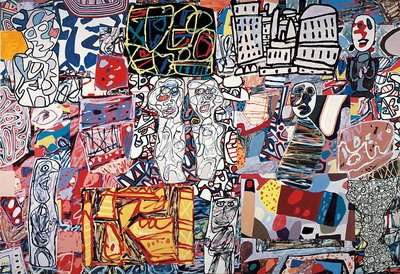
Art above: Jean Dubuffet, “Mêle Moments,” 1976

Previous Post

July 10, 2013
Smiling Skulls: On Death and Diversion
Next Post
July 12, 2013 The Narratives We Need, Part 2
Browse Our Archives
Select a Category A. G. Harmon Alissa Wilkinson Allison Backous Art Authors Brad Fruhauff Bradford Winters Bryan Bliss Caroline Langston Chad Thomas Johnston Chris Hoke Christiana N. Peterson Culture D.G. Myers D.L. Mayfield Daniel Bowman Jr. David Griffith Elizabeth Duffy Faith Film Greg Wolfe Guest Contributor Interview Jan Vallone Jeffrey Overstreet Jessica Eddings-Roeser Jessica Mesman Griffith Kelly Foster Lindsey Crittenden Morgan Meis music Natalie Vestin Nick Olson Peggy Rosenthal Personal Reflection Poetry Friday Reflection Relationships Review Richard Chess Richard Cole Sara Zarr Shannon Huffman Polson Sonya Bilocerkowycz Tania Runyan Tony Woodlief Topical Categories Uncategorized Vic Sizemore Writing
Select a Month October 2018 September 2018 August 2018 July 2018 June 2018 May 2018 April 2018 March 2018 February 2018 January 2018 December 2017 November 2017 October 2017 September 2017 August 2017 July 2017 June 2017 May 2017 April 2017 March 2017 February 2017 January 2017 December 2016 November 2016 October 2016 September 2016 August 2016 July 2016 June 2016 May 2016 April 2016 March 2016 February 2016 January 2016 December 2015 November 2015 October 2015 September 2015 August 2015 July 2015 June 2015 May 2015 April 2015 March 2015 February 2015 January 2015 December 2014 November 2014 October 2014 September 2014 August 2014 July 2014 June 2014 May 2014 April 2014 March 2014 February 2014 January 2014 December 2013 November 2013 October 2013 September 2013 August 2013 July 2013 June 2013 May 2013 April 2013 March 2013 February 2013 January 2013 December 2012 November 2012 October 2012 September 2012 August 2012 July 2012 June 2012 May 2012 February 2008
Follow Us!
TAKE THE
Religious Wisdom Quiz
This chapter in Psalms declares the blessed man who meditates on God's law day and night is like a tree planted by streams. What is its number?
Select your answer to see how you score.
Psalm 23 Psalm 119 Psalm 100 Psalm 1
Related posts from Good Letters

On Writing Odes: Taking Time to Celebrate


Leonard Cohen’s Holy and Broken Hallelujah

Ready or Not for the Days of Awe
TRENDING AT PATHEOS Catholic

Rejecting Doom: Christian Hope And Human Action
Christianity is a religion of hope. We are to have hope and...

It’s What Comes From Within Which Matters
One of the most difficult things for us to understand is why...

Why I Choose the Eucharist Over the Sermon
Choose the Eucharist, Not the Sermon What are we supposed to get...

5 Design Elements Found in Spiritually Rooted Homes
Putting Spirituality Into Home Decor Our homes are more than our living...

Credo: A Story of God Told with the...
About 10 years ago, I began to imagine a personal "Credo" that...

The Anatomy of Divine Revelation in Catholic Thought
The claim that God has made Himself known to human beings is...
view all Catholic blogs
Ad-Free & Subscriber Log-In Subscription Support
- About Us
- 2026 Calendar
- Videos
- Podcasts
- Library of World Religions
- Faith In Media Tracker
- Advertise With Us
- Write for Us
- Privacy Policy
- Terms of Service
- Do Not Sell My Data
- Contact Us
- Radiant Digital
- Manage Newsletter Subscriptions
- Unsubscribe From Notifications
- Sitemap
Copyright 2008-2026, Patheos. All rights reserved.
Subscription Support Ad-Free & Subscriber Log-In
Follow Patheos