
BuddhistCatholicContemplativeEvangelicalGeneral ChristianHinduJewishLatter-day SaintMuslimNew VisionsProgressive Christian
Beliefs
- Buddhist
- Catholic
- Contemplative
- Evangelical
- General Christian
- Hindu
- Jewish
- Latter-day Saint
- More Voices
- Muslim
- New Visions
- Pagan
- Progressive Christian
Topics
- Religion News
- Food and Religion
- Sports and Religion
- Religious Art
- Religious Music and Entertainment
- Religious Events
- History and Religion
- Style and Religion
- Politics and Religion
- Women in Religion
- Recreation Outdoors and Religion
- Business Finance and Religion
- Careers Workplace and Religion
- Education and Religion
- Family Parenting and Religion
- Health Fitness and Religion
- Home and Religion
- Relationships and Religion
- Technology and Religion
- Travel and Religion
Columnists
- Buddhist Columnists
- Business Finance and Religion Columnists
- Careers Workplace and Religion Columnists
- Catholic Columnists
- Contemplative Columnists
- Education and Religion Columnists
- Evangelists Columnists
- Family Parenting and Religion Columnists
- General Christian Columnists
- Health Fitness and Religion Columnists
- Hindu Columnists
- History and Religion Columnists
- Home and Religion Columnists
- Jewish Columnists
- More Voices Columnists
- Latter Day Columnists
- Muslim Columnists
- New Visions Columnists
- Nonreligious Columnists
- Pagan Columnists
- Politics and Religion Columnists
- Progressive Columnists
- Recreation Outdoors and Religion Columnists
- Relationships and Religion Columnists
- Religion News Columnists
- Religious Art Columnists
- Religious Events Columnists
- Religious Music and Entertainment Columnists
- Sports and Religion Columnists
- Style and Religion Columnists
- Technology and Religion Columnists
- Travel and Religion Columnists
- Women in Religion Columnists
Resource Library
- 2026 Calendar
- Library of World Religions
- The 100 Most Holy Places on Earth
- Patheos Answers
- Podcasts
- Videos
- Faith Leaders Database
- Anglican Episcopalian
- Bahai
- Baptist
- Buddhism
- Christianity
- Confucianism
- Eastern Orthodoxy
- Hinduism
- Holiness and Pentecostal
- ISKCON
- Islam
- Judaism
- Lutheran
- Methodist
- The Church of Jesus Christ of Latter-day Saints
- New Age
- Paganism
- Presbytarian and Reformed
- Protestantism
- Religion Behind the Scenes
- Roman Catholic
- Scientology
- Shia Islam
- Sikhism
- Sufism
- Sunni Islam
- Taoism
- Zen
- See all religions
Research Tools
 Ad-Free & Subscriber Log-In Subscription Support
Ad-Free & Subscriber Log-In Subscription Support
Follow Patheos 

- Trending:
- Forgiveness
- |
- Marriage
- |
- Consciousness
- |
- Death Penalty
- |
- Election
- |
- Halloween
 Good Letters
-
Contributors
- Home
- Catholic
- Sisyphus with a Lawnmower
Sisyphus with a Lawnmower
Last updated on: July 8, 2013 at 1:00 am by Vic Sizemore
Sisyphus with a Lawnmower 2013-06-30T22:56:16-07:00 Vic Sizemore
Patheos Explore the world's faith through different perspectives on religion and spirituality! Patheos has the views of the prevalent religions and spiritualities of the world.
 I hate mowing the lawn. I hate lawnmowers.
Our unkempt yard stands out among our neighbors’ lush green lawns. Their leaves and sticks are promptly removed after storms, their yards are neatly mown, and their borders are crisply edged. My wife and I imagine that we get a pass on our shaggy, limb-cluttered yard because everyone knows we’re academics, bookish types who aren’t much use at real work—otherwise we might have already been voted off the street.
I don’t see the point of constantly struggling against nature when she will certainly outlast me. What’s more, I like my yard shaded and shaggy, with leaves and sticks all around. It feels more natural—it is more natural. Why put so much energy into fighting it?
We have family coming this weekend though, and my wife wants things clean and neat before they arrive. So yesterday I started with the yard.
I stepped out to the shed at eight in the morning, to get it over with early. I pulled out the fancy Lawnboy walk-behind my dad brought down when my cheap mower died. It is lime-green and has a black plastic motor cover that is big around the top like a squared-off black mushroom.
It has a two-stroke engine that has for the past three years given me fits. It takes me almost as long to get the thing running as it does to cut the grass.
This time, after the usual struggle, I finally gave up and took it to the local small-engine repair shop. A man in a greasy brown apron came out to the back of my car and stood watching the mower dribble fuel into the trunk. He told me they don’t work on two-stroke Lawnboys anymore because they’re too finicky with the fuel now available. Gas fumes rose heavy from the trunk as he explained to me how new federal emissions regulations have rendered two-stroke engines, in his opinion, useless.
I thanked him and headed back across town. On the drive home, the gasoline odor was so strong in the car that even with all the windows down, I got a dizzy headache—sitting at a stop light woozy in the fumes, I envisioned brain cells inside my skull popping away like Coke bubbles.
I left the Lawnboy at the end of the driveway and dragged my old broken-down mower from the shed, a forest-green off-brand with a Briggs & Stratton engine that had two white puffy spider’s nests webbed to it. Three hours and two trips to Home Depot later, I had the thing running, but at such low RPMs that I had to coax it forward gingerly so it wouldn’t bog down and die in the heavy patches of grass.
Slowly, start-stopping row by row, I mowed the yard. By the time I finished, it was almost three in the afternoon. My whole day wasted on a task I did not value in the first place—and what’s worse, a task I would just have to repeat in a week or two.
While a POW during WWII, Jurgen Moltmann began to develop what would become known as the theology of hope, which shifted focus from the recorded acts of God in the past to the promised acts in the future. This hope was not one of sitting with folded hands, it was one of laboring toward that better world—hard work with a grand purpose.
In the POW camp, Moltmann and his fellow prisoners were set to various tasks of physical labor with no point but to keep them busy at something. Moltmann observed that being forced to labor at endless daily tasks that had no meaning or larger purpose—no future goal, no good outcome to hope for—was the one thing that drove his fellow prisoners mad, even to the point of suicide.
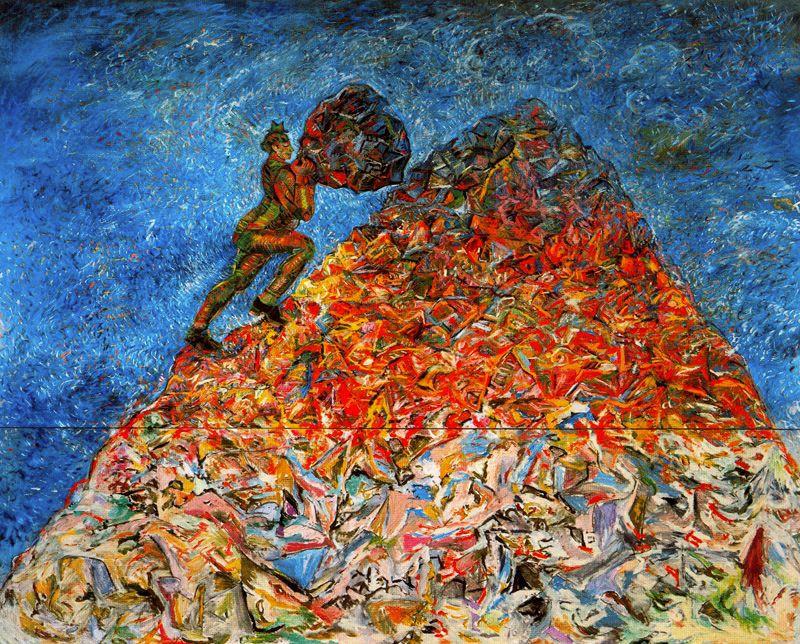
I think of Sisyphus condemned to roll his stone up that hill every day only to watch it roll back down and then throw his shoulder into it and start over. That’s what yard work is to me. It’s not just yard work though, is it? Even obviously useful work can feel like this: any parent engaged in the constant battle with ever-mounting piles of laundry and clutter and dishes and trash recognizes the feeling.
Brother Lawrence knew this kind of work. A lay member of the Discalced Carmelite Priory in Paris, Brother Lawrence did nothing that could be considered great. He didn’t translate Scripture; he didn’t do deep thinking or theology; he was not a social reformer or a great speaker. He labored in the priory kitchen for the good years of his working life. He washed dishes. When he was old he repaired sandals. And yet he found it fulfilling work.
He viewed every task, no matter how menial, as service to his fellow monks and service to God, and therefore possessing all the intrinsic value of so-called nobler acts of piety and service. Brother Lawrence was at peace.
I was irritated at having wasted the whole day on the menial and useless task of lawn mowing, while a manuscript needing revision and submissions needing managing lay dormant in my office. Then my wife came out and walked the yard under the darkening sky. As the first drops of what would be a tree-downing gully-washer started falling, Liz looked around, taking evident pleasure in the lawn.
My tools were unwieldy, and my labor was hard, and what it accomplished would not last long: even as I wheeled the hot mower back into the shed, nature was already erasing my work with her relentless, consuming growth.
It made my wife happy though. That is meaning enough to keep me at it.
Vic Sizemore earned his MFA in fiction from Seattle Pacific University in 2009. His fiction and nonfiction are published or forthcoming in Story Quarterly, Southern Humanities Review, PANK Magazine, Pembroke, Saint Katherine Review, Rock & Sling and elsewhere. An excerpt from his novel The Calling was a finalist for the Sherwood Anderson Award; other excerpts from The Calling are published in Portland Review and are forthcoming serially in Connecticut Review. His short story “Hush Little Baby” won the 28th New Millennium Writings Award for Fiction. Sizemore teaches at Central Virginia Community College.
Previous Post

July 5, 2013
Women Who Make America
Next Post
July 9, 2013 A Baby Smaller Than Roosevelt’s Eye
Browse Our Archives
Select a Category A. G. Harmon Alissa Wilkinson Allison Backous Art Authors Brad Fruhauff Bradford Winters Bryan Bliss Caroline Langston Chad Thomas Johnston Chris Hoke Christiana N. Peterson Culture D.G. Myers D.L. Mayfield Daniel Bowman Jr. David Griffith Elizabeth Duffy Faith Film Greg Wolfe Guest Contributor Interview Jan Vallone Jeffrey Overstreet Jessica Eddings-Roeser Jessica Mesman Griffith Kelly Foster Lindsey Crittenden Morgan Meis music Natalie Vestin Nick Olson Peggy Rosenthal Personal Reflection Poetry Friday Reflection Relationships Review Richard Chess Richard Cole Sara Zarr Shannon Huffman Polson Sonya Bilocerkowycz Tania Runyan Tony Woodlief Topical Categories Uncategorized Vic Sizemore Writing
Select a Month October 2018 September 2018 August 2018 July 2018 June 2018 May 2018 April 2018 March 2018 February 2018 January 2018 December 2017 November 2017 October 2017 September 2017 August 2017 July 2017 June 2017 May 2017 April 2017 March 2017 February 2017 January 2017 December 2016 November 2016 October 2016 September 2016 August 2016 July 2016 June 2016 May 2016 April 2016 March 2016 February 2016 January 2016 December 2015 November 2015 October 2015 September 2015 August 2015 July 2015 June 2015 May 2015 April 2015 March 2015 February 2015 January 2015 December 2014 November 2014 October 2014 September 2014 August 2014 July 2014 June 2014 May 2014 April 2014 March 2014 February 2014 January 2014 December 2013 November 2013 October 2013 September 2013 August 2013 July 2013 June 2013 May 2013 April 2013 March 2013 February 2013 January 2013 December 2012 November 2012 October 2012 September 2012 August 2012 July 2012 June 2012 May 2012 February 2008
Follow Us!
TAKE THE
Religious Wisdom Quiz
What did Stephen see as he was being stoned?
Select your answer to see how you score.
The face of God Angels descending A bright light from heaven Heaven opened and Jesus standing at the right hand of God
Related posts from Good Letters

Poetry Friday: "The Burned Butterfly"

Leonard Cohen’s Holy and Broken Hallelujah

Ready or Not for the Days of Awe

TRENDING AT PATHEOS Catholic

Rejecting Doom: Christian Hope And Human Action
Christianity is a religion of hope. We are to have hope and...

It’s What Comes From Within Which Matters
One of the most difficult things for us to understand is why...

Why I Choose the Eucharist Over the Sermon
Choose the Eucharist, Not the Sermon What are we supposed to get...

5 Design Elements Found in Spiritually Rooted Homes
Putting Spirituality Into Home Decor Our homes are more than our living...

Credo: A Story of God Told with the...
About 10 years ago, I began to imagine a personal "Credo" that...

The Anatomy of Divine Revelation in Catholic Thought
The claim that God has made Himself known to human beings is...
view all Catholic blogs
Ad-Free & Subscriber Log-In Subscription Support
- About Us
- 2026 Calendar
- Videos
- Podcasts
- Library of World Religions
- Faith In Media Tracker
- Advertise With Us
- Write for Us
- Privacy Policy
- Terms of Service
- Do Not Sell My Data
- Contact Us
- Radiant Digital
- Manage Newsletter Subscriptions
- Unsubscribe From Notifications
- Sitemap
Copyright 2008-2026, Patheos. All rights reserved.
Subscription Support Ad-Free & Subscriber Log-In
Follow Patheos