
BuddhistCatholicContemplativeEvangelicalGeneral ChristianHinduJewishLatter-day SaintMuslimNew VisionsProgressive Christian
Beliefs
- Buddhist
- Catholic
- Contemplative
- Evangelical
- General Christian
- Hindu
- Jewish
- Latter-day Saint
- More Voices
- Muslim
- New Visions
- Pagan
- Progressive Christian
Topics
- Religion News
- Food and Religion
- Sports and Religion
- Religious Art
- Religious Music and Entertainment
- Religious Events
- History and Religion
- Style and Religion
- Politics and Religion
- Women in Religion
- Recreation Outdoors and Religion
- Business Finance and Religion
- Careers Workplace and Religion
- Education and Religion
- Family Parenting and Religion
- Health Fitness and Religion
- Home and Religion
- Relationships and Religion
- Technology and Religion
- Travel and Religion
Columnists
- Buddhist Columnists
- Business Finance and Religion Columnists
- Careers Workplace and Religion Columnists
- Catholic Columnists
- Contemplative Columnists
- Education and Religion Columnists
- Evangelists Columnists
- Family Parenting and Religion Columnists
- General Christian Columnists
- Health Fitness and Religion Columnists
- Hindu Columnists
- History and Religion Columnists
- Home and Religion Columnists
- Jewish Columnists
- More Voices Columnists
- Latter Day Columnists
- Muslim Columnists
- New Visions Columnists
- Nonreligious Columnists
- Pagan Columnists
- Politics and Religion Columnists
- Progressive Columnists
- Recreation Outdoors and Religion Columnists
- Relationships and Religion Columnists
- Religion News Columnists
- Religious Art Columnists
- Religious Events Columnists
- Religious Music and Entertainment Columnists
- Sports and Religion Columnists
- Style and Religion Columnists
- Technology and Religion Columnists
- Travel and Religion Columnists
- Women in Religion Columnists
Resource Library
- 2026 Calendar
- Library of World Religions
- The 100 Most Holy Places on Earth
- Patheos Answers
- Podcasts
- Videos
- Faith Leaders Database
- Anglican Episcopalian
- Bahai
- Baptist
- Buddhism
- Christianity
- Confucianism
- Eastern Orthodoxy
- Hinduism
- Holiness and Pentecostal
- ISKCON
- Islam
- Judaism
- Lutheran
- Methodist
- The Church of Jesus Christ of Latter-day Saints
- New Age
- Paganism
- Presbytarian and Reformed
- Protestantism
- Religion Behind the Scenes
- Roman Catholic
- Scientology
- Shia Islam
- Sikhism
- Sufism
- Sunni Islam
- Taoism
- Zen
- See all religions
Research Tools
 Ad-Free & Subscriber Log-In Subscription Support
Ad-Free & Subscriber Log-In Subscription Support
Follow Patheos 

- Trending:
- Forgiveness
- |
- Marriage
- |
- Consciousness
- |
- Death Penalty
- |
- Election
- |
- Halloween
 Good Letters
-
Contributors
- Home
- Catholic
- Cutting Away the Noise
Cutting Away the Noise
Last updated on: July 31, 2013 at 1:00 am by Shannon Huffman Polson
Cutting Away the Noise 2013-07-29T13:33:24-07:00 Shannon Huffman Polson
Patheos Explore the world's faith through different perspectives on religion and spirituality! Patheos has the views of the prevalent religions and spiritualities of the world.
 Fifteen years ago, there was no end to the noise. It took a cutting to get me to silence.
I worked twelve-hour days and longer in an aircraft hangar on a flight line of hundreds of helicopters with the cacophony of auxiliary power units, the collision of metal, and rotor blades beating the air outside, sounds so loud earplugs and noise-canceling helmets were required.
After my shift I would climb into my car and turn on the radio, classic rock or country at a moderately high volume, and drive home to my condo. There I turned on CNN while making something simple for dinner. I watched the thirty-minute circuit and then left it on for company.
Other noise and other stories ensured I didn’t go too far into my own deadening loneliness. I found silence terrifying, though I didn’t see it that way then. I liked motion, and noise, and doing things. I talked a lot. That’s where I saw and added value, where my sense of self worth lay.
Several years later, my hands led me to quiet. I’d spent my twenties with painful inflammation in my hands, multiple instances of trigger finger, a condition usually afflicting the elderly. In trigger finger, the tendon running the length of the finger becomes inflamed, catching on the covering sheath, painfully catching when the finger moves. In surgery, a cut is made at the base of the finger slicing the A-1 pulley covering the tendon, allowing it to move smoothly again.
After one surgery failed to heal correctly, I had both hands operated on at one time against the advice of the surgeon. I had decided I didn’t have time to wait two weeks per hand away from workouts and work. Back at my apartment in the west Texas desert, I lay on the couch, both hands bandaged, my head foggy from narcotics.
I’d prepared food in the fridge and unscrewed the lids of jars I’d use. I found a housekeeper to come and do my dishes; food left out in a warm climate attracts critters in a hurry. I had to ask a friend to come and wash my hair. And I lay useless on the couch, watching the light come in through the blinds on my porch door and making its way lazily across the living room carpet.
I remember not being able to find the remote to turn on the news, feeling thick from painkillers and my hands throbbing, the keenness of violated flesh dulled by drugs. I resigned myself to lie there in the quiet. In the stillness.
I heard for the first time, though I had lived in the apartment for many months, the sound of mourning doves. Their calls moved through the porch doors as though from another world, and in a way it was, a world I had not stopped long enough to know.
I felt a slowing during those two weeks, as though the quiet pushed back on the clock while quickening my senses.
After two weeks I could drive. Getting into my car, I reached for the radio and paused. I put my hand back on the wheel. I heard birdsong as I closed the door, and I let myself notice it. I heard the car door close, the seat belt click, the ignition spark, the engine turn, the sticky tires backing out of a parking space, the rough pavement, the wind outside. This was far from silence, but they were new noises for me, or my ears were newly trained to a pace that could recognize them, hold them.
Over breakfast at home I started to listen for the mourning doves before I headed to master’s swimming, and knowing they were somewhere nearby, I looked at the desert landscape differently, too. One night I heard a coyote, a wavering ghostly sound. The apartment manager explained there was a den just one valley away.
Acoustic ecologist Gordon Hempton says that silence is on the verge of extinction. In an interview with Krista Trippett, he says that the modern measure of silence is the noise free interval, he says, and has documented only twelve places in the United States where there is at least fifteen minutes of real silence.
“This kind of silence is not the absence of sound,” Hempton says. “I mean silence from modern life…what it means to be in a place.” He connects intimacy to the ability to listen at a primal level, something upon which a noisy environment intrudes. “When we truly listen, we have to anticipate we might become changed.”
“Just (to) be here; that is often the challenge for adults when it comes to silence,” says Hempton,”because we are so busy being some place else. When we are in a silent place where there are no distractions we finally get to meet ourselves, and that can be frightening…it’s practically fear of the unknown.”
In 1 Kings, God instructs Elijah to go out and watch as God passes by. Elijah sees great winds, an earthquake, a fire, distractions and shows, the inflammation of our daily lives, but that was not where the Lord could be found. But “after the fire came a gentle whisper,” or, in the King James Bible “a still, small voice.” It was in stillness, in silence, that Elijah could hear the Lord.
Silence for me allowed awareness, and awareness attention. “Prayer is …attention in its purest form,” says Simone Weil, who also notes that “attention is the rarest and purest form of generosity.” I found I was, slowly, better able to pray. My flesh had been cut, and for two weeks distractions sheared away.
Sometimes a cutting is required to see the beauty that lies beneath.
Hempton said we meet ourselves in silence, but entering the scary realm of quiet I moved through myself into the world. Quiet permitted a new kind of intimacy. And there I was able to find myself no longer so alone.
Shannon Huffman Polson is the author of North of Hope: A Daughter’s Arctic Journey. Her essays and articles have appeared in a number of literary and commercial magazines including High Country News, Adventum, Cirque Journal and Alaska and Seattle Magazines. She can be found writing or with her her family in Seattle or Alaska, and always at her website, Facebook, and Twitter.
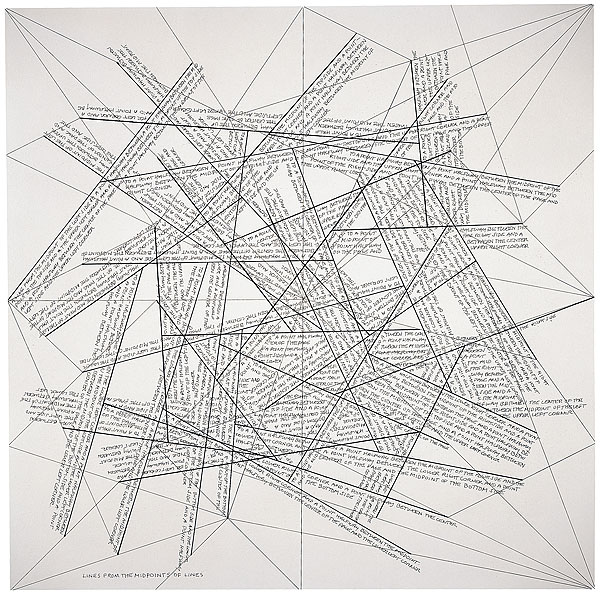
Art above: Sol Lewitt, Lines from the midpoint of lines, 1975.
Previous Post

July 30, 2013
A Feast for Hungry Eyes: An Interview with Sam Phillips, Part 2
Next Post
August 1, 2013 In Praise of the Printed Book, Part 1
Browse Our Archives
Select a Category A. G. Harmon Alissa Wilkinson Allison Backous Art Authors Brad Fruhauff Bradford Winters Bryan Bliss Caroline Langston Chad Thomas Johnston Chris Hoke Christiana N. Peterson Culture D.G. Myers D.L. Mayfield Daniel Bowman Jr. David Griffith Elizabeth Duffy Faith Film Greg Wolfe Guest Contributor Interview Jan Vallone Jeffrey Overstreet Jessica Eddings-Roeser Jessica Mesman Griffith Kelly Foster Lindsey Crittenden Morgan Meis music Natalie Vestin Nick Olson Peggy Rosenthal Personal Reflection Poetry Friday Reflection Relationships Review Richard Chess Richard Cole Sara Zarr Shannon Huffman Polson Sonya Bilocerkowycz Tania Runyan Tony Woodlief Topical Categories Uncategorized Vic Sizemore Writing
Select a Month October 2018 September 2018 August 2018 July 2018 June 2018 May 2018 April 2018 March 2018 February 2018 January 2018 December 2017 November 2017 October 2017 September 2017 August 2017 July 2017 June 2017 May 2017 April 2017 March 2017 February 2017 January 2017 December 2016 November 2016 October 2016 September 2016 August 2016 July 2016 June 2016 May 2016 April 2016 March 2016 February 2016 January 2016 December 2015 November 2015 October 2015 September 2015 August 2015 July 2015 June 2015 May 2015 April 2015 March 2015 February 2015 January 2015 December 2014 November 2014 October 2014 September 2014 August 2014 July 2014 June 2014 May 2014 April 2014 March 2014 February 2014 January 2014 December 2013 November 2013 October 2013 September 2013 August 2013 July 2013 June 2013 May 2013 April 2013 March 2013 February 2013 January 2013 December 2012 November 2012 October 2012 September 2012 August 2012 July 2012 June 2012 May 2012 February 2008
Follow Us!
TAKE THE
Religious Wisdom Quiz
Which letter emphasizes faith without works is dead?
Select your answer to see how you score.
1 Peter Titus James Hebrews
Related posts from Good Letters

Leonard Cohen’s Holy and Broken Hallelujah

Ready or Not for the Days of Awe


TRENDING AT PATHEOS Catholic

Rejecting Doom: Christian Hope And Human Action
Christianity is a religion of hope. We are to have hope and...

It’s What Comes From Within Which Matters
One of the most difficult things for us to understand is why...

Why I Choose the Eucharist Over the Sermon
Choose the Eucharist, Not the Sermon What are we supposed to get...

5 Design Elements Found in Spiritually Rooted Homes
Putting Spirituality Into Home Decor Our homes are more than our living...

Credo: A Story of God Told with the...
About 10 years ago, I began to imagine a personal "Credo" that...

The Anatomy of Divine Revelation in Catholic Thought
The claim that God has made Himself known to human beings is...
view all Catholic blogs
Ad-Free & Subscriber Log-In Subscription Support
- About Us
- 2026 Calendar
- Videos
- Podcasts
- Library of World Religions
- Faith In Media Tracker
- Advertise With Us
- Write for Us
- Privacy Policy
- Terms of Service
- Do Not Sell My Data
- Contact Us
- Radiant Digital
- Manage Newsletter Subscriptions
- Unsubscribe From Notifications
- Sitemap
Copyright 2008-2026, Patheos. All rights reserved.
Subscription Support Ad-Free & Subscriber Log-In
Follow Patheos