
BuddhistCatholicContemplativeEvangelicalGeneral ChristianHinduJewishLatter-day SaintMuslimNew VisionsProgressive Christian
Beliefs
- Buddhist
- Catholic
- Contemplative
- Evangelical
- General Christian
- Hindu
- Jewish
- Latter-day Saint
- More Voices
- Muslim
- New Visions
- Pagan
- Progressive Christian
Topics
- Religion News
- Food and Religion
- Sports and Religion
- Religious Art
- Religious Music and Entertainment
- Religious Events
- History and Religion
- Style and Religion
- Politics and Religion
- Women in Religion
- Recreation Outdoors and Religion
- Business Finance and Religion
- Careers Workplace and Religion
- Education and Religion
- Family Parenting and Religion
- Health Fitness and Religion
- Home and Religion
- Relationships and Religion
- Technology and Religion
- Travel and Religion
Columnists
- Buddhist Columnists
- Business Finance and Religion Columnists
- Careers Workplace and Religion Columnists
- Catholic Columnists
- Contemplative Columnists
- Education and Religion Columnists
- Evangelists Columnists
- Family Parenting and Religion Columnists
- General Christian Columnists
- Health Fitness and Religion Columnists
- Hindu Columnists
- History and Religion Columnists
- Home and Religion Columnists
- Jewish Columnists
- More Voices Columnists
- Latter Day Columnists
- Muslim Columnists
- New Visions Columnists
- Nonreligious Columnists
- Pagan Columnists
- Politics and Religion Columnists
- Progressive Columnists
- Recreation Outdoors and Religion Columnists
- Relationships and Religion Columnists
- Religion News Columnists
- Religious Art Columnists
- Religious Events Columnists
- Religious Music and Entertainment Columnists
- Sports and Religion Columnists
- Style and Religion Columnists
- Technology and Religion Columnists
- Travel and Religion Columnists
- Women in Religion Columnists
Resource Library
- 2026 Calendar
- Library of World Religions
- The 100 Most Holy Places on Earth
- Patheos Answers
- Podcasts
- Videos
- Faith Leaders Database
- Anglican Episcopalian
- Bahai
- Baptist
- Buddhism
- Christianity
- Confucianism
- Eastern Orthodoxy
- Hinduism
- Holiness and Pentecostal
- ISKCON
- Islam
- Judaism
- Lutheran
- Methodist
- The Church of Jesus Christ of Latter-day Saints
- New Age
- Paganism
- Presbytarian and Reformed
- Protestantism
- Religion Behind the Scenes
- Roman Catholic
- Scientology
- Shia Islam
- Sikhism
- Sufism
- Sunni Islam
- Taoism
- Zen
- See all religions
Research Tools
 Ad-Free & Subscriber Log-In Subscription Support
Ad-Free & Subscriber Log-In Subscription Support
Follow Patheos 

- Trending:
- Forgiveness
- |
- Marriage
- |
- Consciousness
- |
- Death Penalty
- |
- Election
- |
- Halloween
 Good Letters
-
Contributors
- Home
- Catholic
- Antisuperchrist: How the Man of Steel Saves, Part 2
Antisuperchrist: How the Man of Steel Saves, Part 2
Last updated on: July 2, 2013 at 1:00 am by Guest Blogger
Antisuperchrist: How the Man of Steel Saves, Part 2 2013-07-01T12:13:28-07:00 Guest Blogger
Patheos Explore the world's faith through different perspectives on religion and spirituality! Patheos has the views of the prevalent religions and spiritualities of the world.
 Guest Post
By Lucas Kwong
Today I want to take up the question that ended yesterday’s post: Is Superman the Übermensch?
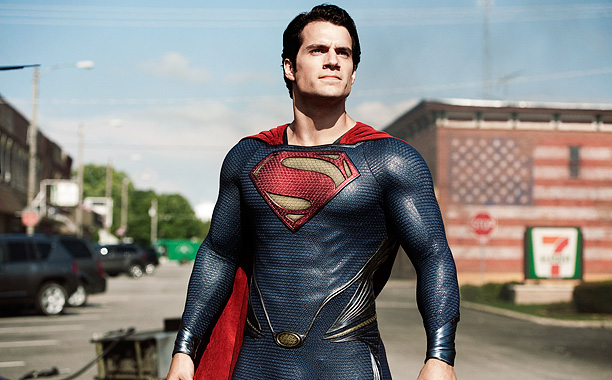
As a host of commentators have pointed out, Superman’s conventional morals have never positioned him as the destroyer of societal norms that Nietzsche championed. In Man of Steel, our hero’s forbearance toward his human antagonists make it clear he isn’t about to super-speed beyond good and evil anytime soon. Yet all the loving compassion in Henry Cavill’s baby blues can’t erase the fact that humanity doesn’t want a mangy drifter for a Messiah, or even a clean-scrubbed-but-nondescript farm boy: it wants a demigod.
It’s telling that, in this revision of comic book history, the “S” on his chest actually represents the Kryptonian symbol for hope. Misinterpreting this, the humans dub him Superman. What’s a self-effacing savior to do?
Indeed, the cosmos itself seems hell-bent on forging Kal-El into Nietzsche’s prototype. The collision between Kryptonian biology and Earth’s atmosphere produces Clark’s horrifically heightened sense of perception, such that his childhood memories involve seeing his teacher as a walking skeleton. In his all-encompassing sensorial receptivity, Clark recalls the Overman’s capacity to absorb life’s totality, incorporating Dionysian chaos and Apollonian order into his being without missing a (goose)step.
As for the Overman’s embrace of eternal recurrence—all possible events that have and will occur—Clark’s identification with the past-as-future is imprinted within his being. Before launching his superboy into space, Jor-El encoded into his son’s DNA the genetic information necessary to resurrect his race. Clark carries in his very marrow the seeds of Krypton’s stratified society.
Nietzsche, of course, looked to eternal recurrence to safeguard against the Christian preoccupation with future judgment: “Not to look to distant unknown salvations and blessings and pardons, but so to live that we would want to live again and want in eternity thus to live!” But this Superman supersedes Nietzsche’s binary. For humans, he represents a “distant unknown salvation,” yet for Kryptonians, he represents the possibility that Krypton, for all its sins, can and should live again.
Superman, in short, embodies the American drive to have it both ways, to embrace the best of the Overman and the best of the slave morality Nietzsche despised*.* Superman’s omnipotence, combined with his capacity to revive his race, means he can act as Christlike bridge between Kryptonian lion and Earthling lamb.
If refuting Plato’s social stratification recapitulates America’s origin myth, then this merging of Son of Man and Overman surely sketches the terms of manifest destiny that fueled its expansion.
Throughout the film, this uneasy détente between Christian and Nietzschean ethics is threatened by the temptation to ditch the meek-and-mild act. As Kryptonian vixen Faora observes before engaging Superman in battle, “The fact that you possess a sense of morality and we do not gives us an evolutionary advantage.” (Although apparently not an elocutionary one: wasn’t there a pithier way for Faora to slip in her ode to Social Darwinism?)
Superman’s Nazarean dreams in a Nietzschean cosmos are cast into sharp relief by his existential photonegative, General Zod. After Superman foils Zod’s plot to terraform Earth into a new Krypton, the general expresses a transcendent drive for revenge. “I was bred to serve my people…. Now I have no people. My soul…that is what you have taken from me!” If that’s not a line from The Genealogy of Morals by Zod, it should be.
This final showdown culminates in the Neck-snap Heard Round the World. Faced with a choice between saving a family and putting down the last surviving co-heir of Krypton, Kal-El opts for the latter. Superman’s choice to kill has provoked fans to righteous fury. Yet this apparently heretical departure epitomizes the spiritual ambivalence in which this Superman finds himself enmeshed.
As much as Superman might desire a third option, his decisive action is precisely what proves that, for all his superpowers, his allegiance lies exclusively with his adopted people. Here, then, is the ultimate sign that Superman has absorbed Pa Kent’s ambivalent advice: sometimes you protect life, sometimes you end it, and sometimes you accomplish both in one fell swoop.
This ad hoc code of ethics is, in the end, the only way for the Last Son of Krypton to satisfy the existential demands the universe has placed upon his shoulders. Interestingly, the Superman-Zod match immediately follows the sacrificial death of sidekick Colonel Hardy. The juxtaposition between Colonel Hardy’s noble demise and Superman’s morally ambiguous death-grip is too pointed to chalk up to mere screenwriting excess: sacrificial death is one bridge too far for this Messiah, particularly given the predestined appearance of Man of Steel 2.
Crucifixion will have to wait till the third film, if not the next reboot.
Indeed, Man of Steel offers an incisive if inadvertent meta-commentary on what we want from our alien superhero. Give us just enough Christ to offer the hope of salvation, and just enough Overman to deliver it without ending the franchise. Give us a hero who embraces the will to power, the drive to self-create and differentiate from the herd—but make sure he loves his mother, too.
Give us a hero whose self-imposed sensorial limitation reflects our self-imposed moral selectivity, our choice to gawk at 9/11 disaster porn one minute and, moments later, tremble for the fate of the one family who seems to have survived the holocaust. Above all, give us a hero who’s kind of hot (but no spit-curl, please, this is the 21st century).
In the end, the Man of Steel may take up journalism not merely as alibi but as escape from the fussy requirements of his vocation: at least at the office, he has nothing more pressing to worry about than keeping his eyeglasses on. And let’s be honest–given the choice between a desk job and saving the world on such specific terms, wouldn’t we feel the same way?
Lucas Kwong is a doctoral candidate in English Literature at Columbia University, specializing in religion and late Victorian literature. When he isn’t writing about Dracula or obsessing over the ideological underpinnings of summer movies, he’s writing music and performing as part of garage rock act Brother K (brotherkmusic.com).
Previous Post

June 30, 2013
Antisuperchrist: How the Man of Steel Saves, Part 1
Next Post
July 3, 2013 It's Always 1984
Browse Our Archives
Select a Category A. G. Harmon Alissa Wilkinson Allison Backous Art Authors Brad Fruhauff Bradford Winters Bryan Bliss Caroline Langston Chad Thomas Johnston Chris Hoke Christiana N. Peterson Culture D.G. Myers D.L. Mayfield Daniel Bowman Jr. David Griffith Elizabeth Duffy Faith Film Greg Wolfe Guest Contributor Interview Jan Vallone Jeffrey Overstreet Jessica Eddings-Roeser Jessica Mesman Griffith Kelly Foster Lindsey Crittenden Morgan Meis music Natalie Vestin Nick Olson Peggy Rosenthal Personal Reflection Poetry Friday Reflection Relationships Review Richard Chess Richard Cole Sara Zarr Shannon Huffman Polson Sonya Bilocerkowycz Tania Runyan Tony Woodlief Topical Categories Uncategorized Vic Sizemore Writing
Select a Month October 2018 September 2018 August 2018 July 2018 June 2018 May 2018 April 2018 March 2018 February 2018 January 2018 December 2017 November 2017 October 2017 September 2017 August 2017 July 2017 June 2017 May 2017 April 2017 March 2017 February 2017 January 2017 December 2016 November 2016 October 2016 September 2016 August 2016 July 2016 June 2016 May 2016 April 2016 March 2016 February 2016 January 2016 December 2015 November 2015 October 2015 September 2015 August 2015 July 2015 June 2015 May 2015 April 2015 March 2015 February 2015 January 2015 December 2014 November 2014 October 2014 September 2014 August 2014 July 2014 June 2014 May 2014 April 2014 March 2014 February 2014 January 2014 December 2013 November 2013 October 2013 September 2013 August 2013 July 2013 June 2013 May 2013 April 2013 March 2013 February 2013 January 2013 December 2012 November 2012 October 2012 September 2012 August 2012 July 2012 June 2012 May 2012 February 2008
Follow Us!
TAKE THE
Religious Wisdom Quiz
Who is the coauthor of some of Paul's epistles and delivered them to churches?
Select your answer to see how you score.
Andrew Barnabas Timothy Silas
Related posts from Good Letters


The Stars of the Earth Cry Out


TRENDING AT PATHEOS Catholic

Creation, Preservation, and Teleology in Catholic Theology
As I write this, it is very early Monday morning. Like millions...

The Parable Of The Sower And The Word...
One of Christ’s most famous parables is that of the sower who...

Rejecting Doom: Christian Hope And Human Action
Christianity is a religion of hope. We are to have hope and...

Why I Choose the Eucharist Over the Sermon
Choose the Eucharist, Not the Sermon What are we supposed to get...

5 Design Elements Found in Spiritually Rooted Homes
Putting Spirituality Into Home Decor Our homes are more than our living...

Credo: A Story of God Told with the...
About 10 years ago, I began to imagine a personal "Credo" that...
view all Catholic blogs
Ad-Free & Subscriber Log-In Subscription Support
- About Us
- 2026 Calendar
- Videos
- Podcasts
- Library of World Religions
- Faith In Media Tracker
- Advertise With Us
- Write for Us
- Privacy Policy
- Terms of Service
- Do Not Sell My Data
- Contact Us
- Radiant Digital
- Manage Newsletter Subscriptions
- Unsubscribe From Notifications
- Sitemap
Copyright 2008-2026, Patheos. All rights reserved.
Subscription Support Ad-Free & Subscriber Log-In
Follow Patheos