
BuddhistCatholicContemplativeEvangelicalGeneral ChristianHinduJewishLatter-day SaintMuslimNew VisionsProgressive Christian
Beliefs
- Buddhist
- Catholic
- Contemplative
- Evangelical
- General Christian
- Hindu
- Jewish
- Latter-day Saint
- More Voices
- Muslim
- New Visions
- Pagan
- Progressive Christian
Topics
- Religion News
- Food and Religion
- Sports and Religion
- Religious Art
- Religious Music and Entertainment
- Religious Events
- History and Religion
- Style and Religion
- Politics and Religion
- Women in Religion
- Recreation Outdoors and Religion
- Business Finance and Religion
- Careers Workplace and Religion
- Education and Religion
- Family Parenting and Religion
- Health Fitness and Religion
- Home and Religion
- Relationships and Religion
- Technology and Religion
- Travel and Religion
Columnists
- Buddhist Columnists
- Business Finance and Religion Columnists
- Careers Workplace and Religion Columnists
- Catholic Columnists
- Contemplative Columnists
- Education and Religion Columnists
- Evangelists Columnists
- Family Parenting and Religion Columnists
- General Christian Columnists
- Health Fitness and Religion Columnists
- Hindu Columnists
- History and Religion Columnists
- Home and Religion Columnists
- Jewish Columnists
- More Voices Columnists
- Latter Day Columnists
- Muslim Columnists
- New Visions Columnists
- Nonreligious Columnists
- Pagan Columnists
- Politics and Religion Columnists
- Progressive Columnists
- Recreation Outdoors and Religion Columnists
- Relationships and Religion Columnists
- Religion News Columnists
- Religious Art Columnists
- Religious Events Columnists
- Religious Music and Entertainment Columnists
- Sports and Religion Columnists
- Style and Religion Columnists
- Technology and Religion Columnists
- Travel and Religion Columnists
- Women in Religion Columnists
Resource Library
- 2026 Calendar
- Library of World Religions
- The 100 Most Holy Places on Earth
- Patheos Answers
- Podcasts
- Videos
- Faith Leaders Database
- Anglican Episcopalian
- Bahai
- Baptist
- Buddhism
- Christianity
- Confucianism
- Eastern Orthodoxy
- Hinduism
- Holiness and Pentecostal
- ISKCON
- Islam
- Judaism
- Lutheran
- Methodist
- The Church of Jesus Christ of Latter-day Saints
- New Age
- Paganism
- Presbytarian and Reformed
- Protestantism
- Religion Behind the Scenes
- Roman Catholic
- Scientology
- Shia Islam
- Sikhism
- Sufism
- Sunni Islam
- Taoism
- Zen
- See all religions
Research Tools
 Ad-Free & Subscriber Log-In Subscription Support
Ad-Free & Subscriber Log-In Subscription Support
Follow Patheos 

- Trending:
- Forgiveness
- |
- Marriage
- |
- Consciousness
- |
- Death Penalty
- |
- Election
- |
- Halloween
 Good Letters
-
Contributors
- Home
- Catholic
- Cathedrals of Consumption
Cathedrals of Consumption
Last updated on: June 5, 2013 at 11:20 pm by Caroline Langston
Cathedrals of Consumption 2013-06-05T23:20:02-07:00 Caroline Langston
Patheos Explore the world's faith through different perspectives on religion and spirituality! Patheos has the views of the prevalent religions and spiritualities of the world.
 Many years ago now, not long after I had been received into the Orthodox Church, I had a dream that has remained vivid: The Divine Liturgy of St. John Chrysostom, our chief celebration of the Eucharist and main Sunday service, is being celebrated right next to the escalators in a Neiman Marcus store.
In the dream, there’s a square plot of carpet outlined by velvet ropes, and inside them two priests, long-haired and long-bearded, are doing some of the works of worship—at this point chanting prayers, and swinging golden censers back and forth.
But instead of incense, the scent being borne over the air conditioning is the collective blast of perfumes arrayed in the glass display cases on either side of the, ahem, temple. The escalators crisscross and roll on their courses, up into the air, bounded by their glittering plate-glass railings.
“A real stairway to heaven!” more than one friend joked. My friend Vincent Rossi, an Orthodox theologian and environmentalist, on the other hand, located the dream’s meaning in my own uneasy suspension between the things of the world, and the things of the world to come.
It is a navigation that I am still contemplating all these years later, and most specifically in terms of how to celebrate the Sabbath.
Yvette Alt Miller’s wonderful recent book Angels at the Table has given me a lot to think about. Miller is an Orthodox Jewish mother—a ba’al teshuvah, as newly observant female Jews are known— a teacher, and a Harvard graduate with a formerly aggressive business career. Angels at the Table is a meticulous explication of the meaning, mechanics, and beauty of the extremely structured, some would say stringent, way that Orthodox Jews remember the Sabbath to keep it holy.
Now, as a Christian I well know that our faith’s approach to the third commandment is fundamentally different from what Orthodox Judaism espouses—and cannot be otherwise, given our understanding of Christ being the fulfillment of what so many Hebrew scriptural observances looked toward.
We are not held to those traditions, exactly—the Sabbath was made for man, and not man for the Sabbath, after all. Lauren Winner discourses thoughtfully on the differences in celebrating the day of rest as a Jew, and as a Christian, in her book Mudhouse Sabbath.
And yet Jesus said, “I did not come to abolish the Law and the Prophets.” The Puritans conducted their own fierce abstinence from labor. My daughter’s Greek godmother often wishes she could return to the blue laws of Astoria, New York, in which everything was closed on Sunday, rather than being stuck for an hour in traffic on Route 7 in Northern Virginia.
For it is a real battle these days: not being overwhelmed and bowled over by the “bleared, smeared” workaday world. And if you are trying to raise children to have some memory of faith, with even the hope of an adult commitment, you have to work at it mightily. The soccer game will just have to wait.
And this is important: Judith Shulevitz once wrote that God gave man the Sabbath as a reminder, and a celebration, that the Jews were no longer slaves. To neglect the Sabbath was therefore to voluntarily remain a slave.
Angels at the Table goes one step further, illuminating beautifully not only why certain activities are not done on the Sabbath, but what not doing them frees you for: In-depth conversation with family. Hospitality. Long walks. Gazing at the sky at dusk to espy the three stars that signal the end of Shabbat.
This is not merely matter of a “day of rest,” that casually tossed about phrase, but a day of worship. A day of ecstasy, even, as the Hasidic Jews would have it.
Slowly, slowly, I am trying to ensure fewer distractions on that day, even if I am not commanded to keep Shabbat. I do not want this to be a day of errands, list-making, paying bills, or of cruising by Lowe’s to see the weekly deals. Or a day of watching television cartoons, which was the major lure when I was a child.
While I don’t mind my children being bored, I don’t want them to be exasperated and miserable, either. Alt Miller has ingenious suggestions for making certain toys and activities “Shabbat only,” made instantly special.
We are somewhere, right now, in the middle: We wake into silence, and each week, I am delaying turning on the radio, although that is hard because my union-contract husband, who has to work on Sundays, is in broadcasting, and I want to be “with” him.
I resist the temptation to just put a load of clothes in the machine and notice instead the stream of sunshine through a window.
We light incense and cense the house, but I often let my son, who has been forbidden computer use during the school week, to play a few games. We have to get in the car to drive to our church, which is a full half-hour away from our house on yes, the Washington, D.C., Beltway.
Yesterday, though, while waiting to attend a friend’s Sunday dinner on that side of town, I fell into the kind of habit that plagues almost all of us contemporary Americans: Wanting something casual to change out of my church dress into, I found myself parking the fabled Montgomery Mall, now a Westfield center.
“What is a mall, Mama?” my four-year-old daughter asked—while she’s been to one a few times, we’ve tried to avoid recreational shopping.
Once inside she was clearly entranced by the abundance, hands running over skirts and blouses as she ran between the racks. After I have picked up a twenty-dollar sundress, we find ourselves selecting among the plethora of Hello Kitty sundresses for my daughter, too.
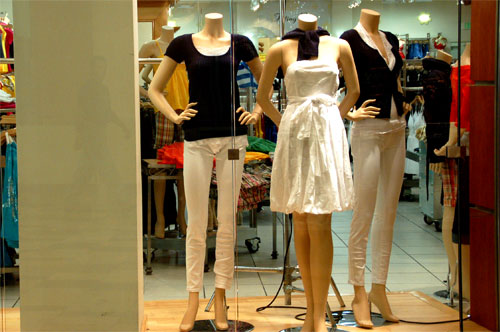
She runs up to the mannequins, which she calls “the pretty ladies.” She kisses each one of them in turn, as if kissing the icons at church.
A native of Yazoo City, Mississippi, Caroline Langston is a convert to the Eastern Orthodox Church. She is a widely published writer and essayist, a winner of the Pushcart Prize, and a commentator for NPR’s “All Things Considered.”
Previous Post

June 5, 2013
For the Time Being
Next Post
June 6, 2013 How Shall I Answer If God Calls My Name?
Browse Our Archives
Select a Category A. G. Harmon Alissa Wilkinson Allison Backous Art Authors Brad Fruhauff Bradford Winters Bryan Bliss Caroline Langston Chad Thomas Johnston Chris Hoke Christiana N. Peterson Culture D.G. Myers D.L. Mayfield Daniel Bowman Jr. David Griffith Elizabeth Duffy Faith Film Greg Wolfe Guest Contributor Interview Jan Vallone Jeffrey Overstreet Jessica Eddings-Roeser Jessica Mesman Griffith Kelly Foster Lindsey Crittenden Morgan Meis music Natalie Vestin Nick Olson Peggy Rosenthal Personal Reflection Poetry Friday Reflection Relationships Review Richard Chess Richard Cole Sara Zarr Shannon Huffman Polson Sonya Bilocerkowycz Tania Runyan Tony Woodlief Topical Categories Uncategorized Vic Sizemore Writing
Select a Month October 2018 September 2018 August 2018 July 2018 June 2018 May 2018 April 2018 March 2018 February 2018 January 2018 December 2017 November 2017 October 2017 September 2017 August 2017 July 2017 June 2017 May 2017 April 2017 March 2017 February 2017 January 2017 December 2016 November 2016 October 2016 September 2016 August 2016 July 2016 June 2016 May 2016 April 2016 March 2016 February 2016 January 2016 December 2015 November 2015 October 2015 September 2015 August 2015 July 2015 June 2015 May 2015 April 2015 March 2015 February 2015 January 2015 December 2014 November 2014 October 2014 September 2014 August 2014 July 2014 June 2014 May 2014 April 2014 March 2014 February 2014 January 2014 December 2013 November 2013 October 2013 September 2013 August 2013 July 2013 June 2013 May 2013 April 2013 March 2013 February 2013 January 2013 December 2012 November 2012 October 2012 September 2012 August 2012 July 2012 June 2012 May 2012 February 2008
Follow Us!
TAKE THE
Religious Wisdom Quiz
We made a deceptive treaty with Israel by pretending to come from a distant land with moldy bread and worn-out wineskins. Who are we?
Select your answer to see how you score.
The Amorites The Canaanites The Gibeonites The Hivites
Related posts from Good Letters


Leonard Cohen’s Holy and Broken Hallelujah

Ready or Not for the Days of Awe

TRENDING AT PATHEOS Catholic

Rejecting Doom: Christian Hope And Human Action
Christianity is a religion of hope. We are to have hope and...

It’s What Comes From Within Which Matters
One of the most difficult things for us to understand is why...

Why I Choose the Eucharist Over the Sermon
Choose the Eucharist, Not the Sermon What are we supposed to get...

5 Design Elements Found in Spiritually Rooted Homes
Putting Spirituality Into Home Decor Our homes are more than our living...

Credo: A Story of God Told with the...
About 10 years ago, I began to imagine a personal "Credo" that...

The Anatomy of Divine Revelation in Catholic Thought
The claim that God has made Himself known to human beings is...
view all Catholic blogs
Ad-Free & Subscriber Log-In Subscription Support
- About Us
- 2026 Calendar
- Videos
- Podcasts
- Library of World Religions
- Faith In Media Tracker
- Advertise With Us
- Write for Us
- Privacy Policy
- Terms of Service
- Do Not Sell My Data
- Contact Us
- Radiant Digital
- Manage Newsletter Subscriptions
- Unsubscribe From Notifications
- Sitemap
Copyright 2008-2026, Patheos. All rights reserved.
Subscription Support Ad-Free & Subscriber Log-In
Follow Patheos