
BuddhistCatholicContemplativeEvangelicalGeneral ChristianHinduJewishLatter-day SaintMuslimNew VisionsProgressive Christian
Beliefs
- Buddhist
- Catholic
- Contemplative
- Evangelical
- General Christian
- Hindu
- Jewish
- Latter-day Saint
- More Voices
- Muslim
- New Visions
- Pagan
- Progressive Christian
Topics
- Religion News
- Food and Religion
- Sports and Religion
- Religious Art
- Religious Music and Entertainment
- Religious Events
- History and Religion
- Style and Religion
- Politics and Religion
- Women in Religion
- Recreation Outdoors and Religion
- Business Finance and Religion
- Careers Workplace and Religion
- Education and Religion
- Family Parenting and Religion
- Health Fitness and Religion
- Home and Religion
- Relationships and Religion
- Technology and Religion
- Travel and Religion
Columnists
- Buddhist Columnists
- Business Finance and Religion Columnists
- Careers Workplace and Religion Columnists
- Catholic Columnists
- Contemplative Columnists
- Education and Religion Columnists
- Evangelists Columnists
- Family Parenting and Religion Columnists
- General Christian Columnists
- Health Fitness and Religion Columnists
- Hindu Columnists
- History and Religion Columnists
- Home and Religion Columnists
- Jewish Columnists
- More Voices Columnists
- Latter Day Columnists
- Muslim Columnists
- New Visions Columnists
- Nonreligious Columnists
- Pagan Columnists
- Politics and Religion Columnists
- Progressive Columnists
- Recreation Outdoors and Religion Columnists
- Relationships and Religion Columnists
- Religion News Columnists
- Religious Art Columnists
- Religious Events Columnists
- Religious Music and Entertainment Columnists
- Sports and Religion Columnists
- Style and Religion Columnists
- Technology and Religion Columnists
- Travel and Religion Columnists
- Women in Religion Columnists
Resource Library
- 2026 Calendar
- Library of World Religions
- The 100 Most Holy Places on Earth
- Patheos Answers
- Podcasts
- Videos
- Faith Leaders Database
- Anglican Episcopalian
- Bahai
- Baptist
- Buddhism
- Christianity
- Confucianism
- Eastern Orthodoxy
- Hinduism
- Holiness and Pentecostal
- ISKCON
- Islam
- Judaism
- Lutheran
- Methodist
- The Church of Jesus Christ of Latter-day Saints
- New Age
- Paganism
- Presbytarian and Reformed
- Protestantism
- Religion Behind the Scenes
- Roman Catholic
- Scientology
- Shia Islam
- Sikhism
- Sufism
- Sunni Islam
- Taoism
- Zen
- See all religions
Research Tools
 Ad-Free & Subscriber Log-In Subscription Support
Ad-Free & Subscriber Log-In Subscription Support
Follow Patheos 

- Trending:
- Forgiveness
- |
- Marriage
- |
- Consciousness
- |
- Death Penalty
- |
- Election
- |
- Halloween
 Good Letters
-
Contributors
- Home
- Catholic
- The Marrow of Prayer
The Marrow of Prayer
Last updated on: May 8, 2013 at 1:00 am by Shannon Huffman Polson
The Marrow of Prayer 2013-05-06T08:24:58-07:00 Shannon Huffman Polson
Patheos Explore the world's faith through different perspectives on religion and spirituality! Patheos has the views of the prevalent religions and spiritualities of the world.
 Early this year, Spanish researchers published a peer-reviewed paper considering the evidence of social learning in Middle Pleistocene hominids as indicated by patterns of butchery.
In the study, part of the Bolomer excavation under the auspices of the Prehistory Museum of Valencia, researchers examined bones to find that breakages during butchering to extract marrow occurred at unlikely places, indicating a specific intention, knowledge and practices transmitted through the generations from parent to child, grandchildren, and great-grandchildren.
I tuck in my three-year-old at bedtime under a mural I painted for him of mountains and trees and animals from his favorite storybooks: Owl Babies, Curious George. I turn the lights off, and brighten the dimmer three clicks, just enough to see. Aslan—the lion from the Narnia books I can’t wait to read to Sam when he’s a couple of years older—emerges from the dark with a slightly punk-rock mane on the wall just above my son’s pillow.
He snuggles under a quilt friends made for him in honor of his Nana and Papa who died before he was born. We read two books.
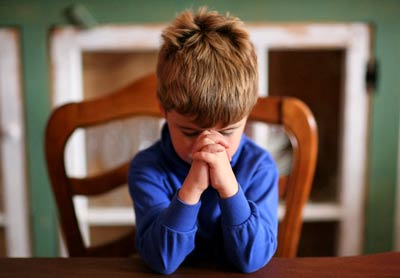
Our routine is the books, and then singing one of several lullabies my mother and father sang to me. And we say a prayer, the Lord’s Prayer or the Twenty-Third Psalm. He watches my mouth and my face intently. We say it every night until one night I realize he is saying it ahead of me. Another night when bedtime came after a scuffle he glowers at me and says: “You don’t say it! I say it!”
I decide guidance in delivery is trumped by content. He calls the Lord’s Prayer “The Jesus prayer,” and Psalm 23 “The Lord is my shepherd,” and he almost always prefers it, even at dinnertime. As far as writing goes, it trumps the Lord’s Prayer: Sam likes stories, and the Psalm has concrete details like pastures and water and valleys and tables, not only kingdoms and wills and trespasses.
On occasion anointing heads with oil and cups overflowing is left out. I can understand. In our kitchen we encourage oil and milk to stay in their bottles and cups.
Pronunciation during these recitations is dicey. I don’t suffer any delusion that there is great depth of understanding. Growing up in mountain territory, I’m not sure my son knows what a pasture is yet, and I pray the meaning of evil and the shadow of death will evade him for a long time to come.
I imagine he has achieved the level of understanding of the “donzerly light” I belted out in the national anthem until learning the actual words at the not-particularly-precocious age of ten.
But he is committing these words—or sounds, at least— and rhythms to memory. He is learning them by heart.
It is popular in the spiritual-but-not-religious city of Seattle to say that parents want their child to make their own choices about faith when they are old enough to decide. But in Kaddish by Leon Wieseltier, he quotes an unnamed rabbi as saying that in order for an adult to have the ability to choose her own faith journey, she must have been brought up in some faith as a child. She must have had the idea of faith presented, the practices of faith learned, wisdom passed down from one generation to the next.
Cheryl Strayed, author of the recent Wild, expressed disappointment in an interview that her mother had not shared her faith with her. Then her mother died and Strayed didn’t know how to find her way. Another woman’s parents were killed in an accident while she was in her teens. Her parents had intentionally not brought her up in any faith tradition, since one was Christian and one Jewish. She, too, was angry. She didn’t have any prayers she knew to pray. She didn’t know the Lord’s Prayer.
I am painfully aware of more failures than successes as a parent. I know my children need more than my husband and I can provide. And whether they come to that realization by our deaths, or in adolescence, or both, the least I can do in all of my inadequacy as a parent is to ensure they have spirits stretched and trained to grace, so that they might lean into that beauty when they most need it.
I’ve knelt by a grave on a windswept tundra hill and prayed the Lord’s Prayer and the Twenty-Third Psalm because I didn’t know what else to pray. I’ve been thankful for words I can work to understand, even when the meaning might lie in the space between words. I’ve been grateful for the stuff of mercy to turn over in my head, for something my soul can rest in and hold on to and take apart over and over again until it makes sense or starts to be beautiful.
This is what I want for our children: the sounds and rhythms and words of prayer to wrestle with and explore when the world falls apart.
“I want to say prayer!” says our toddler. His soft small hands are holding my husband’s and mine before dinner. My husband is mere seconds away from bowing his head to give thanks. The table is laid with a simple dinner I’ve made to build our son’s body and brain. We sit together to build his heart. We pray to build his soul.
At some point life is going to break him at a hard place, more than once, and I want him to have what he needs to heal. I want him to find marrow in his bones.
“The Lord is my shepherd,” my son begins…
“Thy rod and thy staff they comfort me.”
I keep my eyes closed above a half-repressed smile, sparked by amusement, but sustained by deep gratitude.
Previous Post

May 7, 2013
Emerging from the Tomb Intact
Next Post
May 9, 2013 A Theology of Singleness, Part 1
Browse Our Archives
Select a Category A. G. Harmon Alissa Wilkinson Allison Backous Art Authors Brad Fruhauff Bradford Winters Bryan Bliss Caroline Langston Chad Thomas Johnston Chris Hoke Christiana N. Peterson Culture D.G. Myers D.L. Mayfield Daniel Bowman Jr. David Griffith Elizabeth Duffy Faith Film Greg Wolfe Guest Contributor Interview Jan Vallone Jeffrey Overstreet Jessica Eddings-Roeser Jessica Mesman Griffith Kelly Foster Lindsey Crittenden Morgan Meis music Natalie Vestin Nick Olson Peggy Rosenthal Personal Reflection Poetry Friday Reflection Relationships Review Richard Chess Richard Cole Sara Zarr Shannon Huffman Polson Sonya Bilocerkowycz Tania Runyan Tony Woodlief Topical Categories Uncategorized Vic Sizemore Writing
Select a Month October 2018 September 2018 August 2018 July 2018 June 2018 May 2018 April 2018 March 2018 February 2018 January 2018 December 2017 November 2017 October 2017 September 2017 August 2017 July 2017 June 2017 May 2017 April 2017 March 2017 February 2017 January 2017 December 2016 November 2016 October 2016 September 2016 August 2016 July 2016 June 2016 May 2016 April 2016 March 2016 February 2016 January 2016 December 2015 November 2015 October 2015 September 2015 August 2015 July 2015 June 2015 May 2015 April 2015 March 2015 February 2015 January 2015 December 2014 November 2014 October 2014 September 2014 August 2014 July 2014 June 2014 May 2014 April 2014 March 2014 February 2014 January 2014 December 2013 November 2013 October 2013 September 2013 August 2013 July 2013 June 2013 May 2013 April 2013 March 2013 February 2013 January 2013 December 2012 November 2012 October 2012 September 2012 August 2012 July 2012 June 2012 May 2012 February 2008
Follow Us!
TAKE THE
Religious Wisdom Quiz
What were the names of Eli's two corrupt sons?
Select your answer to see how you score.
David and Nathan Jonathan and Saul Abinadab and Shammah Hophni and Phinehas
Related posts from Good Letters

Poetry Friday: "The Burned Butterfly"

Leonard Cohen’s Holy and Broken Hallelujah

Ready or Not for the Days of Awe

TRENDING AT PATHEOS Catholic

Rejecting Doom: Christian Hope And Human Action
Christianity is a religion of hope. We are to have hope and...

It’s What Comes From Within Which Matters
One of the most difficult things for us to understand is why...

Why I Choose the Eucharist Over the Sermon
Choose the Eucharist, Not the Sermon What are we supposed to get...

5 Design Elements Found in Spiritually Rooted Homes
Putting Spirituality Into Home Decor Our homes are more than our living...

Credo: A Story of God Told with the...
About 10 years ago, I began to imagine a personal "Credo" that...

The Anatomy of Divine Revelation in Catholic Thought
The claim that God has made Himself known to human beings is...
view all Catholic blogs
Ad-Free & Subscriber Log-In Subscription Support
- About Us
- 2026 Calendar
- Videos
- Podcasts
- Library of World Religions
- Faith In Media Tracker
- Advertise With Us
- Write for Us
- Privacy Policy
- Terms of Service
- Do Not Sell My Data
- Contact Us
- Radiant Digital
- Manage Newsletter Subscriptions
- Unsubscribe From Notifications
- Sitemap
Copyright 2008-2026, Patheos. All rights reserved.
Subscription Support Ad-Free & Subscriber Log-In
Follow Patheos