
BuddhistCatholicContemplativeEvangelicalGeneral ChristianHinduJewishLatter-day SaintMuslimNew VisionsProgressive Christian
Beliefs
- Buddhist
- Catholic
- Contemplative
- Evangelical
- General Christian
- Hindu
- Jewish
- Latter-day Saint
- More Voices
- Muslim
- New Visions
- Pagan
- Progressive Christian
Topics
- Religion News
- Food and Religion
- Sports and Religion
- Religious Art
- Religious Music and Entertainment
- Religious Events
- History and Religion
- Style and Religion
- Politics and Religion
- Women in Religion
- Recreation Outdoors and Religion
- Business Finance and Religion
- Careers Workplace and Religion
- Education and Religion
- Family Parenting and Religion
- Health Fitness and Religion
- Home and Religion
- Relationships and Religion
- Technology and Religion
- Travel and Religion
Columnists
- Buddhist Columnists
- Business Finance and Religion Columnists
- Careers Workplace and Religion Columnists
- Catholic Columnists
- Contemplative Columnists
- Education and Religion Columnists
- Evangelists Columnists
- Family Parenting and Religion Columnists
- General Christian Columnists
- Health Fitness and Religion Columnists
- Hindu Columnists
- History and Religion Columnists
- Home and Religion Columnists
- Jewish Columnists
- More Voices Columnists
- Latter Day Columnists
- Muslim Columnists
- New Visions Columnists
- Nonreligious Columnists
- Pagan Columnists
- Politics and Religion Columnists
- Progressive Columnists
- Recreation Outdoors and Religion Columnists
- Relationships and Religion Columnists
- Religion News Columnists
- Religious Art Columnists
- Religious Events Columnists
- Religious Music and Entertainment Columnists
- Sports and Religion Columnists
- Style and Religion Columnists
- Technology and Religion Columnists
- Travel and Religion Columnists
- Women in Religion Columnists
Resource Library
- 2026 Calendar
- Library of World Religions
- The 100 Most Holy Places on Earth
- Patheos Answers
- Podcasts
- Videos
- Faith Leaders Database
- Anglican Episcopalian
- Bahai
- Baptist
- Buddhism
- Christianity
- Confucianism
- Eastern Orthodoxy
- Hinduism
- Holiness and Pentecostal
- ISKCON
- Islam
- Judaism
- Lutheran
- Methodist
- The Church of Jesus Christ of Latter-day Saints
- New Age
- Paganism
- Presbytarian and Reformed
- Protestantism
- Religion Behind the Scenes
- Roman Catholic
- Scientology
- Shia Islam
- Sikhism
- Sufism
- Sunni Islam
- Taoism
- Zen
- See all religions
Research Tools
 Ad-Free & Subscriber Log-In Subscription Support
Ad-Free & Subscriber Log-In Subscription Support
Follow Patheos 

- Trending:
- Forgiveness
- |
- Marriage
- |
- Consciousness
- |
- Death Penalty
- |
- Election
- |
- Halloween
 Good Letters
-
Contributors
- Home
- Catholic
- This Old House
This Old House
Last updated on: March 18, 2013 at 10:19 am by A. G. Harmon
This Old House 2013-03-18T10:19:22-07:00 A. G. Harmon
Patheos Explore the world's faith through different perspectives on religion and spirituality! Patheos has the views of the prevalent religions and spiritualities of the world.
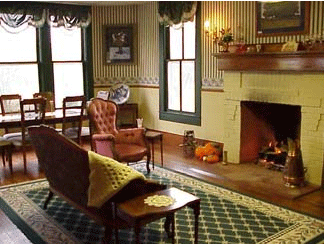 I was raised in a house full of old furniture: old desks, old mirrors, old rugs. There are old paintings on the walls and old linens in the drawers. The silver is old, the lamps are old, and at this point, even most of the photographs are old. After all, who prints such things out these days?
Most of the time the images we take stay locked within the device upon which they’re captured. And there they remain, always new, even as the reality that they memorialize grows further and further into eclipse.
Most of the trappings I speak of are legacies from people much older than I, and in turn those people most likely received them from those who were much older than they. It seems that whenever one of my forbears died, the contents of his house were incorporated into a house belonging to the living, folded in and blended through, the everyday effects and commonplace uses of one set of lives engulfed and assimilated—salt and sugar caught up by water, flour, and milk—ever richer, ever thicker, never done.
On and on it went, the generations past living cheek by jowl with the generations present. Open a drawer and you could easily find a wallet from 1957 sitting alongside fingernail clippers, fresh from Walgreens—earrings from a woman dead a hundred years tangled up with an extra set of the new Ford truck keys—or a parasol handle resting next to a packet of Doublemint gum. Portieres as well as pen knives, oyster plates as much as cuff links, the coin of the nineteenth century was kept deep within the purse of the twentieth.
But legacies were not the only old things that met in that confluence—that delta—rich with loam and teeming with stories. Other, foreign antiquities were added with regularity.
“Character,” it was always said, “cannot come with a chemical smell.” Rather, it has the patina of old primary woods—cherry and maple and walnut—and old base metals—copper and brass and pewter.
To further this philosophy, estate sales were scoured for in newspapers, and antique stores were hunted down on roadsides—a cheval glass, a pie safe, a quilt in the pattern of a double wedding ring—these acquisitions would come under the roof, taking their place among the bloodline heritage. As such, the mélange grew even more varied, storied, and grained.
Faulkner might have said that “the past is not even past,” but hell, in that house, the past was damn certain to be the future—and now that I think back upon it, a very pleasant one. Things that have been settled into, the new broken off and the starch worn out, are just more pleasing to the human touch.
Newer things could be found there too, and they were mostly functional—appliances and fixtures, lighting and technologies, the odd recliner and the chance stereo cabinet—but on the whole the balance was long in the tooth.
I see now that there was a virtue to this, at least in the moral hierarchy of the modern day. For a predilection is set against a “disposable culture,” as ours is always scolded for being. Things were not thrown out casually; what had a pedigree stayed.
There was even some “repurposing” of old objects, though never in a way that called for a structural change. That is, a cabinet or trunk might be used in a way at odds with its original function, but nobody would dream of conducting surgery on the piece in order to make it fit a new role.
Roundly mourned were armoires gutted for televisions, farm tables cut down to coffee table height, and holes bored through perfectly good vases to electrify the vessel into a lamp. No, whatever something started out as was what it remained. You would not make it over into what it might, but should not, be.
With this background, it might come as no surprise that the Crate and Barrel/West Elm/Pottery Barn attitude towards furnishing—with its ethos of horizontality—with its smooth surfaces, shiny chrome, woven carpets, and leather ottomans that transform into bar stands—holds no great charm.
In fact, the clean lines much prized now—the sleek, uncluttered surfaces—leave me wondering where all the stuff is. A piece here and there couldn’t hurt, but I can’t cotton to a whole house full of stuff that seems to have a superior attitude to the people who would sit on it.
It’s a matter of what you’re accustomed to, I suppose; my bias just lies in another direction. Perhaps, through such long acclimation, what others would find stultifying—I’m often told these things are burdensome—I find largely natural. Br’er Rabbit in the Briar Patch.
But at root, I think this proclivity can be summed up by what a Trappist monk said once while I was on retreat.
In the graveyard, the brothers tended stones so ancient that the names had long been worn away. Some of the slabs were as blank as slates; no one could tell who lay beneath them. When asked why, the monk said that these men—many never known by the living—were still among us, and that their names must be kept and accounted for, even if they could not be read.
It’s a mystery that the inanimate objects we carry through the world outlast us by so long, but it’s also a mystery that they retain a caché of sanctity because of those they belonged to.
And if it’s instinctive, atavistic, to seek to touch first class relics—because we suspect life still lingers in those old bones –it’s reasonable to surround ourselves with the second class relics upon which those old bones retired. Crowded, I suppose, but familiar.
I think I’m going to need a bigger house.
Previous Post

March 15, 2013
Rodeo and the Church Calendar
Next Post
March 18, 2013 Auden’s Love of Neighbor
Browse Our Archives
Select a Category A. G. Harmon Alissa Wilkinson Allison Backous Art Authors Brad Fruhauff Bradford Winters Bryan Bliss Caroline Langston Chad Thomas Johnston Chris Hoke Christiana N. Peterson Culture D.G. Myers D.L. Mayfield Daniel Bowman Jr. David Griffith Elizabeth Duffy Faith Film Greg Wolfe Guest Contributor Interview Jan Vallone Jeffrey Overstreet Jessica Eddings-Roeser Jessica Mesman Griffith Kelly Foster Lindsey Crittenden Morgan Meis music Natalie Vestin Nick Olson Peggy Rosenthal Personal Reflection Poetry Friday Reflection Relationships Review Richard Chess Richard Cole Sara Zarr Shannon Huffman Polson Sonya Bilocerkowycz Tania Runyan Tony Woodlief Topical Categories Uncategorized Vic Sizemore Writing
Select a Month October 2018 September 2018 August 2018 July 2018 June 2018 May 2018 April 2018 March 2018 February 2018 January 2018 December 2017 November 2017 October 2017 September 2017 August 2017 July 2017 June 2017 May 2017 April 2017 March 2017 February 2017 January 2017 December 2016 November 2016 October 2016 September 2016 August 2016 July 2016 June 2016 May 2016 April 2016 March 2016 February 2016 January 2016 December 2015 November 2015 October 2015 September 2015 August 2015 July 2015 June 2015 May 2015 April 2015 March 2015 February 2015 January 2015 December 2014 November 2014 October 2014 September 2014 August 2014 July 2014 June 2014 May 2014 April 2014 March 2014 February 2014 January 2014 December 2013 November 2013 October 2013 September 2013 August 2013 July 2013 June 2013 May 2013 April 2013 March 2013 February 2013 January 2013 December 2012 November 2012 October 2012 September 2012 August 2012 July 2012 June 2012 May 2012 February 2008
Follow Us!
TAKE THE
Religious Wisdom Quiz
What does "Nain" mean in Hebrew?
Select your answer to see how you score.
Holy place City of refuge Land of God Pleasant
Related posts from Good Letters

The Crown and Victoria: Tales of Two Queens
TRENDING AT PATHEOS Catholic

Rejecting Doom: Christian Hope And Human Action
Christianity is a religion of hope. We are to have hope and...

It’s What Comes From Within Which Matters
One of the most difficult things for us to understand is why...

Why I Choose the Eucharist Over the Sermon
Choose the Eucharist, Not the Sermon What are we supposed to get...

5 Design Elements Found in Spiritually Rooted Homes
Putting Spirituality Into Home Decor Our homes are more than our living...

Credo: A Story of God Told with the...
About 10 years ago, I began to imagine a personal "Credo" that...

The Anatomy of Divine Revelation in Catholic Thought
The claim that God has made Himself known to human beings is...
view all Catholic blogs
Ad-Free & Subscriber Log-In Subscription Support
- About Us
- 2026 Calendar
- Videos
- Podcasts
- Library of World Religions
- Faith In Media Tracker
- Advertise With Us
- Write for Us
- Privacy Policy
- Terms of Service
- Do Not Sell My Data
- Contact Us
- Radiant Digital
- Manage Newsletter Subscriptions
- Unsubscribe From Notifications
- Sitemap
Copyright 2008-2026, Patheos. All rights reserved.
Subscription Support Ad-Free & Subscriber Log-In
Follow Patheos