
BuddhistCatholicContemplativeEvangelicalGeneral ChristianHinduJewishLatter-day SaintMuslimNew VisionsProgressive Christian
Beliefs
- Buddhist
- Catholic
- Contemplative
- Evangelical
- General Christian
- Hindu
- Jewish
- Latter-day Saint
- More Voices
- Muslim
- New Visions
- Pagan
- Progressive Christian
Topics
- Religion News
- Food and Religion
- Sports and Religion
- Religious Art
- Religious Music and Entertainment
- Religious Events
- History and Religion
- Style and Religion
- Politics and Religion
- Women in Religion
- Recreation Outdoors and Religion
- Business Finance and Religion
- Careers Workplace and Religion
- Education and Religion
- Family Parenting and Religion
- Health Fitness and Religion
- Home and Religion
- Relationships and Religion
- Technology and Religion
- Travel and Religion
Columnists
- Buddhist Columnists
- Business Finance and Religion Columnists
- Careers Workplace and Religion Columnists
- Catholic Columnists
- Contemplative Columnists
- Education and Religion Columnists
- Evangelists Columnists
- Family Parenting and Religion Columnists
- General Christian Columnists
- Health Fitness and Religion Columnists
- Hindu Columnists
- History and Religion Columnists
- Home and Religion Columnists
- Jewish Columnists
- More Voices Columnists
- Latter Day Columnists
- Muslim Columnists
- New Visions Columnists
- Nonreligious Columnists
- Pagan Columnists
- Politics and Religion Columnists
- Progressive Columnists
- Recreation Outdoors and Religion Columnists
- Relationships and Religion Columnists
- Religion News Columnists
- Religious Art Columnists
- Religious Events Columnists
- Religious Music and Entertainment Columnists
- Sports and Religion Columnists
- Style and Religion Columnists
- Technology and Religion Columnists
- Travel and Religion Columnists
- Women in Religion Columnists
Resource Library
- 2026 Calendar
- Library of World Religions
- The 100 Most Holy Places on Earth
- Patheos Answers
- Podcasts
- Videos
- Faith Leaders Database
- Anglican Episcopalian
- Bahai
- Baptist
- Buddhism
- Christianity
- Confucianism
- Eastern Orthodoxy
- Hinduism
- Holiness and Pentecostal
- ISKCON
- Islam
- Judaism
- Lutheran
- Methodist
- The Church of Jesus Christ of Latter-day Saints
- New Age
- Paganism
- Presbytarian and Reformed
- Protestantism
- Religion Behind the Scenes
- Roman Catholic
- Scientology
- Shia Islam
- Sikhism
- Sufism
- Sunni Islam
- Taoism
- Zen
- See all religions
Research Tools
 Ad-Free & Subscriber Log-In Subscription Support
Ad-Free & Subscriber Log-In Subscription Support
Follow Patheos 

- Trending:
- Forgiveness
- |
- Marriage
- |
- Consciousness
- |
- Death Penalty
- |
- Election
- |
- Halloween
 Good Letters
-
Contributors
- Home
- Catholic
- The Poverty of Language
The Poverty of Language
Last updated on: February 26, 2013 at 11:29 pm by Richard Chess
The Poverty of Language 2013-02-26T23:29:29-07:00 Richard Chess
Patheos Explore the world's faith through different perspectives on religion and spirituality! Patheos has the views of the prevalent religions and spiritualities of the world.
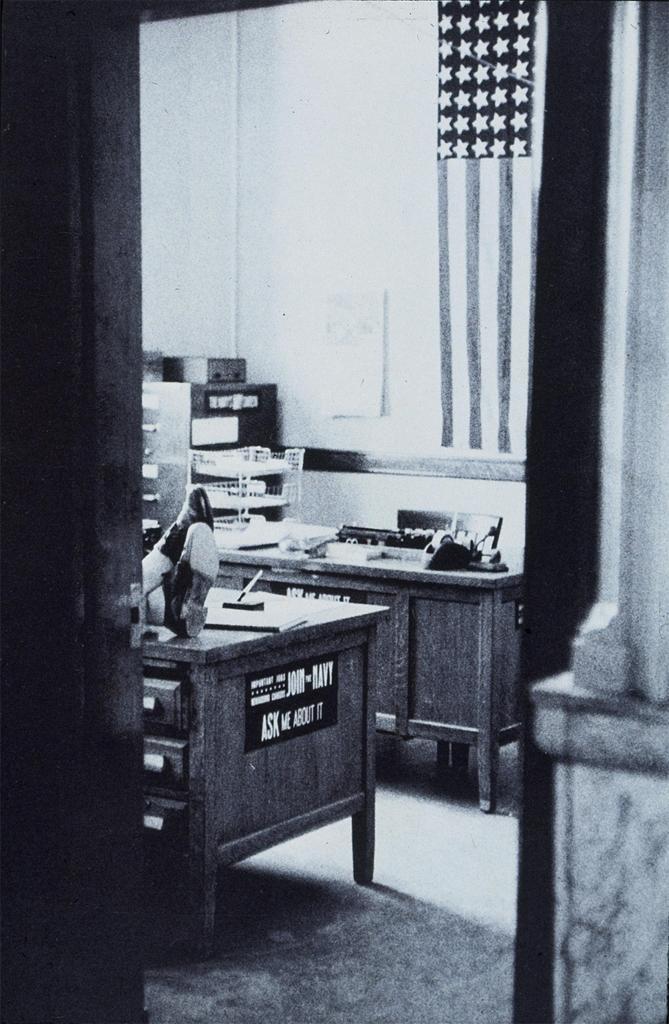 Another exercise. This one an exercise in seeing deeply, visualization, sketching from memory, and composing a written sketch of a photograph held in memory.
The photograph: Robert Frank’s “Navy Recruiting Station, Post Office, Butte, Montana,” published in his groundbreaking book The Americans.
Here’s what I asked students in my “Contemplation and Imagination” class to do:
1. Look at the photo projected on the screen.
2. Close your eyes and visualize, in as much detail as you can, the photo.
3. Look at the photo again. See if you notice anything new.
4. Close your eyes, paying attention to physical sensation.
5. Sketch the photo. (The projector is turned off.)
6. Look at the photo again.
7. Compose a written sketch of the image. (The projector is turned off.)
After this, I invited the students to talk about their experiences of the exercise. One soft-spoken student said, “the word wood to describe the desk—it misses so much.”
Yes, I thought, it’s inadequate, reductive. Lost is the grain. Lost are the shades of lighter and darker wood. It’s why translating sensory experience into language that retains at least some of the texture, complexity, and nuance of physical sensation is so hard.
On my drive home from class that night, I thought: language, whatever else it says, it always says, I sing of loss, I mourn.
I am what is missing.
For the first time in many years (twenty? thirty?), I think of Mark Strand’s poem “Keeping Things Whole.” It begins:
In a field
I am the absence
of field.
This is
always the case.
Wherever I am
I am what is missing.
When she wrote “wooden desk,” did my student think oh, my, there’s so much missing?
“The higher goal of spiritual living is not to amass a wealth of information, but to face sacred moments,” writes Rabbi Abraham Joshua Heschel in The Sabbath.
Maybe she, my student, experienced the disappointment, the despair that comes from losing “a wealth of information” as she tried to preserve in words what she had seen.
“Little we see in Nature that is ours,” writes Wordsworth.
Still, we see. When we are astonished by what we see, when we are shaken, uplifted, wounded, comforted by what we see, the astonishment, the anguish, the joy, the relief we experience is ours. We experience it deeply as ours.
Then we try to tell it, but the words are inadequate. They fail to convey to others what is, alas, unbearably ours and ours alone.
But this is not what troubles Wordsworth in “The World Is Too Much With Us.”
“We have given our hearts away,” he writes, to “getting and spending,” manufacturing and consuming. (As then, 1806, now?)
Where might we turn to have our hearts returned to us? Nature.
This Sea that bares her bosom to the moon;
The winds that will be howling at all hours,
And are up-gathered now like sleeping flowers
Wordsworth gives us nature—intimate, vulnerable, vital—only to show how it has withdrawn from us or, as he writes in the next two lines, how we have become alienated from it.
For this, for everything, we are out of tune;
It moves us not.
Numb and suffering the acute pain of the loss of his tuneful bond with nature, Wordsworth cries out sharply,
Great God! I’d rather be
A Pagan suckled in a creed outworn;
So might I, standing on this pleasant lea,
Have glimpses that would make me less forlorn
Exposed, raw, and at once vulnerable and strong, Wordsworth is nowhere more present in this poem than here: “Great God! I’d rather be / A Pagan suckled in a creed outworn.”
But he isn’t a pagan, and his anguish is addressed to God.
And he doesn’t turn from the lea, the very spot from which he sees and hears the sea and suffers the absence of feeling, the loss of what he once felt in nature.
Sonic patterning: that’s one way a poet tries to make up for the poverty of language, its inherent inability to express the fullness of sensory experience. Just listen to the repeated and modulated sounds running through the few passages of Wordsworth I quoted above. (Go ahead, scroll back up, and read those passages aloud.) Say and feel in your mouth the fullness of this line alone: “A Pagan suckled in a creed outworn.”
Metaphor, or, more broadly, comparisons: that’s another way. Kenneth Koch, in Making Your Own Days: The Pleasures of Reading and Writing Poetry, says this about “comparisons”:
A comparison not only compares things but brings in more of the world. Explanatory sentences tend to restrict and even to reduce the amount of reality in what is being said; poetry, with its comparisons, expands it.
Thus, that seductive sea, that lustful, raging wind “up-gathered now like sleeping flowers.” How impoverished would the poem be if the sea were merely moonlit, the wind merely blowing all night, and both seemed distant and small and made little impression on the man on the lea.
I’m not a good writer. I don’t like writing. That’s what she could have thought, my student, when she looked up at Frank’s photograph and down at her written description of it.
I don’t know if she thought that. I know only this: she experienced loss in the classroom that night, and she was courageous enough to share her experience with the rest of us.
Those other thoughts—I’m not a good writer; I don’t like writing—arise immediately after experiencing loss, to “protect” us from repeating the mistake that made us feel bad in the first place: writing.
The rest of Strand’s poem:
When I walk
I part the air
and always
the air moves in
to fill the spaces
where my body’s been.
We all have reasons
for moving.
I move
to keep things whole.
“There is nothing as whole as a broken heart,” says the Kotsker Rabbi.
Writing: it breaks your heart to make it whole.
Previous Post

February 26, 2013
We Are All Immigrants
Next Post
February 28, 2013 The Way of a Pilgrim
Browse Our Archives
Select a Category A. G. Harmon Alissa Wilkinson Allison Backous Art Authors Brad Fruhauff Bradford Winters Bryan Bliss Caroline Langston Chad Thomas Johnston Chris Hoke Christiana N. Peterson Culture D.G. Myers D.L. Mayfield Daniel Bowman Jr. David Griffith Elizabeth Duffy Faith Film Greg Wolfe Guest Contributor Interview Jan Vallone Jeffrey Overstreet Jessica Eddings-Roeser Jessica Mesman Griffith Kelly Foster Lindsey Crittenden Morgan Meis music Natalie Vestin Nick Olson Peggy Rosenthal Personal Reflection Poetry Friday Reflection Relationships Review Richard Chess Richard Cole Sara Zarr Shannon Huffman Polson Sonya Bilocerkowycz Tania Runyan Tony Woodlief Topical Categories Uncategorized Vic Sizemore Writing
Select a Month October 2018 September 2018 August 2018 July 2018 June 2018 May 2018 April 2018 March 2018 February 2018 January 2018 December 2017 November 2017 October 2017 September 2017 August 2017 July 2017 June 2017 May 2017 April 2017 March 2017 February 2017 January 2017 December 2016 November 2016 October 2016 September 2016 August 2016 July 2016 June 2016 May 2016 April 2016 March 2016 February 2016 January 2016 December 2015 November 2015 October 2015 September 2015 August 2015 July 2015 June 2015 May 2015 April 2015 March 2015 February 2015 January 2015 December 2014 November 2014 October 2014 September 2014 August 2014 July 2014 June 2014 May 2014 April 2014 March 2014 February 2014 January 2014 December 2013 November 2013 October 2013 September 2013 August 2013 July 2013 June 2013 May 2013 April 2013 March 2013 February 2013 January 2013 December 2012 November 2012 October 2012 September 2012 August 2012 July 2012 June 2012 May 2012 February 2008
Follow Us!
TAKE THE
Religious Wisdom Quiz
What empire conquered Babylon?
Select your answer to see how you score.
Greek Empire Assyrian Empire Persian Empire Roman Empire
Related posts from Good Letters


On Writing Odes: Taking Time to Celebrate

Poetry Friday: "The Burned Butterfly"

A Conversation with Alicia Ostriker: Part 1
TRENDING AT PATHEOS Catholic

Rejecting Doom: Christian Hope And Human Action
Christianity is a religion of hope. We are to have hope and...

It’s What Comes From Within Which Matters
One of the most difficult things for us to understand is why...

Why I Choose the Eucharist Over the Sermon
Choose the Eucharist, Not the Sermon What are we supposed to get...

5 Design Elements Found in Spiritually Rooted Homes
Putting Spirituality Into Home Decor Our homes are more than our living...

Credo: A Story of God Told with the...
About 10 years ago, I began to imagine a personal "Credo" that...

The Anatomy of Divine Revelation in Catholic Thought
The claim that God has made Himself known to human beings is...
view all Catholic blogs
Ad-Free & Subscriber Log-In Subscription Support
- About Us
- 2026 Calendar
- Videos
- Podcasts
- Library of World Religions
- Faith In Media Tracker
- Advertise With Us
- Write for Us
- Privacy Policy
- Terms of Service
- Do Not Sell My Data
- Contact Us
- Radiant Digital
- Manage Newsletter Subscriptions
- Unsubscribe From Notifications
- Sitemap
Copyright 2008-2026, Patheos. All rights reserved.
Subscription Support Ad-Free & Subscriber Log-In
Follow Patheos