
BuddhistCatholicContemplativeEvangelicalGeneral ChristianHinduJewishLatter-day SaintMuslimNew VisionsProgressive Christian
Beliefs
- Buddhist
- Catholic
- Contemplative
- Evangelical
- General Christian
- Hindu
- Jewish
- Latter-day Saint
- More Voices
- Muslim
- New Visions
- Pagan
- Progressive Christian
Topics
- Religion News
- Food and Religion
- Sports and Religion
- Religious Art
- Religious Music and Entertainment
- Religious Events
- History and Religion
- Style and Religion
- Politics and Religion
- Women in Religion
- Recreation Outdoors and Religion
- Business Finance and Religion
- Careers Workplace and Religion
- Education and Religion
- Family Parenting and Religion
- Health Fitness and Religion
- Home and Religion
- Relationships and Religion
- Technology and Religion
- Travel and Religion
Columnists
- Buddhist Columnists
- Business Finance and Religion Columnists
- Careers Workplace and Religion Columnists
- Catholic Columnists
- Contemplative Columnists
- Education and Religion Columnists
- Evangelists Columnists
- Family Parenting and Religion Columnists
- General Christian Columnists
- Health Fitness and Religion Columnists
- Hindu Columnists
- History and Religion Columnists
- Home and Religion Columnists
- Jewish Columnists
- More Voices Columnists
- Latter Day Columnists
- Muslim Columnists
- New Visions Columnists
- Nonreligious Columnists
- Pagan Columnists
- Politics and Religion Columnists
- Progressive Columnists
- Recreation Outdoors and Religion Columnists
- Relationships and Religion Columnists
- Religion News Columnists
- Religious Art Columnists
- Religious Events Columnists
- Religious Music and Entertainment Columnists
- Sports and Religion Columnists
- Style and Religion Columnists
- Technology and Religion Columnists
- Travel and Religion Columnists
- Women in Religion Columnists
Resource Library
- 2026 Calendar
- Library of World Religions
- The 100 Most Holy Places on Earth
- Patheos Answers
- Podcasts
- Videos
- Faith Leaders Database
- Anglican Episcopalian
- Bahai
- Baptist
- Buddhism
- Christianity
- Confucianism
- Eastern Orthodoxy
- Hinduism
- Holiness and Pentecostal
- ISKCON
- Islam
- Judaism
- Lutheran
- Methodist
- The Church of Jesus Christ of Latter-day Saints
- New Age
- Paganism
- Presbytarian and Reformed
- Protestantism
- Religion Behind the Scenes
- Roman Catholic
- Scientology
- Shia Islam
- Sikhism
- Sufism
- Sunni Islam
- Taoism
- Zen
- See all religions
Research Tools
 Ad-Free & Subscriber Log-In Subscription Support
Ad-Free & Subscriber Log-In Subscription Support
Follow Patheos 

- Trending:
- Forgiveness
- |
- Marriage
- |
- Consciousness
- |
- Death Penalty
- |
- Election
- |
- Halloween
 Good Letters
-
Contributors
- Home
- Catholic
- Looking at the Real
Looking at the Real
Last updated on: February 19, 2013 at 11:59 am by Guest Contributor
Looking at the Real 2013-02-19T11:59:15-07:00 Guest Contributor
Patheos Explore the world's faith through different perspectives on religion and spirituality! Patheos has the views of the prevalent religions and spiritualities of the world.
A Guest Post by Brian Volck
Monks, I’ve found, having spent some time with them over the years, make good company—rewarding enough, in fact, to spend my birthday with some of them on one of my visits last year.
It was the ideal holiday for an introvert, but I came for more than silence and solitude. I wanted a stiff dose of contemplative prayer—straight, no chaser—what the late Walter Burghardt called “a long, loving look at the real.”
The gift of contemplation is precisely that—a gift, neither earned nor grasped—but there are habits, cultivated over time, to better receive that gift, to keep the self from forever stepping in the way like an attention-starved child, to still the mind’s nervous tic of racing in every direction but deeper.
There are also quiet places and good company in which to sharpen those habits. I’ve prayed—which is not the same as reciting prayers—on my bedroom floor, on a rock shelf in the Grand Canyon, and in the cramped seat of a commercial airliner, as well as in churches, monasteries, and shrines.
A failure to pray rarely results from want of time or space; most often it’s simple lack of resolve. Yet, if the artist who wishes his meager talent to flourish chooses to learn from masters, and if the athlete in training seeks out the best in her sport, then the beginning contemplative should exercise with the athletes and artists of prayer.
Perhaps everyone who prays is a beginner, forever learning to stand at the crossroads of humility and eager longing, but even from the prospect of eternity, there are some who speak or write with more experience and greater authority. Attention to their example and wisdom is rarely wasted.
What I particularly like about Burghardt’s phrase is its confidence that patience and affection help the seeker apprehend reality. Perhaps there’s a quick and emotionally disengaged way to approach the real, by whatever means, but I doubt it.
Visionary scientists rhapsodize about the objects of their lengthy studies, and true contemplatives are living monuments of concentrated effort, assiduously paring away a lifetime’s illusions. There are, to be sure, phony contemplatives (just as there are fraudulent scientists) but few of them last long.
Monks who stay, however, often turn peculiar. Some can be downright cranky. Then again, I have no idea what they were like before or where they’re being led. When I’ve asked monks why they chose their vocation, they typically speak of great need and profound longing.
Not one has told me they came because they felt special, unusually gifted, or particularly holy.
What I suppose I like most about monks—the good ones—is their refreshing honesty. They know themselves to be deeply flawed and in desperate need of help, which is why they seek God and the company of others in the same straits.
If contemplative monks are like anyone else, they’re most like recovering alcoholics who seriously work the twelve steps. Contemporary spiritual writers such as Thomas Keating and Richard Rohr have drawn this comparison before. If you love someone in the long, slow process of recovery from addiction, or if you’re there yourself, you may know what they mean.
The monk and the recovering alcoholic know their powerlessness and accept that their problems are humanly insolvable. Sick and tired of the labyrinthine depths of their self-deception, they surrender to a greater authority—a decision not made once but again and again, growing less difficult in time only through long practice, many failures, and with much support.
With encouragement and wise counsel, they conduct an ongoing and fearless moral inventory, adopt new behaviors, make thoughtful reparations, and accept a lifetime of prayer and meditation in search of God’s will and the grace to carry it out.
In acknowledging their brokenness, the monk and the recovering addict make their slow pilgrimage to serenity, even joy. They find neither, however, without humility, which has nothing in common with the obsequiousness of David Copperfield’s Uriah Heep, and everything to do with honest self-regard.
True humility is the fruit of turning that long, loving look at the real toward oneself: a way of tears that ends in a wistful smile.
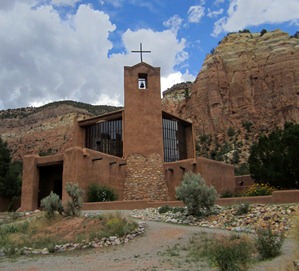
On my birthday retreat at the Monastery of Christ in the Desert, not far from Georgia O’Keefe’s home at Ghost Ranch, I reveled in a desert silence punctuated with liturgies rich with the lush, melismatic chant of Benedictines who know how to sing and to smile.
Knowing they have nothing to offer God other than heartfelt thanks and praise, the monks carefully attend to their singing. It’s a joy to hear and, when appropriate, to join.
One morning, as I stood in the first row of retreatants, Abbot Philip hit a rare sour note on the small keyboard used to announce the melody about to be chanted. If I had done the same in front of so many listeners, I’d have been mortified and likely would have devoted the rest of the liturgy to mental self-flagellation. Instead, Abbot Philip, seeing me looking at him, cocked his head to the side, and with a sheepish grin raised his hands to the side as if to say, “Oh, well. Wasn’t that a funny sound?”
Then, still smiling, he returned to the work of praising the Maker of the Universe, the work to which he has given his life. And in that place and moment, he and his fellow monks looked serene, joyful, and very much at home.
That’s why I seek the company of monks: their lives call me not so much to be a better person but to become—at long last and after many false starts—myself.
Brian Volck is a pediatrician and writer living in Cincinnati. He graduated from the Seattle Pacific MFA program in Creative Writing in 2007. He is currently writing a memoir and a book about the intersection of health, history, and culture in the Navajo.
Previous Post

February 18, 2013
A Matched Pair of Restraining Orders
Next Post
February 20, 2013 Bible Thumping
Browse Our Archives
Select a Category A. G. Harmon Alissa Wilkinson Allison Backous Art Authors Brad Fruhauff Bradford Winters Bryan Bliss Caroline Langston Chad Thomas Johnston Chris Hoke Christiana N. Peterson Culture D.G. Myers D.L. Mayfield Daniel Bowman Jr. David Griffith Elizabeth Duffy Faith Film Greg Wolfe Guest Contributor Interview Jan Vallone Jeffrey Overstreet Jessica Eddings-Roeser Jessica Mesman Griffith Kelly Foster Lindsey Crittenden Morgan Meis music Natalie Vestin Nick Olson Peggy Rosenthal Personal Reflection Poetry Friday Reflection Relationships Review Richard Chess Richard Cole Sara Zarr Shannon Huffman Polson Sonya Bilocerkowycz Tania Runyan Tony Woodlief Topical Categories Uncategorized Vic Sizemore Writing
Select a Month October 2018 September 2018 August 2018 July 2018 June 2018 May 2018 April 2018 March 2018 February 2018 January 2018 December 2017 November 2017 October 2017 September 2017 August 2017 July 2017 June 2017 May 2017 April 2017 March 2017 February 2017 January 2017 December 2016 November 2016 October 2016 September 2016 August 2016 July 2016 June 2016 May 2016 April 2016 March 2016 February 2016 January 2016 December 2015 November 2015 October 2015 September 2015 August 2015 July 2015 June 2015 May 2015 April 2015 March 2015 February 2015 January 2015 December 2014 November 2014 October 2014 September 2014 August 2014 July 2014 June 2014 May 2014 April 2014 March 2014 February 2014 January 2014 December 2013 November 2013 October 2013 September 2013 August 2013 July 2013 June 2013 May 2013 April 2013 March 2013 February 2013 January 2013 December 2012 November 2012 October 2012 September 2012 August 2012 July 2012 June 2012 May 2012 February 2008
Follow Us!
TAKE THE
Religious Wisdom Quiz
I am a sea that parted to let my people cross on dry ground but drowned their enemies. What am I?
Select your answer to see how you score.
The Mediterranean Sea The Jordan River The Red Sea The Sea of Galilee
Related posts from Good Letters

Poetry Friday: "The Burned Butterfly"

Leonard Cohen’s Holy and Broken Hallelujah

Ready or Not for the Days of Awe

TRENDING AT PATHEOS Catholic

Rejecting Doom: Christian Hope And Human Action
Christianity is a religion of hope. We are to have hope and...

It’s What Comes From Within Which Matters
One of the most difficult things for us to understand is why...

Why I Choose the Eucharist Over the Sermon
Choose the Eucharist, Not the Sermon What are we supposed to get...

5 Design Elements Found in Spiritually Rooted Homes
Putting Spirituality Into Home Decor Our homes are more than our living...

Credo: A Story of God Told with the...
About 10 years ago, I began to imagine a personal "Credo" that...

The Anatomy of Divine Revelation in Catholic Thought
The claim that God has made Himself known to human beings is...
view all Catholic blogs
Ad-Free & Subscriber Log-In Subscription Support
- About Us
- 2026 Calendar
- Videos
- Podcasts
- Library of World Religions
- Faith In Media Tracker
- Advertise With Us
- Write for Us
- Privacy Policy
- Terms of Service
- Do Not Sell My Data
- Contact Us
- Radiant Digital
- Manage Newsletter Subscriptions
- Unsubscribe From Notifications
- Sitemap
Copyright 2008-2026, Patheos. All rights reserved.
Subscription Support Ad-Free & Subscriber Log-In
Follow Patheos