
BuddhistCatholicContemplativeEvangelicalGeneral ChristianHinduJewishLatter-day SaintMuslimNew VisionsProgressive Christian
Beliefs
- Buddhist
- Catholic
- Contemplative
- Evangelical
- General Christian
- Hindu
- Jewish
- Latter-day Saint
- More Voices
- Muslim
- New Visions
- Pagan
- Progressive Christian
Topics
- Religion News
- Food and Religion
- Sports and Religion
- Religious Art
- Religious Music and Entertainment
- Religious Events
- History and Religion
- Style and Religion
- Politics and Religion
- Women in Religion
- Recreation Outdoors and Religion
- Business Finance and Religion
- Careers Workplace and Religion
- Education and Religion
- Family Parenting and Religion
- Health Fitness and Religion
- Home and Religion
- Relationships and Religion
- Technology and Religion
- Travel and Religion
Columnists
- Buddhist Columnists
- Business Finance and Religion Columnists
- Careers Workplace and Religion Columnists
- Catholic Columnists
- Contemplative Columnists
- Education and Religion Columnists
- Evangelists Columnists
- Family Parenting and Religion Columnists
- General Christian Columnists
- Health Fitness and Religion Columnists
- Hindu Columnists
- History and Religion Columnists
- Home and Religion Columnists
- Jewish Columnists
- More Voices Columnists
- Latter Day Columnists
- Muslim Columnists
- New Visions Columnists
- Nonreligious Columnists
- Pagan Columnists
- Politics and Religion Columnists
- Progressive Columnists
- Recreation Outdoors and Religion Columnists
- Relationships and Religion Columnists
- Religion News Columnists
- Religious Art Columnists
- Religious Events Columnists
- Religious Music and Entertainment Columnists
- Sports and Religion Columnists
- Style and Religion Columnists
- Technology and Religion Columnists
- Travel and Religion Columnists
- Women in Religion Columnists
Resource Library
- 2026 Calendar
- Library of World Religions
- The 100 Most Holy Places on Earth
- Patheos Answers
- Podcasts
- Videos
- Faith Leaders Database
- Anglican Episcopalian
- Bahai
- Baptist
- Buddhism
- Christianity
- Confucianism
- Eastern Orthodoxy
- Hinduism
- Holiness and Pentecostal
- ISKCON
- Islam
- Judaism
- Lutheran
- Methodist
- The Church of Jesus Christ of Latter-day Saints
- New Age
- Paganism
- Presbytarian and Reformed
- Protestantism
- Religion Behind the Scenes
- Roman Catholic
- Scientology
- Shia Islam
- Sikhism
- Sufism
- Sunni Islam
- Taoism
- Zen
- See all religions
Research Tools
 Ad-Free & Subscriber Log-In Subscription Support
Ad-Free & Subscriber Log-In Subscription Support
Follow Patheos 

- Trending:
- Forgiveness
- |
- Marriage
- |
- Consciousness
- |
- Death Penalty
- |
- Election
- |
- Halloween
 Good Letters
-
Contributors
- Home
- Catholic
- Jesus Died for Somebody’s Sins (But Not Mine)
Jesus Died for Somebody’s Sins (But Not Mine)
Last updated on: February 11, 2013 at 4:36 pm by Chad Thomas Johnston
Jesus Died for Somebody’s Sins (But Not Mine) 2013-02-11T16:36:48-07:00 Chad Thomas Johnston
Patheos Explore the world's faith through different perspectives on religion and spirituality! Patheos has the views of the prevalent religions and spiritualities of the world.
 For Pastor Matt, who hopes to convert my skeptical ears to belief in bluegrass, and our new Associate Pastor Meredith, who has added intellectual hipster chic to our congregation with her PhD and her nose piercing alike. You two help make First Baptist Church in Lawrence, Kansas feel like home.
Patti Smith’s 1975 debut album, Horses, famously opens with the line, “Jesus died for somebody’s sins, but not mine.” Smith goes on to sing, “My sins my own, they belong to me, me.”
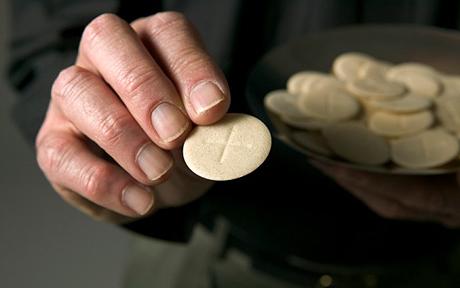
I think about this when I serve communion at church, as partaking of this sacrament is a way for believers to proclaim, “Jesus died for me—even me.” In my three years as communion coordinator, I have only seen a few people dismiss the bread or the cup. They wave their hands at the plate as if to say, “Sorry, this isn’t for me.”
Of course, that may not be what they mean at all. I cannot read minds. They may be allergic to wheat or grapes, for all I know. But if Patti Smith’s lyric speaks for them, I understand. Doubt, disbelief, and disillusionment with the church are rampant, and for many good reasons.
My wife Becki and I prepare the Lord’s Supper the first Sunday of every month at our church. Before the Lenten season in 2012, when I opened the cabinet that held the fingerprint-smudged brass plates we use to serve communion, the dullness of the duty threatened to drown out my devotion.
Sorry God, I thought, but this isn’t for me.
It seemed to me that a robot could do my job. Then I remembered: Robots do fill communion cups—well, sort of.
Anyone who has seen Steve Taylor’s filmic adaptation of Donald Miller’s Blue Like Jazz has seen the factory where pre-filled communion cups are mass produced to save schlubs like me from the monotony of filling infernally small cups with Welch’s finest. Churches can actually order these cups.
I wondered if my pastor knew about them—if my church could order them.
Even more than preparing the plates for the service, however, I dreaded enlisting people to help serve the sacrament. When I asked, they looked at me as if they would rather stand in front of a firing squad than pass the plates from pew to pew. To this day, I serve communion every month to avoid asking a sixth person to help to me distribute the body and blood.
As Lent approached in 2012, committees met to determine what worship would look like during the church’s observance of this liturgical tradition. Someone thought Becki and I should prepare and serve communion every week during the season of bright sadness instead of only once a month as we normally do. We would have protested, but as first-time parents to a four-month-old, I think we were too sleep deprived to offer much resistance.
By the time Lent arrived, I knew Becki needed rest more than I needed her to assist with communion. After seeing her place a box of Raisin Bran in the refrigerator and realizing she would probably put the milk in the cupboard if I failed to intervene, I figured she might accidentally sabotage the Lord’s Supper, too. I decided to handle Lenten communion alone.
I expected to merely endure this duty for six consecutive weeks. As I passed the plates each week, however, I began to take notice of the people who partook of the bread and the cup. I focused less on the tedium and more on the people who occupied the pews—their faces and hands humanizing an otherwise humdrum happening.
As I watched the people pass the plate, I thought of their names in my mind if I knew them. If I appreciated someone’s dedication or their sense of humor, I told God so.
“Jesus died for somebody’s sins,” Patti Smith sang. As I passed the plates, I realized that each person in the pew was a “somebody” in this sense. I realized I could endure and even enjoy communion because I was preparing it and serving it for people I loved—for people God loved, too.
People like Caleb—the son of our friends Jim and Melisa. With mischief in his eyes, he tears off a Herculean hunk of bread where others opt for crumbs.
People like Emily and Troy, whose son Matthew was diagnosed with adrenoleukodystrophy last year. Matthew takes Lorenzo’s Oil now, and draws pictures of the myriad monsters that inhabit “Matthewland” during the church service. He is the most creative child I know, and his church family loves him dearly.
People like JoAn, who became a widow a few years ago. When her husband Dick was on his deathbed, Becki and I visited them in the hospital. Dick set records in cross country at the University of Kansas in the early 1950s. When he lay at the threshold of eternity, his friends said, “You just run to Jesus, Dick. Run to Jesus.”
Jesus died for these wonderful somebodies. As Lent approaches in 2013, I plan to celebrate these somebodies again as Becki and I prepare and serve communion, even though we will not do so every Sunday.
A final thought: I have only seen a few people refrain from taking communion. Whatever their reasons for doing so, I always hear the voice of Patti Smith singing, “Jesus died for somebody’s sins, but not mine.”
But I have also seen children and members of the youth group creep into the kitchen after the service to eat the leftovers of the Lord’s Supper. I can only hope these gluttons of grace will overflow with God’s love, spilling it into the lives of those who would normally refuse it, and allowing them to taste and see that the Lord is good; allowing them to say, “Jesus died for somebody’s sins, and perhaps I am one of those beloved somebodies.”
Next Post

February 11, 2013 Top 25 Films on Marriage
Browse Our Archives
Select a Category A. G. Harmon Alissa Wilkinson Allison Backous Art Authors Brad Fruhauff Bradford Winters Bryan Bliss Caroline Langston Chad Thomas Johnston Chris Hoke Christiana N. Peterson Culture D.G. Myers D.L. Mayfield Daniel Bowman Jr. David Griffith Elizabeth Duffy Faith Film Greg Wolfe Guest Contributor Interview Jan Vallone Jeffrey Overstreet Jessica Eddings-Roeser Jessica Mesman Griffith Kelly Foster Lindsey Crittenden Morgan Meis music Natalie Vestin Nick Olson Peggy Rosenthal Personal Reflection Poetry Friday Reflection Relationships Review Richard Chess Richard Cole Sara Zarr Shannon Huffman Polson Sonya Bilocerkowycz Tania Runyan Tony Woodlief Topical Categories Uncategorized Vic Sizemore Writing
Select a Month October 2018 September 2018 August 2018 July 2018 June 2018 May 2018 April 2018 March 2018 February 2018 January 2018 December 2017 November 2017 October 2017 September 2017 August 2017 July 2017 June 2017 May 2017 April 2017 March 2017 February 2017 January 2017 December 2016 November 2016 October 2016 September 2016 August 2016 July 2016 June 2016 May 2016 April 2016 March 2016 February 2016 January 2016 December 2015 November 2015 October 2015 September 2015 August 2015 July 2015 June 2015 May 2015 April 2015 March 2015 February 2015 January 2015 December 2014 November 2014 October 2014 September 2014 August 2014 July 2014 June 2014 May 2014 April 2014 March 2014 February 2014 January 2014 December 2013 November 2013 October 2013 September 2013 August 2013 July 2013 June 2013 May 2013 April 2013 March 2013 February 2013 January 2013 December 2012 November 2012 October 2012 September 2012 August 2012 July 2012 June 2012 May 2012 February 2008
Follow Us!
TAKE THE
Religious Wisdom Quiz
Which New Testament book is written as a sermon?
Select your answer to see how you score.
Acts Galatians Hebrews James
Related posts from Good Letters

Leonard Cohen’s Holy and Broken Hallelujah

Ready or Not for the Days of Awe


TRENDING AT PATHEOS Catholic

Rejecting Doom: Christian Hope And Human Action
Christianity is a religion of hope. We are to have hope and...

It’s What Comes From Within Which Matters
One of the most difficult things for us to understand is why...

Why I Choose the Eucharist Over the Sermon
Choose the Eucharist, Not the Sermon What are we supposed to get...

5 Design Elements Found in Spiritually Rooted Homes
Putting Spirituality Into Home Decor Our homes are more than our living...

Credo: A Story of God Told with the...
About 10 years ago, I began to imagine a personal "Credo" that...

The Anatomy of Divine Revelation in Catholic Thought
The claim that God has made Himself known to human beings is...
view all Catholic blogs
Ad-Free & Subscriber Log-In Subscription Support
- About Us
- 2026 Calendar
- Videos
- Podcasts
- Library of World Religions
- Faith In Media Tracker
- Advertise With Us
- Write for Us
- Privacy Policy
- Terms of Service
- Do Not Sell My Data
- Contact Us
- Radiant Digital
- Manage Newsletter Subscriptions
- Unsubscribe From Notifications
- Sitemap
Copyright 2008-2026, Patheos. All rights reserved.
Subscription Support Ad-Free & Subscriber Log-In
Follow Patheos