
BuddhistCatholicContemplativeEvangelicalGeneral ChristianHinduJewishLatter-day SaintMuslimNew VisionsProgressive Christian
Beliefs
- Buddhist
- Catholic
- Contemplative
- Evangelical
- General Christian
- Hindu
- Jewish
- Latter-day Saint
- More Voices
- Muslim
- New Visions
- Pagan
- Progressive Christian
Topics
- Religion News
- Food and Religion
- Sports and Religion
- Religious Art
- Religious Music and Entertainment
- Religious Events
- History and Religion
- Style and Religion
- Politics and Religion
- Women in Religion
- Recreation Outdoors and Religion
- Business Finance and Religion
- Careers Workplace and Religion
- Education and Religion
- Family Parenting and Religion
- Health Fitness and Religion
- Home and Religion
- Relationships and Religion
- Technology and Religion
- Travel and Religion
Columnists
- Buddhist Columnists
- Business Finance and Religion Columnists
- Careers Workplace and Religion Columnists
- Catholic Columnists
- Contemplative Columnists
- Education and Religion Columnists
- Evangelists Columnists
- Family Parenting and Religion Columnists
- General Christian Columnists
- Health Fitness and Religion Columnists
- Hindu Columnists
- History and Religion Columnists
- Home and Religion Columnists
- Jewish Columnists
- More Voices Columnists
- Latter Day Columnists
- Muslim Columnists
- New Visions Columnists
- Nonreligious Columnists
- Pagan Columnists
- Politics and Religion Columnists
- Progressive Columnists
- Recreation Outdoors and Religion Columnists
- Relationships and Religion Columnists
- Religion News Columnists
- Religious Art Columnists
- Religious Events Columnists
- Religious Music and Entertainment Columnists
- Sports and Religion Columnists
- Style and Religion Columnists
- Technology and Religion Columnists
- Travel and Religion Columnists
- Women in Religion Columnists
Resource Library
- 2026 Calendar
- Library of World Religions
- The 100 Most Holy Places on Earth
- Patheos Answers
- Podcasts
- Videos
- Faith Leaders Database
- Anglican Episcopalian
- Bahai
- Baptist
- Buddhism
- Christianity
- Confucianism
- Eastern Orthodoxy
- Hinduism
- Holiness and Pentecostal
- ISKCON
- Islam
- Judaism
- Lutheran
- Methodist
- The Church of Jesus Christ of Latter-day Saints
- New Age
- Paganism
- Presbytarian and Reformed
- Protestantism
- Religion Behind the Scenes
- Roman Catholic
- Scientology
- Shia Islam
- Sikhism
- Sufism
- Sunni Islam
- Taoism
- Zen
- See all religions
Research Tools
 Ad-Free & Subscriber Log-In Subscription Support
Ad-Free & Subscriber Log-In Subscription Support
Follow Patheos 

- Trending:
- Forgiveness
- |
- Marriage
- |
- Consciousness
- |
- Death Penalty
- |
- Election
- |
- Halloween
 Good Letters
-
Contributors
- Home
- Catholic
- Haunted by Phantom Limbs
Haunted by Phantom Limbs
Last updated on: February 22, 2013 at 1:00 am by Tony Woodlief
Haunted by Phantom Limbs 2013-02-19T18:19:27-07:00 Tony Woodlief
Patheos Explore the world's faith through different perspectives on religion and spirituality! Patheos has the views of the prevalent religions and spiritualities of the world.
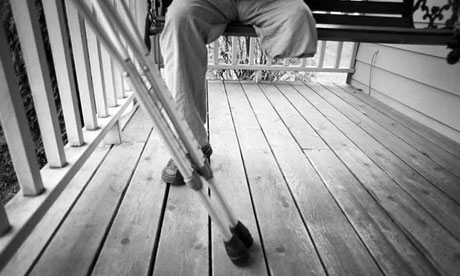 One such patient, under my care, describes how he must “wake up” his phantom in the mornings: first he flexes the thigh-stump towards him, and then he slaps it sharply—“like a bay’s bottom”—several times. On the fifth or sixth slap the phantom suddenly shoots forth, rekindled, fulgurated*, by the peripheral stimulus.*
—Oliver Sacks, The Man Who Mistook His Wife for a Hat and Other Clinical Tales
It is a great temptation, when a part of you has been cut away, to welcome numbness where it may be found. Perhaps what has gone missing is your leg, as with the patient Oliver Sacks describes in his fascinating book about the intersections of psyche and flesh. Perhaps it is a spouse you have buried, or a child. Maybe it’s a friendship that went awry, neither of you knowing why, only that you don’t talk any more, that the very thought of talking makes you cringe.
To have much in life, as most of us do, is almost certainly to lose some of it before we are done.
Friedrich Nietzsche and Kelly Clarkson are wrong; what doesn’t kill you doesn’t necessarily make you stronger. What doesn’t kill you may cripple and embitter and alienate you. The question, I suppose, is whether you will live, or rot.
The quandary of a legless man can be instructive in that regard: A man who has lost his leg is stalked by a painful shadow limb. It throbs so intensely, in some patients, that actual surgery is necessitated. Sometimes the ghost of yourself, in other words, can be so painful that you feel compelled to cut real flesh, to toss out the good after the bad, as it were.
This is certainly no less true when it is some deeper part of ourselves that has gone missing. How else to explain why so few parents of dead children stay married, or why people who forsake their families become harsher, hollower? When the shadow of you hurts, it may seem nothing can be done but press a scalpel to what remains, and carve out the parts screaming through your nerves that something is terribly wrong, that there is supposed to be more to you than this.
The pain of this haunting, as Sacks describes, can be exacerbated by things left undone, and by subsequent events. A patient might report, for example, still feeling the aggravation of a toenail that had begun to grow inward before amputation. Another might report pain, in the phantom leg, as a result of a disc that slips after the amputation. Hurting in the empty places—from amputation, from leaving things unfinished, or simply from life’s progression, is not so uncommon, is it?
I was angry with him, I didn’t say goodbye, and now he is dead.
She is getting married today, and her mother is not here to see it.
We ache in the places where something has become nothing. We are all of us haunted by phantom limbs. Who wouldn’t pray for numbness?
The man with a phantom limb, however, needs to feel something there, if he is ever to walk using a prosthesis. “The disappearance of a phantom,” Sacks tells us, “may be disastrous, and its recovery, its re-animation, a matter of urgency.” The mysteries of the body, the micro-senses and equilibrators it employs to keep us from falling on our faces, the synapses that coordinate our responses, the muscle-memory that is our internal catalog of mistakes and special circumstances—all these combine to give the legless man sensation where the eye tells us no sensation should be, feeling where flesh has been hacked away.
The nerves may howl and the heart may quail, but if a legless man is to walk again he must battle the numbness, unless he wants to sit down and rot.
I sat down to write all this to you, because I figure at least one of you needs to hear it today. I suppose I sat down to write it to myself as well, because God knows I need to know it, chasing numbness as I did in the years following my daughter’s gruesome, painful death, and then again after my divorce. I need to know this.
Sometimes this broken world hacks away at our flesh. Other times it hands us the blades, and we sunder ourselves. Drink down whatever forgetting medicine invites you and the stump will stop hurting, but as God is my witness, you will not move from that place of loss. You’ll lie on the floor, raging at the sky for taking your legs, raging at God, raging at anyone who offers to help. You’ll rage and you’ll drink the numbing draught and then, one day, you will be alone.
You must feel this pain, if you ever want to walk again, if you ever want to leave this dark place. To dispel the bad phantom, Sacks writes, you have to maintain the memory of the limb. Only then can you have hope of moving from the cutting room.
People think you forget in order to move on, but it’s not true. You have to remember. Your body needs it. Your life needs it. Remember, and live.
Previous Post

February 21, 2013
Becoming Uncool in the Pursuit of Truth
Next Post
February 24, 2013 Arts and Faith Oscars 2013 Chat
Browse Our Archives
Select a Category A. G. Harmon Alissa Wilkinson Allison Backous Art Authors Brad Fruhauff Bradford Winters Bryan Bliss Caroline Langston Chad Thomas Johnston Chris Hoke Christiana N. Peterson Culture D.G. Myers D.L. Mayfield Daniel Bowman Jr. David Griffith Elizabeth Duffy Faith Film Greg Wolfe Guest Contributor Interview Jan Vallone Jeffrey Overstreet Jessica Eddings-Roeser Jessica Mesman Griffith Kelly Foster Lindsey Crittenden Morgan Meis music Natalie Vestin Nick Olson Peggy Rosenthal Personal Reflection Poetry Friday Reflection Relationships Review Richard Chess Richard Cole Sara Zarr Shannon Huffman Polson Sonya Bilocerkowycz Tania Runyan Tony Woodlief Topical Categories Uncategorized Vic Sizemore Writing
Select a Month October 2018 September 2018 August 2018 July 2018 June 2018 May 2018 April 2018 March 2018 February 2018 January 2018 December 2017 November 2017 October 2017 September 2017 August 2017 July 2017 June 2017 May 2017 April 2017 March 2017 February 2017 January 2017 December 2016 November 2016 October 2016 September 2016 August 2016 July 2016 June 2016 May 2016 April 2016 March 2016 February 2016 January 2016 December 2015 November 2015 October 2015 September 2015 August 2015 July 2015 June 2015 May 2015 April 2015 March 2015 February 2015 January 2015 December 2014 November 2014 October 2014 September 2014 August 2014 July 2014 June 2014 May 2014 April 2014 March 2014 February 2014 January 2014 December 2013 November 2013 October 2013 September 2013 August 2013 July 2013 June 2013 May 2013 April 2013 March 2013 February 2013 January 2013 December 2012 November 2012 October 2012 September 2012 August 2012 July 2012 June 2012 May 2012 February 2008
Follow Us!
TAKE THE
Religious Wisdom Quiz
What does "Genesis" mean?
Select your answer to see how you score.
Wisdom Law History Origin or beginning
Related posts from Good Letters

Poetry Friday: A Quick Interpretation of the Sixth...


TRENDING AT PATHEOS Catholic

Rejecting Doom: Christian Hope And Human Action
Christianity is a religion of hope. We are to have hope and...

It’s What Comes From Within Which Matters
One of the most difficult things for us to understand is why...

Why I Choose the Eucharist Over the Sermon
Choose the Eucharist, Not the Sermon What are we supposed to get...

5 Design Elements Found in Spiritually Rooted Homes
Putting Spirituality Into Home Decor Our homes are more than our living...

Credo: A Story of God Told with the...
About 10 years ago, I began to imagine a personal "Credo" that...

The Anatomy of Divine Revelation in Catholic Thought
The claim that God has made Himself known to human beings is...
view all Catholic blogs
Ad-Free & Subscriber Log-In Subscription Support
- About Us
- 2026 Calendar
- Videos
- Podcasts
- Library of World Religions
- Faith In Media Tracker
- Advertise With Us
- Write for Us
- Privacy Policy
- Terms of Service
- Do Not Sell My Data
- Contact Us
- Radiant Digital
- Manage Newsletter Subscriptions
- Unsubscribe From Notifications
- Sitemap
Copyright 2008-2026, Patheos. All rights reserved.
Subscription Support Ad-Free & Subscriber Log-In
Follow Patheos