
BuddhistCatholicContemplativeEvangelicalGeneral ChristianHinduJewishLatter-day SaintMuslimNew VisionsProgressive Christian
Beliefs
- Buddhist
- Catholic
- Contemplative
- Evangelical
- General Christian
- Hindu
- Jewish
- Latter-day Saint
- More Voices
- Muslim
- New Visions
- Pagan
- Progressive Christian
Topics
- Religion News
- Food and Religion
- Sports and Religion
- Religious Art
- Religious Music and Entertainment
- Religious Events
- History and Religion
- Style and Religion
- Politics and Religion
- Women in Religion
- Recreation Outdoors and Religion
- Business Finance and Religion
- Careers Workplace and Religion
- Education and Religion
- Family Parenting and Religion
- Health Fitness and Religion
- Home and Religion
- Relationships and Religion
- Technology and Religion
- Travel and Religion
Columnists
- Buddhist Columnists
- Business Finance and Religion Columnists
- Careers Workplace and Religion Columnists
- Catholic Columnists
- Contemplative Columnists
- Education and Religion Columnists
- Evangelists Columnists
- Family Parenting and Religion Columnists
- General Christian Columnists
- Health Fitness and Religion Columnists
- Hindu Columnists
- History and Religion Columnists
- Home and Religion Columnists
- Jewish Columnists
- More Voices Columnists
- Latter Day Columnists
- Muslim Columnists
- New Visions Columnists
- Nonreligious Columnists
- Pagan Columnists
- Politics and Religion Columnists
- Progressive Columnists
- Recreation Outdoors and Religion Columnists
- Relationships and Religion Columnists
- Religion News Columnists
- Religious Art Columnists
- Religious Events Columnists
- Religious Music and Entertainment Columnists
- Sports and Religion Columnists
- Style and Religion Columnists
- Technology and Religion Columnists
- Travel and Religion Columnists
- Women in Religion Columnists
Resource Library
- 2026 Calendar
- Library of World Religions
- The 100 Most Holy Places on Earth
- Patheos Answers
- Podcasts
- Videos
- Faith Leaders Database
- Anglican Episcopalian
- Bahai
- Baptist
- Buddhism
- Christianity
- Confucianism
- Eastern Orthodoxy
- Hinduism
- Holiness and Pentecostal
- ISKCON
- Islam
- Judaism
- Lutheran
- Methodist
- The Church of Jesus Christ of Latter-day Saints
- New Age
- Paganism
- Presbytarian and Reformed
- Protestantism
- Religion Behind the Scenes
- Roman Catholic
- Scientology
- Shia Islam
- Sikhism
- Sufism
- Sunni Islam
- Taoism
- Zen
- See all religions
Research Tools
 Ad-Free & Subscriber Log-In Subscription Support
Ad-Free & Subscriber Log-In Subscription Support
Follow Patheos 

- Trending:
- Forgiveness
- |
- Marriage
- |
- Consciousness
- |
- Death Penalty
- |
- Election
- |
- Halloween
 Good Letters
-
Contributors
- Home
- Catholic
- Becoming Uncool in the Pursuit of Truth
Becoming Uncool in the Pursuit of Truth
Last updated on: February 22, 2013 at 5:46 am by David Griffith
Becoming Uncool in the Pursuit of Truth 2013-02-22T05:46:07-07:00 David Griffith
Patheos Explore the world's faith through different perspectives on religion and spirituality! Patheos has the views of the prevalent religions and spiritualities of the world.
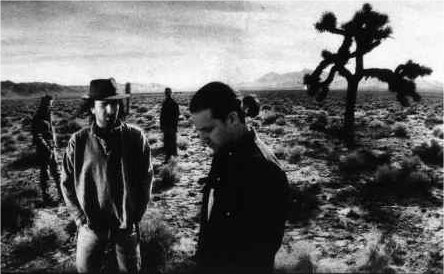
 This morning, prepping for a class I’m teaching called Writing about Film and Music, I stumbled across a YouTube clip of the legendary Brian Eno, producer of U2’s 1987 The Joshua Tree, talking about his role in the making of that iconic album:
I got the sense that [U2] was capable of making a real marriage between the two things I was talking about, between something that was self-consciously spiritual to the point of being uncool—and uncool was a very important idea then, because people were being very, very cool, and coolness is a certain kind of detachment from yourself, with a certain defensiveness, actually, not exposing something, because it’s too easy to be shot down if you’re exposed…
Later, Eno says that U2 was never a critical darling, because they were perceived as wearing their “hearts on their sleeve.” Recall the way Bono has used arena stages as a bully pulpit for his various causes: El Salvador, Northern Ireland, Iraq, and gun violence. I confess I’ve always loved this about Bono, though I know it makes lots of people squeamish.
Later in the same clip, The Edge reveals that during the writing of The Joshua Tree, the band was inspired by the work of the New Journalists, especially Norman Mailer’s Executioner’s Song.
In my last post, I suggested that perhaps narrative nonfiction is the most important art form at the moment, as it helps us to engage in and express our spiritual selves. I see an opportunity here to push a little more on this notion that spiritual nonfiction is our most culturally relevant form of writing.
After teaching class, I ran across another reference to coolness and detachment in a recent American Scholar column, in which William Deresiewicz tries to pin down a definition of the “upper middlebrow”: a “post- rather than pre-ironic” aesthetic that is neither middlebrow nor highbrow, and whose “sentimentality [is] hidden by a veil of cool.”
According to Deresiewicz, the upper middlebrow is “edgy, clever, knowing, stylish, and formally inventive”—and is produced by a variety of un-reproachable figures and institutions, including Jonathan Lethem, Wes Anderson, Lost in Translation, the HBO series Girls, John Stewart, Stephen Colbert, The New Yorker, and This American Life.
It is ultimately designed to flatter its audience, approving our feelings and reinforcing our prejudices. It stays within the bounds of what we already believe, affirms the enlightened opinions we absorb every day in the quality media, the educated bromides we trade on Facebook. It doesn’t tell us anything we don’t already know, doesn’t seek to disturb—the definition of a true avant-garde—our fundamental view of ourselves, or society, or the world.
I’m with Deresiewicz. Those asking for a closer inspection of these arguably “cool” artists and works, those who sense that their perceived value is predicated on how fully they affirm our world view and the nearly limitless spectrum of values that secular humanism embraces, are not just seen as uncool, but as oppressors.
I’ll admit it: I spent years chasing after cool before I finally settled down into an un-ironic pursuit of truth. Quite unexpectedly, this search has manifested itself in becoming a nonfiction writer.
Nonfiction seeks to remove that veil, or in some cases, multiple veils, of distance and detachment. And the New Journalism, whose first-person reportorial techniques have been thoroughly absorbed into the other sub-genres of personal essay and memoir, is credited with being the form that cut through the beaureaucratic double-speak of government officials, the public veneer of celebrities, and the biases all reporters harbor.
That’s not to say the New Journalists (Mailer, Didion, Talese, etc.) are not guilty from time to time of detachment. Mailer famously writes about himself in the third person at the beginning of Armies of the Night, and Talese is known for self-effacement in order to get at the real story. And no one would accuse Didion of being uncool—look at those sunglasses!—though note her late-career turn to memoirs meditating on mortality. It’s not that nonfiction is impervious to the arch, post-ironic conventions of the upper-middle brow. It’s got a foothold in my genre, too.
But the personal essay appeals to me right now because it’s where we can attempt to stop lying to ourselves—no more posturing, no more hiding behind a house style—though we may stumble in the attempt.
To be clear: I’m not calling for a boycott of novels or short stories. I still believe that fiction has the power to transform hearts and minds like no other medium. The genius of fiction is in grappling with characters who seem so unlike us, but who are actually holding up a mirror.
But in fiction—as in the upper-middlebrow—we are invited to be the heroes, the ones who stand back from the mess of the story at a safe distance, the ones who have it all figured out. Personal narrative attracts the voyeur, but we are privy to a real person working through the contradictions, struggle, and doubt inherent in human experience. In fiction, this might be done, but at a remove.
So here I am, an Irish Catholic boy, a Notre Dame grad no less, holding up U2 as the antidote to our detachment. But we must find inspiration where we can, and I am inspired by the determination to remain awake at the expense of being cool. I laugh at Colbert and Stewart, and even Girls. But I’m tired of upper-middlebrow detachment.
Like Deresiewicz, I yearn for works of art and culture that will challenge rather than affirm our views about the world, and what we believe to be our essential nature. I want to hear it from the mouths of the lost and the confused. I don’t mind that it sometimes feels like the blind leading the blind. Cool just doesn’t it do it for me anymore.
Previous Post

February 20, 2013
Bible Thumping
Next Post
February 22, 2013 Haunted by Phantom Limbs
Browse Our Archives
Select a Category A. G. Harmon Alissa Wilkinson Allison Backous Art Authors Brad Fruhauff Bradford Winters Bryan Bliss Caroline Langston Chad Thomas Johnston Chris Hoke Christiana N. Peterson Culture D.G. Myers D.L. Mayfield Daniel Bowman Jr. David Griffith Elizabeth Duffy Faith Film Greg Wolfe Guest Contributor Interview Jan Vallone Jeffrey Overstreet Jessica Eddings-Roeser Jessica Mesman Griffith Kelly Foster Lindsey Crittenden Morgan Meis music Natalie Vestin Nick Olson Peggy Rosenthal Personal Reflection Poetry Friday Reflection Relationships Review Richard Chess Richard Cole Sara Zarr Shannon Huffman Polson Sonya Bilocerkowycz Tania Runyan Tony Woodlief Topical Categories Uncategorized Vic Sizemore Writing
Select a Month October 2018 September 2018 August 2018 July 2018 June 2018 May 2018 April 2018 March 2018 February 2018 January 2018 December 2017 November 2017 October 2017 September 2017 August 2017 July 2017 June 2017 May 2017 April 2017 March 2017 February 2017 January 2017 December 2016 November 2016 October 2016 September 2016 August 2016 July 2016 June 2016 May 2016 April 2016 March 2016 February 2016 January 2016 December 2015 November 2015 October 2015 September 2015 August 2015 July 2015 June 2015 May 2015 April 2015 March 2015 February 2015 January 2015 December 2014 November 2014 October 2014 September 2014 August 2014 July 2014 June 2014 May 2014 April 2014 March 2014 February 2014 January 2014 December 2013 November 2013 October 2013 September 2013 August 2013 July 2013 June 2013 May 2013 April 2013 March 2013 February 2013 January 2013 December 2012 November 2012 October 2012 September 2012 August 2012 July 2012 June 2012 May 2012 February 2008
Follow Us!
TAKE THE
Religious Wisdom Quiz
What was the capacity of a bath?
Select your answer to see how you score.
22 liters 10 liters 15 liters 30 liters
Related posts from Good Letters

Leonard Cohen’s Holy and Broken Hallelujah

Ready or Not for the Days of Awe


TRENDING AT PATHEOS Catholic

Rejecting Doom: Christian Hope And Human Action
Christianity is a religion of hope. We are to have hope and...

It’s What Comes From Within Which Matters
One of the most difficult things for us to understand is why...

Why I Choose the Eucharist Over the Sermon
Choose the Eucharist, Not the Sermon What are we supposed to get...

5 Design Elements Found in Spiritually Rooted Homes
Putting Spirituality Into Home Decor Our homes are more than our living...

Credo: A Story of God Told with the...
About 10 years ago, I began to imagine a personal "Credo" that...

The Anatomy of Divine Revelation in Catholic Thought
The claim that God has made Himself known to human beings is...
view all Catholic blogs
Ad-Free & Subscriber Log-In Subscription Support
- About Us
- 2026 Calendar
- Videos
- Podcasts
- Library of World Religions
- Faith In Media Tracker
- Advertise With Us
- Write for Us
- Privacy Policy
- Terms of Service
- Do Not Sell My Data
- Contact Us
- Radiant Digital
- Manage Newsletter Subscriptions
- Unsubscribe From Notifications
- Sitemap
Copyright 2008-2026, Patheos. All rights reserved.
Subscription Support Ad-Free & Subscriber Log-In
Follow Patheos